


Despite $1B loss, Sprint Q4 beats expectations
Wireless provider Sprint has posted its results for the fourth quarter of 2013, coming in better than what analyst expected. Although they report a loss of $1 billion over the quarter, Sprint was able to add 58,000 postpaid subscribers.. The carrier indicates there were some 5.6 million smartphones; 95 percent of postpaid customers, 66 percent of prepaid customers. With a total of 53.9 million subscribers at year end it’s Sprint’s highest level to date.
If these sort of things are your bag, you can read the full financial details at Sprint’s website.
The post Despite $1B loss, Sprint Q4 beats expectations appeared first on AndroidGuys.

Sprint Sells 5.6M Smartphones in Q4 2013, Stops Reporting iPhone Numbers [iOS Blog]
 Sprint today announced that it sold 5.6 million smartphones in the fourth quarter of 2013 and 20.5 million smartphones for the year. It is unclear how many of those smartphones were iPhones as the carrier is following Verizon Wireless and AT&T in not breaking down its smartphone sales or activations by platform.
Sprint added 682,000 customers in the last three months of the calendar year, bringing its total customer base to 53.9 million subscribers. Total retail postpaid churn was 2.15%, down slightly from the 2.18% measured in the year ago quarter. The company reported a loss of $1 billion, which is less than the $1.3 billion it lost in Q4 2012.
Sprint ended the year with 53.9 million Sprint platform subscribers – its highest level ever – after adding 58,000 postpaid subscribers, 322,000 prepaid subscribers and 302,000 wholesale and affiliate subscribers in the fourth quarter. Sprint sold 5.6 million smartphones in the fourth quarter and 20.5 million smartphones for the year with smartphone sales mix reaching 95 percent for postpaid and 66 percent for prepaid in the quarter.
Earlier this year, Sprint competitor Verizon announced smartphone activations of 8.8 million along with 1.7 million new subscribers in Q4 2013, while AT&T activated 1.2M postpaid smartphones and gained 809,000 new subscribers in the quarter.
Sprint becomes the first US carrier to lose money this quarter as it continues to struggle. Recent rumors suggest Sprint parent company Softbank may be interested in acquiring rival T-Mobile, but regulators have already expressed opposition to the deal.
     |

Apple’s Initial Sapphire Production to Target iWatch, Not iPhone 6?
Evidence has made clear that Apple is investing heavily in sapphire for its future products with the company working with partner GT Advanced Technologies to start production of the material in a new Arizona plant. Earlier reports suggested the sapphire is likely for the next-generation iPhone, but G 4 Games points to new reports from Asian supply chain sources speaking to MyDrivers [Google Translate] and PCPOP [Google Translate] claiming the iWatch will be the first Apple device to be equipped with the scratch-resistant material.
 Furnaces for sapphire glass production
According to the reports, the biggest factor in using sapphire for the iWatch and not the next iPhone is cost, with the price of sapphire driving up the retail price tag of the iPhone. A price increase could be detrimental to Apple as the iPhone already has a premium price tag.
According to Chinese media sources (which are citing “Taiwan supply chain insiders”), Apple has put a lot of effort into fitting the next iPhone with a sapphire screen. These sources claim that “beta” iPhone units (read: some of the prototypes Apple is currently testing) are already sporting sapphire protected panels, but unfortunately, chances are that they will not make it on the final product.
The problem is not necessarily due to low yield (which still is a problem, at least until Apple’s [Arizona] plant will be fully operational), but mainly because fitting a sapphire screen on the next iPhone would make its price skyrocket.
Fortunately though, the same sources also say that Apple will manage to fit sapphire screens on the rumored iWatch. The smartwatch is said to feature a 2 inch panel, and evidently, the production costs would be much lower.
Though the iWatch would certainly benefit from a sapphire layer to protect its display, the volume of raw material and equipment Apple is purchasing hints at much bigger plans than a 2-inch watch display. Apple allegedly has ordered enough furnaces to manufacture approximately 200 million 5-inch sapphire displays, a volume which would meet the yearly demand for its iPhone product line. In 2013, Apple sold approximately 150 million iPhones worldwide.
| |

Geeksphone’s Firefox-and-Android phone launches February 20th for 289 euro

Spain’s Geeksphone has been teasing the Revolution for a few months now, but today’s the day we find out how much the thing will actually cost. The device, which can switch between Firefox OS and Android, will be priced at 289 euro ($395) when it lands on February 20th, just four days before MWC 2014 begins in Barcelona. If you’re fast, however, the company has hinted that it’ll offer the handset for 269 euro with an online only early-bird sale. There’s no word on how much more (or less) this one will set you back if it arrives over in the US, but we’ll keep our ears close to the Iberian ground.
Filed under: Cellphones, Mobile
Source: Engadget Spanish (Translated)

FAA clears Surface for takeoff in US cockpits

Begun, the airline fanboy wars have? Microsoft’s Surface Pro 2 has just joined the iPad on the FAA’s list of approved pilot EFBs (Electronic Flight Bags) for all phases of flight. That follows Delta’s recent announcement that it would deploy 11,000 of Redmond’s hybrid tablets in its cockpits instead of the iPad, which it also considered. Apple’s tablet is already used by American Airlines and others, but Delta said it preferred the readability, productivity apps and other features of the Surface Pro 2. Pilots will now be able to switch from heavy paper charts and books, which Delta said would save millions in fuel costs once the transition is complete in 2015. It also finally puts the pilots on parity with their passengers, as the airline was the first aboard the expanded use of personal electronics.
Filed under: Tablets, Transportation, Microsoft
Source: Surface Blog
Get This Look: Tiled 2
Install the entire layout using only one app
We’re huge fans of changing the home screen around a bit and creating a new user experience for our Android. So much so that we present our ongoing series of Get This Look posts. In a nutshell we show you a new layout, app, widget, or icon set for your Android handset and tell you which apps you’ll need to mimic the feel.
Some of these are a little easier to create than others and many of them can be tweaked to no end. The following details are but the ingredients to which you can create your own delicious Android dish; your results will vary. Which is awesome!
If nothing else, this is a great way to discover new apps, widgets, icons, and more!
Tiled 2 by Themerapp
Why we love this look:
It seriously doesn’t get much easier than installation by the press of a button. Once you’ve installed Themer, a wonderful app for switching up your Android designs, you’re over halfway there. Navigate to the setup called Tiled 2 and install! Don’t like this particular look and want to play around a bit? Go for it!
As for the actual look of this one, we’re fond of the big, in-your-face squares with access to common apps. Yes, it looks a little Windows 8-y, but is that always a bad thing? The white icons and fonts are fantastic and would look great set atop any colors or photos. And who doesn’t appreciate a handy, minimal battery indicator widget?
What you’ll need:
- Themer | FREE
The post Get This Look: Tiled 2 appeared first on AndroidGuys.

Flappy Bird creator Dong Nguyen took his game down to clear his conscience and save us All
 Just in case you hadn’t heard enough Flappy Bird news in the last few days, Flappy Bird creator Dong Nguyen has spoken to Forbes in an exclusive and confidential interview in which he speaks about his decision to take the virally famous game down. In his own words:
“Flappy Bird was designed to play in a few minutes when you are relaxed… But it happened to become an addictive product. I think it has become a problem. To solve that problem, it’s best to take down Flappy Bird. It’s gone forever.”
It’s quite remarkable that the previously unknown Vietnamese developer is making such a moral decision for the betterment of the people playing his game, and probably more than that, I doubt many of us would be able to walk away from the alleged $50,000 he was earning in ad revenue everyday regardless of the moral implications. Perhaps he’s just foolish, or maybe Nguyen is a better person than all of us, though what he did divulge in the interview was that he was haunted by Flappy Bird while it was still available, citing that “my life has not been as comfortable as I was before… I couldn’t sleep.”
Nguyen says that he isn’t done with games, however, and although countless clones of the game have gone up in the wake of Flappy Bird’s demise, he says he won’t be taking legal action against them. It’s quite refreshing to hear Nguyen’s story finally laid out in full and really puts viral successes in a whole new light, reminding us that developers are human too. What do you think about Nguyen’s story? Do you think he was right to take Flappy Bird down, and would you do the same? Let us know your opinion in the comments below.
For the full interview, hit the source link below to go to the Forbes article.
Source: Forbes via Android Headlines

Sprint still struggling despite growing subscriber base and smartphone sales

Sprint has just revealed its Q4 2013 earnings, and despite increasing its postpaid subscriber base to a record 53.9 million, still managed a net loss of $1 billion — nearly four times worse than last quarter. That continues the US carrier’s recent losing streak, and is especially notable during a holiday period when AT&T, Verizon and T-Mobile all had gangbuster quarters. On the plus side, it managed to hit its LTE coverage goal of 200 million people, but that figure is still the lowest of all the major carriers. It also sold 5.6 million smartphones compared to 5 million last quarter, with 20.5 million sold for the year. That accounts for 95 percent of postpaid subscriber sales, which tops its main competitors. With few other financial bright spots, though, new owner Softbank might be wondering what it got itself into.
Filed under: Cellphones, Sprint
Source: Sprint

New wireless charging partnerships could mean fewer cables in your junk drawer

In 2012, Qualcomm and Samsung joined forces to start The Alliance for Wireless Power (A4WP), one of many organizations competing to establish a universal standard for wireless charging. A4WP envisions a wire-free future, but chances are you’re still packing a series of cables to keep your gadgets juiced up. However, the group just announced a pair of partnerships that could lead to a more unified standard and less corded clutter. WiTricity, one of the major competitors in the wireless-charging space, and the Power Matters Alliance (PMA), a leader in inductive wireless charging, joined forces with A4WP today. While they each have their own wireless charging solutions, the PMA and A4WP have committed to sharing some of their specifications to create a wireless power couple of sorts. McDonalds and Starbucks stores already use the PMA’s standard in their charging stations.
In 2011, WiTricity announced a partnership that will see its contact-less, long-field magnetic resonance used to power up Toyotas. With the new partnership, it plans to innovate on and incorporate A4WP’s Rezence specifications into its designs. Rezence, A4WP’s consumer-facing brand, uses near-field resonant technology to allow users to wirelessly charge several devices with different charging specifications simultaneously. We’ve yet to see a real-life device sporting Rezence certification, but A4WP showed off a prototype during CES last year, and announced its first certifications last month. WiTricity joined A4WP as a sponsor, which means it gets a seat on its eight-member board of directors, alongside Broadcom, Intel, Qualcomm and Samsung. The group’s main competition comes from Qi’s Wireless Power Consortium, where Qualcomm also sits on the board.
Filed under: Cellphones, Tablets, Wireless, Mobile
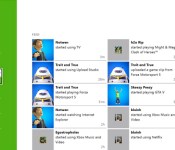
Xbox One’s second big update focused on multiplayer ahead of Titanfall’s March arrival

For better or worse, Microsoft is clearly aware that the Xbox One‘s party system and online multiplayer functionality is lacking. An update aimed at bringing parity between Xbox One’s party system and the Xbox 360 arrives this March — the second half of this Spring’s big XB1 update, the first of which will launch this week — and it features some fairly run-of-the-mill alterations.
The headline feature, for instance? “Get to your friends list faster,” which simply bumps the friends list to the main homepage within the Friends app (the current version is seen above). The rest of the list is along the same lines: party chat will automatically engage when in a party, you’ll be able to chat with people in games you’re not playing, invites to party up can be sent from in-game menus, and a recent players filter is being added to the Friends app as well. Longtime multiplayer gamers will no doubt recognize all this functionality as already available on Xbox 360; we’re thankful it’s coming back, but shouldn’t this have been in the Xbox One at launch?
As previously promised, the multiplayer-focused update is set to arrive just ahead of Titanfall’s March 11th launch. Should today’s news not be too thrilling for you, it sounds like multiplayer isn’t the only aspect of next month’s update: Microsoft says it’ll “continue to share more details in the days and weeks ahead.”
Filed under: Gaming, Software, HD, Microsoft
Source: Microsoft
 AIVAnet