


Developers We Love: Herocraft Ltd
Developers We Love is an ongoing series of posts designed to help discover great Android apps and games. We use the column to highlight both big name developers as well as small, indie outfits. Typically, we’ll opt for those who have released a number of titles before considering them for coverage but this is not a hard rule.
While you may already be familiar with some of these developers, new Android or smartphone users might not. Our aim here is to put companies on your radar so you can enjoy great content!
Who: Herocraft Ltd
Founded in 2001, this Russian outfit employs more than 100 staff and distribute apps in more than one dozen languages around the globe. Offering a mix of both free and paid games in the Google Play Store and Amazon Appstore, nearly everyone we see has a rating of 4 stars or higher. Whether it’s street racing, managing a virtual farm, or goofing around with some cartoon-y characters, you’re sure to find something you like. Bonus points awarded for making games that are fun for the whole family.
Start Here
Some of the more popular games from Herocraft that we recommend first include Race Illegal: High Speed 3D, Ice Rage, Farm Frenzy, and Birds on a Wire. Each of these comes in free versions with in-app advertisements and limitations but provide plenty to give you a feel for their games. Should you enjoy them, pick up the full experience for a buck or two!
Don’t take our word for it, there literally millions of downloads for some of these games. Read through the reviews and you’ll find high average ratings and great user feedback.
The post Developers We Love: Herocraft Ltd appeared first on AndroidGuys.
Samsung and Cisco sign cross-licencse patent deal
Samsung and Cisco have inked a deal which should lead to more innovation across multiple fronts over the next decade or longer. Like the agreement between Google and Cisco from this week, the two companies will benefit by licensing patents from the other party. This works for existing stuff as well as those patented in the next 10 years. As to what falls under the umbrella remains to be seen; it covers a “broad range of products and technologies”. Our gut tells us this likely centers around the connected home and networking in general.
“Innovation is stifled all too often in today’s overly-litigious environment…By cross-licensing our patent portfolios, Cisco and Samsung are taking important steps to reverse the trend and advance innovation and freedom of operation.”
The post Samsung and Cisco sign cross-licencse patent deal appeared first on AndroidGuys.

Why People Learn Faster and Retain More Information with Video

Many employee training and professional development initiatives can be improved with the use of online video. Video content has a few basic attributes that can make the content easier to understand and retain in a number of different educational scenarios. A few reported benefits of video eLearning are as follows:
- eLearning is preferred by employees. More than half of employees report that they would prefer to learn new material on a platform that utilizes online video compared to in-house trainings with human resources representatives.
- eLearning is repeatable. It is important to ensure that all employees within a department are up to speed on the same basic competencies. A repeatable training method is a quality way to measure necessary base knowledge and subsequent growth.
- eLearning is cost-effective. Employees can complete video modules during routine downtime instead of attending a conference for an entire week. In addition, employees can work at their own paces and take extra time to master certain concepts.
Video has a higher level of engagement than standalone written materials. In addition, video training is easy for employees to reference at a later date. Instead of trying to explain complex, technical concepts, indexed video can allow employees to quickly and easily reference a live demonstration.
Video and Repetition can Improve Material Retention Rates
Learning new material almost always requires a degree of repetition that is unique to different individuals with different cognitive strengths. KZO Innovations online video platform allows employees to target specific areas that require more repetition for adequate learning. Similarly, employees can use some sections of video as review for concepts that they are already highly familiar with. Repetition can be refined in the context of professional development and training in the workplace. Focus on providing the right repetition in specific targeted areas for each individual employee.
Work with Different Learning Styles Simultaneously and Build Reference Archives
Memory is not as straightforward as many people assume it is. Video can be customized to cater to different learning styles simultaneously while furthering repetition. A prime example of a video that caters to different learning styles would be a video demonstration that includes a transcript at the bottom or corresponding PowerPoint slides. This video will address the following ways of learning:
- Learners that prefer to read text.
- Learners that prefer to see a task completed.
- Learners that prefer to hear how to complete a task in spoken word.
Archives of training materials such as video and PowerPoint can help employees focus on training presentations rather than trying to focus on the presentation while taking notes. In addition, video can be paused or repeated. Employees are less likely to be distracted by hunger or lengthy amounts of time spent sitting in an uncomfortable position.
Improve Adult Learning with Video
Video gives adults the ability to repeat necessary information and focus on the training presentation with fewer distractions. In addition, the right eLearning platform can address different learning styles simultaneously. Furthermore, the majority of workers report that they prefer video conferencing and training. Improve overall business practice by investing in ongoing eLearning initiatives and reference video archives for employees. In addition, an upfront investment in quality video education materials is much more cost-effective than traditional in-house training sessions. It’s a win-win.
Presented by K-ZO

Comprehensive List Details Every Apple Reference in The Simpsons and Futurama [Mac Blog]
An exhaustive list of all the Apple references ever made in long-running television cartoons The Simpsons and Futurama has been compiled by Yoni Heisler of TUAW. On the air since 1989 and 1999, respectively, The Simpsons and Futurama have featured Apple products in various episodes more than 40 times.
Some standouts include a 2010 episode of Futurama where Bender declares the Mac to be better than the PC and a 1994 episode of The Simpsons, featuring the poor handwriting recognition capabilities of the Apple Newton, a PDA device.
Another highlight is a 2013 episode of The Simpsons that depicts a character attempting to use Siri to locate a hospital.
In this particular Simpsons episode, a store owner tries to use Siri to locate a hospital for Homer.
Upon doing so, Siri tells him, “I’m sorry, I don’t see any ‘hos petals’ near you. Deleting all contact information.”
Furious, the man responds, “No, I didn’t ask you to do that Siri!” To which Siri responds, “Delete confirmed.”
In 2008, The Simpsons aired what may be its most popular Apple-centric episode, with a satirical anti-Apple focus on the “Mapple Store” filled with MyPods, MyPhones, and a “braniac bar.” The episode also introduced Mapple founder and Chief Imaginative Officer Steve Mobbs. “He’s a genius!” shouts the crowd. “He’s like a god who knows what we want!”
During his compilation of references, Heisler was able to speak with The Simpsons writer Bill Oakley and director David Silverman. According to the duo, computers on the show were often drawn as Macs because it was the platform of choice for animators in the 90s.
Oakley also noted that Smithers, Mr. Burns well-known assistant, was written as a Mac user because he “is the type of progressive young fellow who would have a Mac rather than a PC.”
Silverman wanted to be clear that references to Apple are only added to episodes for comedic effect and the show is carefully written to avoid product placement.
“Even if it’s in the Simpsons universe and we created it,” Silverman explained, “we don’t want to put it in every show because it looks like we’re promoting it, and that’s not our point. Mapple is too close to the real thing.”
The full list of Apple references can be accessed on TUAW and is well worth checking out. The compilation includes images, videos, and additional commentary from show creators.
     |

Twitter posts small earnings in first quarter as a public company, but user growth is slowing

Now that Twitter is a publicly traded company, it’s time to add the business to our collection of quarterly earnings reports. So how did it do in the first go-round? Well, there are pros and cons: In what CEO Dick Costolo says was the “strongest financial quarter to date,” the company posted a small earnings of $45 million for the quarter and $75 million for the year, which doesn’t take into account the $511 million loss attributed to stock-related expenses. Still, the earnings of two cents per share beat Wall Street’s estimates, which predicted a loss of three cents. Quarterly revenues were at $242 million, which is a 116 percent jump from this quarter last year.
More interestingly, Twitter’s active user growth appears to be slowing (chart below); the company boasted a total of 241 million active users as of New Year’s Eve, which is only a bump of 9 million from the previous quarter. Compared to previous quarters, this 4 percent growth is a drop from 6 percent in Q3 2013, 7 percent in Q2 and 10 percent in Q1. This growth will need to accelerate if the social network wants to start catching up with Facebook’s 1.2 billion users. Additionally, 184 million people used Twitter on their mobile devices, which the company says is an increase of 37 percent year-over-year.
Twitter also projects an estimated $230-240 million in revenues for the first quarter of 2014, rising to $1.15-1.2 billion for the full year. It also expects adjusted earnings to show up around $10-16 million this quarter, with a range of $150-180 million in 2014.

Filed under: Cellphones, Wireless, Mobile

KnowRoaming’s international sticker SIMs begin shipping to backers today

KnowRoaming, the company behind the roaming SIM “stickers” that popped up on Kickstarter last year, has begun shipping its device to the first 500 backers. The $35 pre-order kit, which includes a SIM sticker and a single-use applicator, enables international roaming at rates far lower than what you’d normally get with your carrier (unless, of course, you’re using a Simple Choice plan with free global data from T-Mobile). What makes KnowRoaming unique, however, is a design that integrates with your existing SIM.
Once you attach the sticker to your carrier-issued card, your unlocked smartphone will detect when you’ve traveled abroad, switching your device over to a partner network. Current rates range from 13 cents per MB of data, 9 cents per minute of talk time and 16 cents per text in the UK, to a whopping $34.80 per MB, 27 cents per minute and $1.07 per SMS in Chad (though most countries offer tariffs at the cheaper end of the spectrum). CEO Gregory Gundelfinger plans to ship between 25 and 50 sets each day, so if your sticker isn’t in this initial batch, you can expect to have it at your door soon.

Filed under: Cellphones, Mobile
Source: KnowRoaming

Time Warner reveals how much money HBO makes, and why it’s not splitting from cable yet

Wondering why you still need a cable TV package to subscribe to HBO in the US? Because HBO is making truckloads of cash keeping things the way they are — even though that might not last forever. Its parent company Time Warner (which spun off Time Warner Cable in 2009) announced financial results for the year, and for the first time in years it included some details about HBO’s business. HBO alone pulled in $1.3 billion in the last three months of 2013, and $4.9 billion for the entire year. Netflix’s numbers are actually pretty close, as the streaming company posted sales of $1.175 billion for the quarter and $4.3 billion for the year, despite having fewer customers than HBO worldwide.
The real difference right now is in how much money each keeps in profits after costs for things like original content (House of Cards and Game of Thrones don’t produce themselves) are accounted for. HBO’s operating profit in Q4 is $414 million, and $1.7 billion for the year, but Netflix’s Q4 profit came in at $82 million, and for its efforts it made $228 million all year. According to Variety, Time Warner CEO Jeff Bewkes said on the earnings call that HBO and Cinemax added about 2 million customers last year, while Netflix grew by 6 million, and added over 2 million customers just in Q4.
If that difference in growth is making Bewkes sweat then he’s not showing it publicly, saying “HBO is in a league of its own” and pointing to stats that show viewers with HBO and Netflix actually view more of both. The “Albanian Army” is expected to continue its European expansion in 2014 and has already sealed up exclusives for streaming content in the next few years, we’ll wait and see if that changes the landscape significantly.
Filed under: Home Entertainment, HD
Source: Variety, Time Warner Q4 Earnings (PDF)

Google Search Updates Bringing in the ‘Google Now Launcher’

Wednesdays seem to be the day that Google likes to release updates for their apps, so today, there has been a slew of them. First one on the list is Google Search. Now the first thing noticed about the update for Google Search is the fact that the once named Google Experience Launcher has been changed to the Google Now Launcher. Seems fitting, given the dedicated Google Now screen. They have also added the “Okay Google Now” hot phrase to the English UK setting. Before you weren’t able to do utilize that if you didn’t have it set for English US, but they added it in so have fun with that UK friends. If you haven’t gotten the update rolled out to yet, hit the download link below to grab the apk. Let us know how it is.
Download here: Google Search 3.2.16
Google Hangouts Updates with SMS and MMS Fixes [Download]

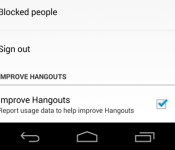
Google Hangouts is seeing a nice little update, bringing in some fixes for SMS and MMS. I guess some users out there were having problems sending messages over 160 characters, but that bug should be squashed with this update. They have also added the ability to use data usage to report an bugs happening with the message app. You can check it or choose to keep it remained unchecked in the settings. So if you haven’t gotten the update rolled out to you yet, hit the download link below to grab the apk.
Download here: Google Hangouts 2.0.303
Source: Android Police

 Many employee training and professional development initiatives can be improved with the use of online video. Video content has a few basic attributes that can make the content easier to understand and retain in a number of different educational scenarios. A few reported benefits of video eLearning are as follows:
- eLearning is preferred by employees. More than half of employees report that they would prefer to learn new material on a platform that utilizes online video compared to in-house trainings with human resources representatives.
- eLearning is repeatable. It is important to ensure that all employees within a department are up to speed on the same basic competencies. A repeatable training method is a quality way to measure necessary base knowledge and subsequent growth.
- eLearning is cost-effective. Employees can complete video modules during routine downtime instead of attending a conference for an entire week. In addition, employees can work at their own paces and take extra time to master certain concepts.
Video has a higher level of engagement than standalone written materials. In addition, video training is easy for employees to reference at a later date. Instead of trying to explain complex, technical concepts, indexed video can allow employees to quickly and easily reference a live demonstration.
Video and Repetition can Improve Material Retention Rates
Learning new material almost always requires a degree of repetition that is unique to different individuals with different cognitive strengths. KZO Innovations online video platform allows employees to target specific areas that require more repetition for adequate learning. Similarly, employees can use some sections of video as review for concepts that they are already highly familiar with. Repetition can be refined in the context of professional development and training in the workplace. Focus on providing the right repetition in specific targeted areas for each individual employee.
Work with Different Learning Styles Simultaneously and Build Reference Archives
Memory is not as straightforward as many people assume it is. Video can be customized to cater to different learning styles simultaneously while furthering repetition. A prime example of a video that caters to different learning styles would be a video demonstration that includes a transcript at the bottom or corresponding PowerPoint slides. This video will address the following ways of learning:
- Learners that prefer to read text.
- Learners that prefer to see a task completed.
- Learners that prefer to hear how to complete a task in spoken word.
Archives of training materials such as video and PowerPoint can help employees focus on training presentations rather than trying to focus on the presentation while taking notes. In addition, video can be paused or repeated. Employees are less likely to be distracted by hunger or lengthy amounts of time spent sitting in an uncomfortable position.
Improve Adult Learning with Video
Video gives adults the ability to repeat necessary information and focus on the training presentation with fewer distractions. In addition, the right eLearning platform can address different learning styles simultaneously. Furthermore, the majority of workers report that they prefer video conferencing and training. Improve overall business practice by investing in ongoing eLearning initiatives and reference video archives for employees. In addition, an upfront investment in quality video education materials is much more cost-effective than traditional in-house training sessions. It’s a win-win.
Presented by K-ZO
 AIVAnet