


Samsung details pricing and U.S. availability for Galaxy Note Pro, Galaxy Tab Pro
Samsung on Tuesday announced the pricing and U.S. launch details for the brand new Galaxy Note Pro and Galaxy Tab Pro devices. Set to arrive on Thursday, February 13, these are the premium tablets with Samsung’s new UI, tons of power, and a host of productivity apps. With sizes that range from 8.4-inches up to 12.2-inches, storage capacities span 16GB to 64GB. All will be sold in two color options: black and white.
These new Pro series devices will be offered at a variety of retailers, including Amazon, Best Buy, Walmart, Newegg, and direct from Samsung. Looking ahead, Verizon will also sell the Galaxy Note Pro 12.2 with 4G LTE connectivity.
- Note Pro 12.2: $749.99 (32 GB)
- Note Pro 12.2: $849.99 (64 GB)
- Tab Pro 12.2: $649.99 (32 GB)
- Tab Pro 10.1: $499.99 (16 GB)
- Tab Pro 8.4: $399.99 (16 GB)
The post Samsung details pricing and U.S. availability for Galaxy Note Pro, Galaxy Tab Pro appeared first on AndroidGuys.

Pebble appstore beta for Android gets released
 You might have heard that Pebble released its new appstore for iOS yesterday, with no Android version in sight. Well, Pebble has since rectified this, not quite with a complete app, but with the Pebble appstore beta for Android. Pebble is apparently using this beta period to weed out any bugs that still exist in the app and also as a subtle recruiting drive for Android developers to come on board. The appstore is aiming to be the one collective marketplace for any and all Pebble related software to be housed and searchable, which is a fantastic idea for those more casual users who can’t always find their way around forums and such.
The beta obviously isn’t without its issues; currently known issues include issues pairing with your Pebble Watch (kind of a big one) and not being able to configure an app if it is running on your Pebble. These are just a few of the bugs, but it’s in the best interests of the final product that this kind of testing and iterations occur before the app is official. It’s just a shame that the Android version wasn’t completed first instead of the iOS version… That said, I know I can’t wait until the appstore is official as it will be a much better way to access different customization options and apps for the Pebble and your smartphone, something which was somewhat of a minefield before.
If you are interested in downloading the beta for the appstore, you can visit the Pebble Developer Blog here which will have full instructions for making the appstore happen on your Android device. Who has a Pebble and has tried out the new appstore on Android? Let us know how you found it in the comments.
Source: Pebble Developer Blog via Phone Arena

iPhone 6 Rumored to Include 10+-Megapixel Camera with f/1.8 Aperture and Improved Filter
 Sources from Taiwan’s industrial chain claim the iPhone 6 will have at least a 10-megapixel camera with an aperture of f/1.8, reports Chinese website IT168 [Google Translate, via GforGames]. This would be an improvement over the current iPhone 5s, which has an 8-megapixel camera with a narrower f/2.2 aperture.
The report also claims Apple will change the filter used on the iPhone 6 camera, replacing the hybrid IR filter used on the iPhone 5s with a resin lens filter manufactured by Japanese company JSR. JSR is known for its ARTON Resins, which are used in digital and video cameras with CMOS image sensors. JSR claims its ARTON filters are lighter and thinner than comparable IR filters and take clearer images due to the resin’s ability to minimize the color shifts of CMOS image sensors.
The IT168 story contradicts an earlier report from the The China Post that claims Apple will continue to use a 8-megapixel sensor in its next iPhone. According to analysts from Nomura Securities, the camera module in the iPhone 6 instead will see improvements in other areas such as optical image stabilization.
(Thanks, Vlad!)
     |
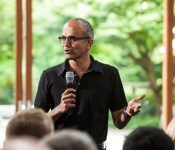
Satya Nadella Appointed Microsoft CEO as Bill Gates Shifts from Chairman to ‘Technology Advisor’
Microsoft announced today that it has appointed company veteran Satya Nadella as Chief Executive Officer to replace retiring Steve Ballmer. Nadella will take over as CEO and join the Board of Directors effective immediately.

As part of this leadership change, Bill Gates is stepping down as Chairman of the Board of Directors and will take a position as “Founder and Technology Advisor”. John Thompson, former CEO of Symantec, will assume the role of Board Chairman. This will mark a significant shift for Gates, who has been asked by Nadella to take a more active role in product development within the company.
Microsoft also announced that Bill Gates, previously Chairman of the Board of Directors, will assume a new role on the Board as Founder and Technology Advisor, and will devote more time to the company, supporting Nadella in shaping technology and product direction.
Gates will work three days each week at Microsoft and will remain actively involved in the Bill & Melinda Gates Foundation, reports Re/code.
| |
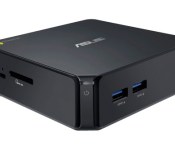
ASUS’ Chromebox arrives in March for $179

As promised late last year, ASUS unveiled its new Chromebox packing Intel’s fourth-generation Haswell processors today. The most compact Chromebox yet, the computer comes sporting either Intel’s Celeron 2955U or i3-4010 processor. Another i7 version of the box will be available outside of North America.
Under the hood of the svelte 4.88 x 4.88 x 1.65-inch device, you’ll get Intel-integrated HD graphics and 16GB of onboard storage. If you need more room to store your stuff, ASUS is also offering buyers 100GB of free cloud storage through Google Drive. Display-wise, the i3 and i7 Chromebox supports 4K Ultra High-Definition displays, and all three have HDMI and DisplayPort out ports for dual-monitor capabilities. You’ll also find four USB 3.0 ports on the device, as well as a built-in SD card reader. You can snag your own ASUS Chromebox in March starting at $179; check out more images below.
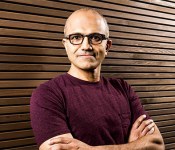
Microsoft chooses cloud and enterprise head Satya Nadella as third CEO

Microsoft has officially named Steve Ballmer’s successor: Satya Nadella. Now the third CEO in the company’s history, he most recently has led Redmond’s efforts in the cloud and enterprise space. With 22 years at the company, Nadella is certainly not the outsider many predicted would take over the roll. But the board, including founder Bill Gates himself, believe that he’s just the man to lead Microsoft into the future. His success in pushing the platform agnostic Office 365, in addition to both consumer facing and enterprise cloud solutions, bodes well for a company who has seen its bread and butter products of Windows and Office struggle in the post PC world.
The naming of Satya as CEO represents something of a return to its roots for Microsoft. While Gates ultimately proved to have solid business instincts, he was at heart a computer nerd (for lack of a better term). Ballmer, on the other hand, was a student of economics and an MBA drop out. Satya received degrees in electrical engineering and computer science before eventually moving on to the University of Chicago’s MBA program.
As part of the transition Bill Gates will be returning to a larger role at Microsoft as Technology Advisor, though, it’s doubtful he’ll be involved in day-to-day decision making. As part of that move, John Thompson (former Symantec CEO and lead independent director of the board at Microsoft) will be taking over as chairman. According to Gates, it was Satya himself who asked him to “step up” his presence at the company and become more involved with guiding the various product groups. No the goal for both men will be to overcome the obvious challenges facing the technology stalwart. If we’re feeling generous, we’d call Windows Phone a modest success. And while 365 is certainly no slouch, it’s still playing catch up to the giant of the cloud productivity space, Google. But its most recent earnings report give reason to hope that Microsoft is slowly becoming the device and services giant it hopes to be.
Below you’ll find a video message from Bill Gates, as well as Satya’s first interview as CEO. And, if you’re interested, the first letter from Satya to his new employees can be found here.
Filed under: Microsoft
Source: Microsoft 1, 2
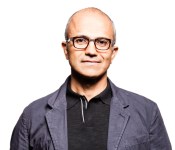
Meet Satya Nadella, the man tasked with reinventing Microsoft

Steve Ballmer couldn’t change Microsoft fast enough. During his 13-year stint as CEO, the company failed to get in front of major technological developments. It struggled to keep pace with the likes of Apple and Google in mobile and search and saw lackluster adoption of its first round of tablets. Ballmer created a sluggish corporate culture that pitted employees against each other, and he wasn’t moving fast enough to right his wrongs. It was time for him to move on.
On August 23rd, 2013, the 34-year Microsoft veteran announced that he would retire within the year. The company’s board set out on a highly publicized five-month journey to find its next leader. Ballmer’s Harvard classmate and Microsoft co-founder, Bill Gates, would join the committee to find a replacement who could follow through on its mission to become a devices and services business in an increasingly fast-paced industry. Over the next five months, the board of directors, led by John Thompson, would narrow its pool of more than 100 candidates to just a few. As time wore on, speculation escalated and outsiders like former Nokia CEO Stephen Elop and Ford CEO Alan Mulally emerged as frontrunners in the glacial race. Meanwhile, rumors pegged internal candidates like former Skype CEO Tony Bates and EVP of Cloud and Enterprise Satya Nadella as possible contenders.
All of that speculation came to an end today when the board appointed Nadella as the third CEO in the company’s near 40-year history. Like Ballmer before him, Nadella is a company man, with more than two decades at Microsoft. He understands how the Microsoft of old works and has managed to lead its cloud and enterprise services to great success, but questions remain about his ability to lead the company into the future.

While Nadella’s name has risen to prominence in the CEO search, he’s flown largely under the mainstream radar during his time at Microsoft. He couldn’t be more different from his predecessor in both demeanor and appearance. In fact, the only physical trait the two appear to share is a receding hairline. Where Ballmer is prone to wild outbursts of chest-pounding, skipping and wild gesticulation, Nadella’s approach to public speaking is enthusiastic, but casual. Chances are, speculation about what drugs Microsoft’s CEO is smoking will die with Ballmer’s departure.
Nadella couldn’t be more different from his predecessor in both demeanor and appearance.
The differences aren’t just skin-deep, however. In selecting Nadella, the board is making a change many have said is necessary: a move toward a leader with a technical background. Born in Hyderabad, India, Nadella earned a bachelor’s degree in electrical engineering from (that other MIT) Manipal Institute of Technology. He then went on to collect a master’s degree in computer science from the University of Wisconsin and an MBA from the University of Chicago. By contrast, Detroit-born Ballmer earned a bachelor’s degree in mathematics and economics from Harvard and after a two-year stint at Procter & Gamble, attended Stanford’s MBA program only to drop out and begin his decades-long tenure at Microsoft. Ballmer was a businessman at a tech company. Nadella is an engineer with a business background.
When he joined Microsoft in 1992, Nadella had already gotten his feet wet in the tech industry at Sun Microsystems. In the years that followed, he held a number of enterprise-focused positions, leading efforts on search and cloud services. Under his leadership as EVP of Cloud and Enterprise, those segments have flourished. In its most recent earnings report, Chief Operating Officer Kevin Turner pointed to Microsoft’s aggressive growth in these areas.

“Our commercial cloud services revenue grew more than 100 percent year-over-year, as customers are embracing Office 365, Azure and Dynamics CRM Online, and making long-term commitments to the Microsoft platform,” Turner said.
Under Nadella’s leadership, Microsoft has made a fundamental shift in the way it delivers its bread-and-butter products (namely Office and Windows) to consumers and businesses. With PC sales slipping and mobile computing gaining ground, Nadella oversaw a shift toward device-agnostic programs with the launch of cloud-based solutions like Office 365 and Windows Server 2012.
Under Nadella’s leadership, Microsoft has made a fundamental shift in the way it delivers its bread-and-butter products.
Though Nadella’s strength in software and business solutions is clear, that’s only part of the equation in Microsoft’s plan to become a device and services company. In late 2012, Ballmer penned a letter to shareholders, outlining a new strategy for the company — one he later admitted to The Wall Street Journal, he was incapable of carrying out himself. He presented a plan in two parts that would see Microsoft developing software and services for a wide range of devices, and a series of devices to optimize its software and services. The plan emphasized consumer and enterprise technology in equal parts. Nadella has proven his ability to drive momentum behind the latter, but Microsoft’s most visible struggles over the past few years have been in the consumer market. Just over three years since it launched Windows Phone OS, Microsoft runs a distant third to Google and Apple, owning just 3.6 percent of the smartphone market in 2013, according to Strategy Analytics.

Despite its struggles in consumer products, not all is lost for Microsoft. Its latest earnings report boasted a 13 percent increase in revenue in its consumer-facing products, with the Xbox One outselling Sony’s PlayStation 4 in the US with 908,000 consoles in December 2013, and Surface sales more than doubling from the previous quarter. With the acquisition of Nokia’s devices and services business, Microsoft is driving deeper into the hardware business. This is unproven ground for the new CEO.
Microsoft is driving deeper into the hardware business. This is unproven ground for the new CEO.
It remains to be seen if Nadella can continue to push both segments of Microsoft forward, but many argue it’s not the present that’s at stake. In order to remain a major player in this rapidly changing space, Nadella will have to lead the decades-old behemoth into new territory and ensure that it doesn’t get caught sleeping on the next big technological shift. With Google gobbling up everything from a smart thermostat company to a maker of military robots, and wearable devices and the internet of things still in their infancy, what that shift will look like is still uncertain.
Judging from a discussion he had with Om Malik at Le Web in December 2013, Nadella is aware of the challenges he faces. Malik, speaking to the entrenched corporate culture at the company and the future of the technology business, asked, “Do you think Microsoft can overcome itself and embrace this future?”
“We have to. There is no other answer in this business than to say you renew yourself every day. And sometimes you’re successful and sometimes you’re not, but it’s the average that counts. We wouldn’t be here 30 years since our founding if we were not able to ride the new waves of technology … The fact that we have the capability that allows us to go and hunt for the new concept is the key to this business and longevity,” Nadella said.
AT&T no longer paying T-Mobile customers up to $450 to switch carriers
Remember that limited time promotion where AT&T would pay T-Mobile customers up to $450 switch wireless providers? It’s done. Over. You missed it.
The Wall Street Journal is reporting that the deal expired on January 31, less than one month after commencing. While AT&T initially did say it would be a limited-time promo, we had hoped for something a little longer than a couple of weeks.
As to be expected, T-Mobile’s CEO John Legere was quick to add his own perspective on the situation.
That was quick! @ATT already revoking the $450 bribe to @TMobile customers? People weren’t falling for it, were they #Randall? #doingitwrong
— John Legere (@JohnLegere) February 3, 2014
AT&T, for it’s part, did unveil new shared data plan this week, kicking off lower pricing for the 10GB and higher options. As for T-Mobile, yes, they are still doling out up to $650 per line to get customers to break their contracts.
The post AT&T no longer paying T-Mobile customers up to $450 to switch carriers appeared first on AndroidGuys.
Samsung schedules February 24 Unpacked event for Galaxy S5
Samsung is expected to introduce its next generation of flagship Galaxy S smartphones on February 24. An invitation posted on the company’s press page tells us that the Galaxy S5 will debut on the eve of Mobile World Congress. No, it doesn’t explicitly mention the device by name but we can think of no other reason for that little ’5′ in the upper right corner.
Those not able to make it Barcelona in person are advised to follow along via Samsung’s Youtube account. We should be able to get a virtual front-row seat from the comfy confines of the couch or office chair.
The post Samsung schedules February 24 Unpacked event for Galaxy S5 appeared first on AndroidGuys.

[ROM] HTC Droid DNA gets Android 4.4.2 and Sense 5.5 via a HTC One stock Port
 If you own a HTC device that isn’t a HTC One, you’ve likely been waiting extremely patiently to hear any word regarding software updates to your HTC device, whether it be Android 4.3 or Android 4.4 KitKat. If LlabTooFer’s leak is correct, most devices newer than the HTC Bufferfly, also known as the HTC Droid DNA, can except to skip Android 4.3 in favour of Android KitKat, and that is expected to happen around March or April. But owing to the fact that HTC has already been late on its delivery of Android 4.4 to the HTC One, you can bet that these other updates will also be late. And that’s when the clever fellows over at XDA come in; thanks to them, the HTC Droid DNA gets Android 4.4.2 and Sense 5.5 far, far ahead of schedule.
The ROM itself technically isn’t a bespoke ROM for the HTC Droid DNA; it’s actually a port from the HTC One software so you will probably see all of the features that you’ve been hearing about on the One. The ROM is also completely stock and supports CDMA and GSM networks. It’s always great to see the community bringing out ROMs, particularly software versions that are slow to reach aging devices, and bringing them out way before their expected released date (if they’ve even been given one). If you want to try out this ROM, hit the XDA Forum link below to jump to the post.
Who has a HTC Droid DNA is going to try this stock port of Android KitKat? If you try it, let us know how you find it.
 AIVAnet