


Facebook’s next news feed tweak: ranking ‘trusted’ sources
Last week Mark Zuckerberg kicked off his year of making sure your time on Facebook is “well spent” by announcing that feeds will refocus on items shared by friends, instead of news. Today the CEO followed up with an announcement that the site will try to identify and highlight “trusted sources” based on community feedback. While the combination of these changes is apparently only going to change the mix of news in feeds from five percent to four percent, its stated claim is to avoid ” sensationalism, misinformation and polarization.”
In an interview with the Wall Street Journal, the VP of product management who oversees the news feed, Adam Mosseri, said “This is an interesting and tricky thing for us to pursue because I don’t think we can decide what sources of news are trusted and what are not trusted, the same way I don’t think we can’t decide what is true and what is not.” Under increasing scrutiny from the media, users and regulators about its control over the information seen by billions of people every day, it appears Facebook’s first choice is to attempt regulation by its own users.
Mosseri indicated that user rankings are still just one of the weights Facebook will use in ordering posts on the news feed, but it’s unclear exactly how the site will avoid potential attempts to game the system, whether by use of bots, coordinated group reporting or other means. However it works, according to Zuckerberg, this is just the start of a process to “prioritize news that is trustworthy, informative, and local.”
Source: Mark Zuckerberg (Facebook)
TaylorMade’s new putter can analyze your golf stroke
Blast Motion is known for making sports sensors aimed at improving your golf, baseball or softball performance and now they’ve teamed up with TaylorMade on a putter that can analyze your putting strokes. The Spider Interactive Powered by Blast putter marries TaylorMade’s most popular putter with Blast Motion’s motion capture sensors and can measure and report your backstroke time, forward stroke time, tempo, impact stroke speed and face rotation. With the accompanying app, users will be able to track their progress, access training modules and view videos of their strokes.
Other companies including Garmin and Zepp, the latter of which just agreed to stop selling one of its sensors in the US as part of a patent dispute settlement with Blast Motion, also offer golf swing sensors. But, like Blast Motion’s Blast Golf setup, they’re external sensors that attach to a golfer’s glove or club. The Spider Interactive putter, however, houses the sensor within the grip.
The putter will be available in various versions starting March 23rd and will cost $400. The mobile app will be available on iOS March 1st and on Android later in 2018.
Logan Paul forced YouTube to admit humans are better than algorithms
YouTube is no stranger to controversy. Many of its top stars have been in hot water recently: From PewDiePie making racists remarks, to a “family” channel with abusive kid pranks, the company’s been under fire for not keeping a closer eye on the the type of content that makes it onto the site. Most recently, Logan Paul, a popular YouTuber with more than 15 million subscribers, faced backlash after posting a video that showed a corpse he came across in Japan’s so-called “Suicide Forest.” That clip, which was eventually taken down by Paul himself, forced YouTube to cut almost all ties with him and to figure out ways to prevent another situation like this.
Up until now, Google’s (and by extension YouTube’s) solution had been to take down offensive channels and tweak its advertiser-friendly guidelines to give brands more control over where their ads show up. But the tech giant is now taking that one step further. Earlier this week, it announced YouTube will now manually review uploads from accounts that are part of its Google Preferred ad tier, which lets brands publish advertisements in videos from the top five percent of YouTube creators.
The shift is notable because it means YouTube will rely less on algorithms to catch bad actors, something that social media companies are finally realizing needs to happen. Facebook and Twitter have both also vowed to hire more humans, as they look to crack down on bots and troll accounts that have plagued their sites. What Google and YouTube hope, naturally, is that this will help avoid another mess like the one Logan Paul created.
Although Paul’s channel “Logan Paul Vlogs” still lives on the platform, YouTube has put on hold the original projects he was working on for YouTube Red, its paid ad-free streaming service. It also terminated his lucrative Google Preferred ad deal, and while he will still be able to monetize his content, not being a part of that advertising package likely won’t earn him nearly as much money. For context, he was reportedly the fourth highest-paid YouTuber in 2017, according to Forbes, earning an estimated $12.5 million — thanks to Preferred, his Maverick apparel line and sponsored posts on social media.
The decision was likely a tough one for YouTube, considering the millions of people who watch Logan Paul’s channel and, perhaps most importantly, the level of influence he has over a key demographic: teenagers. But YouTube had to make an example out of him in order to appease advertisers, which grow more and more concerned that their ads could appear alongside disturbing or inappropriate videos. Last year, AT&T and Verizon (which owns Engadget), among others, pulled ads from Google’s platform after they were displayed on videos related to terrorism and hate groups.
YouTube is also implementing stricter requirements to its Partner Program, which lets smaller channels earn money by placing ads in their videos, to help filter out offensive content. Creators can now only become a YouTube Partner if they have 4,000 hours of watchtime in the past 12 months and over 1,000 subscribers. These changes are in addition to the ones made in 2017, when YouTube began requiring 10,000 channel views minimum in order to be granted partnership status. The company says setting these thresholds will prevent low-quality videos from making money and stop channels from uploading stolen content. That said, it still plans to depend heavily on viewers flagging videos that may violate YouTube’s community guidelines.

YouTuber star “PewDiePie.”
The main challenge for YouTube, is that often it is top users who are uploading dubious content, not the smaller channels. And that begs the question of why it took it so long to act, at least in a tougher manner. It’s not as if YouTube hasn’t dealt with cases similar to Logan Paul’s in the past. Take Felix “PewDiePie” Kjellberg as an example, the Swedish YouTuber with nearly 60 million subscribers who has published videos filled with anti-Semitic and other racist outbursts on more than one occasion. Or the channel “Toy Freaks,” which had over 8 million subscribers and featured explicit content targeted at young audiences, including videos of children vomiting and in extreme pain that it claimed were “pranks.”
Granted, YouTube did act quickly in both cases: PewDiePie lost his original series Scare PewDiePie and Google Preferred deal, similar to Logan Paul, while the ToyFreaks channel was removed altogether. But those acts should’ve been a huge flag that the company needed to take a hard look at itself and change its video-review process, from depending less on machine learning and more on humans. Just as it plans to do going forward.
If the new system would’ve been in place, chances are the controversial Logan Paul video may have never been viewed by the masses and, therefore, YouTube could’ve saved itself from major public outcry. In fact, there’s still an ongoing petition calling for his channel to be deleted, which so far has been signed by more than half a million people. The hope for YouTube now is that, by having humans monitor popular uploads, there will be less of a chance of any foul videos being published in the future. A YouTube spokesperson told Engadget that every decision the company makes has to work for advertisers, creators and users alike, which can be complicated because not every situation is black and white.
With the overhauled YouTube Partner Program, for example, some creators aren’t happy with the new requirements because they don’t think they’ll be able to make money. But YouTube says that of those channels that will be affected, 99 percent are making less than $100 per year. Ultimately, the spokesperson said, all the changes made recently, both to the advertising and community guidelines, are designed to “move everyone forward,” adding that YouTube doesn’t want someone’s bad judgment call to affect the rest of the platform — even though it certainly feels like it is.

Paul Levinson, a professor of communications and media studies at Fordham University, said he has mixed feelings about the decisions YouTube is making. He believes that, by censoring its creators, it will lose the freedom that’s made it the most popular video site in the world. That said, Levinson also understands that it isn’t appropriate to have a corpse or other “disgusting” content in a video.
“Of course, you could argue that if someone doesn’t like it, they don’t have to view it,” he said. “You know, they can just shut it off the second they see it, but obviously, I get why people find that offensive, even repulsive. And so in that sense, it’s a good thing, but at the same time I’m concerned that we’re beginning to see the end of that totally open [internet].”
Now, as we move past Logan Paul’s controversy, it’ll be interesting to see how effective YouTube’s new monitoring system will be, and whether it decides to expand it beyond just the top five percent of videos. But don’t be surprised if some manage to slip through the cracks, because like the algorithms that have failed YouTube in the past, humans are also far from perfect.
Beats Pill+ Bluetooth Speaker in White Discounted to $116 at Target and Amazon
The Beats Pill+ Bluetooth speaker has received a notable discount today at two retailers, with the White model specifically getting marked down to one of the lowest price points seen for the device. At both Target and Amazon you can get the Beats Pill+ in White for $116.99, which is over $30 lower than the speaker’s more common sale price of $150. When it first launched in 2015, Apple sold the Beats Pill+ for $230.
Note: MacRumors is an affiliate partner with these vendors. When you click a link and make a purchase, we may receive a small payment, which helps us keep the site running.
The only other color that appears slightly lowered in price as well is Black, but on Target the color has sold out at the time of writing, and on Amazon every other color option is $149.00 and above (you’ll have to add the speakers to your cart to see how much they are). Elsewhere at retailers like Best Buy, B&H Photo, Walmart, and Newegg the speaker sits at around a similar $149.00 price point, while Apple still sells it for $179.95.
In other Beats sales, Newegg’s official eBay store has the Beats Solo3 Wireless On-Ear Headphones for $197.00, down from $299.00. Colors available include Gloss Black, Gloss White, Rose Gold, and Gold, and there is a limit to three headphones per customer.
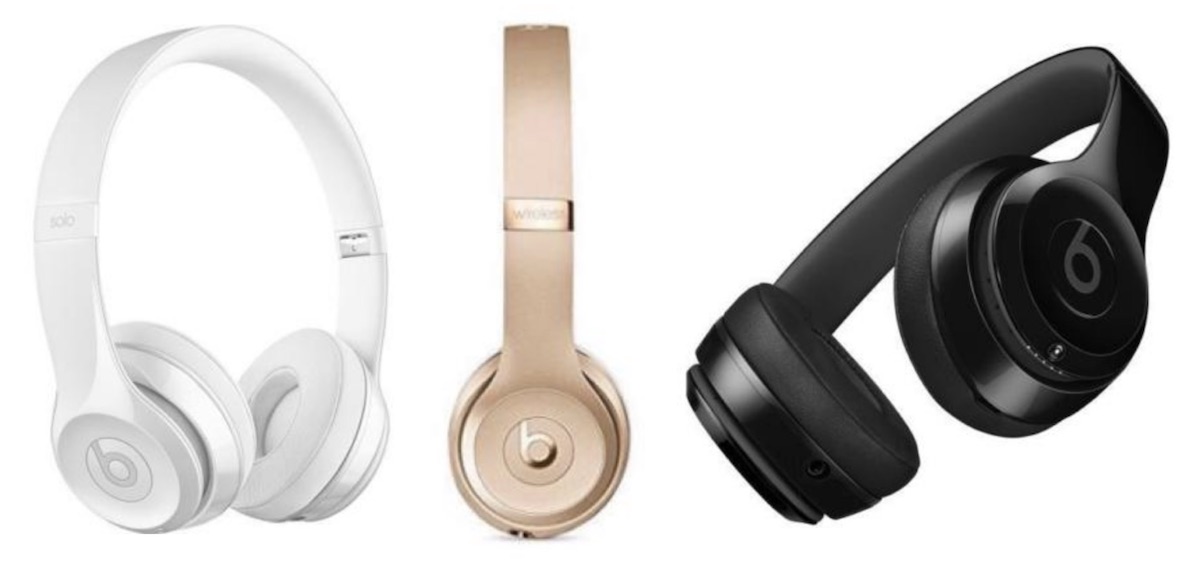
The next best prices can be found at Walmart, Best Buy, and Amazon, which all have the headphones for about $219.99. Like the Beats Pill+ deal, discounts on the Beats Solo3 headphones at these retailers are mostly focused on one color of the device, this time in Black.
For more discounts on Beats and other products — including a UE Megaboom sale going on right now at Best Buy — be sure to visit our Deals Roundup.
Related Roundup: Apple Deals
Discuss this article in our forums
MacRumors Giveaway: Win an Apple Watch Band From Casetify
For this week’s giveaway, we’ve teamed up with Casetify to offer MacRumors readers a chance to win one of the site’s Apple Watch bands.
Casetify offers a wide range of Apple Watch bands, from high-quality steel mesh and leather to some that are customizable with your own design. All Casetify Apple Watch bands fit all Apple Watch models and are available in 38 and 42mm size options.
With the Saffiano Leather Band, priced at $52, you can choose from hundreds of designs offered by Casetify in all kinds of colors and patterns.
The Steel Mesh Band, priced at $82, mimics Apple’s own Milanese Loop and it comes in multiple colors, including gold, rose gold, space gray, and the traditional silver.

Casetify’s Double Tour, priced at $90, is similar to some of Apple’s Hermès bands, but at a much more affordable price. It wraps twice around the wrist and comes with two different band lengths so you can also wear it as a single wrap to change things up.

The Magnetic Apple Watch Band is like the Leather Loop from Apple, with a simple wrap design that emulates the look and feel of genuine leather. It comes in multiple colors like blue, red, black, gray, and pink, and, unlike the Leather Loop, it is available for 38mm Apple Watch models.

The Nylon Fabric Apple Watch Band, priced at $40, looks a lot like Apple’s Woven Nylon bands. It’s lightweight, comfortable, and stylish, with solid and stripe color options available in black, white, and pink.

We are giving away five Apple Watch bands, with winners able to choose any band in any color from Casetify’s collection. To enter to win, use the Rafflecopter widget below and enter an email address. Email addresses will be used solely for contact purposes to reach the winners and send the prizes. You can earn additional entries by subscribing to our weekly newsletter, subscribing to our YouTube channel, following us on Twitter, or visiting the MacRumors Facebook page.
Due to the complexities of international laws regarding giveaways, only U.S. residents who are 18 years or older and Canadian residents (excluding Quebec) who have reached the age of majority in their province or territory are eligible to enter. To offer feedback or get more information on the giveaway restrictions, please refer to our Site Feedback section, as that is where discussion of the rules will be redirected.
a Rafflecopter giveawayThe contest will run from today (January 19) at 11:00 a.m. Pacific Time through 11:00 a.m. Pacific Time on January 26. The winners will be chosen randomly on January 26 and will be contacted by email. The winners will have 48 hours to respond and provide a shipping address before new winners are chosen.
Tags: giveaway, Casetify
Discuss this article in our forums
Apple Hires a Few Dozen Employees From Silicon Valley Data Science Startup
Apple has hired several data scientists from Silicon Valley Data Science, a consulting firm that offers data engineering and data science services, reports Bloomberg.
A few dozen employees from Silicon Valley Data Science joined Apple in December and January to help the company better use its data to improve its advertising efforts. According to the Silicon Valley Data Science website, the startup helped businesses improve customer retention, increase engagement, improve conversion rates, develop new revenue-generating data products, streamline operations, and more.
At Apple, the team will work on ad-related analytics to bolster Apple’s advertising efforts. One area of focus could be better optimizing App Store ads.
Founder and CEO of Silicon Valley Data Science Sanjay Mathur is one of the employees that has taken a position as Apple. His LinkedIn profile now says that he leads “strategy and analytics initiatives for a group at Apple.”
Several other LinkedIn profiles from former Silicon Valley Data Science employees now list data scientist positions at Apple. The company’s former CTO, for example, now works on “Algorithms,” while the former Head of Data Science is now Apple’s “Principal Data Scientist.”
While the Silicon Valley Data Science website is still up, the company shut down in December and its services are no longer offered.
Tags: Apple ads, Apple acquisition
Discuss this article in our forums
Apple Says iOS 11 is Now Installed on 65% of Devices
iOS 11 is now installed on 65 percent of iOS devices, according to new statistics Apple shared yesterday on its App Store support page for developers.
That’s up six percentage points since December 5, when iOS 11 was installed on 59 percent of devices, and 13 percentage points since November 6, when iOS 11 was installed on 52 percent of devices.
28 percent of devices continue to use iOS 10, while earlier versions of iOS are installed on seven percent of iOS devices.
Since iOS 11 was released, its adoption rate has been quite a bit slower than iOS 10 adoption rates in 2017. In January of 2017, for example, iOS 10 was installed on 76 percent of iOS devices.
Apple has released several updates for iOS 11 since its September launch, but the operating system has also been plagued by bugs and security issues, which doesn’t appear to have helped adoption rates.
iOS 11.2.1 and iOS 11.2.2, the two latest iOS 11 updates, were both released to address major bugs and vulnerabilities. iOS 11.2.1 fixed a HomeKit bug that allowed for unauthorized access to HomeKit accessories, while iOS 11.2.2 introduced mitigations for the Spectre vulnerability impacting all modern processors.
iOS 11.2, released in early December, did bring some major new features to the operating system, like Apple Pay Cash and 7.5W Wireless Charging, but even that update doesn’t appear to have spurred a larger than normal growth in adoption rate.
Some iOS 11 users who were unhappy with the current version of iOS were also able to recently downgrade their operating systems when a brief oversight saw Apple signing older versions of iOS dating back to iOS 6.
Apple next week will introduce iOS 11.2.5, another update that introduces an important bug fix for an exploit that allows a malicious link to freeze the Messages app when received via text message.
Related Roundup: iOS 11
Discuss this article in our forums
Apple May Replace Some iPhone 6 Plus Models Needing Whole-Device Repairs With iPhone 6s Plus Through March
If you have a damaged iPhone 6 Plus that qualifies for a whole-device replacement, Apple may replace it with an iPhone 6s Plus through March, according to an internal document distributed to Apple Authorized Service Providers today.
Apple specifically states that “orders for whole unit service inventory of some iPhone 6 Plus models may be substituted to an iPhone 6s Plus until the end of March 2018.” MacRumors confirmed the memo’s authenticity with multiple sources, who requested to remain anonymous due to their positions.
Apple doesn’t specify which iPhone 6 Plus models are eligible, nor does it provide a reason for the substitution, but it likely relates to Apple’s shortage of iPhone 6 Plus replacement batteries until late March to early April.
A previous internal document obtained by MacRumors states that Apple no longer manufactures the iPhone 6 Plus, so it likely has to reboot its production lines to replenish its supply of both the device itself and batteries, which would certainly take time. Apple did not respond to our request for comment.
It’s possible that some customers who have visited a Genius Bar recently opted for a whole-device replacement rather than waiting until March or April for a new battery, which may have depleted the little supply of iPhone 6 Plus replacement units that Apple had, but this is only speculation on our part.
Apple and most Apple Authorized Service Providers can replace an iPhone’s display, battery, speakers, rear camera, or Taptic Engine individually, while a defective Lightning connector, faulty logic board, and most other repairs are generally eligible for a whole-device replacement, our source said.
Your mileage may vary depending on the exact damage to your iPhone and the results of Apple’s diagnostic tests. Apple Support can be reached on the web or by scheduling a Genius Bar appointment at an Apple Store.
Related Roundup: iPhone 6sBuyer’s Guide: iPhone 8 (Neutral)
Discuss this article in our forums
Apple Receives FCC Approval for HomePod, Suggesting a Launch Could Come Soon
Ahead of the promised “early 2018” launch of the HomePod, Apple has received official FCC approval for the smart speaker. Now that FCC approval has been obtained, Apple is free to begin selling the device at any time.
All devices that use communications technologies like Bluetooth and Wi-Fi must be submitted to the United States Federal Communications Commission to ensure compliance with federal regulations before they’re eligible to be sold in the United States. That FCC approval has been obtained suggests the HomePod will launch in the near future.
For comparison’s sake, Apple received FCC approval for the iPhone X on October 4, just under one month before the device was released to the public on November 3.
Today’s FCC clearance of the HomePod follows a rumor earlier this week suggesting HomePod supplier Inventec has already started shipping HomePod units to Apple. Apple is reportedly set to receive “about 1 million” HomePod devices and an industry source that spoke to the Taipei Times, the source of the rumor, has said that the HomePod is coming “soon.”
Apple originally planned to release the HomePod in December, but the company ended up requiring additional development time, delaying its debut until 2018. Apple has said the HomePod will ship out to customers in the US, UK, and Australia in “early 2018.”

Early 2018, by Apple’s historical definition, is something of a broad window. Apple considers “early 2018” to be the period between January and April, so it’s been tough to narrow down the prospective launch date of the HomePod. Given the shipment rumors and the FCC approval, however, we may see the device in late January or early February rather than later in the year.
Like many new Apple products, rumors suggest initial supplies of the HomePod could be constrained at launch. Inventec is expecting revenue from the HomePod to be “limited” during Q1 2018 due to a low quantity of HomePod devices available for shipment.
Related Roundup: HomePod
Discuss this article in our forums
These websites let users calculate the damage from a nuclear missile
As if we weren’t all on edge enough following the accidental release of an imminent ballistic missile warning in Hawaii (thankfully a false alarm), a historian who studies science and nuclear weapons created two applications that are outright scary.
The first, Missilemap, lets users precisely calculate the range, accuracy and warhead size of a nuclear weapon, launched from anywhere in the world, and with a target anywhere in the world. Missilemap was designed to make it easy to see the relationship between missile range, accuracy, and warhead size to help people understand the power of nuclear warheads and long-range missiles.
In real-time use, Missilemap creates a graphical representation of ranges, targeting paths, accuracy, blast damage, and probabilities of death. In simple terms, you can theoretically ask if North Korea can hit, say, Honolulu or San Francisco, with their latest missile.
Its companion app, Nukemap, lets users pick their target and see how the target zone would be affected by a nuclear blast, including the fireball radius, radiation radius, air blast radius, and thermal radiation radius. Users can also export findings from Missilemap to Nukemap to see how their targets would fare.
For a single example, if we target Honolulu with a 10-kiloton weapon allegedly tested by North Korea in 2013, the app calculates that the fireball would be 500 feet, give victims third-degree burns up to a mile away, and result in nearly 50,000 fatalities and nearly 100,000 injured victims.
Meanwhile, if we target New York City with a “Tsar Bomba,” the largest weapon ever designed by the USSR and carrying a 100-megaton payload, we get a fireball nearly four miles in diameter, burns up to 45 miles away, and 8,012,450 fatalities.
The websites are the brainchildren of Alex Wellerstein, a historian of science and technology at the Stevens Institute of Technology in Hoboken, New Jersey. Wellerstein, who has devoted his life to the study of nuclear arms and their effects on geopolitics, is on the advisory committee of the Atomic Heritage Foundation as well as the Alsos Digital Library for Nuclear Issues. He is also the author of “Restricted Data: The Nuclear Secrecy Blog.”
The sites aren’t meant to be used by professionals who work in the field of nuclear security. Wasserstein notes that the apps use somewhat simplified models for understanding the effects of nuclear weapons. All of the data employed by these sites come from unclassified sources.
As far as the geopolitical implications of the site, Wasserstein takes a position and it’s a clear one. On the Nukemap site, he writes:
“The Nukemap is aimed at helping people visualize nuclear weapons on terms they can make sense of — helping them to get a sense of the scale of the bombs. By allowing people to use arbitrarily picked geographical locations, I hope that people will come to understand what a nuclear weapon would do to places they are familiar with, and how the different sizes of nuclear weapons change the results.”
Editors’ Recommendations
- Hawaii’s missile alert agency stored its passwords on Post-it Notes
- NASA’s new X-ray navigation could guide robots through deep space
- FCC to investigate Hawaii’s erroneous missile warning
- First Hawaii, now Japan issues a missile warning in error
- Everything you need to know about masterwork weapons in ‘Destiny 2’
 AIVAnet