


Indie hit ‘Dead Cells’ is coming to consoles this year
In May of last year, indie developer Motion Twin launched Dead Cells in early access on Steam. By blending ‘Metroidvania’ platform exploration with roguelike random generation, the game quickly became a hit with fans and our own editors, selling over 600,000 copies, according to the studio. But for every non-PC player left in the cold, don’t worry: Dead Cells is coming to PS4, Xbox One and Switch sometime in 2018.
Sadly, Motion Twin didn’t announce a specific release date or window, nor if the cost for each console edition would differ from the $20 price tag for the PC version. But it’s great to see another haunting, gothic action game expand its userbase — and we’re especially excited for Dead Cells to arrive on the Switch, which seems tailor-made for ported indie hits.
Source: Dead Cells console trailer (YouTube)
Get two Sonos One speakers for the price of a HomePod
With the debut of the Apple HomePod almost upon us, Sonos has decided to make a move of its own. The company has announced the “Sonos Two” bundle, which will include two Sonos One smart speakers for $349 in the US and £349 in the UK. The bundle will be available for a limited time only starting January 26th. The speakers are normally priced at $199 each.
This is a blatant move to counter Apple’s move into the smart speaker sector; one HomePod is priced at $349 (£319 in the UK). Sonos will be bringing support for Google Assistant and Apple Airplay 2, which will make its debut in iOS 11.3, to its speakers soon. This could possibly mean that Sonos will support Airplay 2 multi-room support before the HomePod, as Apple announced this week that the speaker will not have that basic feature at launch.
Source: PR Newswire
CNN parts ways with YouTube star Casey Neistat
YouTube star Casey Neistat made headlines back in 2016, when CNN bought his company, Beme. While CNN quickly shut down the associated social video sharing app, the team behind it were supposedly working on something new for the news organization. Now, it appears that’s not the case. Buzzfeed reports that CNN has closed the company behind the app, also called Beme, and Neistat is parting ways with CNN.
It’s now clear that CNN didn’t have a clear idea of what it wanted from Neistat when it purchased Beme, apart from some sort of digital news brand aimed at millennials. Neistat couldn’t deliver. “I couldn’t find answers. I would sort of disappear, and I would hide, and I would make YouTube videos for my channel because at least I would be able yield something,” he told Buzzfeed in an interview. “I don’t think I’m giving CNN what I want to give them, and I don’t think they’re getting value from me.”
The Beme team was working on a live news app called “Wire,” and CNN will continue to develop and support it. Some employees will be rehoused in other parts of CNN; others will be let go. It doesn’t bode well for CNN’s digital operations, which has struggled as of late. The company killed its daily Snapchat show just four months after launch back in December.
Source: Buzzfeed
Behold, the bouncing selfie ball
Facebook’s attempt to assess news sources through its users. Donald Trump’s Twitter meltdowns. Instagram’s influencers and ad-labeling challenges. Our lives have become dominated by social media and an incessant need to document our most mundane activities.
Decades, or even centuries from now, future generations will look back on 2018 as the year we hit peak social media obsession. They will observe a gadget introduced this year called the Hypno Eye — a mobile photo booth in the form of a selfie-taking ball — and argue that it signified the beginning of the end for real-world interactions.
“These devices were found at festive gatherings that our ancestors threw,” a future museum guide might say. “Each of these beach ball-sized orbs housed a camera and a touch screen framed by a ring light, so party-goers could take photos and videos of themselves with professional-level lighting. After that, it would generate a short video clip with quirky effects that people could send to themselves via what was known as a text message.”
The people who made the Eye noticed that traditional static photobooths of yore were being neglected at the corporate parties they worked for. Even the funniest props and quickest downloads weren’t drawing partiers anymore. The drinking and dancing was “out there” not in the dark confines of some throwback picture booth. They had to make corporate-branded photos and videos relevant again and decided to put their cameras in the middle of the action.
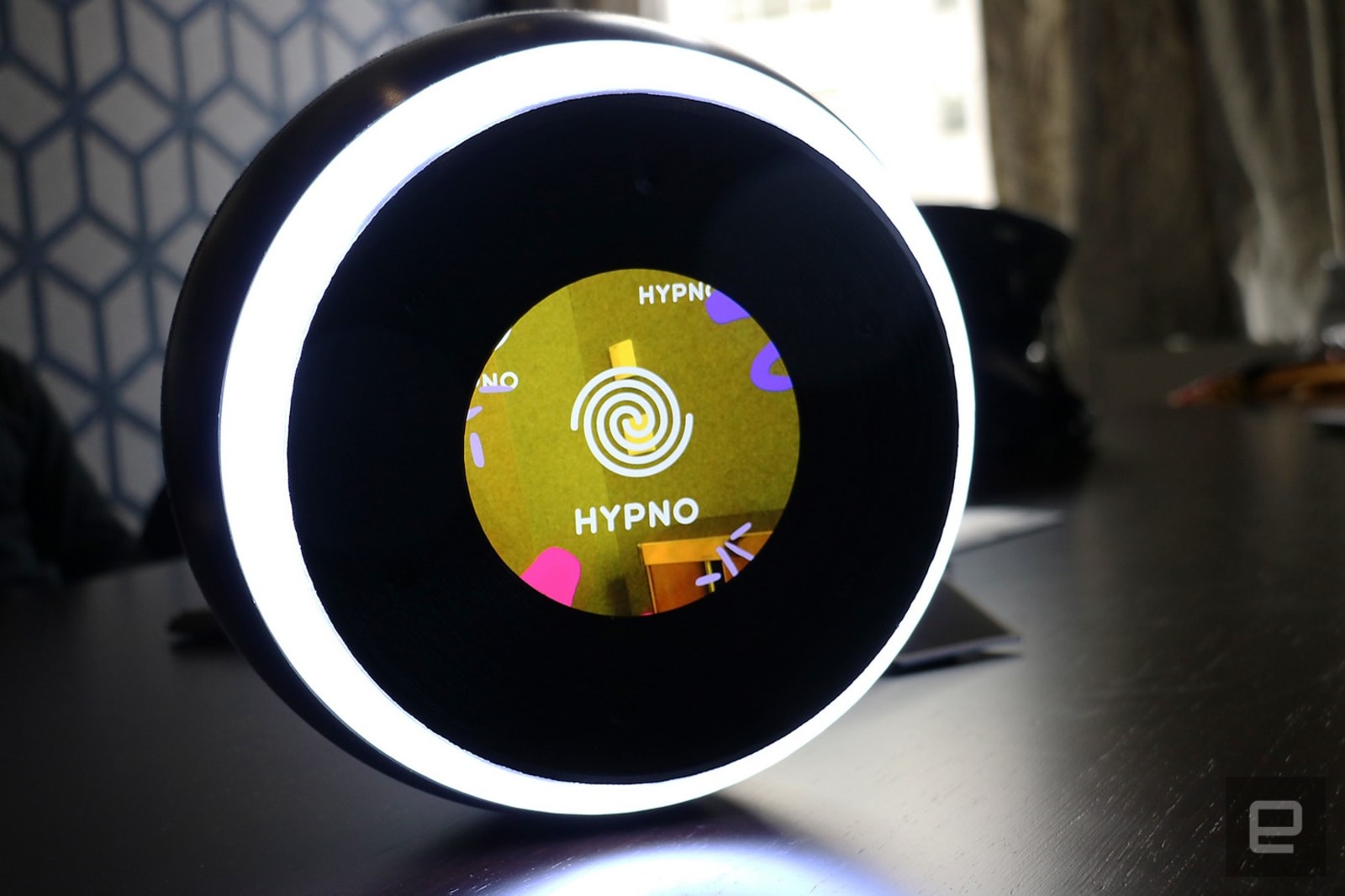
To protect its fragile hardware from damage on the dancefloor, Hypno encased the Eye in a hardy, rubbery foam shell that felt sturdy enough to survive a few bounces. “This allowed people to toss the camera into crowds of people without fear of injury to the device,” the docent might explain. “Though we imagine a few humans may have been hurt by the five-pound ball.”
“But why couldn’t they just use their smartphones? They had those at the time, right?” A curious visitor might ask.
Excitedly pointing a finger up in the air, the guide would respond, “It’s all about facilitating social interaction!” Since people didn’t feel like they could simply discard the orbs after they were done, they were compelled to make contact with other attendees.
“They would pass these orbs around, often to people they didn’t know. This caused them to join each other in group photos, and encouraged the social phenomenon that was known back then as ‘photobombing’.” At this point, the guide might invite visitors to peruse the video archive of 2018’s trendiest partiers. “Like the photo booths that came before, the clips from the Eyes could be posted on individual social media accounts, which you all remember was the primary means of interaction in that time.”

Although the Hypno Eye wasn’t designed for widespread use in people’s homes, the company did entertain the thought of selling the device to general consumers. As the guide might point out, “Remember the ‘influencers’ that rose in popularity during this time? Couldn’t you just see them embracing this, literally?”
Source: Hypno
Apple added two dozen self-driving SUVs to its California test fleet
Last April, Apple was granted a permit to test its autonomous vehicle technology by the state of California and since then, the company has expanded its test fleet from three vehicles to 27, Bloomberg reports. The California Department of Motor Vehicles said that Apple had registered 24 Lexus RX450h SUVs between last July and this month. While initially aiming to develop its own autonomous vehicle, Apple later decided to switch gears and design a self-driving system that could be incorporated into other vehicles. And we’ve seen glimpses of that technology in recent months. A patent application, a presentation from Apple AI Research Director Ruslan Salakhutdinov and a research paper have all pulled back parts of the curtain Apple’s technology development usually hides behind. And a closeup look from Voyage cofounder MacCallister Higgins gave us a bit of a visual.
There are many players in the autonomous vehicle field and Apple has a lot of competition. Companies like Waymo, Uber, Toyota, Lyft, GM, Renault, Baidu, Mercedes-Benz, Volvo, Honda and Yandex are all working on self-driving technology and many have much larger testing operations than Apple. Waymo, for example, is testing its vehicles in California, Washington, Texas, Arizona, Georgia and Michigan and is working on expanding its self-driving test fleet to 600 Chrysler Pacificas. Meanwhile, Uber has been testing its technology in multiple states including California, Arizona and Pennsylvania for the last two years and signed a deal with Volvo last year that will bring the company a fleet of 24,000 XC90 SUVs with which to outfit its tech. Apple has a bit of catching up to do.
Via: Bloomberg
iOS 11.3 Firmware Subtly Hints at iPad With Face ID
Apple is planning to release a next-generation iPad Pro this year with slim bezels and Face ID, like the iPhone X, according to Mark Gurman at Bloomberg News, and evidence of the tablet may have been uncovered in iOS 11.3.
iPad Pro with Face ID mockup by Carlos Guerra
iHelpBR editor Filipe Espósito has discovered strings in the first iOS 11.3 beta that refer to a “modern iPad,” which is notable since Apple’s software engineers referred to the iPhone X as the “modern iPhone” in older firmware, according to both Espósito and developer Guilherme Rambo.
Yep, there’s definitely some references to a “Modern iPad” inside iOS 11.3. pic.twitter.com/JHHone2R1D
— Filipe Espósito (@filipekids) January 25, 2018
While the “modern iPad” strings could be placeholders, as commonly found in Apple’s code, the discovery lends credence to rumors of an iPad Pro with Face ID, which would certainly be a logical next step in Apple’s product roadmap.
“Modern iPhone” meant iPhone X. “Modern iPad” is probably an iPad with Face ID https://t.co/pbMAMj3QCe
— Guilherme Rambo (@_inside) January 25, 2018
KGI Securities analyst Ming-Chi Kuo also expects Apple to release a new iPad Pro with Face ID this year, so there is a good chance the rumor is true. Like the iPhone X, the tablet reportedly lacks a Home button, although it will likely still have an LCD instead of OLED display due to supply, cost, and technological constraints.
It’s unclear if the iPad Pro will have a notch for the TrueDepth system, as illustrated in the first mockup above, or if the device will have uniformly slim bezels on all four sides with enough room for the Face ID sensors.
 iPad Pro with slim bezels rendered by Benjamin Geskin
Face ID is also expected to be featured on a second-generation 5.8-inch iPhone X, a larger 6.5-inch version dubbed iPhone X Plus, and a new, cheaper 6.1-inch model with an LCD, aluminum frame, and no 3D Touch.
Related Roundups: iPad Pro, iOS 11Tag: Face IDBuyer’s Guide: 10.5″ iPad Pro (Neutral), 12.9″ iPad Pro (Neutral)
Discuss this article in our forums
Apple ‘Accelerating’ Efforts to Catch Up With Self-Driving Competition, Expands California Fleet to 27 Vehicles
Apple has expanded its California fleet of self-driving vehicles from three registered last April to 27 as of early 2018, according to a new report posted by Bloomberg today and sourced from emails with the California Department of Motor Vehicles.
Following the first three vehicle registrations, from July 2017 to January 2018 Apple has registered 24 more Lexus RX450h sports utility vehicles in California as part of its self-driving tests. The company is believed to be “accelerating” efforts to catch up to one of the current leaders in the self-driving field, Alphabet’s Waymo.
One of Apple’s previous self-driving Lexus vehicles spotted on the road last year
Work on the “Apple Car” began circulating in rumors from early 2015, when reports of “Project Titan” emerged and pointed towards upwards of 1,000 employees working on developing an electric vehicle at a secret location near the company’s Cupertino headquarters. Over time, the project pivoted away from Apple constructing a vehicle of its own to the development of a self-driving software system, which CEO Tim Cook confirmed last summer.
We’re focusing on autonomous systems,” Cook said in an interview on Bloomberg Television. “It’s a core technology that we view as very important.”
“We sort of see it as the mother of all AI projects,” Cook said in his most detailed comments to date on Apple’s plans in the car space. “It’s probably one of the most difficult AI projects actually to work on.”
Now, Apple is said to be gearing up to compete with Waymo and its self-driving tests, which have currently expanded into six states, encompassing 600 minivans in Phoenix, Arizona alone and now open up to public applicants. Waymo partnered with Lyft last year to begin building a ride-hailing service that aims “to bring autonomous vehicle technology into the mainstream,” and then began testing such a service without a safety driver “or any human at all” behind the steering wheel.
Tags: bloomberg.com, Apple Car
Discuss this article in our forums
Logic Pro X Gets Massive Update With Smart Tempo, New Plug-Ins, and Hundreds of Loops
Apple today released a major 10.4 update for its professional audio editing software Logic Pro X, introducing a huge list of new features for musicians and sound editors.
A new Smart Tempo system is designed to keep multiple tracks in sync regardless of their original tempo, allowing content to be combined together automatically. It lets users record into Logic Pro X using an attached instrument sans metronome or click track, with the software analyzing your performance to create a tempo map for the project.
Several new plug-ins are included in Logic Pro X 10.4, including ChromaVerb, an algorithmic reverb with a colorful visual component, Step FX for rhythmic multi-effect processing, and Vintage EQ with three vintage analog EQ models from the 1950s to 1970s. A full list of all the new plug-ins is below:
– ChromaVerb is a sophisticated new algorithmic reverb with a colorful, interactive interface for creating rich acoustic spaces
– Space Designer is a convolution reverb with a new design and a scalable, Retina interface
– Step FX adds rhythmic multi-effect processing using 3 powerful step sequencers and an X/Y pad
– Phat FX makes your tracks bigger and bolder using 9 effects that add warmth and punch to your sounds
– The Vintage EQ Collection provides 3 accurate models of vintage analog EQs from the 1950s to the 1970s
– Studio Strings and Studio Horns are deeply sampled, realistic ensemble instruments with custom articulation controls
– Mellotron is now available as a standalone instrument plug-in
– Retro Synth now offers 18 different filter models
Two additional drummers with roots and jazz-influenced styles are included, and there are two new vintage brush kits for Drum Kit Designer. Apple has also added more than 800 new loops in a variety of instruments and genres, plus the New Visions library for Alchemy has gained 150 cinematic presets.
Other new features include an undo option for mixer and plug-in actions, an option for saving favorites in the File Browser, support for looping audio files in the Loop Browser, and a new universal design for controlling articulations for a more consistent interface across Logic and third-party instruments.
Today’s Logic Pro X update is free for existing users. New users can download Logic Pro X from the Mac App Store for $199.99. [Direct Link]
Tag: Logic Pro X
Discuss this article in our forums
Apple Seeds First Beta of watchOS 4.3 to Developers
Apple today seeded the first beta of an upcoming watchOS 4.3 update to developers, just two days after releasing watchOS 4.2.2, a minor update focusing on bug fixes and performance improvements.
Once the proper configuration profile has been installed from the Apple Developer Center, the new watchOS beta can be downloaded through the dedicated Apple Watch app on the iPhone by going to General –> Software update.
To install the update, the Apple Watch needs to have at least 50 percent battery, it must be placed on the charger, and it has to be in range of the iPhone.
It’s not yet clear what new features or improvements the watchOS 4.3 beta might introduce, but we’ll update this post once we’ve installed the update and have had time to look for any new features.
Related Roundups: Apple Watch, watchOS 4Buyer’s Guide: Apple Watch (Buy Now)
Discuss this article in our forums
Apple Orders New TV Series From ‘La La Land’ Creator Damien Chazelle
Apple this week signed a straight-to-series order for a drama series from “La La Land” creator Damien Chazelle, according to reports from Variety and The New York Times.
Little is known about the series at this time, but Chazelle plans to write and direct each episode of the series, as well as executive produce. Apple did not divulge information about the subject of the series, where it will take place, or how many episodes Chazelle will make.
Chazelle is best known for writing and directing “La La Land,” which starred Emma Stone and Ryan Gosling. “La La Land” won six Academy Awards, including Best Director, and seven Golden Globe awards. In addition to “La La Land,” Chazelle wrote and directed “Whiplash,” an award winning film starring Miles Teller.
The original TV series for Apple will be Chazelle’s second television-related project, as he also recently inked a deal with Netflix to create “The Eddy,” a musical series set in Paris.
Apple has multiple other original TV shows in the works under the leadership of former Sony executives Zack Van Amburg and Jamie Erlicht, including a revival of 1985 Steven Spielberg sci-fi series “Amazing Stories,” an untitled space drama developed by Ronald D. Moore, known for “Battlestar Galactica,” an untitled “morning show drama” starring Reese Witherspoon and Jennifer Aniston, “Are You Sleeping,” a psychological thriller starring Octavia Spencer that focuses on a podcast that reopens a murder case, “Home,” a docuseries about amazing houses, and “See,” a futuristic drama series.
Related Roundup: Apple TVTag: Apple’s Hollywood ambitionsBuyer’s Guide: Apple TV (Buy Now)
Discuss this article in our forums
 AIVAnet