


HP supercharges Spectre x360 15-inch with Intel 8th-Gen Core and AMD Vega graphics
HP recently refreshed a number of its PCs with a handful of revisions, including a significant redesign of the Spectre 13, a refinement of the excellent Spectre x360 13, and some updates to the midrange Envy line.
As CES 2018 gets underway, the company is continuing its efforts to keep its PCs up-to-date, with a refreshed Spectre x360 15, an Intel version of the Envy X2 tablet, an add-on version of the 3D technology included with its Sprout PC, and more.
HP Spectre x360 15 (2018)
Key Specs
Intel 8th-gen Kaby Lake-R (15 watt) and Kaby Lake-G (65 watt) CPUs
Nvidia GeForce MX150 or AMD Radeon RX Vega M GPUs
15.6-inch 4K UHD micro-edge display
Up to 16GB RAM, up to 1TB PCIe SSD
4.62 pounds (Nvidia) or 4.72 pounds (AMD)
84 watt-hour battery, 13.5 hours (Nvidia) or 12 hours (AMD)
One (Nvidia) or two (AMD) USB-C ports with Thunderbolt 3
The Spectre x360 15 was one of our favorite large convertible 2-in-1s in 2017, offering an attractive design, compelling performance and battery life, and a lovely 15.6-inch 4K UHD (3,820 x 2,160, or 282 PPI) display. The machine received a minor update in late 2017 to Intel’s quad-core eighth-generation Core CPUs and Nvidia GeForce MX150 CPU (a slight bump up from the previous model’s GeForce 940MX). Now, HP is making some additional changes to make the Spectre x360 15 an even more attractive and useful 2-in-1, while giving buyers a more meaningful choice of configurations.
Regarding the latter, HP is expanding the Spectre x360 15 family by adding a second member, this one utilizing the Intel Kaby Lake G-series Core i7, a 65-watt CPU that’s mated with an AMD Radeon RX Vega M GPU. The combination promises to offer better performance compared to the combination of the 15-watt Intel Kaby Lake R-series Core i7 and the Nvidia MX150. According to HP, however, the AMD version is 2.5 times faster in graphics rendering, 40 percent quicker in editing and transcoding 4K video to 1080p, and up to 1.4 times the frames per second (fps) in gaming while simultaneously encoding a video in the background.
In terms of design, HP applied the same aesthetic cues as it used to freshen up the smaller Spectre x360 13. The lines have been made more angular, giving the machine a more modern look, while the Dark Ash Silver with Copper Luxe accents color scheme remains the same. HP made the display bezels even thinner (from 6.8mm to 6.3mm on the sides, and from 17.68mm to 17.3mm on top), making for a slightly smaller chassis overall.
The machine is actually slightly thicker, by 1.5mm, to accommodate the new GPU options, along with a battery size increase from 79.2 watt-hours to 84 watt-hours. Battery life is estimated at 13.5 hours for the Nvidia version and 12 hours for the AMD version. The Spectre x360 15 is also a bit heavier, at 4.62 pounds for the Nvidia version and 4.72 pounds for the AMD version (compared to the previous models 4.4 pounds).
HP didn’t stop there, though. It revised the keyboard, moving away from the row of home keys along the right size and squeezing in a numeric keypad. The speakers have been relocated from the sides to below the display, and the audio power was amped up. And, the touchpad has been shifted slightly left to be more centrally positioned with the spacebar and keyboard home row. Finally, HP improved the AMD version with two USB-C Thunderbolt 3 ports, compared to the Nvidia version’s USB-C 3.1 and USB-C Thunderbolt 3 ports.
Pricing will start at $1,370 for the Nvidia version with 8GB of RAM, and a 256GB solid state drive (SSD), running up to $1,600 for 16GB of RAM and 512GB SSD. The AMD Radeon RX Vega M version will run from $1,500 for 8GB of RAM and 256GB SSD to $1,700 for 16GB of RAM and 512GB SSD. An updated HP active pen will also be available for $90, which adds a laser mouse function, USB-C charging, and tilt support.
Anker Innovations’ five key sub-brands focus on smart home, batteries, and more
Anker, known for its battery packs and mobile accessories, has slowly been becoming more of a fully-fledged hardware company, dipping its toes in various tech categories. In its expansion comes a structural reorganization: Anker Innovations is now the parent company for five key sub-brands, including Anker, Eufy, Roav, Nebula, and Zolo.
Each brand focuses on a particular kind of technology. For example, Zolo is for Anker Innovations’ audio products, and Anker will stick to battery packs and power devices. The company is announcing several new products under these sub-brands, but several have also already been announced and on the market.
Anker
Anker Innovations
Anker is sticking to what it’s best known for — charging and power delivery products. Its latest creation is the PowerHouse 200, which is a smaller version of the regular PowerHouse. It’s akin to a generator, as it can power all sorts of devices, and it’s still quite bulky and big (6.61 lbs) — though it is a more portable version of the original PowerHouse. It has a 200Wh capacity, with a total output of 190W. It has an AC and DC outlet, as well as 3 USB-A ports, and 1 USB Type-C port. It’s expected to launch this summer for $300.
Roav
Anker Innovations
Roav is Anker Innovations’ brand focusing on “in-car” products. Roav has some dashcams on the market, but its latest addition is the Roav Viva, which brings the power of Amazon’s Alexa voice assistant into your car. Simply plug the device into your car’s charging port and you’ll get the exact same functionality of the Amazon Echo with the Roav Viva. It connects to your phone via Bluetooth and uses your phone’s data connection to power internet searches, smart home control commands, music streaming, podcasts, and more. It also has two USB-A ports so you can charge your devices. The Roav Viva will cost $50, and pre-orders will be available in the U.S. A global launch will follow in early 2018.
Zolo
Zolo is the audio brand under Anker Innovations, and the company has two products at CES 2018. The first is the Liberty+, a pair of true wireless earbuds with graphene-coated audio drivers. Zolo claims the earbuds deliver 3.5 hours of “constant beautiful sound,” but they come with a charging case that can provide 48 hours of power on a single charge. The Liberty+ started out as a Kickstarter, successfully raising $2.8 million. The earbuds has the ability to connect to Siri or Google Assistant with a tap of the button, and you can also listen into the environment around you in case you want to be more aware of your surroundings. It will be available on Amazon and the end of January for $150.
The second Zolo product is a Google Assistant-powered speaker, but with a quite non-traditional design. The Zolo Model Zero utilizes Dolby Audio for rich sound quality, and the handbag-esque design is meant to make it portable. Since it has Google’s voice assistant built-in, you can say “Hey Google,” to activate the Assistant and perform all the functions as the Google Home, including listening to music, asking about the weather, or adding an appointment to your calendar. Pricing and availability haven’t been announced yet, but expect to learn more in the coming months.
Nebula
Anker Innovations
The Nebula Capsule is another crowd-funded device that’s now available globally. It’s an Android-powered portable Digital Light Processing projector and speaker. It’s akin to a smart TV, allowing up to 4 hours of movie playtime, or 30 hours on music playback on a single charge. It runs Android 7.1, so you can download apps like Netflix and YouTube, and it supports Bluetooth and HDMI. It costs $350, and it’s available now on Amazon.
Eufy
Eufy is the smart home brand under Anker Innovations, and it doesn’t have any new products at CES 2018. The Eufy Lumos bulbs it announced last year are fairly standard smart bulbs, without the need for a hub, and with support for Alexa. They’re available on Amazon starting at $20.
SoundCore
SoundCore is yet another brand under Anker Innovations, and it confusing tackles audio, like Zolo. It’s not a key brand like the others. The first product we’ll see from this brand will be a neckband-style earphones called Life NC, with noise cancellation. SoundCore’s first product will be available this summer.
Editors’ Recommendations
- Here’s a rundown of Google Home-compatible devices
- No HomePod for Christmas: Apple pushes release of smart home speaker to 2018
- Eufy RoboVac 11c review
- Here are all the devices compatible with Apple’s HomeKit
- Amazon Echo Plus review
Sony’s latest Xperia smartphones boast changes, but not a major redesign
As was widely expected, Sony is unveiling the latest models from its Xperia lineup — the Xperia L2, XA2, and XA2 Ultra — at CES 2018.
Those of us who had been hoping for a major redesign of Sony’s Omni-Balance design that the Xperia line has been rocking since 2013 may be in for a letdown with these devices. Still, there are some clear changes here, the most obvious being the switch to a rear-placed fingerprint scanner on each of the three models — similar to the placement on Huawei devices and the Pixel 2 range. Since this is present on each of the three models here, it’s probably safe to assume that we’ll be seeing more of this choice in the other Xperia phones in 2018. So love it or hate it, it’s likely here to stay for now.
We’re looking at three new models here — an update to the Xperia’s budget range with the Xperia L2, and two new models in Sony’s “super midrange” with the Xperia XA2, and XA2 Ultra. Here’s everything that we know about these devices.
Xperia L2
Despite Sony pulling the plug on its drive for “Affordable Premium” devices, the Xperia L2 is looking to be a solid entry-level addition to the Xperia lineup. Physically, it’s not too much of a change from the original Xperia L1 released in 2017, with the exception of that rear-placed fingerprint scanner. Dimension-wise, the L2 is slightly smaller than the L1, and packs the same 5.5-inch display as its predecessor, as well as the same 1,280 x 720 resolution.
There are also improvements internally. The 1.45 GHz Quad Core processor we saw in the Xperia L1 has been upgraded to a 1.5 GHz processor in the L2, and it also comes with a 3GB of RAM and 32GB of internal storage — both increases from the previous model. The battery has seen some serious improvements, going from a 2,620mAh battery in the L1 to a seriously beefy 3,300mAh on the Xperia L2. That’s an increase of more than 25-percent — which should mean that the Xperia L2 will have some seriously good battery life.
Sony doesn’t seem to have skimped on the cameras either — the rear of the phone has a 13-megapixel snapper that comes equipped with a maximum ISO of 3200. The front camera is a wide-angle 8MP lens that should allow for some great-looking selfies thanks to the additional scope offered by the wide-angle lens.
It’s not all good news. As we said, the physical changes are relatively minor. The L2 also doesn’t come with the latest version of Android — Android 8.0 Oreo — and will instead ship with a version of Android from 2016 — Android Nougat 7.1.1. As of yet, there’s no word from Sony as to whether the L2 will be upgraded to the latest Android version at a later date. That’s got to be a disappointment for any fans of the Xperia L1 who were looking for a serious update with the Xperia L2.
The Xperia L2 will be available in black, pink, and gold in late January/early February. Pricing has not been announced yet, and it’s unclear if it will be available in the U.S.
Xperia XA2
Like the Xperia L2, don’t expect too many physical changes between the Xperia XA1 and the XA2. Both devices are much the same in terms of dimensions, and the fingerprint scanner on the back is the main difference between the two. The XA2 does have a slightly larger display, 5.2 inches compared to 5 inches, so it’s clear that Sony has been able to shrink the top and bottom bezels on the device, even if it’s only a little. The XA2 is now also running a full HD 1080p resolution, replacing the 720p display on the older device.
Internally, the XA2 should be a much more powerful device, thanks to the inclusion of the Snapdragon 630, a respectable midrange processor. The XA2 comes with 3GB of RAM and 32GB of internal storage as standard. Like the L2, the XA2’s battery has seen a significant upgrade, increasing from 2,300mAh to 3,300mAh.
Camera-wise, the XA2 is packing a 23MP shooter on the rear that comes with the ability to shoot video in 4K and slow-motion video at 120fps (frames-per-second). A maximum ISO of 12800 should mean that the single lens is excellent at nighttime photography, though it’s not clear whether the sensor size has been increased to match the ISO. Around the front of the phone, there’s an 8MP selfie camera with the same 120-degree wide-angle lens as the L2, so get used to no longer having to squeeze everyone into frame, or moving to fit as much of the background in as possible.
The Xperia XA2 will launch with Android 8.0 Oreo, and be available in silver, black, blue, and pink (in selected markets) in late January/early February. We don’t know how much the XA2 will cost, and whether it will be available in the U.S.
Xperia XA2 Ultra
The Xperia XA2 Ultra is much the same device as the XA2, but with a few differences. Physically, it’s again much the same to the previous XA1 Ultra, save for a slight thinning of the top and bottom bezels. The 6-inch screen outputs a full HD 1080p resolution, and it’s powered by the same Snapdragon 630 as the XA2. There’s 4GB of RAM, as well as the choice between 32GB and 64GB of internal storage.
Around the back of the phone, you’ll find the new fingerprint scanner and the same single lens as the XA2 — but you’ll find a surprise on the front. The wide-angle 8MP lens on the front of the device has a friend — a 16MP lens with optical image stabilization (OIS). Sony is clearly going all in on making sure XA2 Ultra owners get the best selfies possible.
The battery is a massive improvement, increasing to 3,580mAh from the 2,700mAh on the previous XA1 Ultra.
Like the XA2, the XA2 Ultra will launch with Android 8.0 Oreo, and be available in black, silver, blue, and gold (selected markets only) in late January/early February. Pricing and availability has not been announced.
Editors’ Recommendations
- Sony Xperia XZ Premium, XZs, XA1 Ultra, XA1: Our first take
- Sony Xperia XZ1 review
- Sony Xperia XZ1 Compact review
- Sony Xperia XZ2 Premium: News and rumors
- Huawei’s MediaPad M5 may arrive at CES 2018 to remind you tablets still exist
Sony is finally selling phones in the U.S. with fingerprint sensors, starting with the XA2, XA2 Ultra and L2
Hey look, Sony’s taking things seriously in the U.S.
Sony’s taking to CES 2018 to launch three new mid-range phones: the Xperia XA2, XA2 Ultra and L2. They look like fine phones. They have solid specs for mid-range devices and a few neat features.
But let me tell you the important part up front: all three have fingerprint sensors in the U.S. They’re interestingly rear-mounted fingerprint sensors, rather than the side-mounted power button variety Sony has used for years. And yes, they’re actually enabled right out of the box here in the States. No importing, no hacking, nothing. Finally, our long national nightmare is over.


Left to right: Xperia XA2 Ultra, XA2 and L2
Okay, breathe. It’s really happening. We have a Sony phone in the U.S. with a working fingerprint sensor. It’s not a dream. Let’s move on to the phones themselves.
These are totally expected and standard mid-range phones. The fingerprint sensor is what really matters here.
These three phones are refreshes of the existing Sony mid-range lineup. The XA2 and super-sized XA2 Ultra are understandably built on a similar platform — they run on a Snapdragon 630 processor with a 1920×1080 display, the same 23MP rear camera and supporting specs. The XA2 Ultra is larger, with a 6-inch display and corresponding 3580mAh battery compared to the 5.2-inch and 3300mAh of the XA2. For its extra size the XA2 Ultra adds a secondary front-facing camera with OIS, above and beyond the 8MP 120-degree wide-angle camera found on both, and also bumps up to 4GB of RAM from 3GB.
That’s right, the XA2 Ultra has two front-facing cameras, and one even has OIS. Despite the fact that the rear camera doesn’t have OIS. Who knows.

Sitting well below those two is the Xperia L2, with its 5.5-inch 1280×720 display, quad-core processor (the brand is unknown, but likely MediaTek), 3GB of RAM and sizable 3300mAh battery. It takes a big step down in terms of camera, with a basic 13MP shooter on the back and 8MP wide-angle on the front. The goal here, as is the case with Sony’s low-end range, is to bring that unmistakeable Sony design language down to an affordable price by skimping on the specs — for a point of reference, the current Xperia L1 is just $180. The downside? You’re getting Android 7.1.1 Nougat on board, whereas the others launch on Oreo as you’d expect in early 2018.
All three phones will come to the U.S. as single-SIM models in February, but pricing hasn’t been announced just yet. The XA2 Ultra in particular has a shot at being pretty popular if the pricing is right, as Sony has seen surprisingly good sales of its large mid-range phones — like the XA1 Ultra at $379 — in the U.S. previously. But what really matters here is that we can expect Sony’s upcoming flagships for 2018 to also have fingerprint sensors, which will finally remove the longstanding caveat that has applied every time we talk about its phones here.
Press release:
Sony unveils three new smartphones: Xperia XA2, Xperia XA2 Ultra, and Xperia L2
- Xperia XA2 and large-screen Xperia XA2 Ultra feature 23MP main camera, 8MP 120-degree super-wide-angle front-facing camera (plus second 16 MP front camera on Xperia XA2 Ultra), and a range of upgrades in a sleek, borderless design
- Xperia XA2 and XA2 Ultra come equipped with Qualcomm® SnapdragonTM 630 processor platform
- Xperia L2 also announced, with a 5.5″ HD display, high- capacity battery and 8MP 120-degree super-wide-angle front camera
- All three devices feature new, always-on fingerprint sensor
Las Vegas, 8th January 2018, Sony Mobile Communications (“Sony Mobile”) today unveiled Xperia XA2 and Xperia XA2 Ultra – the latest additions to its popular super mid-range line, with Sony camera technology, elegant designs, and powerful performance.
“Our super mid-range product strategy started out as an exciting new idea based on bringing bold technologies to this section of the market in the most accessible way possible,” said Hideyuki Furumi, EVP, Global Sales & Marketing, at Sony Mobile Communications. “Xperia XA2 and XA2 Ultra are no different, with leading front camera technology first seen in our flagship XZ line. We’re targeting 2018 as a breakthrough year, and look forward to showcasing further innovations across the entire Xperia portfolio over the coming months.”
Xperia XA2 and large-screen Xperia XA2 Ultra – Sony’s renowned borderless display smartphones – add 120-degree super-wide-angle lens front camera and a broad range of performance upgrades to deliver more ways to capture and share life moments with ease.
Xperia XA2 and Xperia XA2 Ultra take the Sony borderless smartphone series to new heights by adding a host of enhancements that make these Full HD screen devices stand out even further from the competition.
Both smartphones feature a high-resolution 23MP main camera upgraded with 4K video recording and 120fps slow-motion video capture (for high- resolution and creative video shots) and much improved low-light sensitivity at ISO 12800 for capturing higher quality photos in dark or indoor conditions.
When it comes to the front-facing camera, Xperia XA2 takes a big step up with an all-new 8MP front camera with 120-degree super-wide-angle lens for fitting more scenery and people into your shots. The Xperia XA2 Ultra ups the ante even further with dual front cameras: a 16MP camera with Optical Image Stabilization (OIS) and display flash for blur-free night-time selfies and an all-new secondary 8MP front camera with 120-degree super-wide- angle lens.
Xperia XA2 and the large-screen Xperia XA2 Ultra deliver an extraordinary mobile viewing experience, with both smartphones featuring a stunning edge-to-edge display and reduced top and bottom bezels. Whether you’re watching videos, browsing the internet, or playing the latest mobile games, the Full HD 1080p screen (5.2″ on Xperia XA2; 6″ on Xperia XA2 Ultra) is designed to exceed expectations for how content is viewed on a smartphone while still fitting comfortably in your hand.
Entertainment experiences on the Xperia XA2 and Xperia XA2 Ultra will not only look great on the screen, but they’ll also sound fantastic with SmartAmp, a feature that significantly enhances the sound quality of music, videos, and games. A perfect complement to the beauty of the bezel-less display, this improved audio feature ensures you’ll be more deeply immersed in your entertainment.
Narrow and stylishly sleek, Xperia XA2 and Xperia XA2 Ultra feature a premium look and feel with an all-new aluminum back panel, precision-edge detailing, and 2.5D curved glass, all of which give these devices a more polished look.
Xperia XA2 and Xperia XA2 Ultra are powered by the Qualcomm® SnapdragonTM 630 processor platform, which delivers 3X the upload and 2X the download speeds compared to their predecessors (i.e., Xperia XA1 and Xperia XA1 Ultra), at 150Mbps and 600Mbps respectively. These devices also come with a new, always-on fingerprint sensor* for greater peace of mind. Xperia XA2 is backed by a high-capacity 3,300 mAh battery, almost 40% larger than its predecessor, while Xperia XA2 Ultra comes with a 3,580 mAh battery, which is more than 32% larger than its predecessor. Both phones will launch on Android 8.0 OreoTM.
Xperia XA2 and Xperia XA2 Ultra feature Sony smart charging technologies. Smart Stamina delivers extended usage during the day and night, while Battery Care and Qnovo Adaptive Charging ensure the battery stays healthy over time. Quick charging is also supported to give you hours of power with just minutes of charging (requires Quick Charger).
Xperia XA2 and Xperia XA2 Ultra will be available in Single SIM in the U.S. Xperia XA2 comes in four colors: Silver, Black, Blue, and Pink, while Xperia XA2 Ultra will be available in Silver, Black, Blue, and Gold.
Xperia L2 is a 5.5-inch borderless display smartphone with 120- degree super-wide-angle lens front camera, all-new metallic design, and always-on fingerprint sensor.
The Xperia L2 smartphone combines a premium camera, sophisticated design, superior performance, and long-lasting battery life in a 5.5-inch borderless HD display – all at an affordable price. Xperia L2’s high-quality 13MP main camera features a fast autofocus to quickly capture sharp photos and a 3X clear image zoom to hone in on your subject from afar. The device
takes a big step up with an all-new 8MP front camera with 120-degree super- wide-angle lens for fitting more scenery and people into your shots.
Xperia L2 also comes with a new, always-on fingerprint sensor for greater peace of mind and is backed by a larger capacity 3,300 mAh battery, which is more than 25% larger than its predecessor. The device is designed to last throughout the day and night thanks to its smart battery management functions, including Stamina Mode and Smart Cleaner. These battery-saving features optimize app use and activate the device’s power-saving capability.
This smartphone is equipped with the Android 7.1.1 Nougat operating system and increased memory at 3GB RAM and 32GB internal memory storage, with an external microSD memory card slot to allow up to 256GB of additional storage. Xperia L2 is crafted in a loop-like surface with a curved back panel and metallic design that fits comfortably in your hand as you enjoy watching your videos or posting on social media.
With the all-new Xperia L2, Sony’s trademark excellence in audio and visual technology and smartphone craftsmanship are all packed into a reasonably priced high-performance smartphone that’s perfect for capturing and sharing a wider variety of your life moments with ease and style.
Xperia L2 will launch in Single SIM in the U.S. and come in three colors: Black, Gold, and Pink.
Xperia XA2, Xperia XA2 Ultra, and Xperia L2 will all roll out in early February.
HP’s Z 3D camera brings Sprout 3D capture to any PC
HP’s Sprout all-in-one PCs have always been intriguing: they’re ideal 3D capture machines, thanks to their unique cameras. But they’re also inconvenient if you already have a powerful computer and monitor of your own. That’s where the new Z 3D camera comes in. HP basically ripped out the 3D capture feature from the Sprout Pro and turned it into a portable accessory that can be attached to almost any monitor (as long as it has a flat back). It’ll let VR artists and other 3D creators easily capture real-world objects, without needing to invest in a specialized PC.

Additionally, you’ll also be able to capture 2D documents and collaborate over live video with the Z 3D camera. Of course, it can’t fit in all of the features from the Sprout computers. There’s no desk projection, and consequently none of the unique multitouch features that take advantage of that. But it could still be useful for anyone who needs to add 3D capture to their workflow. Since it’s just an accessory, you can buy one and use it across several machines in your office or studio. While we don’t have many specifics to go on, HP says it’ll scan objects with “computer-graphics-friendly resolutions,” and it’ll offer individual texture maps for physical-based rendering and VR.
Unfortunately, we don’t know how much the Z 3D Camera will cost, or when it’ll be available.
Click here to catch up on the latest news from CES 2018.
Anker’s Bluetooth charger brings Alexa to your modern car
Some automakers are already planning to load their new models with Amazon’s famous voice assistant, but you don’t need to buy a new car to have Alexa as a road companion. Anker has launched a new plug-and-play Bluetooth smart charger at CES 2018 called Roav Viva, and it can give you access to the AI no matter what car you’re driving — as long as it supports Bluetooth 4.0 A2DP. The technology’s been around since early 2010s, so chances are your vehicle comes equipped with it if you purchased it within the past few years.
You can do anything you can usually do with Alexa through Roav Viva, such as checking for weather conditions or ordering a coffee. If you want to play music, you can ask Alexa to connect to iHeartRadio or Pandora. You can also listen to audiobooks on Audible, play Jeopardy with friends during a road trip and use voice commands to look up directions on Google Maps, Apple Maps or Waze. If you want to use Roav Viva as a charger, you can plug in two devices at once. Since it’s powered by Anker’s super-fast PowerIQ charging technology, you may even be able to quickly switch between the gadgets you’re charging if you need to.
Anker’s Roav Viva works with both Android and iPhone, including the iPhone 8 and iPhone X. Unlike Garmin Speak, which can also put Alexa in your car for $150, this one will only set you back $50. It’s now available for pre-order on Amazon in the US, and it’ll also launch globally early this year.
Click here to catch up on the latest news from CES 2018.
Source: Roav Viva
HP’s Spectre x360 15 gets the usual upgrades and a fingerprint reader
You’d be hard pressed to see a big difference between HP’s last Spectre x360 15, and the new version of the convertible it’s debuting at CES. Aside from the slightly edgier styling this year, with sharp corners and lines replacing friendlier rounded ones, they look pretty similar. Just like its smaller sibling, the new Spectre x360 15 is mostly an incremental upgrade, with faster hardware meant to make it a better MacBook Pro competitor. That’s unfortunate if you were hoping for something truly new, but it’s still a solid machine on paper for content creators.
The big update this time around: 8th generation quad-core Intel Core processors, as well as your choice of Radeon RX Vega M or NVIDIA GeForce MX150 graphics. The GPU options are a bit disappointing if you were hoping to see more powerful components, like NVIDIA’s 10-series lineup, but they’re still a step beyond the GeForce 940MX from the last Spectre. HP has also added a fingerprint reader along the right side of the machine, as well as a full sized number pad on the keyboard. The 4K 15.6-inch monitor is intriguing, but that’s something last year’s model also offered. And of course, being a 2-in-1, you can flip its screen all the way around to use as a tablet.
You can configure the Spectre x360 15 with up to two Thunderbolt ports, and you can also choose from the black and copper accent HP has been leaning on for a while, or black and silver. The company claims it’ll also get 13.5 hours of battery life, and it can reach a 50 percent charge in just 30 minutes (while it’s shut down).
While it’s not exactly revolutionary, the Spectre x360 looks like a compelling option for anyone considering a stylish Windows workhorse. It’ll start at $1,370 when it lands on March 18th.
Click here to catch up on the latest news from CES 2018.
HP’s Omen PCs will let you stream games to slower computers
HP is getting into the game streaming arena — though probably not in the way you’d expect. With the aptly titled “Omen Game Stream” app, it’ll integrate the feature in all of its gaming PCs later this spring. Basically, you’ll be able to take advantage of the powerful hardware from an Omen machine to play games on just about any PC over the internet. It’s the sort of thing we’ve seen from NVIDIA and Valve, both of which offer in-home streaming solutions. With this app, HP could make life a lot easier for gamers who need their Overwatch fix when they’re away from their rigs.
At the heart of Omen Game Stream is technology from Parsec, which can deliver 1080p gaming at up up 60 frames per second. As usual with these types of solutions, what you’re actually seeing is a video of what the more powerful machine is outputting. In a brief controlled demo from HP, the app appeared to deliver a smooth experience while streaming some modern games. But of course, that was being shown under ideal internet conditions.
HP claims you’ll be able to stream games from anywhere with a “strong” internet connection, but it’s not offering any specifics about bandwidth minimums yet.

Click here to catch up on the latest news from CES 2018.
HP unveils an Intel version of its Envy x2 hybrid
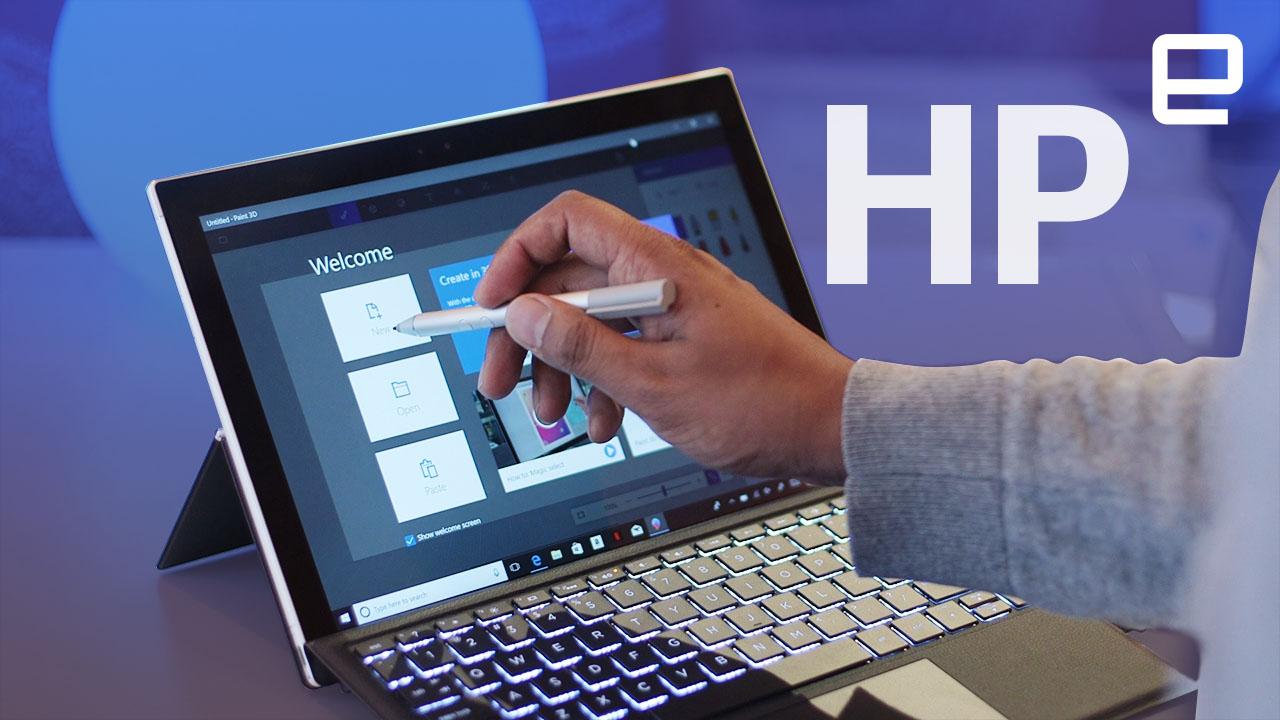
It turns out HP has another Envy x2 hybrid laptop coming this year, in addition to the Snapdragon-powered model it unveiled last month. As you’d expect, instead of a mobile chip, it features an Intel 7th-generation Core processor (a pity HP couldn’t fit in an 8th-generation chip) along with optional LTE connectivity. It’s more of a traditional Surface competitor for people who aren’t yet ready to adopt a Snapdragon chip for their computing needs. And based on what we’ve seen, it’ll offer up some worthy competition to Microsoft’s machines.

It’s tough to tell the Intel-powered Envy x2 apart from its Snapdragon sibling. They both feature 12.3-inch 1080p screens, and well, they look like Surface clones. The big difference between the two is how their included keyboard cases connect to their screens. This model relies on an origami-like fold to prop up the tablet portion, like the iPad Pro, while the Snapdragon version houses an articulating kickstand. Honestly, that’s the one I prefer by a mile. Angling a screen to your liking is simply much more convenient than being stuck with one position.
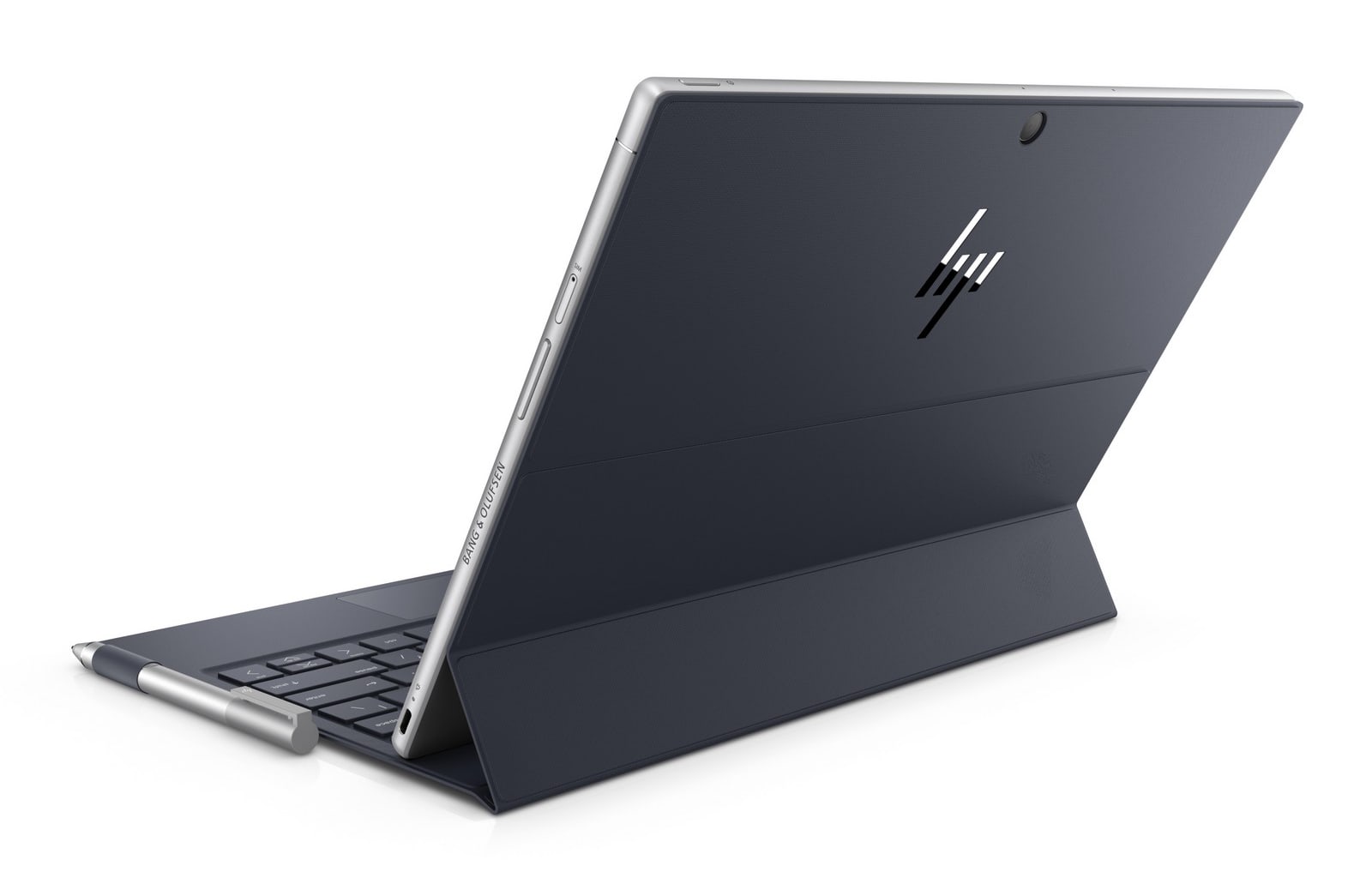
The Intel Envy x2 is also slightly heavier, weighing in at 1.65 pounds, compared to 1.54 pounds with the mobile-powered version. That’s not a hugely noticeable difference, and it still puts the new x2 slightly under the Surface Pro 4’s 1.73-pound weight. It features a fanless design, so it won’t get noisy once you get working, and includes a 13 megapixel rear camera and a 5MP front-facing camera. There aren’t many surprises with its hardware: It comes with HP’s Digital pen, and HP promises 15 hours of battery life. Notably, the company claims you’ll be able to charge it up to 90 percent in just 90 minutes.
In my brief time with the Envy x2, it felt like a fairly straightforward hybrid PC. The tablet feels sturdy and well made, and the keyboard had a satisfying amount of travel. And, surprisingly enough, it didn’t feel that much different from the Snapdragon-powered x2 when I held each in one hand. My biggest gripe is with its keyboard stand. It’s not very flexible, and, as usual with these types of cases, I had a lot of trouble getting the origami fold to hold up the tablet. It’s simply more trouble than it’s worth. That case design also makes it tough to hold the Intel Envy x2 on your lap, something that’s at least possible with the Snapdragon model.
HP isn’t divulging pricing on the Envy x2 yet, but you can expect it to appear in the spring. It seems like a decent hybrid, but I’m hoping HP offers up some alternatives to that wonky keyboard case.
Click here to catch up on the latest news from CES 2018.
Alexa is coming to Windows 10 PCs from HP, ASUS and others
Amazon’s Alexa recently arrived on headphones and even toilets, but it’s about to become much more ubiquitous by hitting Windows 10 PCs later this year. HP, ASUS and Acer have revealed that the voice assistant is coming to various models, including ASUS’s ZenBook and VivoBook lineup, the HP Pavilion Wave, and select Acer Spin, Swift, Switch and Aspire notebooks. Amazon will release a special Alexa app in the spring, and laptop builders are tapping Intel’s Smart Sound tech to make sure that the app can pick up your voice when you’re not right next to your PC.
“Hands-free access to Alexa on PCs can be helpful to customers in many ways, like making it simple to interact with your smart home, get news or weather, set timers, and more,” Amazon Alexa VP Steve Rabuchin said in a statement.
In August, Amazon and Microsoft unveiled a surprise alliance with the aim of integrating their respective Alexa and Cortana voice assistants by the end of 2017. The companies obviously missed that deadline, and the new Alexa Windows 10 app isn’t part of that. Instead, Amazon is working on a separate app that will let you access information in much the same way you do on Echo and third-party devices.

HP’s Pavilion Wave, one of the PCs that will have Alexa, looks more like a smart speaker than a PC. However, it will also appear on more classic laptop models from Acer (like the Switch, above), ASUS and other companies.
Unlike with other Alexa integrations, Alexa on PCs will be able to show on-screen, as well as tell you about the information you requested. However, some current Alexa features — like controlling security cameras and other smart home features, messaging and calling, Spotify and Amazon Video — won’t be available at launch.
Amazon and Alexa are in pitched battle over their respective Alexa and Assistant apps, with both companies trying to get them into as many cars, smart speakers, hubs, headphones, smartphones and other devices as possible. For example, Google recently announced an Assistant alliance with lock-maker Schlage, and Alexa is appearing in a Bluetooth car charger. Google does have one leg up with its Assistant: Its available in many more countries (in Europe and elsewhere) than Alexa.
Amazon hasn’t set an exact date for the release of the app, and it’s unclear so far if it will work on any old Windows 10 PC. Hopefully we’ll learn more details as the big CES 2018 show goes on.
Click here to catch up on the latest news from CES 2018.

