


SanDisk’s tiny 1TB USB-C stick is the perfect smartphone upgrade
There’s a kind of weird pleasure to be derived from the ever-shrinking size of data storage. Sandisk’s latest prototype at CES 2018 continues the company’s tradition of space crunching, with a one-terabyte USB-C dongle for your next laptop, tablet or Android phone. And, well, what else can I say? Compared to existing, sometimes bigger USB-C storage, it’s adorably petite, even at this early stage. However, there’s no word on when it’ll appear in stores — and how much it’ll cost. I’d just caution any enthusiasm with the point that this could well be another gadget that’s easy to lose.
Click here to catch up on the latest news from CES 2018.
Rokid’s AR glasses are janky as hell, but they have to start somewhere
Rokid’s AR glasses aren’t ready for public consumption, but the company is releasing them this year anyway. Rokid is an AI company based in China and it’s made a name for itself building smart home products, but its latest gadget is a pair of frames that aim to be the AR glasses of our sci-fi dreams. Right now, however, their functionality is limited.
The Rokid glasses respond to basic hand gestures like sliding tiles of a menu left and right simply by swiping the air, or selecting one by making a fist. The images appear in the upper-right corner of the lenses, superimposed over the real world. The images are clear enough to read the bold, basic text on them, but they’re far from high-def. The coolest thing Rokid’s lenses can do at the moment is facial recognition, with contact information appearing for any face you’ve programmed in. For now, that’s about it.
The Rokid glasses are more streamlined than a complete headset like HoloLens or even the Magic Leap One, but they’re still decidedly bulky. They run on batteries and have an internal processor, and support Bluetooth and Wi-Fi. The demo version Rokid is showing off at CES is larger than the model that’ll be available to the public later this year, though the frames overall still scream “there’s high-tech in here.” However, they’re a good starting point — and that’s exactly what Rokid wants.
In releasing the glasses when they’re still in prototype form, Rokid hopes to open-source development of apps and collect data on how people actually use the AR functionality. From there, the company plans to improve the design of future models.
Click here to catch up on the latest news from CES 2018.
Intel’s quantum computing efforts take a major step forward
It’s been almost three months since Intel announced a 17-qubit superconducting chip, meant to pave the way for a future powered by quantum computers. Today at CES, Intel CEO Brian Krzanich showed off its latest superconducting test chip, the 49-qubit “Tangle Lake.”
Off the bat, let’s be clear: quantum computing is still quite theoretical, and it’s estimated that we’ll need to over a million qubits to have something viable. Dr. Michael Mayberry, corporate vice president and managing director of Intel Labs, predicts it will be “five to seven years” before the industry even begins to tackle the problems of engineering such vastly complex chips.

In addition to working on superconducting qubits, Intel is also investing in “spin qubits,” a relatively new development which requires (bear with us) quantum control of the electron and the nuclear spin of a single atom in silicon. The benefit of spin qubit chips is they should be much smaller than the superconducting chips. Intel is obviously an expert in silicon, and it’s already developed a way to fabricate spin qubits on its 300nm process — a far larger, less-refined tech than we see in modern chips.
All of these efforts then, are baby steps along the way to a true quantum computing. Intel isn’t the only one pursuing this goal — IBM happens to have a giant 50-qubit quantum computer hanging around at CES — and the competition between tech giants to own this next generation of computing can only make it come faster.
Click here to catch up on the latest news from CES 2018.
Linksys unveils a cheaper version of its WiFi mesh router
Last year at CES, router specialist Linksys revealed its take on home mesh networking. Each tri-band ‘Velop’ tower could serve as a router, range extender, access point and bridge, giving you ultra-fast connectivity in every corner of your home. The only problem? They were fairly expensive — not everyone wants to spend $500 on a three-node bundle. If you fall into this camp, fear not — Velop is working on a cheaper, but slower dual-band mesh system too. The new towers are slightly smaller and will work with any tri-band module you might have already purchased. Bingo.
To get into the nitty-gritty for a moment — each node is a Dual-Band AC 2×2 802.11ac Wave 2 with MU-MIMO radio configuration, delivering combined speeds of up to 1300 Mbps. You can monitor your network through a companion app or by using a selection of custom Velop Alexa skills.
I was able to get up close with the new dual-band nodes at CES. They look, well, just like the old ones — plain and plastic, with few annoying lights and logos. That’s probably for the best, however — most people (myself included) would prefer their router to be as inconspicuous as possible, especially if there are five of them dotted around their home. The dual-band system will be available globally this spring, though unfortunately Linksys is staying tight-lipped about the pricing. A spokesperson for the company promised me, however, that each node would be “more than half the price” of its tri-band equivalent. Make of that what you will.

Click here to catch up on the latest news from CES 2018.
Makeblock’s Codey Rocky wants to be your kid’s cute coding robot friend
Makeblock, a maker of Lego-compatible electronic blocks to teach kids how to code, has ventured into robotics. At CES 2018, it’s showing off the Codey Rocky, a cute little robot that serves to be your coding companion. It boasts easy to-use robotics hardware plus a graphical programming interface so even your precocious little six-year-old can get started on her engineering career.
The face of the Codey Rocky is comprised of blue LEDs that light up to look a bit like pixel-based art. Underneath are three buttons labeled A, B and C respectively, plus a speaker. The overall construction is made out of a high gloss plastic and the wheel portion of it is comprised of army tank-like treads. What’s especially cool is that there’s a module on the back that shares the same pogo pins as the rest of the Makeblock lineup, so you can easily attach it to not just Makeblock materials but also standard Lego bricks.
Ah, but the Codey Rocky is not just a robot. Snap the detachable face out of its wheel base and it becomes a handy controller which you can use to play games. The controller — nicknamed Codey — also happens to be the brains of the operation, as it includes more than 10 electronic modules with which you can control with code. You can make it happy or angry, or to just vibrate when you tap its side. To add even more excitement to your coding adventure, the Codey has a 6-axis gyroscope that you can manipulate by moving or tilting your controller.
In order to program the Codey Rocky, you will drag and drop colored blocks into a friendly graphical user interface. When the kids get older and more advanced, those basic coding skills can then transition to coding actual languages like Python.
Makeblock hopes to retail the Codey Blocky close to $100, but before it can do that, it needs to be backed through Kickstarter. That shouldn’t be a problem though, as it’s already met its $100,000 goal (and then some) with around 1,065 backers at the time of this writing. If you do want to get one at a discounted price, you best back it now, as the Kickstarter has only 18 more days to go.
Source: Kickstarter (Codey Rocky)
Sony Aibo first impressions: old robot dog, new tricks
Sony revived its robodog series late last year, offering a limited first run of next-generation Aibos for keen Japanese fans. Despite a killer $1,800 price-tag, the company apparently sold plenty, and those preordered Aibos are finally on their way to their new owners. Finally, the company has brought the new robotic pet out of Japan, and while I could coo in Aibo’s general direction, unfortunately no petting was allowed. Regardless, it was disarmingly cute.

The dog dunderstood a handful of English-language directions, including hand-shaking and commands to sit. The revived Aibo has cute, glassy OLED eyes and a camera inside its nose, which can act as a webcam for your home when you’re away. The robopup contains a quad-core CPU, built-in LTE and WiFi, as well as motors and gyroscopes to augment the 22 different articulated parts. It has speaker for robotic yips and yaps and four microphones to pick up voice commands — something it was capable of doing despite the noise of a packed Sony press event.
Multiple touch-sensitive zones on Aibo’s back, front and head ensured the robot visibly reacted to the Sony-approved robodog handlers, but I’m more interested to see how the robot dog behaves once it learns to differentiate between owners. According to Sony spokesman, your Aibo will begin to learn which humans give the best snuggles, or at least whoever pets it the most.
Dogs may be man’s best friend but Aibo won’t be yours unless you give it some love — no matter how much you paid for it.
Merge is the closest thing we have to an AR Nerf gun
The folks at Merge picked a fitting name for their augmented-reality company, considering that their latest product combines the fun of Nerf guns with the fantasy of first-person shooters. The 6DoF Blaster is a lightweight plastic gun with four clickable buttons, including the trigger, and a space for a smartphone to rest horizontally across its top. The game plays out on the screen, with players ducking, walking and shooting as if the action were taking place in the real world.
The game Merge is showing off for the 6DoF Blaster looks a lot like Superhot, and it’s a lot of fun. Players shoot neon robots in a simplistic 3D environment, and the extra buttons allow them to zoom in, slow down time and reload in an instant. It plays seamlessly, following crouching and walking movements just fine. Think of it like a Nerf gun, but without the mess of squishy bullets to pick up when the fun is done.
The 6DoF Blaster will cost about $30 when it’s available this summer (in a few different colors, no less). Merge plans to open up the entire ecosystem to outside developers and see what kinds of experiences they come up with. The iPhone version of the demo game is built in Apple’s ARKit, which is also open to developers, though there’s also an Android version.
In addition to that, Merge also launched its “Cube” last year, a $15 device that uses a smartphone to create holographic, augmented-reality effects. If you point your smartphone at it, for example, you can use an anatomy app to explore different parts of the human body, such as the brain or lungs. Combined with the 6DoF Blaster, Merge aims to create an AR platform for a wide range of genres, including education.

The Merge Cube
Edgar Alvarez contributed to this report.
Click here to catch up on the latest news from CES 2018.
Plex’s plan to serve all media will soon include podcasts
After adding new features like live TV and DVR (with automated commercial removal), news and Android Auto support over the last year, we didn’t see anything brand new from Plex during tonight’s CES event. However, soon the streaming platform will add another new element as it tries to cover all media users consume across devices: podcasts. We spoke to co-founder Scott Olechowski who explained that when it launches, users won’t need a server, and as you’d expect with Plex, it will sync access across devices like desktop and mobile. “Where it makes sense” you can expect downloads for offline listening as well.
What could come next, however, is the integration of podcasts with other media users access on Plex, like TV shows and movies. For example, if you get deep into a new show, it could suggest the official podcast, a fan ‘cast or even a related online video series. By working with content creators to add their shows directly to Plex, it could make its platform even more interesting. TechCrunch mentions that it’s in the “early stages” of talks about license its software to companies that sell combo TV tuner/antennas, which could also extend its reach.
Click here to catch up on the latest news from CES 2018.
Foreo’s UFO is a vibrating puck that makes facial sheet masks better
Skincare company Foreo is adding a bit of tech into a beloved pampering ritual with its new UFO and UFO Mini devices. The company is calling these smart masks, and UFO stands for “Ur Future Obsession” — both of which are sort of misnomers. The UFOs are more like palm-sized pucks that vibrate, similar to the Neutrogena Wave cleansers. You attach a mini sheet mask, which Foreo is selling at $9.99 for seven, and rub the device all over your face. During this, the UFO is going through a preset cycle — heating up for 30 seconds, followed by a period of vibrating, and finishing with 30 seconds of cooling down.
There are benefits to having these extras when applying a sheet mask — the heat opens up your skin’s pores to help you better absorb the juicy goodness. A light ring on the UFO also glows red, green and blue to signal whether you’re in the heat, vibrate or cool phases respectively. But they also offer other benefits. The red light is supposed to stimulate collagen production to counter signs of aging, the green brightens a dull complexion while the blue is supposed to fight bacteria and promote blood circulation. According to Foreo, anyway.
After I tried out a 90-second facial on half of my made-up face, I did notice a lot less residue left on my face compared to what I typically see after a 20-minute mask. This makes me think that the heat did help my skin absorb more of the mask, but it could also be the fact that the UFO’s sheet is so much smaller than a traditional mask. It’s also easier to ensure that areas on my face that are not always covered by sheet masks, like the corners of my nose and around my mouth, got some mask goodness. Beyond that, I couldn’t tell if there was much of a difference in results from using UFO compared to my usual sheet masks.
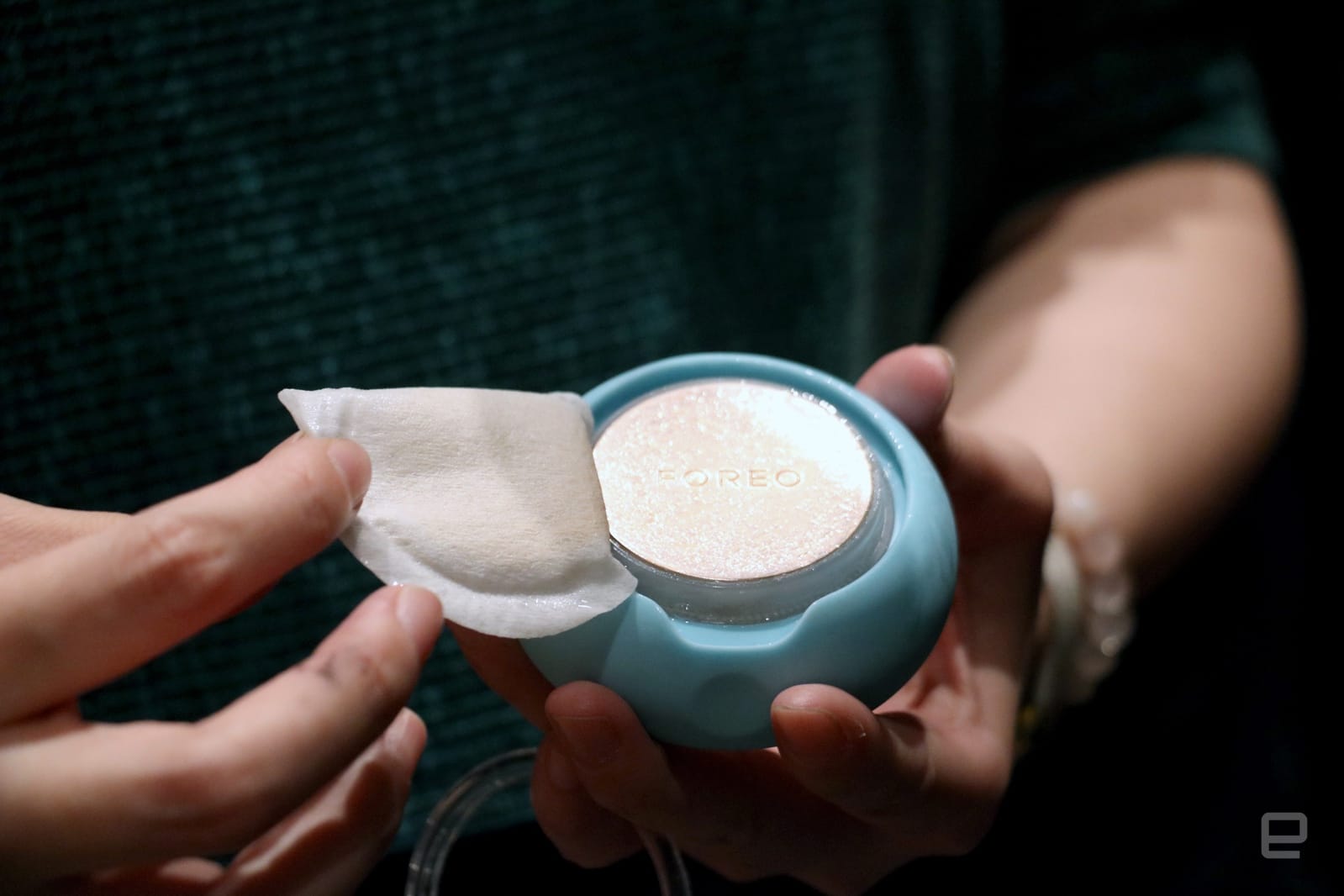
Still, the whole experience was immensely comfortable. The UFO will only go up to 120 degrees Fahrenheit and down to 40 degrees, so your skin won’t get scorched. I thought that having to rub the device all over my face would be troublesome, but since it’s only for 90 seconds, I wasn’t too bothered. I think the only reason to pick a traditional sheet mask over the UFO is if you’re feeling extremely lazy and want to put on a mask, lay down and not have to physically exert yourself at all.
The UFO’s battery should last for up to two weeks on a charge if you’re using it twice daily. Foreo is offering morning and nighttime masks at launch, with preset cycles catered to each. The UFO costs $279, while the Mini, which doesn’t have the cooling capability, is $179. That’s not money that I want to spend unless I know it will truly improve my complexion, but others might like the entire UFO pampering experience.
Click here to catch up on the latest news from CES 2018.
Putting Alexa inside a pair of smartglasses makes a lot of sense
Vuzix has been a regular at CES for years, crafting head-mounted displays and smartglasses often aimed at businesses — or very enthused wearable fans. The Vuzix Blade, its latest pair of augmented reality spectacles tries to balance that B2B / consumer sales pitch by adding a voice assistant. Amazon Alexa’s newest home is a pair of smartglasses.
Firstly, the crush of a CES evening show is never the best place to test out a voice assistant: you need a strong connection to make her receptive to your requests. So, pretty much all my Alexa queries fell on deaf robot ears.
Fortunately, the Blade worked in every other way — and most of us know how Alexa works by now, so I’m giving it the benefit of the doubt. A Vuzix spokesmen reiterated that the smartglasses work with every Alexa skill open to developers. If you can do it with a smart speaker, then you can do it with these.
The Blade has one advantage over your audio-only Echo speaker, however. In typical Vuzix fashion, there’s a floating screen running Android, offering visual assistance to your voice commands. Ask for directions, and the Blade smartglasses will show you the way. This is where the business uses shine too: with an AR app, a fictional engineer look at a broken circuit board, get the glasses to identify what’s wrong, and order the parts immediately through Amazon.
Here at CES, I was wearing prototype hardware on sale to developers. It’s a cool $1,800 for these, and the hardware is a little uncomfortable on the nose after a few minutes. Fortunately, the final version is expected to cost a nudge over half of that: $1,000.
Yes, of course an Echo Dot is still way, way cheaper, but Vuzix’s Blade demonstrates that Amazon Alexa has the potential to turn into something far more than a tech curio that gathers dust somewhere in your living room.
Click here to catch up on the latest news from CES 2018.

