


Lead Google Duo engineer teases group calls, web app, and more
Group calls in Duo might finally be a thing.
Although it still isn’t quite as popular as Apple FaceTime, Google Duo has quickly become one of the best video/audio calling apps around. Google’s pushed out regular updates to the app since its debut less than two years ago, and Duo’s lead engineer recently teased a few upcoming features we could see later in the year.

On January 9, Justin Uberti posted a Tweet promoting Duo video calls on Google’s new Smart Displays and said it was “time to kick off our 2018 Google Duo roadmap.” One user then replied asking Uberti if there was a chance Duo would get a web app, support for Chrome OS, group calls, and improved audio quality.
Uberti’s response?
Yes
— Justin Uberti (@juberti) January 9, 2018
It’s possible that all of these are things in the works for Duo, but then again, there’s a chance that Uberti and his team are only working on one or two of these things. Support for group calls is what I’d like to see the most, but you won’t find me complaining if all these things are added throughout 2018.
Of these features, which one would you like to see added to Duo?
Allo and Duo Head of Product leaves Google for Facebook
It’s not just you: The Philips Hue update system is overwhelmed today
It turns out these smart bulbs are kinda popular.

Philips used CES as a perfect opportunity to drop a big feature update into its app today, but in order to use that app all of the bulbs in your home need to also be updated. This isn’t usually a big deal, but because so many people are trying to update their Hue bulbs today the servers at Philips are a little overwhelmed.
Long story short, it’s going to be a little while before you get access to this new feature. If you’re not excited about constantly checking the update screen in the Hue app until the update is finally ready, Philips has a solution for you.

It’s not enabled by default because a random blinking light in your home is disconcerting, but Philips offers the ability to silently auto-update your bulbs when an update is available. You can pick a specific time to have these updates installed, and doing so makes it possible for the update to be downloaded to the hub during non-peak times. Here’s how that works:
Open the Hue app.
Tap on the Settings gear at the top right of the navigation strip.
Scroll down and select Software update.
Scroll to the middle of the page and tap Automatic update.
Tap the switch to enable Automatic update.
Set a time for when the Automatic update will occur
This isn’t going to get you the update today. This background update will check in with Philips in the next 24 hours, and pull the update down when it is available. Once that update is at your Bridge, the update will be installed on your bulbs at the time you selected.
Here’s hoping next time Philips is a little better prepared for everyone to want their Hue update as soon as a new feature is announced.
LimeBike adds e-bicycles to its dockless sharing service
Renting and riding a bicycle from a dockless bike-sharing scheme can be tough work. The two-wheeled transporters are built to last, which means they often have thick, heavy frames and chunky tires. If you’re out of shape or intending to ride uphill, they can be a little off-putting. Thankfully, LimeBike has a solution — electric-assist bikes. The company unveiled the Lime-E today, a green machine with a rechargeable lithium battery and a 240-watt motor. It can help you reach speeds of 15 MPH and will, the company claims, adapt to your individual riding style too.
It’s still a hefty bicycle, however. At CES 2018, I was able to sit on the saddle and, for a moment, pretend I was gliding down the streets of San Francisco. (I would have ridden it for real, but a crowded convention hall didn’t feel particularly safe.) The motor is always-on and will kick in as soon as you’ve unlocked the bike. The battery is hot-swappable, though you can’t replace it yourself — LimeBike’s staff will be roaming around and refreshing batteries in between rides. If you’re interested, it’ll cost $1 to unlock and an additional $1 for every 15 minutes that you’re riding.

LimeBike operates in a bunch of US locations including Seattle, Miami, and the greater San Francisco bay area. (The company also expanded to Zurich and Frankfurt, its first European markets, last month.) The Lime-E will be added to the company’s existing fleet later this month — a useful differentiator, perhaps, from the countless other bike-rental services that have been popping up around the world. Electric-assist bikes aren’t for everyone, but if you want to be just a little healthier — while still getting around at a decent pace — this could be an option worth considering.
Click here to catch up on the latest news from CES 2018.
Source: LimeBike (Blog Post)
Lenovo’s Mirage Solo makes the case for standalone Daydream headsets
Last year, Google announced that it would be making standalone Daydream headsets with the help of HTC and Lenovo. While HTC might have bowed out of the agreement, Lenovo is definitely still in it, as we could already see from its FCC filing last month. Now, at CES 2018, we finally get to see it in person. Say hello to the Lenovo Mirage Solo, the first ever standalone Daydream headset. And I got to try it out.
As mentioned, instead of being powered by a phone or a PC, the Mirage Solo is an all-in-one device. It’s powered by a Qualcomm Snapdragon 835 processor, it has 4GB of RAM and 64GB of storage. There’s even an microSD card slot, which is handy if you have a VR camera and want to quickly check out what you’ve shot. You’ll need to wear headphones in order to hear audio — there’s no speakers here — but thankfully there’s a 3.5 mm headphone jack on the side.
It also has a 5.5-inch display with QHD resolution, which, yes, does produce really nice colors and produces sharp, clear, images. Yet, I did experience a slight screen door effect where the quality wasn’t quite as smooth as I had hoped, especially when watching videos. It’s definitely still better than most other phone-based VR headsets I’ve seen however, and there’s always a chance that Lenovo could tweak a few things prior to its launch to improve matters. There’s a really wide 110-degree field of view.
Importantly, the Mirage Solo is also the first Daydream headset that incorporates Google’s WorldSense technology that doesn’t require external cameras or sensors for positional tracking. Indeed, the Mirage Solo actually has six degrees of freedom, letting you dodge enemy fire and duck behind virtual barricades like you could with an Oculus Rift or a HTC Vive. Oh, and by the way? Dodging bullets is way easier when you don’t have to worry about tripping over a tethered cable. Another nice bonus of wearing a standalone headset instead of a phone-based one: you’ll never see those annoying text message notifications interrupt your gameplay.

While Google’s phone-based VR headset is small and lightweight, the Mirage Solo definitely isn’t. Measuring 8.03 by 10.61 by 7.08 inches and weighing in at 1.42 pounds, the headset will definitely take up serious footprint on your living room shelf. Instead of soft fabrics like the original Daydream headset, the Mirage Solo is constructed out of a high-quality plastic, with telescoping sides and quick-release buttons placed throughout for easier adjustability.
To wear the Solo, you put it on like a backwards baseball cap, placing the large brace-like shell around the top of your head. Then, you tighten it by turning a ratcheting wheel at the back. From there, you can adjust the goggles nearer or further away from you by hitting a button underneath the headset.
I thought it was pretty easy to put on, even while wearing my glasses. That said, I had to shift the headset around a few times so that it would fit nice and snug around my head. At first, I was a little afraid that I would ratchet it too tight and the headset would slip off my head, but I eventually got the hang of it.
You might think it would feel heavy on your head, but Lenovo has engineered the headset to be evenly load distributed so that the front of the headset doesn’t weigh you down. And I have to say that Lenovo did a pretty good job here — after the initial adjustment period, the headset felt pretty secure and didn’t feel too heavy at all, even as I was ducking and dodging around. What added to the comfort is the contoured padding along the insides of the headset. Truly, they felt luxurious.
As for battery life, it comes with a 4,000 mAh battery which Lenovo tells us should last you a solid seven hours of gameplay or video viewing before it needs to recharge. It comes with the standard Daydream controller as well. Lenovo also announced a VR180 Mirage Camera, which works really well with the Solo — just pop in the microSD card from the camera to view your very own VR content.
Though Lenovo wouldn’t confirm the Mirage Solo’s final price, it did say that it’ll cost under $400. That seems a little expensive, but bear in mind that you don’t need a phone or a PC to use it and it’s perhaps the cheapest 6DOF headset you can get. Availability is set for the second quarter of this year.
‘Blade Runner: Revelations’ is built for Lenovo’s new VR headset
The newly-launched Lenovo Mirage Solo is the first-ever standalone Daydream headset, so Google wants to make sure you’ve got stuff to do with it. Partnering with Alcon Media Group, it has unveiled Blade Runner: Revelations, a VR experience set in the Blade Runner universe. You’ll play the role of seasoned blade runner Harper solving the mystery behind some kind of replicant plot, using resources like a flying spinner, blaster and Esper image reconstruction.
The game is one of the first to take advantage of WorldSense, Google’s new position tracking tech that works without any external sensors. The game uses it to let you “duck, dodge and lean, and step backwards, forwards and side to side, unlocking new gameplay elements that bring the world of Blade Runner to life,” Alcon explains in a news release.
The Mirage Solo offers six degrees of freedom like with an Oculus Rift or HTC Vive, but with the added bonus of no cables to trip over or external sensors to worry about (you still need to be careful though, obviously). There’s also no need for a smartphone, which means no annoying notifications.
Blade Runner: Revelations was created by Seismic Studios, working with Google, and is “best experienced with the Lenovo Mirage Solo,” the studio says — hopefully, you can also play it on other Daydream headsets, though. Expect it to arrive sometime this spring at the same time around the new headset.
Google unveils point-and-shoot VR cameras from Lenovo and Yi
Last year at VidCon, YouTube CEO Susan Wojcicki revealed VR180, a new video format that just shows you stuff in front of you, rather than behind you. When viewed in a VR headset, the videos are especially immersive — think of it as a giant field of view that stretches wider and taller than your standard IMAX screen so much so you can actually feel like you’re in the room. But in order to watch such VR content, one also needs to create it. So at CES 2018, Google is partnering with Lenovo and Yi Technology to announce two new VR180 cameras: the Lenovo Mirage Daydream and the Yi Horizon VR180.
Both cameras are designed to essentially be point-and-shoot devices and, from my brief time with both of them, they look very much alike. They’re both slim, compact, with dual 13-megapixel fisheye lenses each, as well as a 2.2-inch touch screen on the back. The Mirage Camera comes in white while the Yi Horizon is clad in black. One interesting part about the Horizon is that the display flips around, so you can take a VR180 selfie.
They can both capture images, record video as well as livestream video directly to YouTube Live. The content can be viewed on a standard display of course, but it’s really meant to be used with a VR headset. And since these cameras have WiFi built-in, shipping those captured media files to Google Photos or YouTube is relatively easy. Both cameras work with Google’s VR180 companion app to upload and view content.
The Mirage Camera and the Yi Horizon are Google’s first VR180 cameras for the consumer market. There’s an existing Z Cam K1 Pro made for professionals, while companies like Panasonic and LG have signed on to release more VR180 cams in the future. Panasonic also announced recently that it’ll be building VR180 support into their GH5 cameras with an add-on.
As for price, well, they’re yet to be determined at this point. Lenovo did say that its camera will be priced under $400, and both cameras are set to ship later this year.
Honda reveals more details about its companion mobility robots
They’re really (mostly) real! At CES in Las Vegas on Tuesday, Honda officially debuted its four newest mobility and companionship robots, part of the company’s 3E (Empower, Experience, Empathy) program. Though they are currently only in the conceptual stage, Honda plans to develop the platforms with a variety of like-minded partners as part of the company’s “open innovation” approach.

First up, we’ve got the 3E-D18, an autonomous off-road vehicle designed for rugged applications — everything from backcountry search and rescue to agriculture — the more mundane and time-consuming, the better. Based on Honda’s existing ATV chassis, the D18 is expected to feature all-wheel drive and virtually indestructible airless tires, enabling it to scrabble over nearly any obstacle.

The 3E-C18 is more of a robotic pack mule, albeit less adventurous than the D18. Designed for indoor and outdoor use, the C18 can carry cargo as well as leverage machine learning to operate autonomously by observing how the humans around it behave.

Similarly, the 3E-B18 can operate indoors or out, but is built to carry more delicate items, like humans. The B18 is specifically designed to operate within tight pedestrian confines of modern city sidewalks and can be utilized to port everything from your luggage to your kids to yourself.

The 3E-A18 isn’t designed to carry your stuff so much as support your mental and emotional well-being — it’s a natural-built helper. Honda envisions the A18 serving in malls and airport, helping shoppers and travellers with directions and guidance, as well as understanding the needs of the people it’s interacting with and responding accordingly. And rather than a cold metallic shell, this robotic service animal will offer a soft, pliable skin and communicate using simple facial expressions.

And, not to be outdone by the likes of Tesla, Honda also showed off its vision for its Mobile Power Pack, a portable, rechargeable battery. These Power Packs can hold a 1kWh charge and be daisy-chained together to provide as much electricity as necessary for the job at hand — whether it’s an electric motorcycle, the D18 ATV, or the green energy-powered home of the future. And, since the Packs are hot-swappable, there’s no downtime when one runs out of juice. Just flip it out for a fresh battery and you’re good to go.
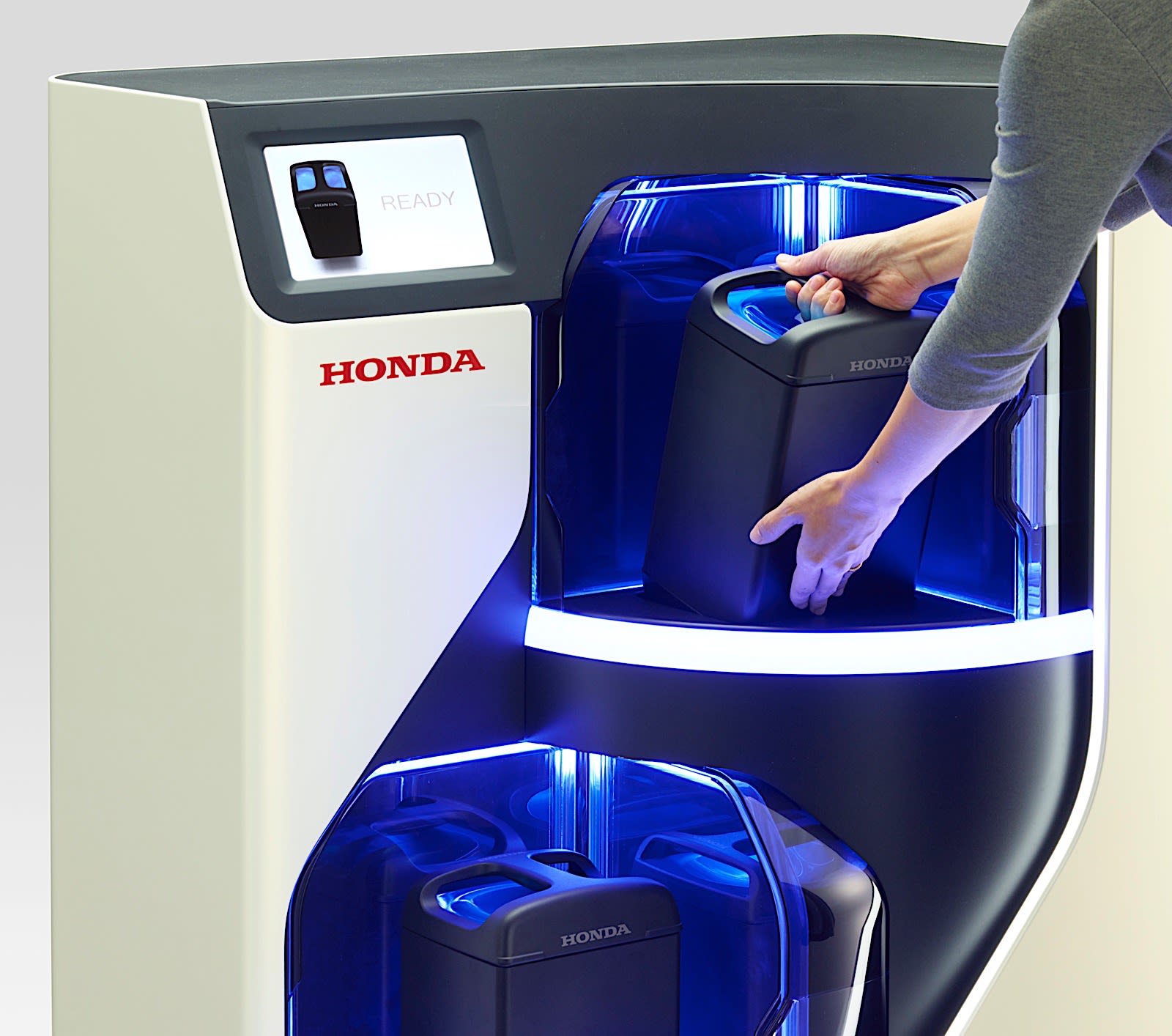 There isn’t even a real need to recharge the dead cells yourself. Honda envisions a future where you simply walk to an “Exchanger” on the corner and trade in your depleted Power Packs for freshly charged ones.
Click here to catch up on the latest news from CES 2018.
The Blocks modular smartwatch will always be a concept
It’s been several years since Blocks had its initial 15 minutes of fame, capturing the internet’s attention with the idea of a modular smartwatch. The first prototypes were about as rough and ready as they could feasibly get, but the public’s appetite for the ambitious product hadn’t waned by the time the crowdfunding campaign started over a year later. More than $1.6 million in pledges and another few years of development, and the Blocks smartwatch is kinda, finally here. But so much has changed in interim. Project Ara is dead, modularity isn’t the buzzword it once was, and we’ve gone from not knowing if we really need a smartphone accessory on our wrist to a saturated smartwatch market. But the founding fathers of Blocks still believe they have something unique to offer.
It’s at CES 2018, the biggest tech show of the year, that Blocks hopes to generate a renewed interest in its vision. The startup does actually have some news to share. It shipped its first, so-called “beta” units, to the most fervent of Kickstarter backers in 2017. But sub-par manufacturing caused Blocks to seek a new partner, and at the same time they switched from a Qualcomm chipset to the faster-clocked, quad-core MediaTek 6580M platform — restrictive and expensive licensing conditions inspired that particular move, I’m told. But now the product is up-to-scratch, and how the Blocks team first envisioned it. They are on track to deliver to all crowdfunding backers and to start shipping retailer pre-orders within the next few months. So, CES is being treated by them as, finally, the launch of Blocks.
The team is also currently working on updating their smartwatch OS to Android 8.0 Oreo, so customers can be treated to a faster, more battery-efficient software experience soon after receiving their device. The Blocks OS was originally developed by a company called Cronologics, helmed by ex-Googlers who built smartwatch software with regular Android as the backbone (Alexa support being one of their highlighted achievements). Android Wear, which the big G was focused on, didn’t allow the hardware access the Blocks team needed, modular components being key to the product and all. A little over a year ago, Cronologics was acquired by Google, bringing those rogue staff full circle and leaving Blocks to take over development.

The hardware itself was always the main USP of Blocks, though. While the “core,” as the team calls it, houses the brain, AMOLED touchscreen, battery, speaker and a few other key components, it’s the links that form the strap that provide all additional functionality. There’s a battery module for extra juice, a GPS/GLONASS module, and one that includes temperature, humidity and air pressure sensors, as well as an altimeter. There’s also a heart rate sensor, and an LED torch module. You can chop and change these, of course, perhaps opting only to attach the battery module and pairing that with a regular watch strap. Customization is great and all, but you can find the functionality these modules offer on countless other smartwatches already.
The Blocks squad is under no illusion they’ve got the next Apple Watch on their hands, or even close to a mass market product. Where they think they can fit, however, is in the niches everyone else isn’t. The plan is to target very specific use cases, and monopolize those customers. The biggest opportunities, they believe, will be with enterprise clients who have no use for an off-the-shelf product. A plant manager might want a smartwatch for workers that can provide precise indoor location information, incorporate a harmful gas sensor and a panic button. Maybe the watch can identify when a machine operator is tired or stressed and get them to switch out with a co-worker. This is where Blocks, as a hardware platform rather than just a watch, might shine.

Blocks has already had some interesting conversations around custom projects — even one about building a larger, collar-style device for racing camels that could relay real-time stats and physiological data. The team are developing a vein recognition module for biometric authentication, an NFC module (hello payments), an air quality sensor, a perspiration and stress monitor and a UV sensor. They are working with Flic, another crowdfunding success, to incorporate their smart button tech into a module, and a company called FlickTek for using Blocks as a gesture control device.
For Blocks, CES isn’t so much a stage for a product launch, but an announcement the platform is open for business. Now the core is out the door, the team is hoping to work with anyone and everyone to build new modules and explore new use cases. I’m told it won’t be long now until the SDK is matured to the point that developers can easily hack together new prototype links. Blocks wants to partner with companies and universities to bring new sensor tech to the watch, and for firms and academics to come to them with new ideas. And if it makes sense to commercialize, then they can tread that path together.

At the moment, Blocks doesn’t really differentiate itself from all the other, many smartwatch options out there, but now it’s about tapping unexplored potential. So even though the hardware the team originally promised is ready for delivery, they hope, in some ways, Blocks will always be a concept.
Click here to catch up on the latest news from CES 2018.
Lululab’s skincare assistant peers deep into your pores
Getting clearer, healthier skin could soon be as easy as taking a selfie. At CES 2018 in Las Vegas on Tuesday, Lulu Lab — a member of the Samsung-C accelerator program — showed off its novel skincare camera designed to capture and analyze facial features with a single picture.

Dubbed the Lumini, the system uses a multispectral camera to see below the surface of your skin and more accurately diagnose a variety of potential issues including wrinkles, acne, melasma, and pore size. AI software, running on a mobile device, then grades your face, highlights trouble spots and recommends skincare products to address them. The Lumini is being marketed for B2B and will be available at cosmetic counters worldwide starting this summer.
Click here to catch up on the latest news from CES 2018.
Sony’s totally wireless sports earbuds are surprisingly good
During last night’s press event, Sony revealed its latest sports earbuds with totally wireless and wireless models — two of which feature active noise cancellation. Now that CES is officially open, I stopped by the company’s booth to try out the in-ears that interest me most: the totally wireless WF-SP700N. After a few minutes of listening, I was quite impressed.
Over the last year or so, the number of true wireless earbuds has increased exponentially. New companies are popping up all the time with the devices and most of the big names in audio have announced models of their own. In fact, Sony debuted its WF-1000X back at IFA, but the WF-SP700N that’s here at CES has the sporty treatment. This includes IPX4 rating that protects the tiny audio devices from sweat and moisture at the gym or during a run. In fact, Sony claims it’s the first to put active noise cancellation in a pair of water-resistant true wireless sports earbuds.
Like a few of Sony’s other audio gadgets, the WF-SP700N features an ambient sound mode, so you can let a bit of outside noise in while you’re listening to that Yacht Rock playlist on Spotify. And like most other totally wireless earbuds, the company includes a charging case that can offer two full charges or a 15-minute quick charge. Should you need the latter, Sony says 15 minutes will give you up to 70 minutes of listening time. When fully charged, expect up to three hours of battery life at a time with the WF-SP700N and nine hours total when you factor in the case. That’s on the lower end of what I’ve seen recently with most companies claiming around five hours of playback on a single charge.
After a few minutes listening to the earbuds, I came away quite impressed by the audio quality. The WF-SP700N has punchy highs and a solid amount of bass that’s not overpowering. I’ve found these true wireless devices tend to lack a healthy dose of base a lot of the time, but I’m happy to report that’s not the case here. The bass is slightly better on the Bose SoundSport Free I’ve been using for a while now, but that model is also a bit more expensive. I’ll take a bit less low-end tone for the $70 difference.
Like most of what Sony announces at CES, the company says the WF-SP700N will ship this spring. When it does, expect your choice of white, black, yellow and rose gold/gray color options when you’re ready to part with $180 to grab a pair. That’s not a bad price considering some totally wireless earbuds cost $250 or more.
Click here to catch up on the latest news from CES 2018.
 AIVAnet