


Amazon’s flop of a phone made newer, better hardware possible
Amazon devices have taken root in our homes with almost alarming speed, but the tech giant hasn’t gotten everything right. Back in 2014, Amazon released the Fire Phone, an ambitious smartphone that remains the company’s biggest hardware flop to date. The comapany has never confirmed how many Fire Phones it sold, but considering Amazon took a $170 million write-down in October of that year, it’s fair to say the device bombed.
While the Fire Phone was a punchline and a commercial failure, it did lead to good things — eventually. In a conversation with Engadget at CES, Sandeep Gupta, Amazon’s Technical Program Manager for Fire TV, suggested that the teams and processes built to make the Fire Phone reality also made possible the impressive hardware ecosystem we now see.
“Building the phone was sort of a trial by fire,” Gupta said before groaning at his pun. “It was a very intense product, and we learned so much. And the teams we built from the Fire Phone have helped seed a lot of the other teams. You’ll see people on the Echo team, the TV team, the tablet team who got their start on the Phone team.”
If Amazon’s teams learned a lot, it’s because they needed to achieve a lot. The Fire Phone wasn’t Amazon’s first hardware project; a handful of Kindles came before, not to mention a few Fire tablets and Fire TV set-top boxes. But the Phone presented fresh technical challenges for Amazon to grapple with.
“The phone is, without a doubt, one of the hardest working hardware products you can build,” Gupta said. “They’re very compact. You’ve got antennas, you’ve got an ecosystem, you’ve got an app store, you’ve got content services, you’ve got the whole kit and caboodle.”
It didn’t help that the Fire Phone was designed to be more complex than rival smartphones from the get-go. Four front-facing sensors tried to track the motion of user’s heads so some of the images that appeared on-screen would move with them. And since the Fire Phone was intended to be a kind of concierge for Amazon’s massive online store, we got Firefly: a feature that allowed people to scan everyday objects around them for identification and eventual purchase. That’s one hell of an undertaking, but Amazon powered through despite a relative lack of experience.
Along the way, Gupta says, Amazon was forced to figure out the intricacies of small-scale hardware design, not to mention more efficient ways to work with chipset vendors and manufacturers. Amazon also had countless other questions to answer. How do you define your product? What are the milestones in development to work toward? While the answers to those questions weren’t complete, they were enough to prepare Amazon to do better in the future.
“The engineering excellence was there,” Gupta said. “That’s what continued to flow through the organization and allowed us to get to where we are.”
If Amazon had learned those lessons sooner, the Fire Phone might not have turned out the way it did. Still, even though it languished on store shelves, the Fire Phone itself wasn’t a bad device. The hardware was expensive but functional. The software was overly ambitious, but it was impressive when it worked. Amazon (perhaps wisely) decided not to use its refined understanding of the development process to build another phone, but Gupta is adamant that the company’s “trial by fire” made subsequent devices like the Echos and the improved Fire TVs better.
“We took those learnings and now we’ve been able to apply them to a lot of the other products we’re building,” Gupta said. “And sometimes you learn what to do by learning what not to do.”
Click here to catch up on the latest news from CES 2018.
New bill seeks to ban Huawei from any US government contracts
Mere days since Huawei lost a deal with AT&T to sell its flagship phones in the US due to security concerns, the Chinese tech company faces a new challenge to its US expansion plans. Congress has just proposed a bill that prohibits any government agency from working with Huawei (and another Chinese tech firm, ZTE). The bill, titled H. R. 4747: “Defending U.S. Government Communications Act,” cites several intelligence reports that these telecommunications companies are “subject to state influence.”
The bill references a 2011 report from the United States China Commission alleging Chinese governmental influence upon Huawei and other companies, a 2013 statement by General Michael Hayden of the CIA and NSA that the telecom company had shared sensitive information with the Chinese state and a 2015 FBI report that reiterated a concern that the Chinese government would be able to access US business communications via Huawei technology. In 2017, says the bill, ZTE Corporation pled guilty to illegally shipping US-origin items to Iran, a violation of the International Emergency Economic Powers Act. As a result of this and other assertions, the bill seeks to prohibit the use or procurement of any telecommunications equipment or services from the two companies as a “substantial or essential component of any system, or as critical technology as part of any system.”
As noted by TechCrunch, the bill still needs to be approved by the Committee on Oversight and Government Reform, then passed to the House floor for a vote. If the bill succeeds there, it will be sent along to the Senate, and eventually the President for a signature before it could become law.
Via: TechCrunch
Source: US Congress
Bathrooms are getting smarter, for better or worse
Getting up from the toilet after a satisfying bowel movement, you walk right over to the sink and start washing your hands. “Alexa, flush my toilet,” you say while reaching for your toothbrush. Your mirror starts displaying your schedule for the day, the weather update and latest news. Suddenly, there’s a ping — your toilet has detected an anomaly in your stool and recommends you increase your fiber intake. A dispenser built into your medicine cabinet whirs and spits out a fiber supplement.
The futuristic bathroom I just described isn’t that far away from becoming reality. In fact, at CES 2018, Kohler unveiled a new addition to its toilets and shower devices that let you ask Amazon’s Alexa to assist you. Moen also added Alexa support to its smart shower line, promising Siri compatibility is on its way. Smart mirrors that tell you your daily agenda while assessing your complexion have already been available for months, too.
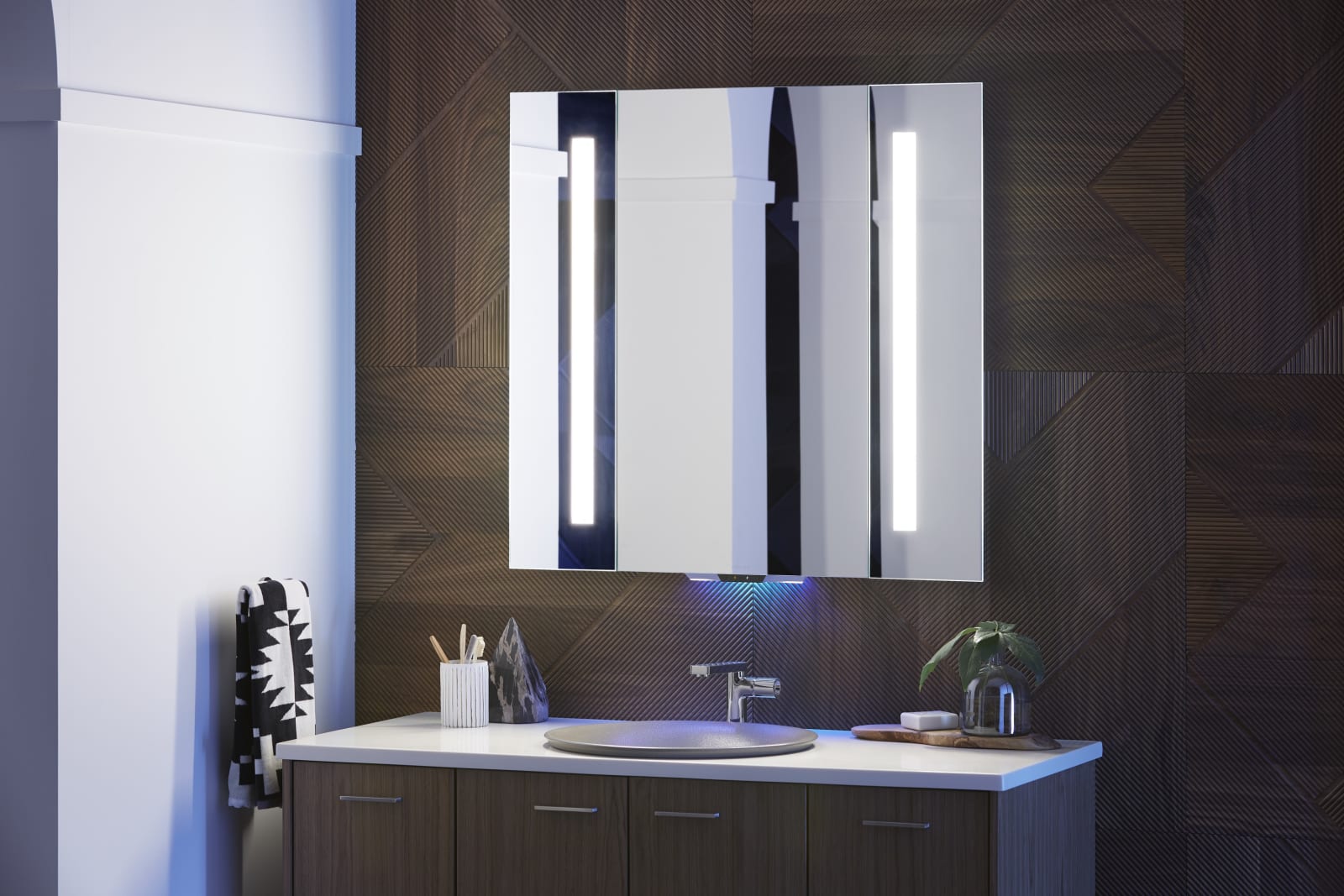
It’s a little strange to tell someone to flush your toilet for you — it feels oddly intimate and lazy. But there are benefits to having such an option. Germaphobes can avoid touching surfaces potentially covered in bacteria, while those who have limited use of their hands due to injury or disability have a convenient alternative. Of course, there are other hands-free methods for flushing, like motion sensors or foot flushes. So having a conversation with your toilet just feels unnecessary.
That’s why Kohler is less interested in you talking to your bath fixtures than it is in taking advantage of Alexa’s tendrils snaking throughout your home. For example, you could ask an Echo in your kitchen to run a bath while you finish the dishes. The new Perfect Fill Tub would then automatically turn the faucet on, adjust the temperature to your preference and turn off when the water was just right. When you’re washing up the dishes after dinner, you can tell Alexa to get your bath ready, so you don’t have to actually go turn on the tap and monitor the water temperature yourself.
Moen, on the other hand, provides Alexa as a complement to its existing U by Moen connected bathroom system, which is mostly controlled by an in-shower panel. Using the voice assistant in the shower would be tricky, since the sound of water spraying all over could potentially confuse Alexa.

Smart home companies believe there’s plenty of room for more technology in the toilet. Abbie Byrom, director of global partnerships at Samsung SmartThings, said there is potential for the bathroom to be a way to glean insights into a person’s health. Future toilets could tell if a woman is pregnant, not only saving her a possibly embarrassing run to the pharmacy, but also alerting the more-oblivious to their situation.
But the idea of a toilet that analyzes and potentially collects information on your waste feels even more invasive than a voice-controlled flush. Although it’s not meant to replace a visit to your doctor, there are still myriad concerns around privacy and accuracy that make it unlikely that we’ll see a poop-analyzing toilet anytime soon.
Not only would companies have to ensure compliance with HIPAA guidelines that protect a person’s medical data from being shared with others, they would also have to defend their networks and servers against exploits that could leak this sensitive data to the public. Plus, each new device you introduce presents another potential access point for anyone trying to harvest your data, whether it is the smart mirror’s camera that scans your face or the radio that sends your data from your weighing scale to your phone.

Byrom also suggested that there could be connected medicine dispensers in the bathroom that remind the elderly (or just plain forgetful) to take their pills. Again, smart pill bottles that ping you to take your medicine already exist, but if this technology is already built into your medicine cabinet, it saves you the trouble of having to buy another device.
The good news is, major companies in both the smart home and toilet industries agree it’s important to respect the sanctity of the bathroom, where we are often at our most exposed and vulnerable. “It’s a place where we begin and end our day. It’s such a personal space,” said Tony Hang, district sales manager for Toto.
The challenge, then, is to make sure that the push of smart home technology into the bathroom isn’t just about adding technology for technology’s sake. Instead, it’s imperative that companies are thoughtful about how and why these features are being implemented. For now, it’s clear the industry is just dipping its toes into digitizing our bathrooms, but it’s likely to dive in deeper soon.
Click here to catch up on the latest news from CES 2018.
Bitcoin was briefly legal tender at KFC Canada
Say what you will about its heart-stoppingly tasty chicken — KFC is willing to get weird. Whether it’s a zany VR cooking experience, suggesting orders based on your face or chicken-flavored nail polish, the chain has pulled its share of stunts over the years. Now it’s letting customers in Canada pay with bitcoin for a limited time…so long as they only order a new crypto-themed meal bucket.
The Bitcoin Bucket, which includes 10 tenders, waffle fries, a side, some gravy and a pair of dips, costs however much of the cryptocurrency you can get for $20 Canadian. As the joke goes, that’s equivalent to 0.001167 bitcoin at the time I type this, but that could swing wildly by the time this post is published — and again by the time you read it. Given bitcoin’s meteoric rise, however, buying chicken with that fraction of currency now could mean forfeiting value if the cryptocurrency’s value skyrockets higher.
The point might be moot since the Bitcoin Bucket is sold out on KFC’s website with no indication it will go on sale later, so don’t go mortgaging your house to scoop up more of the cryptocurrency just yet.
Via: Motherboard
Source: Colonel & Co (KFC Canada)
Prototype satellite makes way for 4K ‘Earth observation’
British company Earth-i confirmed the successful launch of a prototype satellite earlier today. Called the CARBONITE-2, it’s an early test version of a planned constellation (the Vivid-i) that will be the first network bringing full color, full motion video from Earth’s orbit.
The prototype satellite has a UHD camera aboard, which will be able to capture high-res images of locations anywhere on Earth, as well as record up to two minutes of video similar to Urthecast. It’s just the first step for Earth-i, though; the company plans to use CARBONITE-2 to prove that its tech is viable, as well as demonstrate what the eventual group of satellites can do. The company has already ordered its next five satellites in the Vivid-i constellation.
“The launch of VividX2 is a significant next development of Earth-i’s constellation, and welcomed by ESA,” said Josef Aschbacher, the director of Earth observation programmes at the European Space Agency. “The Vivid-i Constellation will provide capabilities we haven’t seen before including full-colour video, and an assured stream of high-quality data from space to help improve both our planet and our lives on Earth.”
The CARBONITE-2 launched on the Polar Satellite Launch Vehicle, from the Sriharikota rocket launch center in southeast India. It was one of 31 payloads aboard the rocket and was the first launch for the PSLV after it suffered a payload fairing error last August.
Sample video from an earlier prototype, CARBONITE-1, shows satellite video of traffic on a highway in Dubai:
Source: Earth-i, SSTL
Major League Soccer is creating its own FIFA eSports league
There’s a new eSports organization in town. In partnership with EA Sports, Major League Soccer is launching eMLS — an eSports league in which 19 of the 23 MLS clubs will select a competitor to represent them. Those gamers will compete in the eMLS Cup, which will take place during PAX East in April, and the winner will then go on to the FIFA 18 Global Series and have a chance to play in the FIFA eWorld Cup.
Introducing #eMLS. See #FIFA18 competitors representing @MLS clubs compete to win the #eMLSCup 🏆 on the road to the #FIFAeWorldCup. Learn more ➡️ https://t.co/akT972Fhwf pic.twitter.com/wIWo17WXne
— EA SPORTS FIFA (@EASPORTSFIFA) January 12, 2018
MLS clubs will only be able to send one gamer to represent them in eMLS events and, as Polygon reports, it’s not yet clear if they will receive the same benefits and salaries that NBA 2K League or Overwatch League players do. The future of eMLS is also not set in stone just yet as eMLS is currently only set up for FIFA 18.
Having professional gamers represent their teams is becoming more and more popular for soccer clubs. Clubs like VFL Wolfsburg, Manchester City and West Ham United have signed professional gamers in the past as did New York City FC last year.
Gary Stevenson, president of MLS Business Ventures, said in a statement, “This step forward into competitive gaming is a key component in our partnership with EA Sports to promote deeper engagement and connections between MLS supporters and the millions of FIFA players around the world.”
Source: eMLS
63 games and apps on Google Play served porn ads
If you still haven’t made it a habit to inspect Google Play applications before installing them, then maybe this will make you rethink your ways. Security firm Check Point has discovered a new malicious code hiding inside 63 games and apps on Google Play — a malicious code the company dubbed “AdultSwine” that served porn ads, to be exact. Check Point said the rogue applications were targeted towards kids, but a Google spokesperson told Engadget that they were more for the general audience. Google also clarified that they weren’t part of its vetted list under the Designed for Families Program, but it’s not that hard to imagine children downloading random games they find on the Play store.
Based on a user’s review on one of the apps, AdultSwine has been around since November, and a closer look revealed that it can do more than show inappropriate advertisements. When you launch one of its host apps — you can see the full list here — the code sends info back to its server, which chooses between three actions to take. In addition to serving porn ads, it could also display fake malware notifications designed to fool you into installing a security app that’s loaded with actual malware. Or, to trick you into registering for premium services charged to your account.
Thankfully, Google has quickly collaborated with Check Point to pull the host apps off the Play store. The big G also disabled the developers’ accounts and will issue what it says are “strong warnings” to users who installed the 63 apps. And there are lots of them, since the applications were downloaded between 3 million and 7 million times.
Google has systems in place meant to prevent apps with shady programs like these from making it to the Play Store and into people’s phones. This isn’t the first time those systems didn’t work, but the fact that the host apps were something kids would download makes this scheme extra egregious.
Via: The Financial Times
Source: Check Point (1), (2)
Bezos family donates $33 million to Dreamers scholarship program
A number of tech companies and executives have voiced support of the Deferred Action for Childhood Arrivals (DACA) program. But Amazon CEO Jeff Bezos and his wife MacKenzie have just given $33 million in support to DACA recipients, also known as Dreamers. The two just donated the money to TheDream.US, which provides scholarships to Dreamers, and their donation will give 1,000 DACA recipients money to attend college. It’s the largest donation in history of TheDream.US. “My dad came to the US when he was 16 as part of Operation Pedro Pan,” Jeff Bezos said in a statement. “He landed in this country alone and unable to speak English. With a lot of grit and determination — and the help of some remarkable organizations in Delaware — my dad became an outstanding citizen, and he continues to give back to the country that he feels blessed him in so many ways. MacKenzie and I are honored to be able to help today’s Dreamers by funding these scholarships.”
Prior to President Trump’s decision to remove DACA protections in September, hundreds of CEOs, including Bezos, signed a letter asking him to keep the program intact and many voiced their disappointment when the president decided to end protections. In October, companies such as Google, Facebook and Amazon said they would lobby Congress to pass DACA protection legislation and in November, over 100 companies filed an amicus brief in support of plaintiffs aiming to reinstate DACA protections.
Dreamers receiving aid from TheDream.US get $33,000 in scholarships spread out over four years. “Our students are highly motivated and determined to succeed in college and in life. We’re a three-and-a-half-year-old program, so we don’t yet have graduation rates,” said the organization’s president, Candy Marshall, in a statement. “But our scholars are thriving academically. 94% return to their college after the first year; the national average is 72%. We expect a 75% graduation rate.”
Source: TheDream.US
Toyota insists its e-Palette is more than a concept car
There’s one thing that keeps Toyota CEO Akio Toyoda up at night. It’s not a traditional car company like Honda, Ford or Nissan. Or what he’s going to have for breakfast the next day. It’s technology juggernauts like Facebook, Google and Apple and what might happen when they decide to enter the automotive industry proper. Will the company be ready? Is it doing enough to stay ahead of a potential broadside from Silicon Valley? The answer, Toyoda believes, is to morph Toyota into a data and smart mobility company. One that’s less about selling cars and trucks and more about moving people, products and services in the most efficient way possible.
At the forefront of this change is the e-Palette, a fully autonomous electric vehicle with a deceptively simple design. It is, at its core, a box with eight wheels. The interior can be empty or filled with seats, screens or shelves. Toyota thinks it could be used for mass transit, parcel deliveries and temporary accommodation — maybe all three on the same day, provided the furniture is easy enough to swap out. And there’s no steering wheel, pedals or gearshift to worry about: The vehicle will be completely driverless. It is, in short, a blank slate for urban transportation.
At the heart of the e-Palette is the Mobility Services Platform (MSPF), a software layer that Toyota is developing for a seemingly inevitable future in which nobody owns a car. With MSPF, drivers can request and unlock a vehicle with their smartphone. On the back end, Toyota has fleet-management tools, so any company — it could be Toyota itself or a company that owns a bunch of its vehicles — can keep tabs on its driverless army remotely. Bryce Merckling, who works on mobility services at Toyota Connected, calls the e-Palette the “physical manifestation” of MSPF.
“It’s the platform for the platform, essentially,” he said.

To build e-Palette, though, Toyota needs some help. Amazon, Uber, Mazda, Pizza Hut and Chinese Uber rival Didi Chuxing have all agreed to form an “alliance” that will help Toyota take the project from ambitious concept to real-world vehicle. These partners are the sort of companies that might ultimately buy or lease the e-Palette on city streets. Pizza Hut could use a few to ferry deep pans around Chicago. Amazon might want a hundred to carry parcels between its enormous warehouses. They each have needs, questions and ideas that Toyota wants to hear to ensure the vehicle is a hit.
“Instead of trying to force something on them,” Merckling explained, “we wanted to work with them from the get-go.”
Each partner has an area of expertise to bring to the project. Uber, for instance, is the king of ride-sharing at the moment and has its own self-driving pilots under way. Amazon is an e-commerce titan that delivers a small country’s worth of parcels every day. And Pizza Hut? Well, Pizza Hut delivers pizza — and people like pizza. “We just wanted to be involved with partners that we thought were really important,” Merckling explained.
Amazon and Uber, surprisingly, are happy to be working with each other. Normally they’re competitors (both have food-delivery services, for instance), but here their needs are aligned: Both want an autonomous, electric vehicle to move things around. Toyota has also promised to keep the e-Palette “open.” That means Uber should, in theory, be able to plug its own autonomous-driving software into the MSPF and keep a crucial edge over its ride-hailing rivals. “That was a big deal for them,” Merckling said.
At the moment, Toyota is planning to build the e-Palette in three sizes: small, medium and large. They’re all the same width and height — only the length varies between vehicles. Merckling stressed, though, that this could change in the future. In fact, almost everything about the project could change as Toyota consults further with the e-Palette alliance. The company isn’t sure, for instance, what its final business model will be. It could sell the pods to companies or have a fleet that businesses are able to dynamically hire, customize and then return throughout the day. “Right now we’re open to everything,” Merckling said.
There are challenges ahead. EV batteries, for instance, need to improve or the fleet will struggle to keep up with demand. Citizens and companies will request them — but all the pods will be stuck at chargers or unable to reach their final destination. To solve the problem, Toyota is working on flatter, higher-density “prismatic” batteries with Panasonic. “Further evolution, in terms of performance, price and safety, and the securing of stable supply capacity, are pressing issues,” Toyoda said when the pair announced their partnership last month.

Toyota also needs to think about public safety and how the e-Palette fits into public policy around the world. Legislators are slowly preparing for a future with autonomous cars. However, with its multipurpose design, the e-Palette is quite different from the average Tesla. Toyota has, however, already won the support of one city. It plans to run the e-Palette alongside other mobility solutions during the 2020 Olympic and Paralympic Games in Tokyo. “Toyada-san is very ambitious,” Merckling said. “He always has been. So when he gives a deadline like that, he really wants to meet it. He’s not just throwing something out there for fun.”
Toyota hopes to have trials in North America and Europe shortly after the games. A full commercial launch is, of course, a long way off. But the company is hell-bent on bringing the e-Palette concept to life. “It’s going to be a fun challenge,” Merckling added. “We don’t want this to be a concept vehicle that’s shown off one time and then it’s gone. We actually want to develop this and have it on the road.” If Toyota can do that while keeping its original vision intact, it will be the CEOs of Facebook and Apple, rather than Toyoda, who are kept up at night.
Click here to catch up on the latest news from CES 2018.
The best mice of CES 2018
If you’re in the market for a new mouse to dominate opponents or simply wow your co-workers, the Consumer Electronics Show is a great place to see what is coming soon.
Here we list the best mice at CES 2018, all of which target the PC gamer. Manufacturers range from Cooler Master to Mad Catz to Razer, some of which provide their own take on Logitech’s wireless charging solution that hit the market in early 2017.
Cooler Master MM830
Highlights
Hidden D-pad buttons
RGB illumination
Built-in OLED screen
Sensitivity up to 24,000DPI
Pixart 3360 optical sensor
Release date: Q2 or Q3 2018
Price: TBD
Cooler Master’s upcoming mouse is unique because it includes a “hidden” D-pad under the thumb consisting of four, low-profile buttons. Perfect for MMOs and MOBA games, your thumb will never need to leave the surface as it maneuvers to all four buttons: Just “rock” your thumb up, down, left, or right for actuation. These buttons are configurable through the company’s desktop utility.
In addition to assigning D-pad commands, the software can be used to assign functions to the wheel, customize the RGB illumination, and set the DPI levels ranging up to 24,000 dots per inch. The “durable” PBT chassis also plays host to a built-in OLED screen with a 96 x 94 resolution so you can add a team logo or unique design directly to the mouse itself. This screen is presumably programmable through Cooler Master’s desktop software.
 AIVAnet