


Azio’s Retro Classic keyboard is luxurious, but imperfect
Read this site for long enough and you’ll know I have a crazy love for ostentatious mechanical keyboards. The madder the design, and the louder its keys, the more I’m enthralled, and Azio’s latest offering is a real doozy. The Retro Classic is a USB or Bluetooth-equipped input device styled to make a steampunk faint in admiration. And even though I have no particular affiliation for that lifestyle, I love having it on my desk.
The first thing to say about the Retro Classic is that it looks like it was built in the 1920s by a coterie of cloth-hatted civil engineers. If you’re looking for something quiet and lightweight, this is the opposite, weighing in at a divinely heavy four pounds, clad in zinc aluminum with either a gunmetal or copper top. It’s sufficiently hefty that I’d be tempted to use it in self-defence against an armed burglar. There are four chunky rubber feet below the keyboard itself and the back two can be twisted to lift it up.
As the name implies, the Retro Classic is modeled after vintage typewriters with a mechanical hammer action. The switches in this case are produced by Kailh, aping the style and technology of the more well-known Cherry MX. Purists prefer the latter for serious, heavy-duty eSports, but Kailh’s switches will do for pretty much everyone else. There’s an excellent amount of travel and resistance, and a beautifully loud click when you reach the bottom of each key.
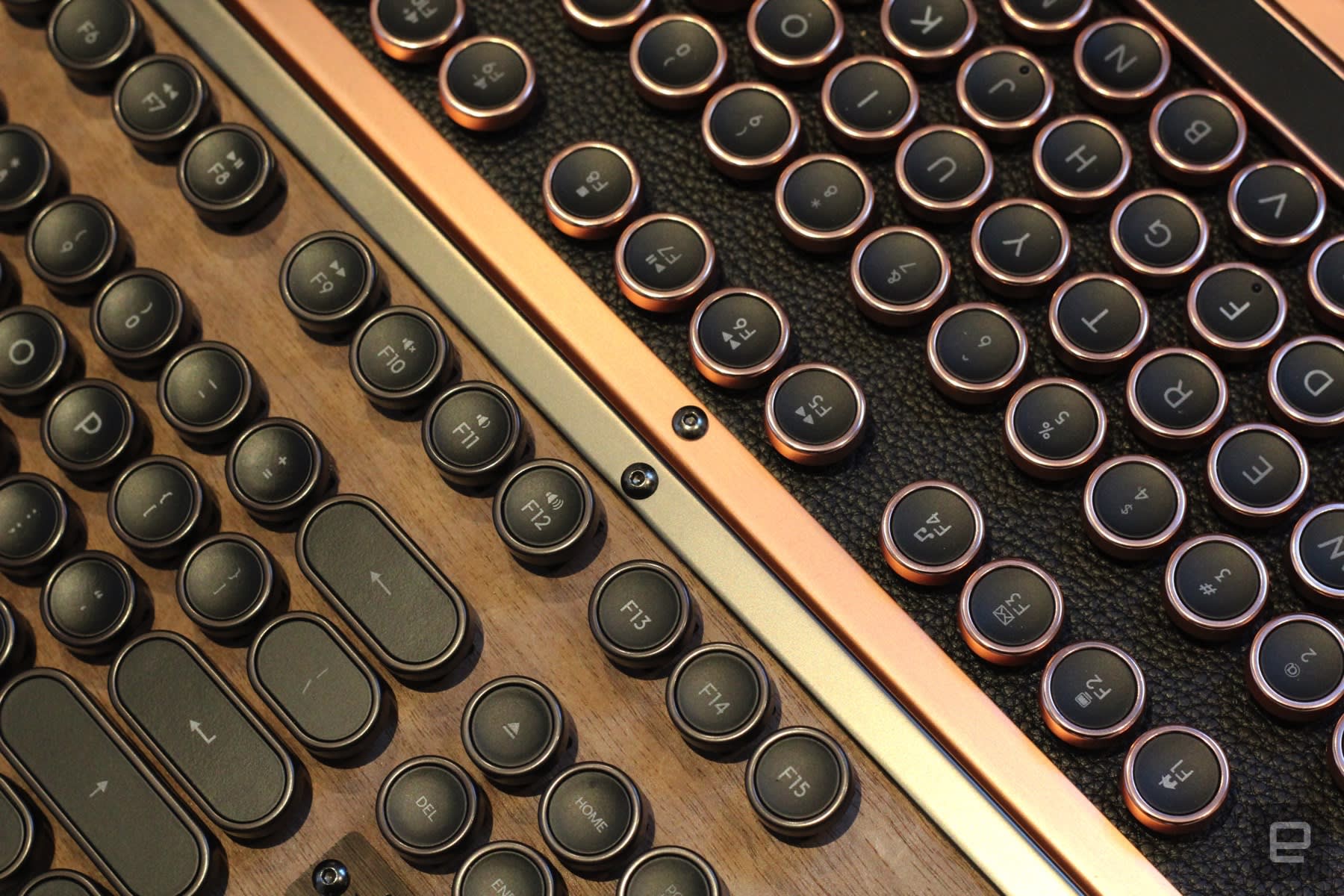
The custom-made semi-transparent keycaps are rounded and spaced a couple of millimeters from one another, tighter than comparable old-timey keyboards. The tradeoff between space and compactness is always the amount of errors you’re likely to make. And certainly, the learning curve is steep if you’re coming from another keyboard, but it’s nothing too egregious. In the first week or so of testing, the worst thing I did was hit the keyxap next top the one I wantedf.
Speaking of the keycaps, the unit comes set up for a Windows PC, so if you’re looking to run it with OS X, you’ll need to set aside 10 minutes. A bag of OS X-related keys are included in the packaging, along with a cleaning cloth, and you’ll be tasked with pulling off the existing caps. Fortunately, the keys can be pulled off pretty easily and pushed back on without the need of an additional tool or any sweat.

One of the big selling points for the Retro Classic is the use of natural wood and leather in its construction. The look, feel and smell of this thing is amazing, especially the Artisan with its leather topper. In fact, everything about this keyboard screams luxury, including its six-foot-long USB A to USB C cable: a godsend if you’re rocking a standing desk.
If I have a niggle or two, and of course I do, it’s that I have a sense Azio narrowly missed its chance of making my perfect keyboard. The keycaps are just a little bit too flimsy for a product as ostensibly premium as this one, and that’s a problem. The same goes for the screen-printed letters above the status lights in the top right-hand corner. The choice of serif font and the way it’s been applied is totally inconsistent with the sans-serif letters on the keys themselves. And it’s details like that which matter when you’re spending more than two benjamins on a keyboard.

Azio is selling the Retro Classic for $220, or $190 for the wired-only version. Having one of these on your desk is a delight, and it’s a keyboard that makes you more considered about how you type, and what you’re typing. I feel distinctly more hip having it on my desk, and it’s fortunate nobody checked my hip quota before sending it over.
But like all luxury keyboards, it’s a conversation piece, something that’s distinctly nice to have, rather than something that’s essential. You can pick up a decent keyboard for $10 — but this is the thing you buy when you’re making a statement. Do you need it? No, never. Do you want it? Of course you do, and it’s a joy to type with as well. It’s the same logic that applies to a first-class plane ticket or those limited-edition kicks you waited all night to buy. The question in all those scenarios is the same: Do you have that sort of money to burn?
DroNet’s neural network teaches UAVs to navigate city streets
Scientists from ETH Zurich are training drones how to navigate city streets by having them study things that already know how: cars and bicycles. The software being used is called DroNet, and it’s a convolutional neural network. Meaning, it learns to fly and navigate by flying and navigating. The scientists collected their own training data by strapping GoPros to cars and bikes, and rode around Zurich in addition to tapping publicly available videos on Github. So far, the drones have learned enough to not cross into oncoming traffic and to avoid obstacles like traffic pylons and pedestrians.
To achieve this, DroNet produces a pair of outputs from each frame of reference, a steering angle and a collision probability. The software doesn’t require much computing power, and also doesn’t need any GPUs (no need to pause your cryptocurrency mining), so it can be applied to a variety of UAVs, even palm-sized nano drones. As you’ll see in the video below, the results at this point are pretty impressive. The drones are even able to navigate indoor spaces like office buildings and parking garages as well — perfect for delivering packages — with no training data.
Speaking to IEEE Spectrum, University of Zurich’s Professor Scaramuzza said not to get too excited just yet. For starters, the drone’s motion and prediction abilities are constrained to a constant height and the neural network hasn’t been integrated with exploration tasks. So, it sounds like using a DroNet-equipped UAV on a search-and-rescue mission in the woods might not be feasible at the moment.
The end goal? Drones that can fly around and navigate “exactly” like birds do, according to Scaramuzza. Let’s hope Boston Dynamics doesn’t catch wind of this.
Via: IEEE Spectrum
Source: ETH Zurich
Amazon Treasure Trucks are hawking their wares at Whole Foods
Amazon’s attempts to pitch its own brand at Whole Foods will clearly extend well beyond pop-up stores. The internet retailer has announced that its deal-serving Treasure Trucks are starting to appear at “various” Whole Foods Market stores across the US, giving you a chance to pick up discounted products (ordered through the Amazon mobile app) while you’re shopping for produce. This isn’t just about advertising Amazon, though.
The January 30th introductory offer is an Instant Pot pressure cooker. Rather appropriate for a Whole Foods location, don’t you think? However, you’ll also receive a coupon for $10 off $40 a Whole Foods purchase as well as recipes from Nom Nom Paleo writer Michelle Tam. As such, this is more about creating a harmonious link between Amazon and Whole Foods than promoting one or the other.
There’s no mention as to if or when the truck appearances will wind down. We’ve asked Amazon for more details about the campaign. It wouldn’t be shocking if these continued indefinitely, mind you. Amazon wants to remind everyone that it owns Whole Foods, and it will likely drive that point home as long as it can.
Source: Amazon
Get a glimpse of Netflix’s latest sci-fi movie, ‘Mute’
February will hopefully be rewarding for sci-fi fans who subscribe to Netflix. In addition to Altered Carbon’s debut this week, later in the month we’ll finally get a peek at director Duncan Jones’ Mute. The movie has been floating around for about as long as Jones has been a filmmaker (he previously directed Moon, Source Code and Warcraft), and now we finally have a look at it. The movie follows a mute bartender caught up in a jam, and features as much neon, mustachioed Paul Rudd and as many flying cars as you’d hope. If this was enough to stoke your curiosity, the movie premieres February 23rd.
Source: Netflix (YouTube)
The state of solar installers after Trump’s tariff
Two days after President Donald Trump signed hefty tariffs on imported solar panels, a five-man team was hauling slabs of them up the outside of a brownstone in Brooklyn’s Sunset Park.
In below-freezing January winds, they set up steel tilt racks on the roof to hold 16 panels and wired the system to a solar inverter, making the power usable in the house and able to feed back into the electrical grid. The team from Brooklyn SolarWorks, an installation company with 21 full-time employees, finished the job around sunset.
The contract cost about $27,000. But James Luria, a media consultant who has only owned the house for six months, expects to pay around $3,000 for the installation. “It was the obvious thing to do,” Luria said.
Among the reasons for the cut price: a 30 percent federal tax credit, 25 percent New York state credit, 20 percent off property tax in New York City and a net-metering policy that allows homes to sell their excess solar power back to the grid. While the incentives vary across states, places like California, Massachusetts and South Carolina have made solar increasingly attractive for individual homeowners as much as corporations, and the average cost of a solar installation has dropped more than 70 percent since 2010. New York aims to have 50 percent of the state’s energy come from renewables by 2030.
This rapid growth and promise of a rosy future is part of the reason for the concern over Trump’s recent tariffs. The 30 percent markup on solar cells from overseas — which ultimately falls to 15 percent over the next four years — could lead to a net loss of 23,000 American jobs, according to the Solar Energy Industry Association. Analysts at GTM Research predict an 11 percent reduction in panel installations over the next half decade while Bloomberg reports that installation costs will increase 3 percent for residences, 4.4 percent for commercial projects and nearly 9 percent for utility-scale facilities like solar farms.
The tariffs also reflect how the burgeoning solar market in the US — and the energy industry as a whole — is tied to government policies that can easily swing a company’s or consumer’s decision to invest in renewables. Even in December, an industry report found that “political uncertainty” including the threat of tariffs was responsible for a decline in installations.
“Utilities are the last natural monopoly — or at least formerly natural monopoly — in the country, and that by necessity provides a lot of regulation,” said Evan Dube, senior director of public policy at Sunrun, a national solar company. “In general, when you’re dealing with energy, you’re dealing with this regulatory environment.”
“There is no question that policy is a very important part of what we do,” said Dan Whitten, a spokesman for the Solar Energy Industries Association. However, he added, “The money we spend on lobbying is a drop in the bucket compared to other industries.”

According to the nonprofit Solar Foundation, there are more than 260,000 jobs in the solar industry, a 178 percent growth since 2010. The vast majority of those jobs are not in manufacturing panels but in the labor surrounding the equipment — solar panel installer is set to be the fastest-growing job in the US over the next decade. Companies that handle electrical work, construct supports for solar panels and carry out repairs are the core of the business in the US and therefore the companies that will be most affected by tariffs.
Those are companies like Brooklyn SolarWorks, the outfit behind last week’s brownstone installation, which started three years ago. CEO T.R. Ludwig said that because the industry relies heavily on incentives, it develops in fits and starts (he calls it the solar coaster). His company, which also specializes in rooftop solar “canopies” on stilts, is “barely” profitable, he said. Nearly all of his panels come from overseas makers like South Korea’s LG, and he took a loan to secure $250,000 worth of them at the end of 2017, anticipating the tariffs.
“This is a trade case, about manufacturing, but the way solar has gotten its toehold is that these panels don’t install themselves. There’s a whole apparatus around these panels,” he said. “If this makes the projects more expensive and there’s that many less projects being green-lighted, that’s going to have a real effect on the jobs for these people.”
Jessica Baldwin, the president of six-person New York installation company Solar Plumbing Design, said she was more concerned with the winding down of the federal tax credits starting in 2020 (by 2023 the residential credit will disappear while commercial and utility credits remain at 10 percent) and potential changes to net metering in New York. “I’d say the tariff is the least of the problems,” she said.
Incentives are designed to jump-start an industry while companies drive costs down, not sustain those companies forever. But shifts in energy policy affect customer decisions to switch to solar and, therefore, valuable jobs in the industry.
Take Nevada, with its thousands of square miles of desert. At the end of 2015, state regulators scrapped net metering in the state. Major solar companies Vivint, Sunrun and SolarCity subsequently pulled out of the state, and around 2,600 jobs vanished. Eighteen months later, the state legislature allowed customers to sell their electricity back to the grid again.
While solar is on the frontier of energy technology, its installation jobs are essentially manual labor. “It’s a construction job,” said Ludwig, whose company pays its installers between $18 and $35 per hour, without them necessarily needing experience in the solar industry before joining.
Michael Lawrence, for instance, was the on-site electrician at the recent Brooklyn roof installation. With a background in construction, he has moved from Pennsylvania to Connecticut and now New York, chasing gigs wherever the government incentives are strongest. “It’s been nonstop work the whole time,” he said. He’s now been in solar for nearly a decade.
Pinterest hires Google computer vision expert to sort your Pins
Pinterest is very committed to improving its search technology through AI — so committed, in fact, that it just hired one of the foremost experts in the field. The social network has announced that it’s recruiting Chuck Rosenberg, Google’s AI vision research leader, to become its Head of Computer Vision. He spent just shy of 14 years at Google and was responsible for a number of major AI-related efforts, including the first large deployment of an image-focused deep learning network.
The exact nature of what Rosenberg is doing is under wraps, to no one’s surprise, but he’s expected to guide engineers as they craft “large-scale” object detection algorithms. Before Google, he worked at HP Labs and was one of iRobot’s earliest employees.
While it might seem odd for Rosenberg to switch employers while Google is still pushing the boundaries of AI, it’s easy to see why Pinterest would want to reel him in. He’s joining right as the company’s AI-based image recognition is hitting its stride — there are now over 300 million visual searches every month, or a 70 percent increase compared to a year earlier. Rosenberg could prove instrumental to keeping that momentum going, and could make Pinterest indispensable the next time you need to find a recipe or choose an outfit.
Source: Pinterest
Google credits AI for stopping more rogue Android apps in 2017
Google likes to boast of its ability to shut down Android malware, and it apparently has good reason to brag about 2017. The company took down over 700,000 apps that violated Play Stores policies last year (a 70 percent increase over 2016), and it was considerably better at pulling rogue apps in time to avoid infections. Thanks to a slew of new machine learning techniques, it caught 99 percent of apps with “abusive contents” before anyone had installed them.
It credits Google Play Protect for one of the biggest improvements: its ability to spot extremely harmful apps that commit fraud, steal info or allow hijacks. While there weren’t many of them, the mechanism reduced the number of installations by an “order of magnitude” over 2016, Google said. It added that it took down over 250,000 copycat apps (those trying to piggyback off the success of popular apps) and “tens of thousands” of apps violating policies against apps that feature hate speech, illegal acts and porn.
Google is fully aware that its system isn’t foolproof, and that some apps will still slip through the cracks. The improvements do make a better case for sticking to Google Play for app downloads when you can, though.
Of course, it’s important to stress that this is just one part of the Android security puzzle, and that there are lingering issues that may be difficult or impossible to completely address. Although Google Play Services helps make Protect and other security measures available across a wide range of Android versions, it’s still true that most Android phones aren’t running recent editions of the operating system. If there’s a fix that requires a newer OS, you’re stuck.
And remember, many Android users in China and elsewhere don’t have access to the Play Store. They have to go through third-party outlets, some of which have poor malware screening. There’s only so much Google can do to help when offering the Play Store in China would involve censorship and other compromises, but that still leaves a large chunk of the Android world in a more vulnerable position.
Source: Google
FCC: Officer behind Hawaii false missle alert thought it was real
The FCC has published the preliminary findings of its investigation into Hawaii’s false missile alert, and it suggests that the story didn’t play out as you might have heard. Where initial reports claimed the Hawaii Emergency Management Agency officer who triggered the mass panic clicked on the real alert by mistake, the FCC said the officer fully intended to click it — because they’d misinterpeted a mangled message. Reportedly, the midnight shift supervisor had played a standard recording that included both the usual “exercise, exercise, exercise” language and the text from a real Emergency Alert System message, which includes “this is not a drill.” Although other officers saw this was a drill, the one who clicked the alert was convinced it was real.
The rest of the report is more predictable. The FCC cited both “inadequate safeguards” for false alerts and a “lack of preparation” for the event of a false alarm. It notified the state governor, Pacific Command and Honolulu police almost immediately, but its outreach to others was thwarted by congested phone lines. It didn’t decide to broadcast the corrective emergency alerts until about 20 minutes after the false alarm, and another 18 minutes after that to actually send it.
Hawaii has already taken steps to prevent future gaffes, and the FCC expects to make its own recommendations with its final report.
The report comes right as the FCC has made changes to how Wireless Emergency Alerts work. Carriers will have to deliver “more geographically precise” alerts, with no more than an 0.1-mile overshoot, as of November 30th 2019. Companies will also have to let you keep alerts for 24 hours (or until you delete them) so that you can revisit them if necessary. While this wouldn’t have affected the Hawaii incident, it could prevent some unnecessary alerts. It could also reduce the risk of desensitizing the public — you don’t want to miss a life-or-death alert because you’ve received one too many irrelevant warnings.
Source: FCC (PDF 1), (2)
What Trump means when he talks nukes at the State of the Union
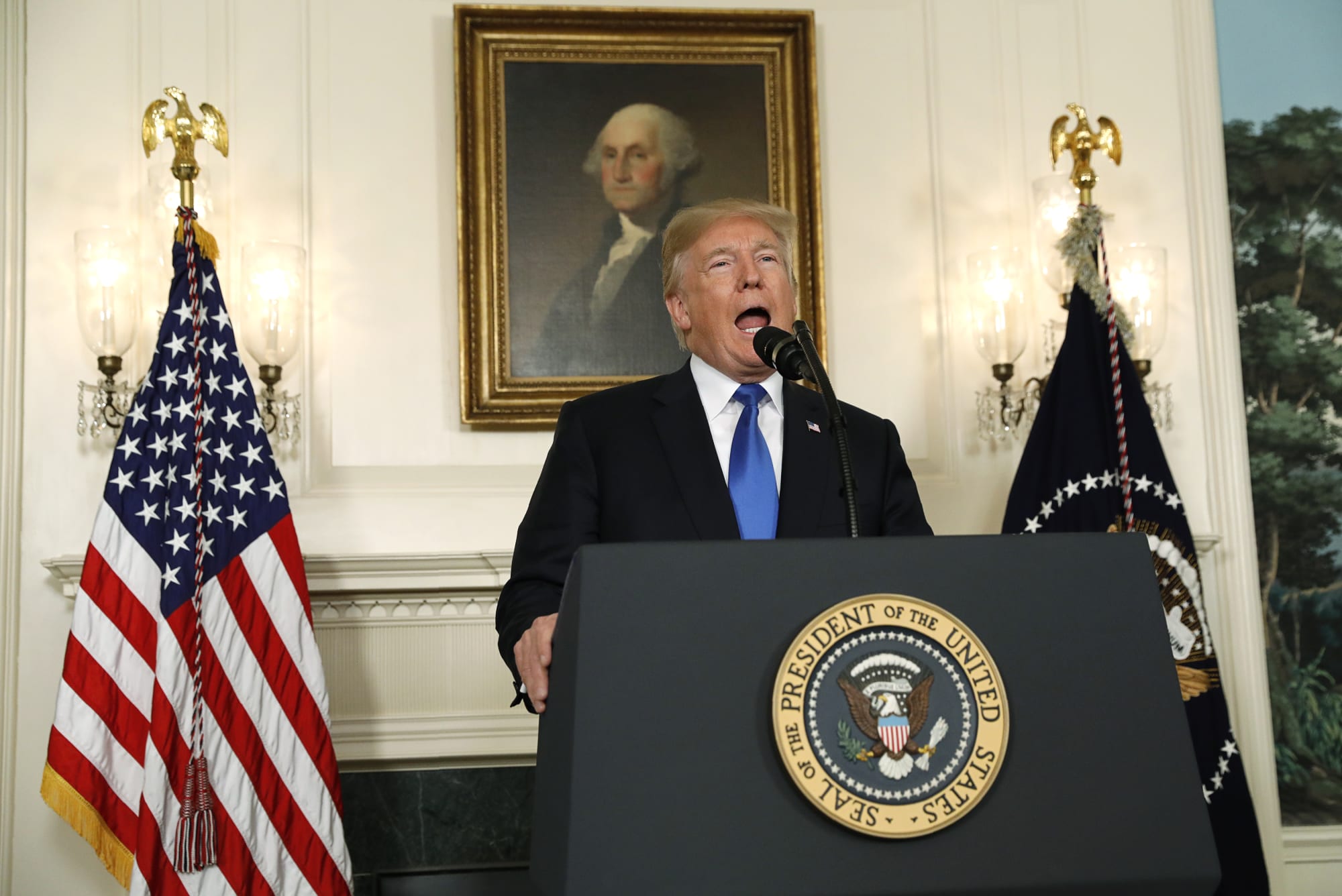
President Donald Trump is expected to cover five main topics in his first State of the Union address tonight, including the economy, immigration, infrastructure and trade. The fifth topic, national security, will pull the spotlight to North Korea and the erratic, ad hominem nuclear standoff between North Korean leader Kim Jong-un and Trump himself.
The tension of this relationship has spilled over to Twitter, where Trump has lobbed insults and threats at Kim over the past year. Trump called Kim “little Rocket Man” and declared the US’ “nuclear button” was “much bigger and more powerful” than Kim’s. In August, Trump promised “fire and fury” if North Korea didn’t stop testing nuclear weapons, and Kim later called Trump a “mentally deranged dotard.”
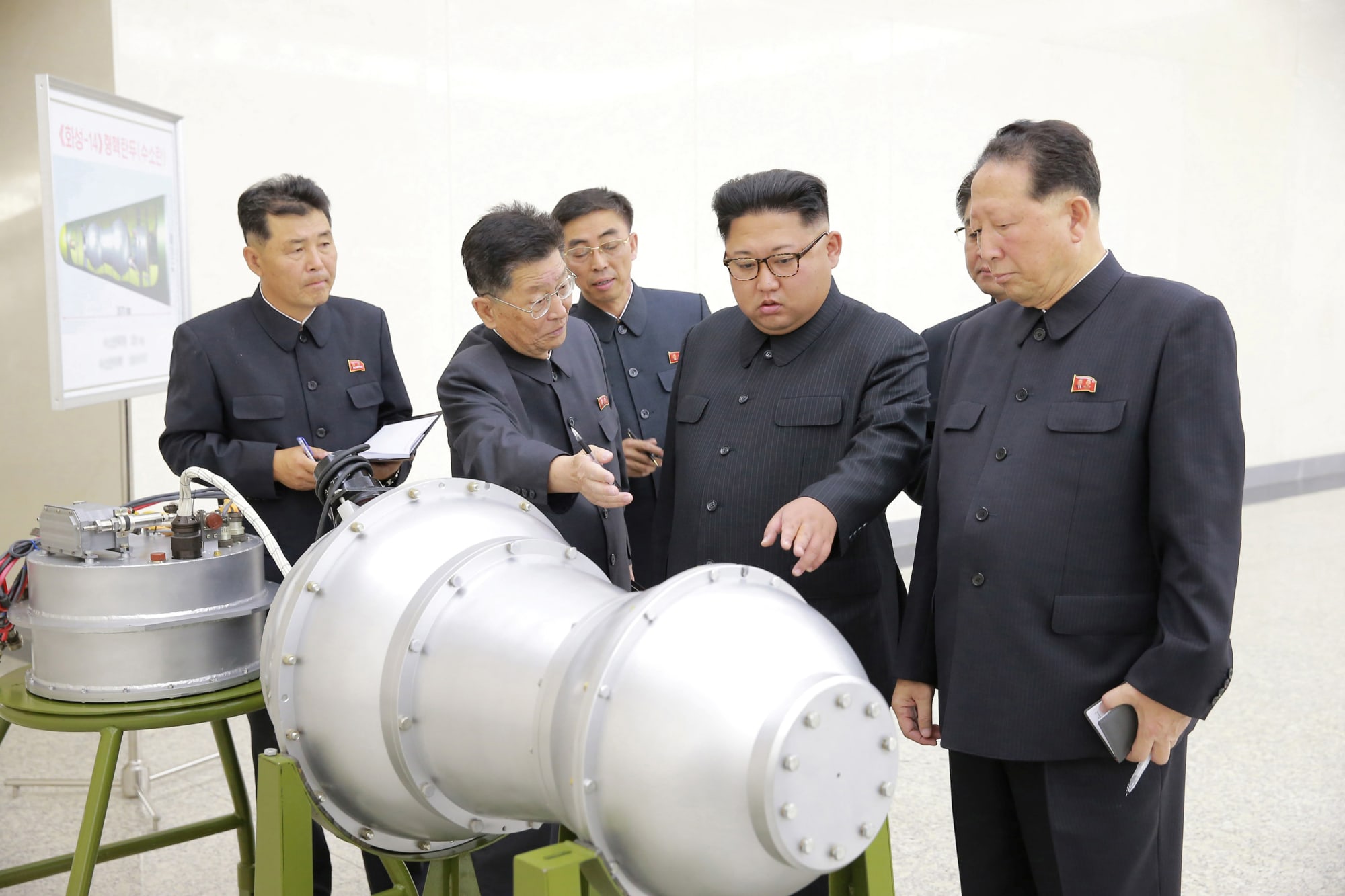
Meanwhile, North Korea carried out more than a dozen nuclear tests throughout 2017, including launching intercontinental ballistic missiles theoretically capable of striking the US mainland. Its most recent ICBM test was in November.
Despite the public peacocking and Trump’s historically cavalier attitude toward nuclear weapons, his administration hasn’t outlined its official plans for the US stockpile. That changes in February, when the White House is set to release the 2018 Nuclear Posture Review, an update from the 2010 position endorsed by President Barack Obama.
This is Trump’s chance to lay out his vision for modernization — and a draft of these plans leaked earlier this month, giving us a peek at the administration’s approach to nuclear weapons on the world stage. When Trump discusses North Korea and nuclear technology during the State of the Union, here’s what he’s actually saying.
Low yield, high volume
Much of the draft review follows in the footsteps of previous administrations, keeping intact Obama’s $1.25 trillion plan to update aging nuclear infrastructure and warheads, largely in response to Russia’s modernization efforts. As enemies in the Cold War, the US and Russia hold a vast majority of the world’s nuclear arsenal: At the height of the standoff, the US built 45,000 nuclear weapons, while the USSR manufactured 95,000. Disarmament agreements since then have nudged those numbers down, and there are currently 15,000 nuclear weapons on Earth. The US has 6,800 warheads while Russia has an estimated 7,000.
Presidents since Richard Nixon have reduced the size of the US nuclear arsenal: George HW Bush cut 9,500 weapons from the program, or 41 percent, while President George Bush eliminated 5,000 warheads, or roughly half of the remaining stockpile. Obama took a less aggressive approach, allocating money for modernization and jettisoning just 702 warheads by 2016.
However, the Trump proposal would actually add nuclear warheads to the US inventory in the form of “low-yield weapons.” The draft NPR calls these “supplements,” and they’re largely in response to the perceived Russia threat. The US has an existing stockpile of about 1,000 low-yield weapons.
“These supplements will enhance deterrence by denying political adversaries any mistaken confidence that limited nuclear employment can provide a useful advantage over the United States and its allies,” the review reads. “For example, Russia’s belief that limited nuclear first use, potentially including low-yield weapons, can provide such an advantage is based, in part, on Moscow’s perception that its greater number and variety of non-strategic nuclear systems provide a coercive advantage in crises and at lower levels of conflict.”
Despite the name, low-yield nuclear weapons are monstrous, city-destroying forces, comprising any warhead under 20 kilotons. Little Boy and Fat Man, the nuclear bombs dropped on Japan during World War II, were low-yield, and they killed more than 120,000 people combined, scorching Hiroshima and Nagasaki bare.
The US and other countries are constantly researching new types of nuclear weapons. Recently, scientists have been focused on building more agile and accurate nuclear bombs, including ideas like directed-energy devices, which would explode in a targeted direction.
“The most recent that I’ve seen — and it strikes me as just bizarre — is that they’ve started strapping GPS guidance systems onto nuclear bombs so that it can be guided the same way our cruise missiles and so forth are,” Richard Rhodes, author of The Making of the Atomic Bomb, told Engadget in May. “Instead of being, let’s say, accurate within 30 feet of a target, it would be accurate within 3 feet of a target.”
The draft NPR doesn’t mention GPS-guided missiles or directed-energy devices specifically, though these are the future technologies keeping scientists busy around the world. There are nine countries with nuclear-weapons capabilities today: The US, Russia, China, France, the United Kingdom, Pakistan, India, Israel and North Korea.
The draft argues many of these countries are building up their nuclear inventories, giving the US reason to beef up its own stockpile. In the age of nuclear proliferation, this is a tired story — it’s essentially the same reason the Obama administration gave to justify its $1.25 trillion modernization plan, though the Trump NPR paints a pointedly bleak portrait of world affairs:
[Russia and China] have added new types of nuclear capabilities to their arsenals, increased the salience of nuclear forces in their strategies and plans, and engaged in increasingly aggressive behavior, including in outer space and cyber space. North Korea continues its illicit pursuit of nuclear weapons and missile capabilities in direct violation of United Nations Security Council resolutions. …There now exists an unprecedented range and mix of threats, including major conventional, chemical, biological, nuclear, space and cyber threats, and violent non-state actors. These developments have produced increased uncertainty and risk.
In this din of fear, the draft review proposes lowering the barrier for deploying nuclear weapons.
Extreme circumstances
The draft takes its cue from the 2010 NPR when it says, copied verbatim, “The United States would only consider the use of nuclear weapons in extreme circumstances to defend the vital interests of the United States, its allies, and partners.” However, the updated version expands the definition of such events: “Extreme circumstances could include significant non-nuclear strategic attacks. Significant non-nuclear strategic attacks include, but are not limited to, attacks on the US, allied, or partner civilian population or infrastructure.”
Essentially, the draft opens the door for the US to respond to a devastating cyberattack with a nuclear strike. Perhaps a low-yield strike, even. Previously, the US has been averse to a first-use scenario, pledging to launch nuclear weapons only if the country were directly targeted by other nukes.
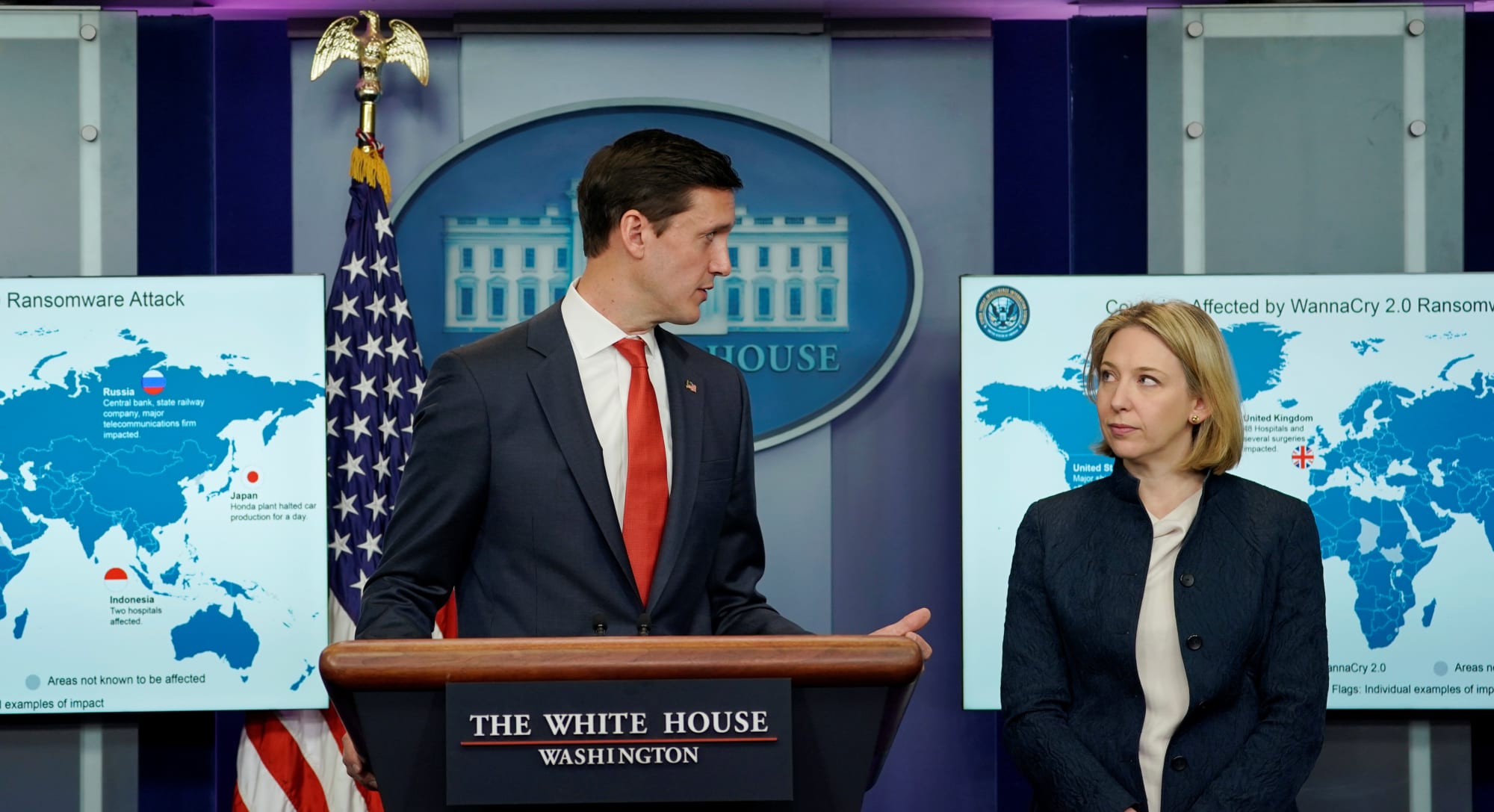
“It’s actually incredibly alarming that the Trump administration is putting forth the idea that we could use nuclear weapons in response to a cyberattack,” Alexandra Bell of the Center for Arms Control and Non-Proliferation told National Public Radio on Monday. “The Trump plan actually puts multiple options on the table — nuclear weapon in response to a chemical attack, to a biological weapons attack, to an attack on civilians without a real description of where that threshold is and really widens the options for President Trump to use nuclear weapons.”
Diplomacy
Post-nuclear politics are finicky, as world leaders play chicken with world-destroying weapons. This has been the norm for more than 50 years: Countries with nuclear weapons can grab the world’s immediate attention by making a threat or even just (loudly, publicly) investing in their arsenals. Whenever the US makes noise about its nuclear weapons, for instance, Russia is sure to respond with its own announcements and investments, and vice versa.
This is nuclear diplomacy in action. The US Intelligence Community’s 2017 Worldwide Threat Assessment acknowledges this aspect of the nuclear ecosystem, particularly in regards to North Korea — a country that does not actually want to use its nuclear weapons, according to experts.
“We have long assessed that Pyongyang’s nuclear capabilities are intended for deterrence, international prestige, and coercive diplomacy,” the assessment reads.
To that end, the US and other countries have signed a series of treaties meant to deter nuclear proliferation, and even rid the world of nuclear weapons altogether. The most notable of these is the Nuclear Non-Proliferation Treaty, enacted in 1970. Signatories agree to not build or acquire new nuclear weapons, and promise to disarm completely. One hundred and ninety-one countries have signed the NPT, including the US and Russia. North Korea signed it in 1985 but withdrew in 2003.

The United States now faces a more diverse and advanced nuclear-threat environment than ever before.
A draft of the 2018 Nuclear Posture Review
Adding nuclear weapons to the US stockpile is in direct opposition to the NPT, and the authors of the draft review are aware of this fact.
“The United States remains committed to its efforts in support of the ultimate global elimination of nuclear, biological and chemical weapons … Nevertheless, global threat conditions have worsened markedly since the most recent 2010 NPR, including increasingly explicit nuclear threats from potential adversaries,” the draft reads. “The United States now faces a more diverse and advanced nuclear-threat environment than ever before, with considerable dynamism in potential adversaries’ development and deployment programs for nuclear weapons and delivery systems.”
The view from here
Just as the State of the Union offers a chance for the president to lay out his vision of the future, the draft Nuclear Posture Review provides a snapshot of the Trump administration’s approach to national security and its view of the world in general. It’s a fairly terrifying planet from this lens, one that Trump has vowed to fight with “fire and fury” — much as Harry S. Truman, the president who dropped the nuclear bombs on Hiroshima and Nagasaki, predicted in his diary in 1945:
“We have discovered the most terrible bomb in the history of the world. It may be the fire destruction prophesied in the Euphrates Valley Era, after Noah and his fabulous Ark.”
Apple Senior VP Eddy Cue Announced as Featured Speaker for SXSW 2018
Apple’s senior vice president of internet software and services Eddy Cue has been announced as a Featured Speaker for 2018’s South By Southwest Conference event. SXSW takes place from March 9-18 in Austin, Texas, and Cue will lead a talk focused on startup companies and the tech sector, accompanied by CNN senior reporter Dylan Byers.
Other speakers include Steve Jobs biography writer Walter Isaacson, Reddit CEO Steve Huffman, Star Wars: The Last Jedi writer/director Rian Johnson, Waymo CEO John Krafcik, YouTube CEO Susan Wojcicki, and more.
During last year’s SXSW conference, Apple Music Beats 1 radio host Zane Lowe appeared as a speaker.
“The speakers announced today feature a diverse group of leaders and innovators that make SXSW the foremost destination for creative people,” said Hugh Forrest, Chief Programming Officer. “As SXSW celebrates the 25th year of Interactive and Film, the cross-industry talent announced today reflects the ongoing convergence of the modern world, the trends we see throughout our programming, and the paramount reason for our now unified conference experience.”
The full schedule of events for this year’s SXSW can be found online. Besides keynote speakers discussing a variety of topics, the Austin-based festival includes film screenings, concerts, gaming events, a comedy festival, and more.
At Apple, Cue oversees the iTunes Store, Apple Music, Apple Pay, Apple Maps, iCloud, and the iWork and iLife suites of apps. He had previously headed Siri development, but work on Apple’s AI assistant shifted to software engineering chief Craig Federighi sometime last year. The move was confirmed by Apple in September.
Tags: Eddy Cue, SXSW
Discuss this article in our forums
 AIVAnet