


I can’t buy a phone from OnePlus until it cares about privacy and security

There are some things more important than “seems faster” and less expensive.
Dear OnePlus,
Fool me once, shame on you. Fool me twice, shame on me. Steal my data and I’ll never settle for using one of your products ever again.
OK, maybe steal is a bit harsh. I guess it’s possible that getting caught up in user data controversies twice in six months then allowing someone else to steal customer financial data for the same six months and waiting a week to do anything about it after someone else exposed it is a happy little accident. Stranger things have happened.
But either way, it’s time to stop giving money — and second or third chances — to a company that obviously doesn’t treat our personal data with enough care.
OnePlus either doesn’t care or isn’t capable of handling user data properly. Either way, it means they don’t deserve any of it.
Before you hunt me down for saying this, you need to know that I advised we temper our response to the first instance of improper data collection when asked about it. I get looped in when it comes to anything about privacy or security because we are a team and that’s the role I play. I can’t remember exactly what was said, but the conversation went something like, “This is no different than anything Samsung or Moto or LG does except they didn’t explicitly tell you when you first signed into the phone,” and I really did feel that way.
I also thought you almost did it right when you owned up to it all and promised to move the opt-out setting somewhere that a new user would actually see it instead of hiding it. Analytics are important for every company that makes a product and they are hard to do without your customers feeling like they are a dairy heifer.
Clippy knows all your secrets.
Next, we saw some sketchy behavior from the clipboard app. The clipboard is not something you want being used for data collection of any kind; you use it for web URLs, passwords, and all sorts of things you don’t want anyone to see. Your explanation makes sense — it’s left over from the Chinese version of the operating system and it doesn’t send the data it collects anywhere. Why you’re collecting clipboard data from users in China is the next question you need to answer, but I’ll chalk it up to an overworked developer missing it and leaving it there. It happens.
The holy grail of user data — your credit card

The saga about customer credit card data fraud is a mess, but a mess that can happen to any company. I don’t believe the explanation — that a malicious script was injected into payment code — but if it is true there is still the whole thing about you knowing there was a problem for a week but still leaving everything in place and causing the theft of even more credit card information.
None of these things happened in a bubble. Each is a serious mishandling of your customers’ trust and privacy and you now fall under the three-strike rule. You’re out.
Money isn’t everything
The fact that a new OnePlus 5T is at least several hundred dollars cheaper than a comparable phone from Google or Samsung or Apple is not lost on me. But that ignores the other costs. One’s personal data is valuable to all these companies, but each one does a better job at handling it than you, OnePlus.
I could attribute this to you being new at all this, except that your parent company, OPPO Guangdong Electronics, has been making consumer electronics for 17 years and is the fourth largest smartphone manufacturer in the world. Your current CEO, Pete Lau, was actually vice-president of OPPO. You can’t use being new at this game as an excuse.
How much is your trust worth?
This is my opinion; my coworkers don’t share my views, and some recommend the OnePlus 5T as one of the best phones available. We’re both right. Ignoring all the careless ways you’ve treated your customers’ data, you otherwise make a really good phone and sell it on the cheap. From a point of view that excludes privacy concerns, the OnePlus 5T is one of the best phones you can buy. But I’ll not exclude privacy concerns — mine or anyone else’s.
This is something I feel needs to be said. I also think you, OnePlus, need to make a concerted effort to ensure that privacy and security — your loyal customers’ most important assets in this digital age — are just as important as phone speed and camera performance.
In other words, OnePlus, get your shit together.
Once that happens, I might change my mind, and I want to change my mind.
Sincerely,
-Jerry
OnePlus 5T and OnePlus 5
- OnePlus 5T review: Come for the value, not the excitement
- OnePlus 5T specs
- Should you upgrade from the OnePlus 3T?
- OnePlus 5T vs. Galaxy S8: Beast mode
- All of the latest OnePlus 5T news
- Join the discussion in the forums
OnePlus
Amazon
How to eject a disk from your PlayStation 4

You’re not alone in your confusion
The first thing you notice when you open you brand new shiny PlayStation 4 is how tiny the buttons on the front are. Don’t even get me started on how they just about blend in with the machine while they’re at it. Well, if you’ve found yourself confused by which button is the power and which is the disc ejector, look no further. We’ve got your back here!
Physical buttons to eject the disc
Every PlayStation console has a different set-up for where the power button is compared to the disc ejection button. Here are the examples of where the buttons are for each! Be sure to get your reading glasses on, they’re pretty small.
PlayStation 4 Pro

The power button is on the left and the eject disc button is on the right. The buttons are on the same bar on the front of your machine. This bar is located on the bottom of the center section of your console!
PlayStation 4 Slim

The power button is on the left and the eject disc button is on the right. They’re incredibly close together which makes it a hassle to deal with so just keep in mind the power button is long and square, while the eject button is small and circular.
PlayStation Standard Model

The power button is on the top and the eject button is on the bottom. If it helps you remember at all just think of it in order first you turn it on, then you inset or eject the disc!
Disc ejection from an in-menu selection

You can also eject a disc without ever pushing a physical button!
When the disc is inserted in your PlayStation simply hover over the option to play and select the options button.
A menu will pop up, just select eject and you’ve got it!
Questions
Are you having any issues removing your disc from your PlayStation 4? Did these tips help you? Let us know in the comment section below!
PlayStation 4

- PS4 vs. PS4 Slim vs. PS4 Pro: Which should you buy?
- PlayStation VR Review
- Playing PS4 games through your phone is awesome
Amazon
OnePlus 5T gets first public Oreo update with OxygenOS 5.0.2
OTA updates incoming!
I’ve said it before and I’ll say it again – privacy and user security issues aside, one OnePlus’s biggest strengths lies with speedy software updates. The company launched an open beta of Android Oreo for the OnePlus 5T at the tail-end of December, and just a month later, a public Oreo build is already rolling out.

The exact software version is OxygenOS 5.0.2, and it’s the first public OxygenOS update that’s based on Android 8.0 Oreo. As such, you can expect your standard Oreo updates such as picture-in-picture, notification dots, and more.
However, since this is a OnePlus phone, there are a few additional features to check out. There’s a new design for the 5T’s Quick Settings, its CPU has been updated to security patch level CVE-2017-13218, and there’s a slew of updates for the built-in launcher, gallery, weather app, and file manager.
OxygenOS 5.0.2 will start arriving on devices today, but as with all updates, it’ll be pushed out incrementally and should arrive on all handsets within a few days.
OnePlus 5/5T Open Beta removes Clipboard app, adds iPhone X-like gestures
OnePlus 5T and OnePlus 5
- OnePlus 5T review: Come for the value, not the excitement
- OnePlus 5T specs
- Should you upgrade from the OnePlus 3T?
- OnePlus 5T vs. Galaxy S8: Beast mode
- All of the latest OnePlus 5T news
- Join the discussion in the forums
OnePlus
Amazon
Stations by Spotify beats Pandora at its own game

Stations by Spotify is clean, beautiful, and a lot of fun to use.

I’ve jumped back and forth between music streaming services a lot over the past couple years, including the likes of Google Play Music, Pandora, and even Apple Music. Spotify has been my go-to for the last few months, and I’ve really enjoyed my time with it so far. However, it’s now gaining a new component that makes it even better – Stations.
Stations by Spotify is a new app that’s currently being tested in Australia, and it’s essentially Spotify’s answer to Internet radio services like Pandora. Assuming you already have a Spotify account, using Stations is as easy as opening the app, tapping the Get Started button to automatically link your Spotify info, and you’ll be able to instantly start listening.


Music starts playing on Stations as soon as you open the app, and as you cycle between the other genres that are available, the music will automatically switch over to play something new.
There’s a good selection of music to listen to out of the box, including the likes of 80s Hits, Workout, Coffeehouse, R&B, Classic Rock, Indie, and more. You’ll find simple controls near the bottom of your screen for liking a song and pausing it, and tapping the menu button in the top right will show controls for editing your stations, inviting friends to use the app, and controlling some basic settings.
Stations’ simplicity is the star of the show.
On the Edit Stations page, you can browse through all of the available stations you can listen to. These are grouped into categories so finding exactly what you want is pretty simple, and you can add and remove stations as you please with just a tap.
The whole aesthetic of Stations is extremely clean, and even in its early form, the app runs like butter and music streams without a hitch. There’s also a subtle vibration for each station you scroll through, and while this can be turned off in the settings, I’ve found myself to like it quite a bit.
There’s no word just yet if Spotify will release Stations in other markets, but in just my short time using the app, I immediately got hooked on it. The simplicity in design and function makes Stations a joy to use, and it’ll probably be my new go-to app when I just want to relax or focus and listen to some good tunes.
You can download Stations by Spotify from the Google Play Store if you live in Australia, but if you don’t and still want to give it a shot, check out the APK file here.
Spotify is testing a sleeker and less cluttered UI for its Android app
Curiosity’s sweeping Mars panorama shows how far it’s come
After over five years on Mars, the Curiosity rover has done a lot of science and taken a few knocks. While trekking up Mount Sharp recently, however, it paused at Vera Rubin Ridge during a rare period of clear weather. There, it used its mast camera to snap 16 images that NASA assembled into a magnificent, ultra-wide-screen panorama (and video, below) that shows its entire trip to date.
The images were taken on October 25th, 2017 during the 1,856th “sol,” or Martian day, when it was clear enough to see mountains some 50 miles distant. NASA notes that the image “has been white-balanced so the colors of the rock materials resemble how they would appear under daytime lighting conditions on Earth.”
NASA annotated Curiosity’s entire trip showing how it went from its initial landing site to Yellowknife Bay, then on to Darwin, Cooperstown and the Kimberly. From there, it hit Namid Dune, ducked and weaved through Murray Buttes, checked out Ireson Hill, crossed the Bagnold Dunes and landed at Vera Rubin Ridge. The image background shows mountains that form Gale Crater’s ridge, and the foreground lower portions of Mount Sharp, which sits in the middle of the 96-mile wide crater.
The rover had used its nuclear-powered motor to climb 1,073 feet when it took the shot on the northwestern ridge of lower Mount Sharp. It traveled 10.95 miles at that point, which doesn’t seem a lot, but the vista shows the obstacles it had to deal with. Next up, the rover will continue its climb up Mount Sharp, checking out regions showing the presence of clay and sulfates. Both of those materials have the potential to harbor micro-organisms.
Source: NASA
Mercedes drove around the globe to train its autonomous cars
On a rainy September day in Frankfurt Germany, Mercedes-Benz executives and I got in a specially built semi-automated S-Class to track our drive to Stuttgart. It was the first leg in a five-month, five continent training of the automaker’s self-driving system called the Intelligent World Drive that ended at CES earlier this month.
It’s easy to forget that road laws and regulations differ not only in other countries but even within the United States. While Californians are used to right-turns on red lights and motorcycles lane splitting on the highway, in other places, both of those are not only frowned upon, they’re illegal.
That means automakers not only have to learn the local laws of each region but the driving habits of the people in those areas plus varying signage and road markings. Mercedes-Benz decided to hit five continents to discover and log those differences. Germany was the first step, but it also traveled to Shanghai, Melbourne, Cape Town and finally Los Angeles and Las Vegas.
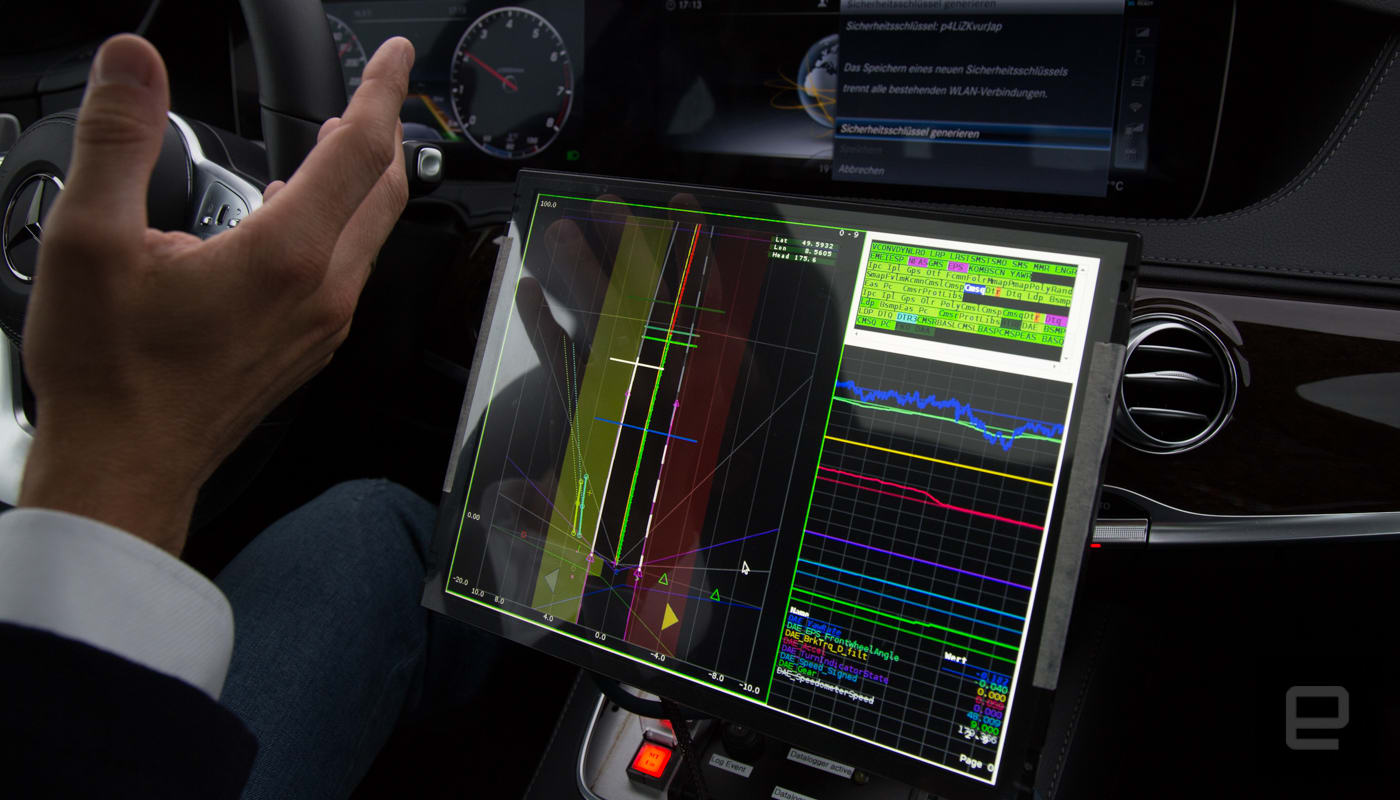
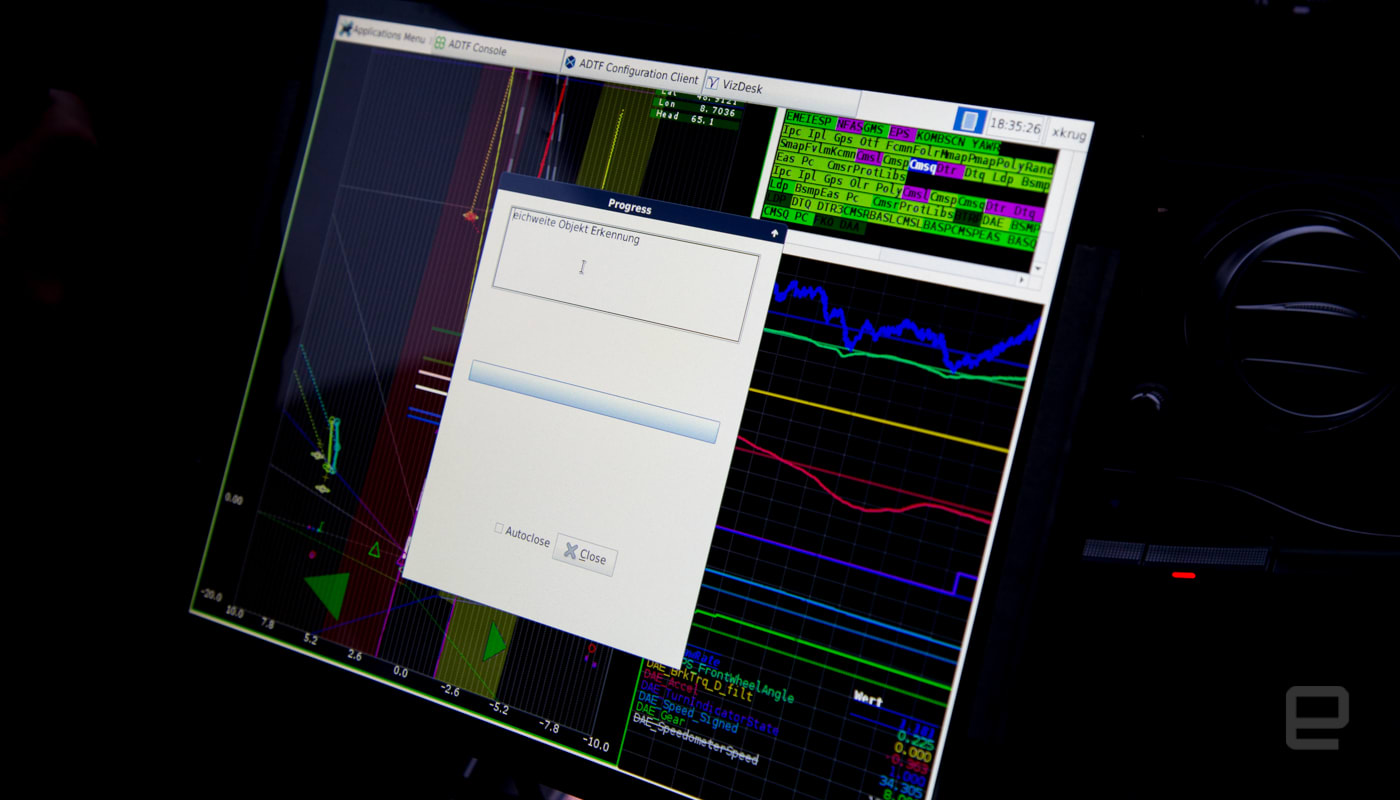
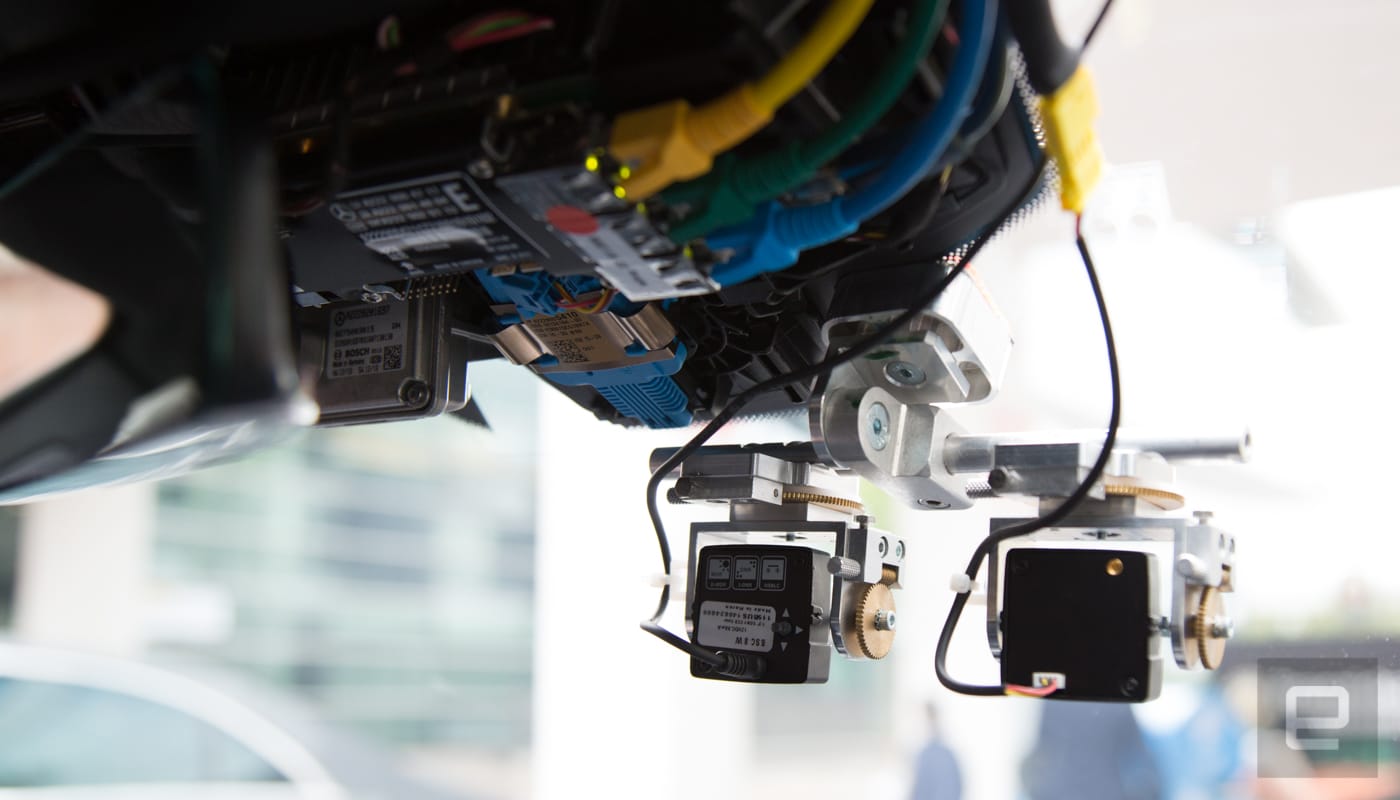
The automaker’s custom-built S-Class included additional cameras, a trunk full of computer equipment (to collect data from the drives) and an in-car display showing how the vehicle sees the world. As the team drove the car, it logged specific challenges on its own but the driver and co-pilot could manually log new, odd, or surprising situations. During its trip around the world, they found more than enough of those.
For example, in China, the team encountered what the car (and anyone used to driving in Europe and the US) thought were pedestrian crosswalks on the highway. The markings are actually to help drivers keep a safe distance between them and the vehicle in front. Shanghai’s countdown traffic lights and elaborate traffic signs were also something that the automaker realized it needs to address if it wants to put an autonomous car in that market.
In Melbourne, Australia, (where they drive on the left side of the road) Mercedes came across the slightly confusing “hook turn” where the car turns right from the left-most lane. It involves moving slightly out of your lane then watching the traffic light of perpendicular traffic. That’s a tough maneuver for a human, but for a computer-controlled car, the number of variables it would have to consider make it nearly impossible with the tech that’s available now.
In South Africa, sand on the roads covering lane markers was fodder for the team’s research. It’s an important piece of data that illustrates how important high-quality maps are to self-driving cars. The narrow, cobbled roads of some Cape Town neighborhoods also presented the car with new data.
Finally, it was off to the United States where the company was hoping to gather data about our large highways and the traffic that fills those roads. Starting in Los Angeles where gridlock is a part of daily life, the team encountered a sign they found unusual, but the average Californian wouldn’t think twice about. A 20 mile per hour sign for when “children are present.” It seems a simple enough rule, you’re near a school and when it’s in session, you slow down. But the variables surrounding that are incredibly complex.
For example, the car needs to know about school zones. It has to know when school is in session. It has to know about holidays. It needs to understand where that zone begins and ends. It has to take into account what time children arrive at and leave school. What if there’s an after-school event, should the car slow down then? What if there are kids at the school during the weekend? What are the local laws governing all these situations and are they different from town to town, district to district, county to county, and state to state? “Sometimes the rules are not really deterministic so you need to somehow interpret them,” Christoph Von Hugo, head of active safety for Daimler AG said.
That’s all for a single sign in one country. It illustrates the need for automakers like Mercedes to not only conduct these types of fact-finding missions but also work closely with regional lawmakers. While companies brag they’ll have autonomous cars on the road in the next few years, the amount of work that goes into training these systems in places beyond an automaker or tech giant’s headquarters is extremely important. There is no one-size-fits-all when it comes to driving.
In Las Vegas, Von Hugo took me on my second ride in the modified S-Class. In Germany he piloted the car to Stuttgart and during that drive, it rained heavily, we encountered construction, traffic, and cars cut us off a few times. He happily logged these events into the system. Now, near the convention center that housed CES, the drive was less about compiling data and more about what they learned. “Some of the situations — even if you knew them beforehand — seen through the eyes of an autonomous car, they suddenly become, different, more relevant. Maybe even frightening,” he said.
He and the rest of his team will take the giant pile of data, toss out what’s not relevant and study everything else. The company is far from ready to deploy fully autonomous cars that understand all aspects of the road in any region, but this drive has given it a base level of information.
Meanwhile, Mercedes offices in all these countries will continue to work on their location. To fine-tune how a car would react to things like pedestrians on the highway at night, sand on the road, determining who goes first at a four-way stop and reading street signs that sometimes don’t tell the whole story.
Von Hugo said not to expect another big around-the-world drive from the automaker, “I hope that we don’t really need to do it again this way. But that certainly doesn’t mean that we won’t hit the road anymore with test vehicles.”
The self-driving car is going to take time, research and a whole lot of driving in countries all over the world because I don’t drive the same way someone in Australia drives and our future self-driving probably won’t either.
Samsung made a special chip for mining cryptocurrency
Samsung has a chip designed specifically for mining cryptocurrency. Rather than repurpose a GPU to do the dirty work, Samsung made an Application Specific Integrated Circuit (ASIC), which is a specialized processor that is more efficient at mining than, say, an NVIDIA 1080 card. The company has entered into a distribution agreement with an as-of-now anonymous Chinese partner for distribution. As TechCrunch notes, this is significant for at least one reason: This gives the Korean company a way into the Chinese ASIC market, where local firms dominate. It’s too early to tell what sort of impact (if any) this could have on Samsung’s bottom line, or how it could affect cryptocurrency and China’s local players.
Source: TechCrunch
Yamaha’s AI transformed a dancer into a pianist
Artificial intelligence is already everywhere, so it’s inevitable that it would invade the arts. Yahama showed a new kind of AI tech that translated the movements of renowned dancer Kaiji Moriyama into musical notes on a piano, “a form of expression that fuses body movements and music,” the company said. He used it during a concert in Tokyo entitled Mai Hi Ten Yu, dancing and “playing” the piano with his body, accompanied by the Berlin Philharmonic Orchestra Scharoun Ensemble.
Yamaha’s system ensures that the dancer plays music that makes some sense, rather than just random notes. Moriyama carried four types of sensors on his back, wrists and feet that translated his movements into data. The AI then instantly creates melodies based on a database of MIDI music. The MIDI data is then shipped to a Yamaha Disklavier player piano, in this case a $150,000+ CFX concert grand, which translates it into sound.
Though Moriyama was to a large degree in charge of the beat, the experiment does beg the question of how much he was actually responsible for the music. In an accompanying making-of video, though, the dancer explains that he had more to do with it than you might think. The music changed depending on how he balanced, allowing him to effectively create different tunes using his entire body.
If body movements be fine tuned enough to the AI, then it’s easy to see how a dancer could gain fairly granular control of chords and notes. Looking at it that way, Yamaha’s claim that “this performance represents steady progress in the pursuit of new forms of artistic expression” does hold up.
Via: Japankyo
Source: Yamaha
Uber’s latest venture is a bike-sharing service in San Francisco
Uber’s piloting a new service in San Francisco alongside dockless bike-sharing startup Jump. Uber Bike will let users rent one of Jump’s 250 bikes, charging $2 for the first 30 minutes and an additional per-minute fee thereafter. Jump was granted a permit by the San Francisco Municipal Transportation Agency earlier this month, which made it the first company to operate a dockless bike-sharing program in the city. Jump’s 250 bikes should launch around the city between now and March and the SFMTA may allow the company to release 250 more after nine months, depending on how things go. The permit was issued for 18 months, during which the SFMTA will evaluate the program and the public’s response.

Uber’s pilot program will initially be available to users who travel in the areas of San Francisco where Jump’s electric bikes will be available. Others will be able to join a wait list. “We’re always kind of searching for options to make transportation affordable and more accessible for people,” Andrew Salzberg, Uber’s head of transportation policy, told TechCrunch. “It fits into this larger vision, we think, that there can be multiple modes of transportation that can be made available through the Uber app. There are lot of places where there are many trips that it’s probably going to be quicker and cheaper to hop on a bike. Strategically, it makes a lot of sense for us as a business.”
This program certainly isn’t the only bike-sharing option in San Francisco. Ford launched a GoBike program in 2017 and its fleet should number 7,000 bikes by the end of this year. However, Ford’s bikes must be docked at a station whereas Jump’s can be left wherever it’s legal to park a bike. For now, Ford’s fleet is made up of traditional bikes, but by April it will have pedal-assist electric bikes as well. Last year, another dockless bike-sharing company, LimeBike, said it had applied for permits to operate in San Francisco, but while the city’s pilot program with Jump is ongoing, it won’t grant permits to any other dockless programs. LimeBike does have a program up and running in nearby South San Francisco.
Uber says that it’s focusing on the San Francisco pilot for now, but it could be adopted more widely in the future. “You don’t do a pilot if you don’t have hopes to make it a vision for the future,” Salzberg told TechCrunch.
Image: Uber
Via: TechCrunch
iOS 11.3 Beta to Get Throttling Kill Switch in February as Apple Trials ‘Reserve a Battery’ System in Canada
Following a report that the United States government is investigating Apple’s power management function that slows down some older iPhone models, Apple issued a statement on late Tuesday confirming that it has “received questions from some government agencies” and is “responding to them.”
In the statement, Apple also confirmed the timing of its promised power management toggle, allowing customers with an iPhone 6 through iPhone 7 Plus to disable the function: it will be rolling out in a future iOS 11.3 beta version in February. The software update will be publicly released later this spring.
Apple’s full statement was shared by Axios earlier today:
About a year ago, we delivered a software update that improves power management during peak workloads to avoid unexpected shutdowns on certain iPhones with older batteries. We know that iPhones have become an important part of the daily lives of our customers and our intention was to improve the customer experience.
We sought to further improve the customer experience in December by announcing a significant discount on replacement batteries for certain iPhones. We also announced that we began developing a new iOS feature to show battery health and which would recommend when the user should consider replacing their battery. These actions were taken to further assist our customers and help extend the life of their iPhones. In addition, users will be able to see if the power management feature is being used to prevent unexpected shutdowns, and turn if off if they so choose. These features will be included in a developer release next month and a user release this Spring.
As we told our customers in December, we have never — and would never — do anything to intentionally shorten the life of any Apple product, or degrade the user experience to drive customer upgrades. Our goal has always been to create products that our customers love. Making iPhones last as long as possible is an important part of that.
We have received questions from some government agencies and we are responding to them.
Apple’s power management function can also be sidestepped by replacing an iPhone’s battery if necessary. We’ve previously outlined steps on how to initiate this process at an Apple Store or Apple Authorized Service Provider.
In related news, Apple recently added a “Reserve a Battery” option to its support website in Canada. This system, not available elsewhere yet, allows customers with an iPhone 6 or newer to reserve a battery online and have Apple contact them when a battery is available at their preferred Apple Store.

This system can be found by signing into your Apple ID on Apple’s Get Support page and selecting Battery, Power, and Charging → Battery Replacement → Reserve a Battery. An anonymous tipster told us that Canada is a trial country, suggesting Apple may choose to expand this reservation system to other regions.
Apple promises to contact customers within three to five days to let them know when their battery replacement can be completed. Its support website currently quotes an estimated two to four week wait in Canada.
MacRumors previously obtained an internal Apple memo that stated iPhone 6 Plus replacement batteries were in short supply and unavailable until late March or early April around the world. Apple’s internal document quoted a shorter wait of “approximately two weeks” for iPhone 6 and iPhone 6s Plus batteries.
Apple said batteries for all other eligible iPhones were expected to be available “without extended delays” in most countries.
In addition to probes from the United States government, over 50 class action complaints have been filed against Apple since it fully disclosed the power management changes it made in iOS 10.2.1, nearly a year after the update was released. Apple apologized for its lack of communication in a letter to customers.
Related Roundup: iOS 11Tags: Canada, iPhone Slowdown
Discuss this article in our forums
 AIVAnet