


Apple ‘Accelerating’ Efforts to Catch Up With Self-Driving Competition, Expands California Fleet to 27 Vehicles
Apple has expanded its California fleet of self-driving vehicles from three registered last April to 27 as of early 2018, according to a new report posted by Bloomberg today and sourced from emails with the California Department of Motor Vehicles.
Following the first three vehicle registrations, from July 2017 to January 2018 Apple has registered 24 more Lexus RX450h sports utility vehicles in California as part of its self-driving tests. The company is believed to be “accelerating” efforts to catch up to one of the current leaders in the self-driving field, Alphabet’s Waymo.
One of Apple’s previous self-driving Lexus vehicles spotted on the road last year
Work on the “Apple Car” began circulating in rumors from early 2015, when reports of “Project Titan” emerged and pointed towards upwards of 1,000 employees working on developing an electric vehicle at a secret location near the company’s Cupertino headquarters. Over time, the project pivoted away from Apple constructing a vehicle of its own to the development of a self-driving software system, which CEO Tim Cook confirmed last summer.
We’re focusing on autonomous systems,” Cook said in an interview on Bloomberg Television. “It’s a core technology that we view as very important.”
“We sort of see it as the mother of all AI projects,” Cook said in his most detailed comments to date on Apple’s plans in the car space. “It’s probably one of the most difficult AI projects actually to work on.”
Now, Apple is said to be gearing up to compete with Waymo and its self-driving tests, which have currently expanded into six states, encompassing 600 minivans in Phoenix, Arizona alone and now open up to public applicants. Waymo partnered with Lyft last year to begin building a ride-hailing service that aims “to bring autonomous vehicle technology into the mainstream,” and then began testing such a service without a safety driver “or any human at all” behind the steering wheel.
Tags: bloomberg.com, Apple Car
Discuss this article in our forums
Logic Pro X Gets Massive Update With Smart Tempo, New Plug-Ins, and Hundreds of Loops
Apple today released a major 10.4 update for its professional audio editing software Logic Pro X, introducing a huge list of new features for musicians and sound editors.
A new Smart Tempo system is designed to keep multiple tracks in sync regardless of their original tempo, allowing content to be combined together automatically. It lets users record into Logic Pro X using an attached instrument sans metronome or click track, with the software analyzing your performance to create a tempo map for the project.
Several new plug-ins are included in Logic Pro X 10.4, including ChromaVerb, an algorithmic reverb with a colorful visual component, Step FX for rhythmic multi-effect processing, and Vintage EQ with three vintage analog EQ models from the 1950s to 1970s. A full list of all the new plug-ins is below:
– ChromaVerb is a sophisticated new algorithmic reverb with a colorful, interactive interface for creating rich acoustic spaces
– Space Designer is a convolution reverb with a new design and a scalable, Retina interface
– Step FX adds rhythmic multi-effect processing using 3 powerful step sequencers and an X/Y pad
– Phat FX makes your tracks bigger and bolder using 9 effects that add warmth and punch to your sounds
– The Vintage EQ Collection provides 3 accurate models of vintage analog EQs from the 1950s to the 1970s
– Studio Strings and Studio Horns are deeply sampled, realistic ensemble instruments with custom articulation controls
– Mellotron is now available as a standalone instrument plug-in
– Retro Synth now offers 18 different filter models
Two additional drummers with roots and jazz-influenced styles are included, and there are two new vintage brush kits for Drum Kit Designer. Apple has also added more than 800 new loops in a variety of instruments and genres, plus the New Visions library for Alchemy has gained 150 cinematic presets.
Other new features include an undo option for mixer and plug-in actions, an option for saving favorites in the File Browser, support for looping audio files in the Loop Browser, and a new universal design for controlling articulations for a more consistent interface across Logic and third-party instruments.
Today’s Logic Pro X update is free for existing users. New users can download Logic Pro X from the Mac App Store for $199.99. [Direct Link]
Tag: Logic Pro X
Discuss this article in our forums
Apple Seeds First Beta of watchOS 4.3 to Developers
Apple today seeded the first beta of an upcoming watchOS 4.3 update to developers, just two days after releasing watchOS 4.2.2, a minor update focusing on bug fixes and performance improvements.
Once the proper configuration profile has been installed from the Apple Developer Center, the new watchOS beta can be downloaded through the dedicated Apple Watch app on the iPhone by going to General –> Software update.
To install the update, the Apple Watch needs to have at least 50 percent battery, it must be placed on the charger, and it has to be in range of the iPhone.
It’s not yet clear what new features or improvements the watchOS 4.3 beta might introduce, but we’ll update this post once we’ve installed the update and have had time to look for any new features.
Related Roundups: Apple Watch, watchOS 4Buyer’s Guide: Apple Watch (Buy Now)
Discuss this article in our forums
Apple Orders New TV Series From ‘La La Land’ Creator Damien Chazelle
Apple this week signed a straight-to-series order for a drama series from “La La Land” creator Damien Chazelle, according to reports from Variety and The New York Times.
Little is known about the series at this time, but Chazelle plans to write and direct each episode of the series, as well as executive produce. Apple did not divulge information about the subject of the series, where it will take place, or how many episodes Chazelle will make.
Chazelle is best known for writing and directing “La La Land,” which starred Emma Stone and Ryan Gosling. “La La Land” won six Academy Awards, including Best Director, and seven Golden Globe awards. In addition to “La La Land,” Chazelle wrote and directed “Whiplash,” an award winning film starring Miles Teller.
The original TV series for Apple will be Chazelle’s second television-related project, as he also recently inked a deal with Netflix to create “The Eddy,” a musical series set in Paris.
Apple has multiple other original TV shows in the works under the leadership of former Sony executives Zack Van Amburg and Jamie Erlicht, including a revival of 1985 Steven Spielberg sci-fi series “Amazing Stories,” an untitled space drama developed by Ronald D. Moore, known for “Battlestar Galactica,” an untitled “morning show drama” starring Reese Witherspoon and Jennifer Aniston, “Are You Sleeping,” a psychological thriller starring Octavia Spencer that focuses on a podcast that reopens a murder case, “Home,” a docuseries about amazing houses, and “See,” a futuristic drama series.
Related Roundup: Apple TVTag: Apple’s Hollywood ambitionsBuyer’s Guide: Apple TV (Buy Now)
Discuss this article in our forums
DJI Osmo Mobile 2 review: get your smooth on
DJI remains one of the most recognizable names in tech, primarily for their drones, but their aerial devices make use of a very important aspect of photo and video – stabilization. For full size cameras, DJI has a slew of gimbal solutions, but last year they shrunk these products down to size for smartphones. The DJI Osmo Mobile has become the gimbal of choice for many smartphone-based content creators, but it definitely had a few annoying quirks and did not take into full consideration the next frontier of visual content: social media.
DJI’s New Drone
DJI Mavic Air announced: the drone you were waiting for?
Head over to our partner site Drone Rush for all the details on the new DJI Mavic Air.
The top drone manufacturer in the world took the wraps off a new machine this morning— the all-new …
With the newest version of the Osmo Mobile, DJI has not only made the gimbal more accessible in terms of handling and even price, it has also updated what could be considered a niche device into something anyone can benefit from. This is the DJI Osmo Mobile 2 review.

As a content creator, I got my hands on the original Osmo Mobile for smooth footage and further creativity after hitting the record button. With a little bit of work, DJI’s gimbal allowed for lovely timelapse footage and even hands-off video recording. That way, I would be able to get out in front of the camera rather than always being behind it.
There were some issues in the design of the gimbal though. It was small enough to fit in a backpack and wasn’t difficult to maneuver in one hand for long periods of time, but mounting the Osmo to existing places like a tripod required a very specific part that screwed into the side of the handle. This was odd and cumbersome to do. In the Osmo Mobile 2, this is one of the first issues that is directly addressed – with a ¼ 20’ thread found in the bottom portion. This makes for much easier and more intuitive setups where users can just screw a plate on the bottom and securely stand the Osmo up.

This does change the way the Osmo is charged and handled, however – DJI has now eliminated the need for battery packs. For better or worse, spare batteries are a thing of the past as the entire unit is now charged by the micro-USB port to the side of the control area. While a USB Type-C port would have been preferred, eliminating this part of the gimbal’s power features also made everything even lighter than before.
DJI has eliminated the need for battery packs but the gimbal’s built-in battery can now power your phone
Speaking of power features: there is a full USB port on the back that can power the mounted phone. That’s right, the 15-hour battery within the handle can be used as a power bank, which works in a pinch when your smartphone needs some juice to do stuff like livestreams.
The updated Osmo Mobile 2 is light as a feather – this further benefits the handling experience and takes away the little bit of strain felt after long periods of usage. Some users might have preferred hot swapping batteries but the Osmo Mobile 2 can go for a long 15 hours – plenty of time for a super long recording or livestream. Unless you’re looking to use the gimbal for hours daily, it should last for several days between charges.
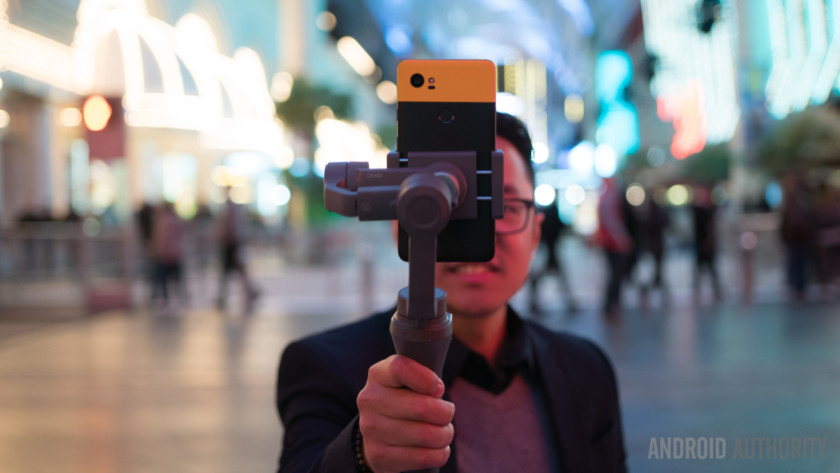
But that mention of livestreaming brings us to the other big design change of the Osmo Mobile 2 – portrait mode. People might not generally be big fans of vertical video, but the fact remains that social media platforms like Instagram and Snapchat thrive on it. And DJI has outfitted this gimbal with a rotating clamp that can hold the phone upright for content that is meant for these platforms. Simply loosen the back portion of the clamp, rotate it accordingly, and portrait mode stabilization is achieved. This also answers the question of the Osmo Mobile 2’s usefulness when smartphone video stabilization is continuously improving. While true, OIS and EIS are features typically afforded to rear cameras, but not front-facing shooters.
A new rotating clamp enables portrait mode stabilization, but it too isn’t perfect
There is one big peeve I have here, however – the rotation of the clamp should have been designed to be done with the phone inside. Going from portrait mode to landscape requires users to remove the phone, rotate the plate clockwise 90 degrees and then mount it again so that the rear camera is not obstructed. The ability to rotate the plate counter-clockwise 90 degrees would have solved this issue easily and allowed the phone to remain mounted, even if rebalancing would still be needed. It honestly astounds me that the engineers at DJI didn’t seem to think that one through.
Despite this extra step when moving between different orientations, changing the clamp to a spring loaded mechanism does help the balancing process. A fastener for the rear arm still needs to be used for horizon balancing, but smartphones can slide and adjust within the clamp if further adjustments have to be made. One just has to find the sweet spot for their own phone so that it remains steady when the gimbal is powered off. Once, found, power it up and the motor does the rest.

Buttons and controls on the new stabilizer have seen a few changes, with the main difference being the removal of the trigger button. This took a bit of getting used to, as the trigger on the original Osmo Mobile was used to keep the phone locked on its current plane when needed. What used to be easily accessed by the index finger for locking the plane and resetting the horizon is now done by one’s thumb on the main button panel. Changing modes and tracking functions, then, is a bit less comfortable than before.
Editor’s Pick
A closer look at the LG V30 in Raspberry Rose (and the $2K Signature Edition)
When LG released the V30 back in August 2017, it was available in four colors: Aurora Black, Cloud Silver, Moroccan Blue, and Lavender Violet. Just a few days before CES 2018, the company announced an …
Otherwise, the rest of the buttons and controls will feel familiar to any previous Osmo users. The joystick smoothly moves the gimbal on any axis and there is a zoom slider on the side. These controls work with the DJI Go app, which has improved significantly since the original Osmo Mobile.

But unfortunately this is where DJI’s app makes or breaks the experience. I should mention that for this review, I have been using an unreleased beta version of the DJI GO app, though it is important to note that the Play Store updates show support for this new product already. So, although the promise of fully updated software is something to consider, DJI’s history of shoddy Android development still has to be mentioned. Back at CES, the app worked well enough for me to use it on the show floor and around Downtown Vegas, but during the filming of this review the app would either crash when opening up the camera or simply not connect at all to the gimbal.
DJI’s history of shoddy Android development still has to be mentioned
However, this is not an isolated incident – I own a Mavic Pro and have had the same issues on most Android phones aside from Samsung Galaxy devices. So, if you are not using the latest phones you might have a bit of a hard time getting the app to work consistently. Harsh as it might be, this is a reality that DJI/Android fans have wrestled with for some time now. It almost makes perfect sense why this gimbal is starting out as an Apple Store exclusive – there are a lot of kinks to work out with the Android side of things.
When the app does work, it is very nice to use the physical controls to their fullest extent. As mentioned before, the M mode button is used to change the gimbal’s behavior – one press changes the horizon lock, two presses resets the gimbal position, and three presses changes which camera is being used.
Snapchat
Snapchat will soon let you share Stories on Twitter, Facebook, and across the web
Snapchat is taking a step out of its walled garden with a new feature that will enable the sharing of Stories with other users outside of the main app.
If this all sounds a little familiar, …
That last feature is one that only works with the DJI Go app, which is required for users to get the full experience. However, plenty of users will probably be happy to just use the gimbal as a stabilizer with some control via the joystick when using other apps like Snapchat or the built-in camera app.

The DJI Go camera app affords a lot more control over exposure and color, which is nice – but the modes are really what opens up the creativity. The motors can move the phone around automatically for effortless panoramas, for example. ActiveTrack allows the user to set a point that the camera app and gimbal will continuously follow.
This is on top of the Timelapse mode, which has the gimbal keep the phone steady as it stays put and records a scene’s movement over time. Or, you can put these two together for a Motionlapse or a Hyperlapse – whereby tracking keeps the camera trained on a subject while being moved around, marrying the aesthetic of a timelapse with dynamic movement.
It’s important to note that users will have to be aware of the gimbal’s limits. ActiveTrack in particular gave us a few headaches as the gimbal occasionally went nuts on even slow moving subjects. We’ve been told this is getting fixed and refined in firmware updates leading up to its full retail release and shortly after.
See Also
Google Pixel 2 and Pixel 2 XL review (Updated: addressing some issues)
This review is brought to you by MNML Case, an ultra-thin case that showcases the beauty of your new phone and fits like a glove! Get 15% OFF your Google Pixel 2 case or Google Pixel …
We also noticed that the gimbal could get pushed over the edge, quite literally – in portrait mode especially, a top heavy phone like the Pixel 2 XL would just keel over under the lack of strength in the motors. Remember to counteract any movements with corrections via the joystick.
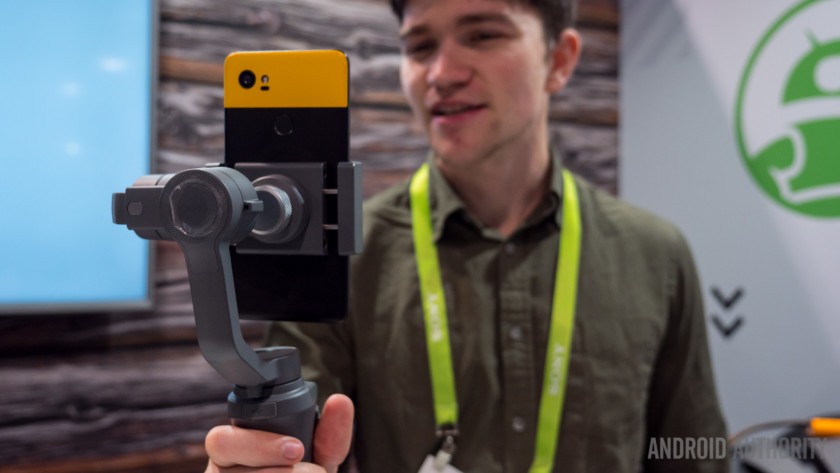
Despite some of its flaws and specific use case scenarios, plenty of people took to the original Osmo Mobile as a productive tool in one’s creative toolbox. If you’re a smartphone creative, you probably already have the original Osmo Mobile and if it works just fine, upgrading may not be necessary. The new edition builds upon the first by adding focus to today’s biggest video content platform – social media – despite maintaining its somewhat steep learning curve.
But DJI’s greatest change in the Mobile 2 is in the price – at $129 (on pre-order now), this gimbal shifts from being a tool that made sense for prosumer creators to one that could benefit just about anyone. As DJI states, this device is made to “share your story.” DJI squarely targets new, perhaps young users who really want to step their social game up with the Osmo Mobile 2.
PRE-ORDER NOW FROM B&H
Are you a user of the original Osmo Mobile? Does DJI’s new gimbal add to your social media game? Let us know what you think of the new edition in the comments below!
The best Sony Xperia XA2 Ultra cases for peace of mind
With a massive 6-inch screen and the incredible new dual-lens selfie cameras on the front of the phone, the Xperia XA2 Ultra may not have brought the design refresh fans were looking forward to, but it still looks set to take the midrange phone market by storm. Sometimes you need shelter from that storm, and while the XA2 Ultra is tough, its not without its weaknesses. Thankfully, they can be shored up with a little bit of help. That’s why we’re here with the best Sony Xperia XA2 Ultra cases that you can buy to keep your pride and joy safe from the hazardous world out there.
AVIDET Ultra-Clear Gel Case ($8)
So you’re in a quandary — you want to keep your phone protected, but you’re in love with the XA2 Ultra‘s design, and want to be able to see it. What do you do? Thankfully, the answer for this clearly important question is right here: A clear gel case. It might not be as protective as a bulky, rugged case, but the soft TPU material provides good protection against minor falls and bumps, and keeps the body of your phone safe from scratches and other similar hazards. Best of all, since it’s completely clear, it won’t block your view of your phone’s design.
Buy one now from:
Amazon
Roxfit Ultra Precision Hard Shell ($16)
Roxfit is the case-maker for Sony Xperia phones, and it wears its “Made for Xperia” label proudly. As well it should, because Roxfit cases are among the best you can get for your Xperia phone. The Ultra Precision Hard Shell case clips around the outside of your phone, protecting the body from scratches and damage. While the hard material won’t be the first choice for anyone worried about drop damage (it lacks the shock-absorption of TPU “gel” cases), it will offer great protection against most other damage, including bumps against hard materials and scratches from keys or coins in the same pocket. A raised bezel at the front of the phone keeps the screen from touching surfaces, and the slim minimalist design ensures that you’ll easily forget it’s on there once applied.
Buy one now from:
Mobile Fun Roxfit
TOPAce Shock Resistant Carbon Fiber-Style Case ($9)
Who says protection can’t be stylish? Style is very subjective, but we think you’ll agree that this case from TOPAce looks pretty good. The brushed metal look of the body gives way to carbon fiber-style panels at either end of the case — but don’t be fooled by the looks. You’re dealing with shock-resistant and durable TPU here, so don’t think this case is hard and lacks in drop protection. Quite the opposite, in fact; airbag-like pockets at each of the corners distribute shock around the absorbent material, and away from your phone. A raised edge keeps your phone from touching dirty surfaces, and the case itself adds grip and prevents unsightly fingerprints from forming.
Buy one now from:
Amazon
Olixar Armadillo Rugged Case ($15)
How about adding some extra utility to your phone? Olixar‘s Armadillo isn’t just an excellent protective choice, with a dual-layer construction that offers the best of hard cases and gel cases by combining TPU and polycarbonate (PC) — it also comes with a handy kickstand on the rear. The kickstand is flicked out easily, perfect for media viewing on the go, or simply for people to prop their phone up where they can see it. The rugged looks will appeal to anyone who wants a case that looks like it belongs in a post-apocalyptic survival flick, while the textured TPU materials means it’s even easier to keep a hold of your phone.
Buy one now from:
Mobile Fun
Official Sony Style Cover Stand Case ($46)
If you really want the best possible quality and fit, why not go straight to Sony itself? The company offers some great cases for the Xperia XA2 Ultra, including this Style Cover Stand Case. It’s a combination of a hard, PC inner case that clips onto your phone and protects the sides and back, and a softer, bifolding cover that wraps around the front of your phone to protect the screen when it’s not in use. You can fold the cover into a horizontal stand for your phone, and when you’re done with watching a film, YouTube, or whatever, flipping the cover over your screen puts your phone into sleep mode, pausing whatever you were watching automatically. It’s slim and form-fitting to the XA2 Ultra, and provides great protection. It’s on the pricey side, but you’ll struggle to find a quality flip case like this anywhere else.
Buy one now from:
Mobile Fun Sony
Editors’ Recommendations
- The best Sony Xperia XA2 cases to keep your smartphone looking ‘Xcellent’
- The best Honor View 10 cases to keep your midrange monster beautiful
- Keep your shiny bezel-less phone safe with the best LG G6 cases and covers
- Best Honor 7X cases to keep your budget phone beautiful
- The best Xperia XZ1 Compact cases to safeguard your small smartphone
U.S. government will investigate fraudulent net neutrality comments
The furor surrounding the net neutrality repeal that took place in December 2017 is continuing to be a strong political punching ground. The U.S. Government Accountability Office (GAO) will investigate claims that millions of comments provided to the Federal Communications Commission in support of the repeal were in fact made by bots impersonating real people.
The investigation comes after weeks of pushback against the FCC’s ruling, with challenges coming from the attorneys general of multiple states, Firefox creator Mozilla, and the Internet Association. Political strength has also been leveraged in this fight, with many congressional Democrats backing net neutrality regulations, which ensured internet access was treated as a utility and could not be exploited by internet providers. Supporters believe such regulation is needed to ensure a free, open internet for everyone.
One of the major issues surrounding the repeal has been the matter of the millions of anti-net neutrality comments that were allegedly made by bots impersonating millions of Americans. This comment system, supposedly used to inform the FCC of the public feeling towards bills, has been accused of being broken by these bot accounts, and forced a representation of the American people’s feelings that was not truly reflective.
This particular challenge to the repeal, launched by an open letter from U.S. Rep. Gregory W. Meeks, D-N.Y., and other representatives, asked the GAO to investigate the impact that these comments had on the process, and to discover the extent of the comment fraud on the FCC’s eventual decision. A reply, published by the Energy Commerce Dem Twitter account, reveals GAO’s acceptance, and the time frame that the investigation is expected to complete within, no less than five months.
NEWS: GAO has accepted 10 Democrats’ request for an investigation of the pervasiveness of fraudulent comments made during a federal rule making process. pic.twitter.com/fVlBIxBAVG
— Energy Commerce Dems (@EnergyCommerce) January 23, 2018
The issue of the fake voters is a particularly thorny issue in the net neutrality battle. One study estimated that removing the fake comments left a comments section that was 98.5 percent against the FCC’s repeal. With the supposedly bot-driven comments, that divide drops to 60 percent against. While this indicates the scale of the possible bot problem, it also shows that the FCC was already willing to go against 60 percent of the comments anyway, raising the question of how much impact the comments truly had on the decision.
Editors’ Recommendations
- Multiple challengers take on the FCC’s net neutrality repeal
- FCC officially repeals 2015 Net Neutrality regulations by a narrow margin
- What you need to know about net neutrality
- Study: Social media bots aren’t just annoying, they’re used to sway opinions
- Is this why FCC chairman Ajit Pai canceled his CES appearance?
U.S. government will investigate fraudulent net neutrality comments
The furor surrounding the net neutrality repeal that took place in December 2017 is continuing to be a strong political punching ground. The U.S. Government Accountability Office (GAO) will investigate claims that millions of comments provided to the Federal Communications Commission in support of the repeal were in fact made by bots impersonating real people.
The investigation comes after weeks of pushback against the FCC’s ruling, with challenges coming from the attorneys general of multiple states, Firefox creator Mozilla, and the Internet Association. Political strength has also been leveraged in this fight, with many congressional Democrats backing net neutrality regulations, which ensured internet access was treated as a utility and could not be exploited by internet providers. Supporters believe such regulation is needed to ensure a free, open internet for everyone.
One of the major issues surrounding the repeal has been the matter of the millions of anti-net neutrality comments that were allegedly made by bots impersonating millions of Americans. This comment system, supposedly used to inform the FCC of the public feeling towards bills, has been accused of being broken by these bot accounts, and forced a representation of the American people’s feelings that was not truly reflective.
This particular challenge to the repeal, launched by an open letter from U.S. Rep. Gregory W. Meeks, D-N.Y., and other representatives, asked the GAO to investigate the impact that these comments had on the process, and to discover the extent of the comment fraud on the FCC’s eventual decision. A reply, published by the Energy Commerce Dem Twitter account, reveals GAO’s acceptance, and the time frame that the investigation is expected to complete within, no less than five months.
NEWS: GAO has accepted 10 Democrats’ request for an investigation of the pervasiveness of fraudulent comments made during a federal rule making process. pic.twitter.com/fVlBIxBAVG
— Energy Commerce Dems (@EnergyCommerce) January 23, 2018
The issue of the fake voters is a particularly thorny issue in the net neutrality battle. One study estimated that removing the fake comments left a comments section that was 98.5 percent against the FCC’s repeal. With the supposedly bot-driven comments, that divide drops to 60 percent against. While this indicates the scale of the possible bot problem, it also shows that the FCC was already willing to go against 60 percent of the comments anyway, raising the question of how much impact the comments truly had on the decision.
Editors’ Recommendations
- Multiple challengers take on the FCC’s net neutrality repeal
- FCC officially repeals 2015 Net Neutrality regulations by a narrow margin
- What you need to know about net neutrality
- Study: Social media bots aren’t just annoying, they’re used to sway opinions
- Is this why FCC chairman Ajit Pai canceled his CES appearance?
From 50 Cent to $8M — rapper’s forgotten stash makes him a bitcoin millionaire
Curtis “50 Cent” Jackson has announced that he’s been a bitcoin millionaire for quite some time and just didn’t know it. Or at least, he’d forgotten he was. The rapper and actor revealed that he forgot he was sitting on a stack of 700 bitcoins, having taken them from some fans as payment for his 2014 album, Animal Ambition.
Citing at the time that he wanted to “stay with the times,” according to IBTimes, when 50 Cent released said album four years ago he allowed fans to pay for it with the flagship cryptocurrency. At the time bitcoins were worth around $660 each and ultimately represented a reasonable portion of the rapper’s earnings from the album: Around half a million dollars. Today though, with bitcoin worth north of $10,000 each, that’s a much more sizable amount.
Indeed with around 700 bitcoins in total, 50 Cent’s cryptocurrency fortune is worth close to $8 million, a fact that he recently celebrated on his Instagram account, citing the TMZ article that broke the story.
“Not bad for a kid from South Side, I’m so proud of me,” he said.
Although 50 Cent has been one of the more successful rappers in recent decades, he has faced his own share of financial difficulties. He famously filed for bankruptcy in 2015, though maintained hold of properties and even posted images of himself around the time with stacks of cash. Although he still had that 700 bitcoin then, it was actually worth less than when he was first paid with it, equating to less than $200,000.
Today though, 50 Cent is very firmly part of the bitcoin millionaires club. He may want to hold on to it too, as some experts we recently spoke to believe that within the next few years it could be worth upwards of 10 times what it is today.
50 Cent isn’t the only person to find themselves surprise millionaires thanks to early cryptocurrency investment. Some of the saddest cases, however, are when people realize too late. Bitcoin lost to landfill due to owners scrapping old computers is not uncommon. It’s why estimates suggest as much as $30 billion worth of bitcoin may have been lost over the years.
T-Mobile is helping customers stay connected throughout the Olympics
If you’re lucky enough to be headed to South Korea in a few weeks to catch the Winter Olympics, you’re practically required to share your good fortune with folks back home. And while that doesn’t mean buying everyone you know a plane ticket to Pyeongchang, it does mean keeping all your friends and family members abreast of the action taking place in the world’s greatest sporting event.
With T-Mobile, you’ll quickly become the most popular person around, as you take advantage of the Un-carrier’s free unlimited high-speed data, free unlimited calls to the U.S., and free texting. So whether you’re watching figure skating, hockey, or downhill skiing, you can pretend that your friends and family are with you.
The free data and unlimited calls within South Korea are available throughout the winter games, while free texting is already including for T-Mobile subscribers in more than 140 countries and destinations. Conveniently, you won’t have to do anything at all to reap these rewards (except, of course, be a T-Mobile customer). Beginning February 7 and continuing through March 20 following the closing ceremonies of the Paralympic Games, unlimited data and calling will automatically kick in across South Korea for T-Mobile customers with postpaid plans, absolutely for free.
“The Winter Games are full of unforgettable moments, and now, T-Mobile customers in South Korea can snap, tweet, and share those big moments without worrying about bill shock when they get back home,” said John Legere, president and CEO of T-Mobile. “And while the carriers gouge you and make you jump through ridiculous hoops, the Un-carrier makes it easy! Free and unlimited data and calling just HAPPEN from the moment you step foot in South Korea.”
T-Mobile can also help you with your communications needs as you make your way from the U.S. to South Korea. Thanks to T-Mobile’s partnership with Gogo, Un-carrier subscribers can access free texting throughout their flights, along with a free hour of smartphone Wi-Fi. Bear in mind though that this only works on domestic flights, so if your trip to South Korea includes a layover somewhere in the U.S., you’ll be able to enjoy this additional perk.
Editors’ Recommendations
- The best unlimited data plan: Verizon vs. T-Mobile vs. AT&T vs. Sprint
- Don’t listen to the guy at the mall. How to pick the best smartphone data plan
- Sprint wants to pull you in with free Hulu under its unlimited data plan
- Google Project Fi will no longer charge you for more than 6GB of data
- The best cheap phone plans save you cash without sacrificing service
 AIVAnet