


Researchers create ‘true’ 3D holograms by trapping particles
SciFi movies like Star Wars and Avatar depict holograms that you can see from any angle, but the reality is a lot less scintillating. So far, the only true color hologram we’ve seen come from a tiny, complicated display created by a Korean group led by LG, while the rest are just “Pepper’s Ghost” style illusions. Now, researchers from Brigham Young University (BYU) have created a true 3D hologram, or “volumetric image,” to use the correct term. “We can think about this image like a 3D-printed object,” said BYU assistant prof and lead author Daniel Smalley.
The team used something called an “Optical Trap Display” to create the volumetric images. The difficulty with holograms so far is that you need something to reflect the laser light so your eyes can see it. BYU’s device uses lasers to trap a a tiny particle in free space, and can force it to move in a path, much like how electromagnets deflect the electron beam in a CRT television. Other blue, red and green lasers then illuminate it. If the particle moves fast enough, it creates the illusion of a solid, animated holographic image.
“A single point was dragged sequentially through all these image points, and as it did, it scattered light,” said Smalley in a video (below). “And the accumulated effect of all that scattering and moving was to create this 3D image in space that is visible from all angles.”
The researchers say the system is the first to create a floating, animated images that you can actually interact with. The video shows various shots of the researchers placing their fingers under some of the generated images, for example.
So far, the group has “3D light printed” a butterfly, prism, animated rings and Leia-like figure. The images so far are rather crude, probably because of the limitations of how quickly the lasers can move the particle, and they’re also rather tiny, so the research clearly has a ways to go. To be fair, though, it apparently looks better in person than on video, which picks up flicker that the human eye doesn’t see.
The aim now is to scale things up for larger images and work out other bugs. Smalley admits that the images will never be as realistic as you’d expect in movies and other medium, but could still revolutionize medical imaging and other fields. “If you could get a high-resolution MRI image of the data before the procedure … you could use this little display to give you the cross section of the artery,” he said.
Source: BYU
Pre-match ‘PUBG’ meet-ups won’t be nearly as violent
PlayerUnknown’s Battlegrounds is shaking things up. But why improve a formula that’s already helped it nab 25 million PC players and over three million Xbox One players? Well, the problem lies with its pre-match meet-ups, which spawn players in the same area causing strain on its servers. Bluehole’s solution is to plop groups of players in different starting locations on both its maps, according to a Steam community post. Anything that solves the game’s rocky performance issues should be welcomed by fans.
But, there’s more. The developer is removing weapons on the starting island prior to a match — a measure likely aimed at reducing the mayhem ahead of the actual carnage. And, spurred by its purge of 150,000 cheaters, Bluehole is also ready to test a new anti-cheat security tool.
Source: Steam
How to buy a smartwatch in 2018
The smartwatch industry’s identity crisis may be coming to an end. Familiar tech brands like Motorola, Microsoft and Pebble have retired from making wearables, while others like ASUS are rumored to be giving up on the category, leaving us with a shrinking selection of devices to choose from. But fitness and fashion brands have rushed to fill the vacuum, while more specialized watches are also on the rise. This means shoppers will need to prioritize some features over others. As it turns out, there’s not yet a perfect solution.
If you’re reading this, chances are you already know you want a smartwatch and have at least a cursory understanding of the benefits. (Or you could be trolling in the comments about why people shouldn’t buy smartwatches.) I’m not here to convince you to get one; I’m here to help you navigate the smartwatch world by showing you our favorites and flagging some key questions to ask.
The basics
Before we dive into our short list, bear in mind the phone you’re using will significantly narrow down your options. Android users won’t consider the Apple Watch, since the device only works with iOS. On the other hand, iPhone fans won’t get as much out of Android Wear (not to mention third-party systems like Fitbit OS or Tizen OS) as Android users. In fact, folks with Samsung phones may even prefer the company’s Tizen-based Gear smartwatches to Android Wear offerings.
You should also consider whether you want LTE connectivity. Most people won’t need this feature, since there are few instances where you would leave your phone behind and still want to remain connected. But if you find your handset a burden and still want to keep an eye on your notifications, a watch with a cellular radio might serve you well. Bear in mind, though, that this connectivity often comes at the expense of battery life and requires a chunkier case (with the Apple Watch Series 3 LTE being a notable exception). You’ll also be limited to a handful of options, and they’re typically more expensive than their non-LTE counterparts.
Our top picks
To make your life easier, here’s a quick rundown of our favorite smartwatches. From our experience, these offer the best combination of features and design. All of our top picks have built-in GPS, heart rate sensors, mobile-payment tech and swim-tracking, in addition to support for third-party apps and some sort of digital assistant.
| Built-in GPS | Yes | Yes | Yes | Yes |
| Heart rate sensor | Yes | Yes | Yes | Yes |
| Music streaming | Yes | Yes | Yes | No |
| NFC/contactless payments | Apple Pay | Samsung Pay | Fitbit Pay | Garmin Pay |
| Waterproof | Up to 50 meters | Up to 50 meters | Up to 50 meters | Up to 5 ATM |
| Starting price | $329 | $300 | $300 | $300 |

Chris Velazco / Engadget
Apple Watch Series 3
If you use an iPhone, the Apple Watch Series 3 is practically a no-brainer. It offers robust health tracking, Apple Pay compatibility, music streaming, convenient messaging tools and useful third-party apps. While some may not like the device’s square face, Apple’s design is otherwise inoffensive and blends in with most outfits. You can spring for an LTE version, but as I said earlier, this will hamper the Watch’s battery life, which is already shorter than what rival devices are capable of.

Edgar Alvarez / Engadget
Samsung Gear Sport
We also like the Samsung Gear Sport, which integrates well with Galaxy phones and has a unique rotating bezel that makes navigation easier. It’s hardy enough to withstand seawater, so you can keep it on at the beach, and it runs the company’s own Tizen OS, which now supports thousands of third-party apps. The Gear Sport is rated to last up to four days on a charge and can control SmartThings appliances, making it a good option for those who have already bought into Samsung’s ecosystem.

Daniel Cooper / Engadget
Fitbit Ionic
Fitbit’s first full-fledged smartwatch is also a strong contender, thanks to its precise sleep-tracking and onscreen workout guides. The Ionic’s bold hexagonal design won’t be for everyone, but those who don’t mind Fitbit’s aesthetic will appreciate the well-rounded suite of health features. The company promises up to five days of battery life, which is longer than rival devices with color touchscreens. In fact, this only falls short of the Garmin Vivoactive 3, which uses a transflective panel that’s relatively dull by comparison.

Daniel Cooper / Engadget
Garmin Vivoactive 3
Garmin’s latest Vivoactive smartwatch also makes our list. Many runners swear by the company’s running watches, thanks to their accurate distance-tracking and typically long battery life. Indeed, the Vivoactive 3 is supposed to last up to seven days on a charge, and it can measure metrics for a wide variety of activities, including less-commonly supported exercises like indoor rowing, stair stepping and yoga. It even tracks your golf game, keeping an eye on hazards, obstacles and your shot distance. If you’re willing to spend about $150 more, the Forerunner 645 GPS running watch can stream music to your Bluetooth headphones.
Honorable mention: Samsung Gear S3 and Huawei Watch 2
The best smartwatches available now tend to focus on fitness, but there are some multipurpose devices from traditional tech companies that deserve special mention. In particular, Samsung’s Gear S3 and Huawei’s Watch 2 squeeze plenty of features into relatively small frames, offering lots of value for the money.

Chris Velazco / Engadget
The $350 Gear S3 Frontier runs third-party apps on Samsung’s Tizen OS, automatically tracks exercise and features a useful rotating bezel. With some Googling, you can even find it for less than $300. The Huawei Watch 2 ($300) bundles GPS, NFC payments, music streaming and a heart rate sensor with an inoffensive design.
Both these options aren’t as capable as our top picks when it comes to fitness tracking, but they’re powerful enough for average users who just want a snapshot of their daily activity.
Pick a priority: fitness versus fashion
If you can’t live with Apple’s square face, Fitbit’s hexagonal design, Samsung’s rotating bezel or Garmin’s not-really-color screen and you don’t believe using a nicer strap will change your mind, then look for something from your favorite fashion brand. Just keep in mind that these fashion-forward devices tend to lack the comprehensive features that our top picks all offer.
If it is indeed a fashion watch you’re after, you won’t be wanting for options. Fossil Group alone has released 300 models licensed to various fashion brands (think: Kate Spade, DKNY, Emporio Armani, Diesel, etc.) while other companies like Movado, Montblanc, Tag Heuer and Louis Vuitton have launched their own devices as well.
Most of these run Android Wear, which performs basic fitness tracking (counting your steps and active time), puts a digital assistant on your wrist and streams music to Bluetooth headphones. In general, they lack built-in GPS or heart rate sensors. There are non-Android Wear options available as well, but they tend to support fewer apps and have less functionality.

You might also consider hybrid smartwatches — analog timepieces with basic fitness-tracking and notification systems. They’re usually much more fashionable than touchscreen watches, but you won’t get much more than step counts and confusing vibration alerts. Mondaine’s Helvetica stands out as a particularly stylish option while established watchmakers like Timex and Frederique Constant (recently acquired by Citizen) have some nice offerings too. Nokia’s Steel HR is also a worthy candidate: What it lacks in style cred it makes up for with more-robust fitness tracking via an onboard heart rate sensor.
Wrap-up
It remains to be seen which companies will stick with smartwatches, but if nothing else it’s clear that tech giants like Apple and Samsung will continue to update their existing product lines. Fitness watches and trackers don’t seem to be going anywhere either. For now, if you don’t like the Apple Watch Series 3 or Samsung’s Gear Sport, you’ll have to agree to some trade-offs in functionality. Fashionistas in particular will have to wait for stylish options with more-robust features, but in the meantime the all-purpose models have come far enough that we can now recommend them to the masses.
ESPN is adapting its popular ‘First Take’ show for Facebook
Facebook has been busy adding new shows to its Watch tab for a while now. But let’s face it, big name broadcasters aren’t exactly flocking to the social network as an avenue for their content. That’s what makes today’s news pretty significant. ESPN announced a new version of its popular First Take sports talk program that will be tailored to the more interactive confines of Facebook. The key difference? More viewer participation.
Titled First Take: Your Take, the new show will stream three times a week (Monday, Wednesday and Friday) at 3PM ET on the show’s Watch page. It’s scheduled to debut this coming Monday, January 29th, so ESPN can take full advantage of Super Bowl week. The show will feature the same host trio as the normal TV broadcast: Stephen A. Smith, Max Kellerman and Molly Qerim. What makes it different is viewers will be encouraged to submit their hot take videos as a means of weighing in on a topic. According to Variety, producers will select the best ones and one fan will be chosen to debate Smith and Kellerman on each week’s final show.
The cable network isn’t just doing this on a whim. Variety reports that Facebook is paying the sports network for a six-month exclusive on the show. However, Facebook isn’t the only social network ESPN plans to blanket with Super Bowl coverage. It also announced a show for Twitter hosted by Katie Nolan and Mike Golic Jr. called Double Coverage. That one is scheduled to air next Wednesday, Thursday and Friday at 4PM ET live from Minneapolis — site of next weekend’s big game. If you’re not familiar, Nolan was the host of the Sports Emmy-winning show Garbage Time on FS1 before Fox Sports pulled the plug on it last year. Golic Jr., of course, is the son of long-time ESPN personality and former NFL player Mike Golic of Mike & Mike fame.
Facebook has been open about its desire to land more sports content for its video hub, reportedly willing to spend a “few billion dollars” to get just that. The company recently hired Europort CEO Peter Hutton to help it secure global rights to more events, so its definitely serious about padding the library. If ESPN makes a big commitment to Facebook Watch, the social network could be well one its way to achieving its goal. Let’s just hope the next show includes Dan Le Batard and Stugotz.
Source: Variety
Indie hit ‘Dead Cells’ is coming to consoles this year
In May of last year, indie developer Motion Twin launched Dead Cells in early access on Steam. By blending ‘Metroidvania’ platform exploration with roguelike random generation, the game quickly became a hit with fans and our own editors, selling over 600,000 copies, according to the studio. But for every non-PC player left in the cold, don’t worry: Dead Cells is coming to PS4, Xbox One and Switch sometime in 2018.
Sadly, Motion Twin didn’t announce a specific release date or window, nor if the cost for each console edition would differ from the $20 price tag for the PC version. But it’s great to see another haunting, gothic action game expand its userbase — and we’re especially excited for Dead Cells to arrive on the Switch, which seems tailor-made for ported indie hits.
Source: Dead Cells console trailer (YouTube)
Get two Sonos One speakers for the price of a HomePod
With the debut of the Apple HomePod almost upon us, Sonos has decided to make a move of its own. The company has announced the “Sonos Two” bundle, which will include two Sonos One smart speakers for $349 in the US and £349 in the UK. The bundle will be available for a limited time only starting January 26th. The speakers are normally priced at $199 each.
This is a blatant move to counter Apple’s move into the smart speaker sector; one HomePod is priced at $349 (£319 in the UK). Sonos will be bringing support for Google Assistant and Apple Airplay 2, which will make its debut in iOS 11.3, to its speakers soon. This could possibly mean that Sonos will support Airplay 2 multi-room support before the HomePod, as Apple announced this week that the speaker will not have that basic feature at launch.
Source: PR Newswire
CNN parts ways with YouTube star Casey Neistat
YouTube star Casey Neistat made headlines back in 2016, when CNN bought his company, Beme. While CNN quickly shut down the associated social video sharing app, the team behind it were supposedly working on something new for the news organization. Now, it appears that’s not the case. Buzzfeed reports that CNN has closed the company behind the app, also called Beme, and Neistat is parting ways with CNN.
It’s now clear that CNN didn’t have a clear idea of what it wanted from Neistat when it purchased Beme, apart from some sort of digital news brand aimed at millennials. Neistat couldn’t deliver. “I couldn’t find answers. I would sort of disappear, and I would hide, and I would make YouTube videos for my channel because at least I would be able yield something,” he told Buzzfeed in an interview. “I don’t think I’m giving CNN what I want to give them, and I don’t think they’re getting value from me.”
The Beme team was working on a live news app called “Wire,” and CNN will continue to develop and support it. Some employees will be rehoused in other parts of CNN; others will be let go. It doesn’t bode well for CNN’s digital operations, which has struggled as of late. The company killed its daily Snapchat show just four months after launch back in December.
Source: Buzzfeed
Behold, the bouncing selfie ball
Facebook’s attempt to assess news sources through its users. Donald Trump’s Twitter meltdowns. Instagram’s influencers and ad-labeling challenges. Our lives have become dominated by social media and an incessant need to document our most mundane activities.
Decades, or even centuries from now, future generations will look back on 2018 as the year we hit peak social media obsession. They will observe a gadget introduced this year called the Hypno Eye — a mobile photo booth in the form of a selfie-taking ball — and argue that it signified the beginning of the end for real-world interactions.
“These devices were found at festive gatherings that our ancestors threw,” a future museum guide might say. “Each of these beach ball-sized orbs housed a camera and a touch screen framed by a ring light, so party-goers could take photos and videos of themselves with professional-level lighting. After that, it would generate a short video clip with quirky effects that people could send to themselves via what was known as a text message.”
The people who made the Eye noticed that traditional static photobooths of yore were being neglected at the corporate parties they worked for. Even the funniest props and quickest downloads weren’t drawing partiers anymore. The drinking and dancing was “out there” not in the dark confines of some throwback picture booth. They had to make corporate-branded photos and videos relevant again and decided to put their cameras in the middle of the action.
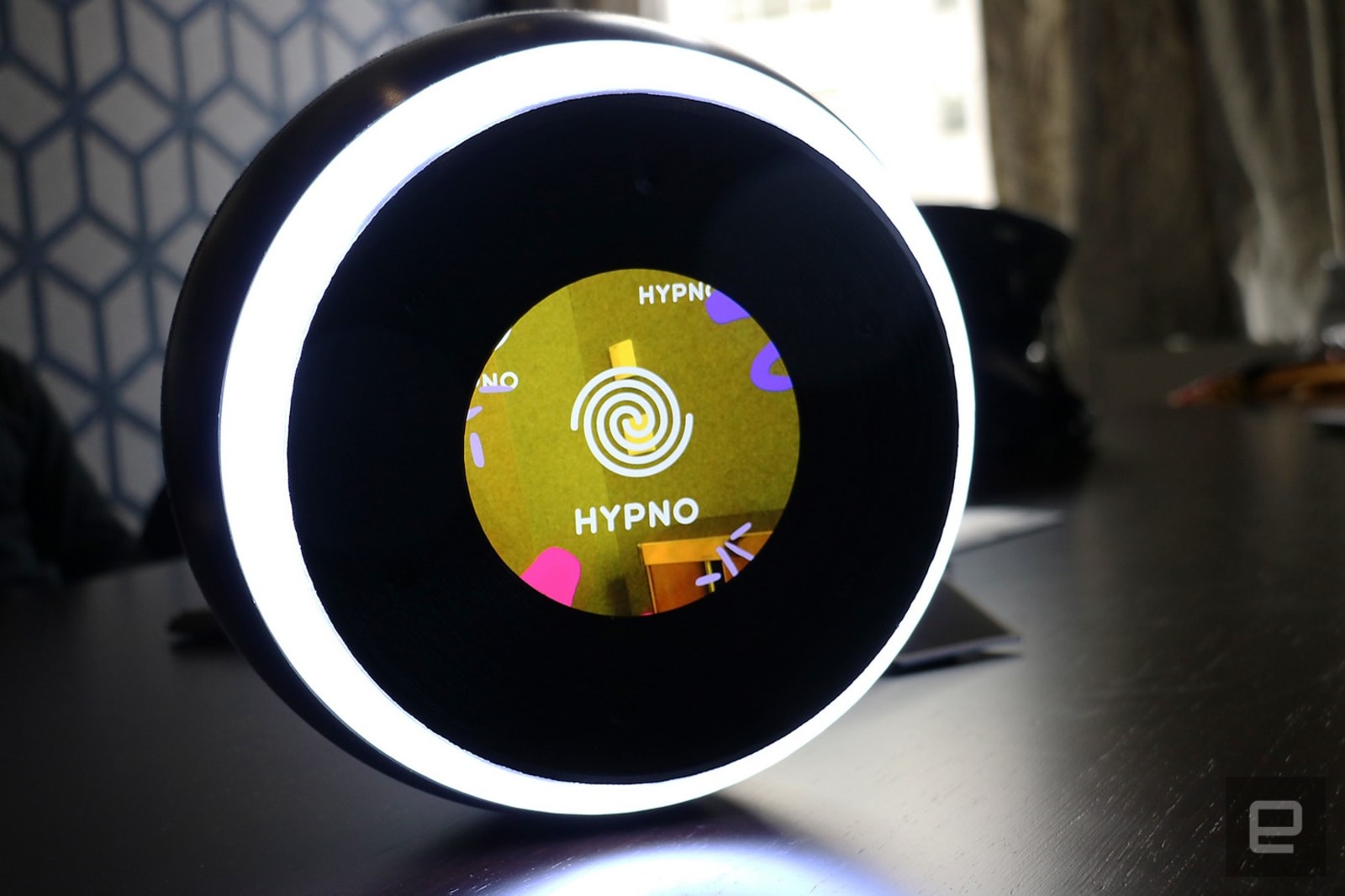
To protect its fragile hardware from damage on the dancefloor, Hypno encased the Eye in a hardy, rubbery foam shell that felt sturdy enough to survive a few bounces. “This allowed people to toss the camera into crowds of people without fear of injury to the device,” the docent might explain. “Though we imagine a few humans may have been hurt by the five-pound ball.”
“But why couldn’t they just use their smartphones? They had those at the time, right?” A curious visitor might ask.
Excitedly pointing a finger up in the air, the guide would respond, “It’s all about facilitating social interaction!” Since people didn’t feel like they could simply discard the orbs after they were done, they were compelled to make contact with other attendees.
“They would pass these orbs around, often to people they didn’t know. This caused them to join each other in group photos, and encouraged the social phenomenon that was known back then as ‘photobombing’.” At this point, the guide might invite visitors to peruse the video archive of 2018’s trendiest partiers. “Like the photo booths that came before, the clips from the Eyes could be posted on individual social media accounts, which you all remember was the primary means of interaction in that time.”

Although the Hypno Eye wasn’t designed for widespread use in people’s homes, the company did entertain the thought of selling the device to general consumers. As the guide might point out, “Remember the ‘influencers’ that rose in popularity during this time? Couldn’t you just see them embracing this, literally?”
Source: Hypno
Apple added two dozen self-driving SUVs to its California test fleet
Last April, Apple was granted a permit to test its autonomous vehicle technology by the state of California and since then, the company has expanded its test fleet from three vehicles to 27, Bloomberg reports. The California Department of Motor Vehicles said that Apple had registered 24 Lexus RX450h SUVs between last July and this month. While initially aiming to develop its own autonomous vehicle, Apple later decided to switch gears and design a self-driving system that could be incorporated into other vehicles. And we’ve seen glimpses of that technology in recent months. A patent application, a presentation from Apple AI Research Director Ruslan Salakhutdinov and a research paper have all pulled back parts of the curtain Apple’s technology development usually hides behind. And a closeup look from Voyage cofounder MacCallister Higgins gave us a bit of a visual.
There are many players in the autonomous vehicle field and Apple has a lot of competition. Companies like Waymo, Uber, Toyota, Lyft, GM, Renault, Baidu, Mercedes-Benz, Volvo, Honda and Yandex are all working on self-driving technology and many have much larger testing operations than Apple. Waymo, for example, is testing its vehicles in California, Washington, Texas, Arizona, Georgia and Michigan and is working on expanding its self-driving test fleet to 600 Chrysler Pacificas. Meanwhile, Uber has been testing its technology in multiple states including California, Arizona and Pennsylvania for the last two years and signed a deal with Volvo last year that will bring the company a fleet of 24,000 XC90 SUVs with which to outfit its tech. Apple has a bit of catching up to do.
Via: Bloomberg
iOS 11.3 Firmware Subtly Hints at iPad With Face ID
Apple is planning to release a next-generation iPad Pro this year with slim bezels and Face ID, like the iPhone X, according to Mark Gurman at Bloomberg News, and evidence of the tablet may have been uncovered in iOS 11.3.
iPad Pro with Face ID mockup by Carlos Guerra
iHelpBR editor Filipe Espósito has discovered strings in the first iOS 11.3 beta that refer to a “modern iPad,” which is notable since Apple’s software engineers referred to the iPhone X as the “modern iPhone” in older firmware, according to both Espósito and developer Guilherme Rambo.
Yep, there’s definitely some references to a “Modern iPad” inside iOS 11.3. pic.twitter.com/JHHone2R1D
— Filipe Espósito (@filipekids) January 25, 2018
While the “modern iPad” strings could be placeholders, as commonly found in Apple’s code, the discovery lends credence to rumors of an iPad Pro with Face ID, which would certainly be a logical next step in Apple’s product roadmap.
“Modern iPhone” meant iPhone X. “Modern iPad” is probably an iPad with Face ID https://t.co/pbMAMj3QCe
— Guilherme Rambo (@_inside) January 25, 2018
KGI Securities analyst Ming-Chi Kuo also expects Apple to release a new iPad Pro with Face ID this year, so there is a good chance the rumor is true. Like the iPhone X, the tablet reportedly lacks a Home button, although it will likely still have an LCD instead of OLED display due to supply, cost, and technological constraints.
It’s unclear if the iPad Pro will have a notch for the TrueDepth system, as illustrated in the first mockup above, or if the device will have uniformly slim bezels on all four sides with enough room for the Face ID sensors.
 iPad Pro with slim bezels rendered by Benjamin Geskin
Face ID is also expected to be featured on a second-generation 5.8-inch iPhone X, a larger 6.5-inch version dubbed iPhone X Plus, and a new, cheaper 6.1-inch model with an LCD, aluminum frame, and no 3D Touch.
Related Roundups: iPad Pro, iOS 11Tag: Face IDBuyer’s Guide: 10.5″ iPad Pro (Neutral), 12.9″ iPad Pro (Neutral)
Discuss this article in our forums
 AIVAnet