


Facebook settles out of court in unique revenge porn case
Facebook may have left itself wide open to whole heap of legal headaches after it recently reached an out-of-court settlement in a revenge porn case. Between late 2014 and early 2016, the naked picture of a 14-year-old girl from Northern Ireland was repeatedly shared to a “shame” page on Facebook. Police are said to have failed to act fast enough to build any kind of case, so the girl, who said she was blackmailed into sharing the image in the first place, sued the alleged perpetrator and Facebook instead. After exhausting efforts to get the case dismissed from the High Court, Facebook negotiated a confidential settlement with the teen, which is thought to be the first time anyone has achieved the slightest success in a suit of this kind.
Facebook has been named as the co-defendant on several publicized revenge porn cases, but nothing has come of them. The social network argues, and judge’s agree, that it’s merely a platform and not responsible for what bad actors post to its pages. Revenge porn only became a specific criminal offense in Northern Ireland in early 2016, almost a year after it was recognized in other parts of the UK. It carries a maximum jail term of two years. Facebook wasn’t charged under these laws, of course. The teen sought damages for misuse of private information, negligence and breach of the Data Protection Act. Her lawyers argued that while Facebook took down the images when notified, it did not do enough to stop the person responsible from reposting.
Since Facebook settled, this case doesn’t set any kind of legal precedent, nor does the social network shoulder any blame. The company told the BBC that “for legal reasons, we are only at liberty to state that no judgement has been rendered in this case and that there has been no determination of any actual or potential liability for Facebook.” But settling, as anyone that’s ever watched a courtroom drama knows, is as good as admitting defeat. For anyone considering a similar civil suit against Facebook, Twitter or others, there’s now an example of someone sorta winning. Not a precedent, but something close.
Even worse for Facebook, the case calls the social network’s self-policing efforts into question once again. Naturally, Twitter has a revenge porn problem too, and both platforms are taking steps to combat it. Facebook may have actually avoided this particular lawsuit had one of its latest tools — which uses photo matching to stop images being republished — been available earlier. In Australia, you can even send nudes to Facebook to proactively block if you think there’s a chance they might get shared. That might seem just strange, but when you’re scanning for revenge porn, fake news, hate speech, harassment and everything in between, any heads-up is welcome.
Via: The Register
Source: The Irish Times
US Congress reportedly lobbied AT&T to dump Huawei smartphones
AT&T recently revealed that it wouldn’t carry Huawei smartphones, despite rumors that it would be the first US carrier to do so, raising suspicions that politics played a part in its decision. Now, Reuters is also reporting that US lawmakers did indeed pressure AT&T to drop its plans to carry handsets from the Chinese company. Furthermore, Senators and House members are also pressuring AT&T to end its collaboration with Huawei on standards for its next-generation 5G network.
The government is telling companies that dealing with Huawei, China Mobile and other firms could harm their ability to procure government contracts. “The next wave of wireless communication has enormous economic and national security implications,” said Michael Wessel of a US-Chain security review commission. “China’s participation in setting the standards and selling the equipment raises many national security issues that demand strict and prompt attention.”
To back that up, Congress has proposed a bill that would bar any government agency from working with Huawei over spying concerns. It claims that, according to the CIA, NSA, FBI and other agencies, Huawei has shared sensitive information with China, and that Chinese security agencies can access private US business communications via Huawei tech.
China’s participation in setting the standards and selling the equipment raises many national security issues that demand strict and prompt attention.
Huawei has long protested that its equipment contains no backdoors that could threaten US communications infrastructure, however. It told Reuters that its equipment is used by 45 of the world’s top 50 carriers, and that security for its clients is paramount. China also counter-accused US companies like Cisco of providing potentially insecure switches and other equipment.
The Huawei issue drew the attention of the Chinese foreign ministry, which said that “we hope that China and the United States can work hard together to maintain the healthy and stable development of trade and business ties.” Though no handsets from companies like Xiaomi, Huawei and ZTE are available through US carriers, Apple’s iPhones and other devices are sold by China Telecom, China Unicom and other carriers. In fact, the iPhone 7 was the second-best-selling smartphone in China behind the Oppo R9S.
Apple recently built its iCloud data centers in China in order to comply with laws, raising concerns about the security of data from users in other nations. CEO Tim Cook admitted as much, but said the message was simply a “mistake.”
Source: Reuters
iPhone Was Most Activated Smartphone in United States Last Quarter According to Survey
Apple increased its share of smartphone activations in the fourth quarter of 2017, following the release of the iPhone 8, iPhone 8 Plus, and iPhone X, according to data shared with MacRumors by Consumer Intelligence Research Partners.
iPhones accounted for 39 percent of activations in the United States between October and December, up from 34 percent in the year-ago quarter, based on CIRP’s survey of 500 people who activated a new or used smartphone during that period.
Samsung was the runner-up with a 32 percent share of activations during the quarter, trailed by LG at 13 percent. All other smartphone vendors, including Motorola, HTC, and others, accounted for the remaining 16 percent share.
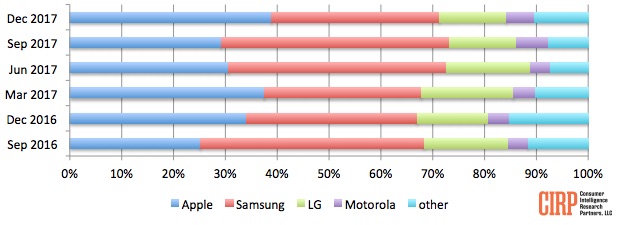
The survey findings are rather unsurprising given a trio of new iPhones launched between late September and early November, while Google’s Pixel 2 and LG’s V30 were essentially the only major Android smartphones to debut during the quarter.
CIRP co-founder Josh Lowitz:
Apple’s iOS increased its mobile operating system share in the US in the most recent quarter. While Android still leads, the launch of the new iPhone 8, 8 Plus, and X models, without similar new Android phones, allowed Apple to increase its share of activations in the quarter, relative last quarter and to the year-ago quarter.
The survey also shows that Apple and Samsung continue to form a smartphone duopoly in the United States, with no sign that’ll change any time soon.
Related Roundups: iPhone 8, iPhone XTags: Samsung, CIRP, AndroidBuyer’s Guide: iPhone 8 (Neutral), iPhone X (Buy Now)
Discuss this article in our forums
Facebook’s Hugo Barra says standalone headsets are key to social VR
Even though Oculus didn’t have an official presence at CES this year, its leader, Hugo Barra, made a surprise appearance at Qualcomm’s press conference to make an important announcement: Xiaomi would be its global hardware partner for Oculus Go, its first standalone VR headset. What’s more, Xiaomi would also be making a special variant of the Go, the Mi VR Standalone, especially for China. In an interview with Barra following the press conference, he explained the reason for the push in standalone headsets: social VR.
“This is a product category that will help us bring the most number of people into VR and really start unlocking these opportunities for social presence,” said Barra. “It’s the idea of having a completely self-contained product that you can just put on and start using it. You can do everything in one step.”
“Everything is integrated together in one device,” he continued. “That is the best experience that we think can be created.”
When Facebook CEO Mark Zuckerberg stood on stage at last year’s Oculus Connect and said that he wants to bring VR to a billion people, he really meant it. And a key reason for doing so is not just to sell hardware or games — although that’s obviously a pretty good incentive as well — but it’s to further Facebook’s agenda of connecting the world via social VR.
“The vision that we have is for VR to enable people to spend time together and to do things together that they otherwise wouldn’t be able to,” said Barra. “It could be something as simple as Facebook Spaces, where you get in a place together with your avatars and interact. But it could also be watching something together, or playing a game together or doing any number of things together.”

“And, of course, the more people we have in VR, the more people are going to start spending time together [in VR]. Which brings us back to why standalone VR is a huge focus for us.”
In 2016, Oculus first showed off Project Santa Cruz, a prototype of its higher-end standalone headset, to a select group of reporters. But last year, it announced that it was working on a lower-end and much more affordable version of it called the Oculus Go. It’ll be priced at just $199, and importantly, it’s the product that Facebook hopes will drive the VR category to the masses.
The other part of Oculus’ quest to spread VR to as many people as possible is its new partnership with Xiaomi. “[Xiaomi] is a very exciting, innovative company,” said Barra of his former employer. But more important, he said, Xiaomi has a history of making high-quality products at very affordable prices. Also, while the Mi Standalone VR does share the same core features as the Oculus Go, Barra said there are aspects to its hardware and, more importantly, its software, that makes it highly localized to the Chinese market.
“It was very important for us to work with a partner who could bring a lot of leadership and expertise about the Chinese market,” he added. “It’s a market that is very important for us because we want to bring VR into as many hands as possible.”
There’s certainly evidence to suggest China’s importance in the VR industry. According to a Canalys report, China accounted for 40 percent of VR shipments in 2016, while an IDC report suggests that China is on pace to become the world’s largest market for virtual- and augmented-reality headsets by 2020. This is in part due to China’s billion-plus consumer base, but also the rapid growth of VR-related startups in the country in recent years.

Facebook isn’t the only company investing in standalone VR. Google, for example, unveiled a standalone Daydream headset, the Lenovo Mirage Solo, at CES. The Mirage Solo sets itself apart from the Oculus Go with Google’s WorldSense technology, which gives it six degrees of freedom and positional tracking without external cameras or sensors. But the Mirage Solo is also tentatively priced at around $300, which is $100 more than the Oculus Go.
Barra doesn’t seem worried about the competition. “We pride ourselves first and foremost on being the leaders in VR,” he said. “We’ve been doing this for a very long time. We have a pretty high degree of confidence that the Oculus VR experience is the best, by a wide margin, from anything else you see out there.”
Facebook’s heavy investment in standalone headsets doesn’t mean that it’s giving up PC or mobile-based VR. “Standalone is the newest one, and is obviously one that we’re really excited about,” said Barra. Mobile VR is still very important, because it’s the lowest barrier to entry, while the Rift offers the highest-quality VR. “We believe in all three,” he said.
But in the end, Barra believes that standalone headsets are the future. It will be, he says, the easiest way to get people to use VR. “The Oculus Go will be our most successful VR product on the market,” he said. Whether or not that will ultimately lead to mass social VR adoption, however, remains unclear.
Click here to catch up on the latest news from CES 2018.
Amazon Starts Taking Pre-Orders from U.K. Customers for Echo Spot
Amazon began taking pre-orders from U.K. customers for its Alexa-powered Echo Spot speaker on Tuesday. Announced along with all-new Echo models in September 2017, the compact display-and-speaker unit has only been available in the U.S. before now.
The Spot is capable of standard Amazon Echo functions like controlling smart home devices and streaming music, but can also show users additional information like song lyrics, weather forecasts, and the time on its 2.5-inch display.
The circular unit can also play content from Amazon Video and YouTube, just like its bigger brother, the Echo Show.
The Echo Spot costs £120, although Amazon is currently offering a discount of £20 per unit when two are bought together (£200). Pre-orders are expected to ship on January 24, which means the entire Echo family will be available to U.K. customers from then on.
The Echo dot was the top-selling Amazon device over the 2017 holiday season, as well as “the best-selling product from any manufacturer in any category across all of Amazon,” according to the e-commerce company.
As Amazon’s Alexa devices continue to dominate the smart speaker market, Apple has plans to release its own music-focused smart speaker device, called HomePod, early this year.
HomePod will be controlled mainly through the user’s voice using Siri, and include access to Apple Music and other expected smart speaker functionalities, like asking about the weather, traffic, setting reminders, timers, and more.
Note: MacRumors may benefit from affiliate links clicked in this article
Tags: Amazon, United Kingdom, Amazon Echo
Discuss this article in our forums
Twitter Rejects Claims It Snoops on Private User Data Including Direct Messages
Twitter has rebuffed claims by a conservative media outlet that its staff monitor users’ private data, including direct messages sent over the social network (via TechCrunch).
Earlier this week, Project Veritas, which hosts sting operation-style videos produced by self-proclaimed “guerrilla journalist” James O’Keefe, posted footage that appears to show Twitter engineers admitting that teams of employees access users’ data.
In one brief clip, a senior network security engineer appears to say that the social media company would be able hand over President Donald Trump’s data, including deleted tweets and direct messages, to the Department of Justice, subject to a subpoena.
Last week, Twitter criticized Project Veritas in a public statement for its “deceptive” and “selectively edited” report.
We deplore the deceptive and underhanded tactics by which this footage was obtained and selectively edited to fit a pre-determined narrative. Twitter only responds to valid legal requests and does not share any user information with law enforcement without such a request.
Referencing its privacy policies and terms of service which explain how it holds and stores information that users choose to share, Twitter said it is “committed to enforcing our rules without bias and empowering every voice on our platform, in accordance with the Twitter Rules”.
Project Veritas has been criticized in the past for using underhand and deceitful methods in its investigations. In November last year, one of its undercover employees was caught trying to bait reporters at The Washington Post by falsely claiming to be a sexual assault victim of Republican U.S. Senate candidate Roy Moore.
Twitter regularly reveals the number of legal requests it receives and responds to in its biannual transparency report. The company received 2,111 government information requests in the U.S. and produced at least some information for 77 percent of them during the period between January 1 and June 30, 2017.
Note: Due to the political nature of the discussion regarding this topic, the discussion thread is located in our Politics, Religion, Social Issues forum. All forum members and site visitors are welcome to read and follow the thread, but posting is limited to forum members with at least 100 posts.
Tag: Twitter
Discuss this article in our forums
Amazon’s Echo Spot bedside speaker clock comes to the UK
Last year was a big year for Alexa. First, Amazon released updated versions of its popular Echo speakers and then brought its smart assistant to screens with the launch of the Echo Show and the Echo Spot. However, like many Amazon products, they often take their time to travel across the Atlantic. The Echo Show took around five months to launch in the UK and we’ve been waiting since September for its smaller sibling to make its debut. Today, Amazon announced that its smart alarm clock will cost £120 and is now available to pre-order.
Actually, calling the Echo Spot a smart alarm clock is doing it a disservice. It is essentially a smaller Echo Show that is designed to sit beside your bed. It plugs into Alexa, connects to your smart home, handles video calls and displays up-to-the-minute updates via its circular 2.5-inch display. Due to its lack of size and reduced output, it’s also a lot cheaper than the Echo Show, which will set you back £200.
To incentivise pre-orders, Amazon UK is offering an Echo Spot two-pack for £200, a saving of £40. The company says that orders will begin shipping from January 24th.
Via: Amazon Press Office
Source: Echo Spot (Amazon UK)
TAG Heuer covered its smartwatch in real diamonds
If you like your tech on the bling side, we’ve got good news for you. Watchmaker TAG Heuer has revamped its 18K white gold Connected Modular 45 smartwatch with no less than 589 baguette-sized diamonds — 23.35 carats’ worth in fact — and it can be yours for a mere $197,000 (£143,000). The watch, which takes the title of most expensive smartwatch in the world, is basically just last year’s $1,600 Connected Modular 45 with a makeover. Underneath all the ice is the same Android 2.0 device with the same tech. And while there was surprising demand for the original when it first came out, something tells us that the Full Diamond model won’t see quite the same level of sales.
Via: CNet
Source: TAG Heuer
YouTube Currently Testing New Dark Mode for Mobile iOS App
YouTube appears to be in the testing phase of adding a new dark theme for its official iOS app, according to reports.
Some Reddit users revealed on Monday night that a new dark mode was already live as an option in the Settings section of the app after updating to version 13.01.4.
Dark mode via Redditor amievengabereal
However, as of this morning, rollout of the feature still seems to be limited to a handful of users, suggesting a selective server-side activation on YouTube’s end.
App Store release notes for YouTube version 13.0.1 make no mention of the dark mode addition either, but we’ll update this article if the rollout gains pace anytime soon.
YouTube is a free download for iPhone and iPad. [Direct Link]
Tag: YouTube
Discuss this article in our forums
Boeing unveils the design of a hypersonic plane that could hit 3,800 mph
The battle is well and truly on to replace Lockheed Martin’s legendary SR-71-“Blackbird” hypersonic plane after Boeing this week unveiled a concept design that takes high-speed flight technology to the next level.
Dubbed the “son of Blackbird,” Boeing’s design is a direct competitor to Lockheed’s under-development SR-72 and would travel at five times the speed of sound (Mach 5) — or 3,836 mph (6,174 kmh). To put that in perspective, your run-of-the-mill Boeing 787 Dreamliner passenger jet has a cruising speed of around 560 mph (903 kmh), while the McDonnell Douglas F-15 Eagle fighter plane can push the dial to around 1,650 mph (2,665 kmh).
So yes, a ride in Boeing’s design would have your eyeballs pressing against the back of your skull and your stomach searching for an orifice through which to escape.
Boeing’s concept (above), revealed at the American Institute of Aeronautics and Astronautics SciTech forum in Orlando, Florida, reveals a sleek design that could one day be used for both reconnaissance and combat missions.
Clearly mindful of the huge challenges that come with designing such an aircraft, Boeing chief scientist for hypersonics Kevin Bowcutt told Aviation Week recently: “It’s a really hard problem to develop an aircraft that takes off and accelerates through Mach 1 all the way to Mach 5 and beyond.”
Bowcutt said Boeing is working on developing the aircraft in two stages, with the first involving test flights of an F16-sized, single-engine precursor aircraft to prove the design’s viability. After that, the team would aim to develop a “twin-engine, full-scale operational vehicle” similar in size to the 107-foot-long SR-71.
Boeing will draw on its experiences developing the experimental and unmanned X-43 and X-51 Waverider hypersonic planes, Popular Mechanics reported.
The X-51 had its first fully successful test flight in May, 2013, flying at Mach 5.1 for three and a half minutes before running out of fuel and crashing into the Pacific.
But the X-51 was dropped from a larger aircraft before using a rocket booster to reach Mach 4.8. It then jettisoned the booster and used a scramjet engine to reach Mach 5. “A hypersonic replacement for the SR-71 would need to take off under its own power, accelerate through Mach 1 and up to above Mach 5, and then slow back down and land, a much more difficult challenge,” Popular Mechanics pointed out in its report.
Editors’ Recommendations
- Boeing unveils prototype refueling tanker drone for aircraft carrier operations
- United’s Boeing 747s have flown into the sunset, here’s why ‘Jumbo’ fans are sad
- Take to the virtual skies with these free flight simulators
- Airbus hybrid-electric plane project gets a boost from Rolls-Royce
- Out of this world rides: The best futuristic cars from science fiction movies
 AIVAnet