


The best mobile photo-editing apps
There’s no shortage of photo-editing apps for mobile devices. But if you want to graduate beyond Instagram filters, the sheer number of listings on the App Store or Google Play can be overwhelming. We’ve sifted through dozens to find the ones worth your time (and money, in some cases).
A word about built-in photo apps
The Photos app on iOS got a big upgrade with iOS 11 and works well for basics like adjusting exposure, cropping and applying a quick filter, but doing anything more than that is tough. Same goes for Google Photos on Android. These stock apps are fine if you’re looking to treat your smartphone like a traditional point-and-shoot camera, but for the purpose of this list we’re focusing on bridges between quick filters and full-on desktop editing suites.
Lightroom CC

For a while, Adobe spent all its energy updating Lightroom on mobile, much to the chagrin of longtime desktop customers. While frustrating for everyone else, that diligence paid off in spades for the Android and iOS users. Lightroom CC on mobile boasts state-of-the-art AI photo processing with a one-touch auto-adjustment mode, in addition to capturing and editing RAW files. There’s also HDR photo capture and a slew of presets and tweaks that should feel familiar to desktop users. More than that, everything you take on your phone will sync with Lightroom CC on your computer or tablet, meaning you can start an edit on one device and finish it on another.
There are a few drawbacks to be aware of (no perspective corrections, HDR that sometimes looks over-processed), but even so, Lightroom CC belongs on your device if you’re serious about mobile photography.
Snapseed
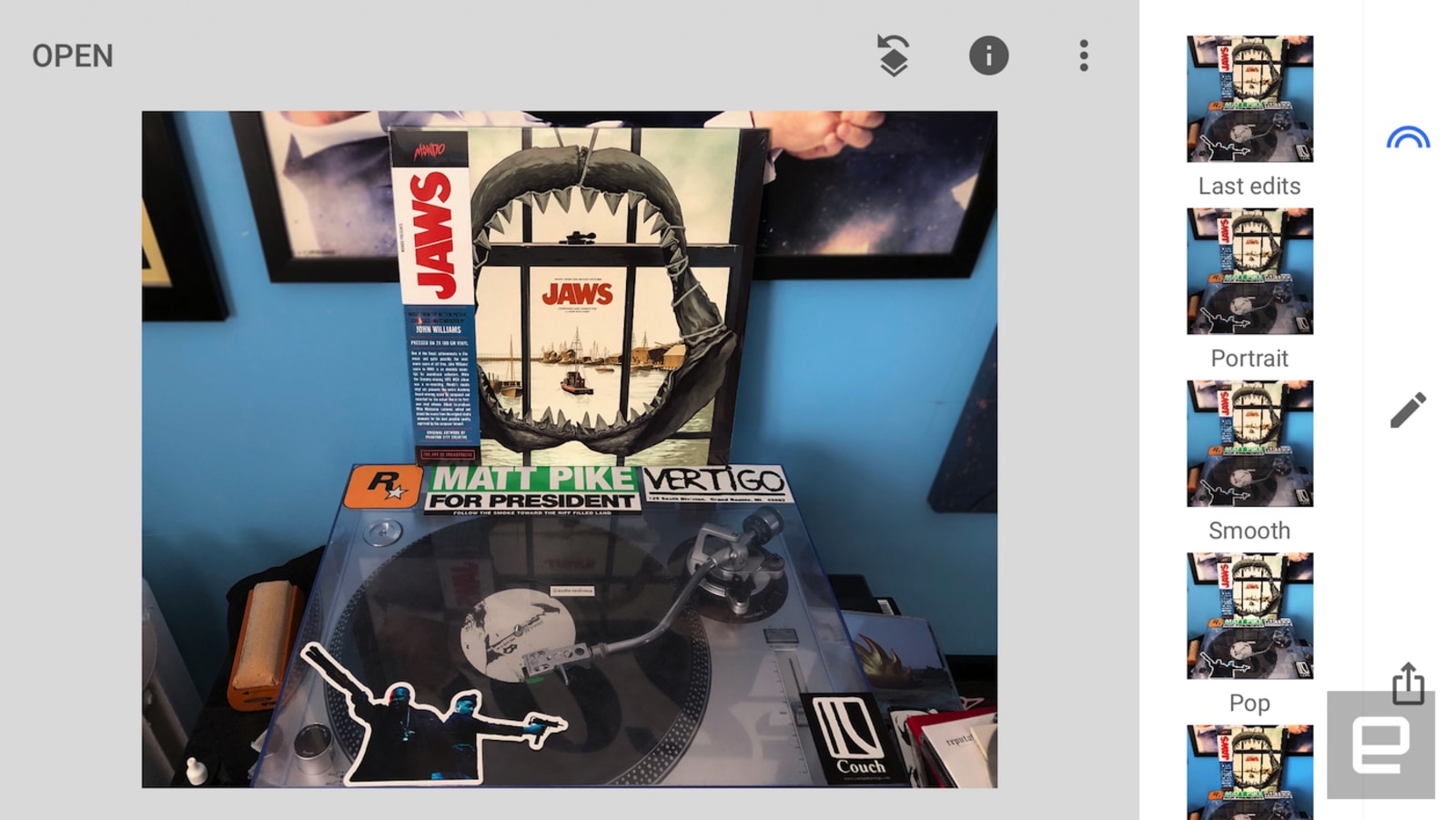
Of all the apps on this list, Google’s Snapseed might strike the best balance between capabilities and overall user-friendliness. The free photo-editing app leans on AI to detect faces and has a number of handy presets that can take your photos from flat to dramatic with the press of a button (“portrait” is especially versatile). Speaking of presets, you can also make custom settings for easier batch editing. Snapseed also has perspective-correction tools for when you aren’t able to get a shot lined up just right.
Features like double exposure and head posing are a little gimmicky, but things like manually adjustable curves for color channels, contrast and saturation help make up for those. Maybe best of all, you can overwrite an original photo upon export rather than creating a copy. It’s a small step toward reducing clutter on your device or cloud storage library, but it makes a big difference.

Timothy J. Seppala/Engadget
VSCO
If you routinely find yourself cursing Instagram’s algorithm, maybe VSCO (right) is the app for you. In addition to its editing tools and photo presets, the app is also a full-fledged social network with private messaging and a feed of pictures from the community, VSCO itself and people you’re following. The app also offers how-tos, GIF editing, video editing and support for RAW capture and editing. And, of course, there are myriad presets (free and paid) if you need to post something in a hurry but don’t want to sacrifice style. Ponying up for a subscription grants access to interactive presets that mimic classic film stocks like Fuji Pro 400H and Kodak Portra 160 and 400.
Prisma
Prisma became passé shortly after its debut, but that doesn’t mean its cloud-powered photo editing is any less impressive. The app’s distinctive, artistic filters truly stand out from what’s available elsewhere, taking inspiration from pointillism, Monet, fractals and a ton of styles in between. You can make your own painterly looks as well, and can even apply it or a premade style to video too. Taking a photo or video and making it look like a work of fine art is dead-simple (one press does it all), which makes Prisma an attractive proposition for both newcomers and the more experienced among us.

Timothy J. Seppala/Engadget
The downside is that Prisma’s headlining feature requires a data connection, so editing away from home will run your battery down and count toward whatever data cap you might have. Just remember to turn off the watermark before exporting; it’s not like anyone will need help identifying where you edited your latest masterpiece.
Photoshop Express
For when you need some extra muscle for your mobile edits, there’s Photoshop Express. In addition to a smattering of filters and presets, Express also features powerful local adjustments for things like red-eye and blemish removal. There are also features for making collages and adding professional-looking text overlays to photos. Another unique feature is its selection of crop settings. You can trim a picture to fit different social-media needs, be it a Facebook cover photo, YouTube thumbnail or even a LinkedIn background.
And like Lightroom, if you’re an Adobe CC subscriber your edits will sync across devices. You can even export a photo from the mobile app to desktop, and once the upload is complete Photoshop will open on your computer so you can make any advanced changes before publishing. Yeah, it feels pretty futuristic.

Steve Jobs Introduced the MacBook Air Exactly 10 Years Ago Today
Today marks the tenth anniversary of the late Steve Jobs unveiling the MacBook Air, the world’s thinnest notebook at the time.
After introducing the AirPort Time Capsule and sharing some iPhone and Apple TV news, Jobs walked over to his podium, grabbed a manilla envelope, and pulled out the sleek MacBook Air. The crowd at Macworld erupted with applause as Jobs held the ultra-light notebook in the palm of his hand.
The thinness came at a cost. The base model ran $1,799 for a 1.6GHz Intel Core 2 Duo processor, 2GB of RAM, and an 80GB hard drive. A maxed out version was also available for $3,098, around $300 more than the base Mac Pro at the time, with a faster 1.8GHz processor and a 64GB solid-state drive.
MacBook Air was all about firsts. The notebook was Apple’s first without a CD/DVD drive, first to ditch a range of ports and connectivity options, first with a multi-touch trackpad, first to have the option for SSD storage, first to weigh just three pounds or less, and first with a mercury-free display.
A single design decision also epitomized the past decade of Apple: a flip-down door on the right side of the machine provided access to only a single USB port, a headphone jack, and a micro-DVI port.
We’ve seen Apple go down this path many times since: it introduced the MacBook with just a single USB-C port, reduced the MacBook Pro’s connectivity to Thunderbolt 3 ports, and removed the headphone jack on the iPhone 7. Each change generated controversy, but ultimately set the course for its future.
Stephen Hackett of 512 Pixels has shared a great piece titled The MacBook Air: A Decade’s Worth of Legacy over at MacStories that dives into the notebook’s history. He also put together the video below.
A decade later, the MacBook Air remains a product in Apple’s lineup, but likely only because it is a lower-cost option. Beyond a minor speed bump last June, the notebook hasn’t been updated since March 2015, and it very well may be discontinued once Apple feels able to sell its 12-inch MacBook for around $999.
Related Roundup: MacBook AirTag: Steve JobsBuyer’s Guide: MacBook Air (Neutral)
Discuss this article in our forums
Nearly all new US electricity capacity was renewable in 2017
Renewable energy played an important role in the US last year… although you might not want to cheer too loudly. Data from both the Rhodium Group and the Energy Information Administration shows that solar and wind power represented 94.7 percent of the net new electricity capacity (15.8GW out of 16.7GW) added in 2017. However, that’s mainly because fossil fuel power continued to fade away. Electrek noted that plant closures removed 11.8GW of utility-scale fossil fuel power from the equation — this was more a testament to the decline of coal than a triumph for green tech.
In a sense, renewable energy was bound to face an uphill battle. Solar and wind power had a banner year in 2016 (16.7GW in new utility capacity), with solar power in particular setting a record for new installations. Unless that breakneck pace kept up, the 2017 figures were never going to be especially flattering. There was an important milestone, mind you. Solar and wind electricity surpassed a combined 10 percent of electricity use for the first time in March, so it’s clearly finding some use.
The environment didn’t see much benefit, mind you. CO2 emissions dropped 1 percent in 2017, which sounds fine until you realize that emissions dropped an average of 1.6 percent between 2005 and 2016. The EIA even expects emissions to increase in 2018.
The data represents a mixed bag as a result. This suggests that the Trump administration’s early efforts to prop up fossil fuels aren’t having much success, and that the market will gradually shift to renewables regardless of the White House’s intentions. However, it’s not necessarily booming to the extent it did in the past. And when the US government clearly isn’t interested in offering a helping hand, a resurgence is considerably less likely.
Via: Electrek
Source: Rhodium Group
Google freezes addiction center ads after word of sketchy referrals
Google rarely stops advertising for an entire category, but it’s making that exception to halt some serious abuses. The search firm has temporarily stopped running addiction center ads worldwide after a report revealed that sketchy referral services in the UK were earning huge, undisclosed referral fees (to the tune of tens of thousands of dollars) from addiction centers looking for new patients. The company had already stopped offering these ads in the US following concerns about the practice in September, but the complexity and “varying degrees of regulation” around the world had persuaded it to stop all activity while it searched for a “better way” to help addicts.
The move will phase out ads through a gradual region-by-region process. When they come back will depend on Google figuring out a safe way to provide ads without allowing companies that rely on giant referral commissions.
The incident illustrates the challenges Google faces as a de facto health resource for many internet users. While it wants to steer people toward help, it also has to deal with dodgy companies that prey on these same vulnerable people. The momentary pause may have only come after media stories drew attention to the problem, but it’ll still be helpful if it leads to more trustworthy health ads.
Source: TechCrunch
Apple and Tim Cook Honor the Life of Dr. Martin Luther King, Jr.
Apple today has honored the life of Dr. Martin Luther King, Jr. with a full-page tribute on its website. A photo of Dr. King is accompanied by a famous quote of his: “The time is always right to do what is right.”
Apple CEO Tim Cook also shared a quote from Dr. King on Twitter and added “let’s find the light and the love, together.”
“Darkness cannot drive out darkness; only light can do that. Hate cannot drive out hate; only love can do that.” Let’s find the light and the love, together. #MLK
— Tim Cook (@tim_cook) January 15, 2018
Today is Martin Luther King Jr. Day in the United States, a federal holiday in commemoration of his birthday. The iconic leader of the African-American civil rights movement would have turned 89 years old on Monday.
Note: Due to the political nature of the discussion regarding this topic, the discussion thread is located in our Politics, Religion, Social Issues forum. All forum members and site visitors are welcome to read and follow the thread, but posting is limited to forum members with at least 100 posts.
Tags: Tim Cook, Martin Luther King Jr
Discuss this article in our forums
Corning’s glass is half full and rising
The name Corning is synonymous with glass and with good reason.
It was Corning that developed the bulb-shaped glass for Edison’s incandescent lamp; Corning’s heat-resistant glass made safer railroad lanterns, technology which evolved into car headlights; CorningWare and Pyrex provided temperature resistance in kitchens and labs, and its glass ceramics were even employed in the nose cones of space ships.
Today we associate the name with Gorilla Glass, which is widely used in the mobile industry, but Corning is also a big manufacturer of display glass for TVs, optical fiber for communications, and the glass in catalytic converters for cars. The company recently unveiled Valor Glass, a new glass packaging product for use in the pharmaceutical industry, and it’s making further inroads in the automotive sector with car exteriors and interiors.
“We are really driven by this belief that we can continue to make life-changing innovations,” Chief Strategy Officer Jeff Evenson told Digital Trends. “We see a material with almost unlimited potential. We can make it strong, we can adjust its optics, we can adjust its chemical properties, we can adjust its thermal expansion behavior or lack thereof, we can adjust its electronic properties, and obviously we can adjust its color and other aesthetic properties.”
166 years of expertise
Now in its 166th year, Corning has 107 facilities and employs more than 45,000 people. Its global headquarters and research and development center is, naturally, based in Corning, in upstate New York, but it has facilities and employees all over the world. Most recently the company acquired an empty, million-square foot plant in Eugene, Oregon, which was previously the Hynix computer-chip plant. Corning has yet to reveal what it plans to make there.
Corning Incorporated
Corning Incorporated
Corning Incorporated
Corning Incorporated
While Corning is a household name, much of the work it does is behind the scenes, producing glass that goes into other manufacturer’s products. Most of its $9.4 billion sales in 2016 were generated by producing glass layers for TVs, and optical fiber strands for telecommunication networks.
“The display industry is our largest business in terms of sales and earnings,” Evenson said. “We account for a little bit more than 50 percent of the glass that goes into all televisions around the world.”
“We see a material with almost unlimited potential.”
Its Gen 10.5 glass technology allows it to make a piece of glass that’s as thin as a business card, has the area of roughly two king size beds, and is flat to within 200 atoms all over without polishing. It’s not something that can be practically shipped, so Corning builds its factories contiguously with the panel maker’s enormous plants.
“The main TV in someone’s living room continues to grow larger and that’s the biggest trend and driver of volume for us,” Evenson said. “These large pieces of glass allow manufacturers to make large TVs much more cost effectively.”
The same manufacturing techniques are employed for the increasingly tough Gorilla Glass that covers many of our smartphones, and the display glass inside them, though the formulation is different.
“Our second largest business is optical communications,” Evenson explains. “Worth in excess of $3 billion in sales, we sell not only optical fiber, but a lot of the connectors and cables that go around it.”
Corning advanced the development of optical fiber in 1970 after winning a competition issued by the British Post Office Telecommunications department, which would later become British Telecom, to create a light pipe that could keep at least 1 percent of the light over a kilometer. Corning scientists used a technique called vapor deposition, originally developed to produce high quality glass for telescope lenses to create strands of glass with very high purity.
“They were really focused on low thermal expansion, and what they observed was that the irregular expansion you’d get in normal glass that you’d have in a window was caused by impurities,” Evenson said. “They realized that you’d have to start with gasses instead of sand to control the purity. So, they learned to turn the gasses into a solid and then eventually remelt the solid and make it into a glass and that’s how optical fiber is made.”
Last September, Corning passed its billionth kilometer of optical fiber sold. It has been investing heavily in fiber plants in North Carolina and elsewhere to support higher levels of production ahead of the shift to 5G. Verizon has already agreed to a $1.05 billion three-year minimum purchase agreement for Corning to provide fiber optic cable and associated hardware to help it improve coverage and speed the roll out of 5G capabilities.
Venturing further into pharmaceuticals and the auto industry
“Our next big business is environmental technology, built on the invention in the 1970s of extruded ceramics that can put the area of a soccer pitch into the volume of a soda can,” he said. “That has dramatically reduced emissions from cars, not only cars with internal combustion engines but also hybrid electric vehicles.”
This long-standing relationship with auto manufacturers has led Corning to think about where else glass might improve cars. We went to see Corning’s glass concept car at CES last year. Externally, the company is using Gorilla Glass to make lighter windows, which can provide better fuel economy or longer range in electric cars, and higher performance because lighter cars with a lower center of gravity can accelerate and brake more rapidly.
Corning Incorporated
Corning Incorporated
Gorilla Glass can be used to make clearer and more durable windshields, better able to deflect rock strikes without damage. Corning can also put an electronically controlled opacity film between the layers of glass to enable tinting of your car windows at the push of a button.
“For the interior of cars, it gives you a highly durable surface and allows car manufacturers to make an interface with the same responsiveness as a smartphone,” Evenson said.
This could enable new curved interior designs and even entire dashboards that can function as touchscreens. Corning is currently working with “25 auto platforms globally.”
“There are questions we’ve been asking at Corning that we’re getting closer to providing definitive answers to.”
The latest Corning product to hit headlines is its new Valor Glass, developed for the pharmaceutical industry. Back in 2011 the U.S. Food and Drug Administration (FDA) released a paper that highlighted problems with glass vials. Interactions with the liquid inside can cause flaking, particles that shouldn’t be there can get in during manufacturing, and breakages cause frequent recalls.
Corning worked with Merck and Pfizer to develop damage resistant glass that’s more efficient to manufacture and far less prone to contamination. It’s investing heavily to build facilities that will make this new aluminosilicate glass packaging and expects it to grow into a big business fast.
Seeking glass innovations
This new direction came about because Corning CEO Wendell P. Weeks also had a seat on the board at Merck and saw the problem. Because the applications for glass are so varied, Corning is constantly looking for new possibilities and partnerships.
“Sometimes you have an event like the British Post Office Telecommunications competition explaining to the world exactly what they need,” Evenson said. “Sometimes you have somebody like Steve Jobs realizing that to make the original iPhone, a plastic cover was insufficient, and he needed something that offered more scratch resistance.”
Corning Incorporated
Jobs was annoyed that plastic scratches too easily, but he felt glass was too prone to cracking. He got wind of Gorilla Glass, but Corning wasn’t ready for mass production. In typical Jobs style, according to Walter Isaacson’s biography, he put in an order and gave Corning six months to produce enough cover glass for the original iPhone. Now in its fifth generation, Gorilla Glass has been used in more than 5 billion devices to date.
“Our relationships with companies have now evolved to the point that we share roadmaps with each other and that informs our research direction, Evenson said. “One area we don’t talk about much, but where I think glass could become incredibly valuable, is in the semiconductor industry to build high performance servers, switches, and routers.”
As people try to pack more transistors into a smaller volume by stacking chips, they need something in between that allows for electronic insulation needed while preserving the thermal properties of the silicon. Evenson thinks glass could be ideal and Corning is already working on glass interposers, though he admits it’s very early days for this kind of technology.
“We have lab reports going back 100 years. There were things 80 years ago that had no scientific limit, but there were practical limits at the time, and now we’re seeing advances that allow you to do those things,” Evenson excitedly said. “There are questions we’ve been asking at Corning that we’re getting closer to providing definitive answers to.”
One thing is for sure: Corning will continue to try and develop new glass innovations everywhere it sees a potential opportunity.
Editors’ Recommendations
- Will we ever have unbreakable smartphone glass? We asked an expert
- SilverBorn uses silver and corn fibers to keep your sheets clean and comfy
- Like your whisky straight, no color? Graphene turns aged spirit transparent
- Huawei Mate 10 Pro review
- Apple shopping spree continues with $390M investment in Finisar
Corning’s glass is half full and rising
The name Corning is synonymous with glass and with good reason.
It was Corning that developed the bulb-shaped glass for Edison’s incandescent lamp; Corning’s heat-resistant glass made safer railroad lanterns, technology which evolved into car headlights; CorningWare and Pyrex provided temperature resistance in kitchens and labs, and its glass ceramics were even employed in the nose cones of space ships.
Today we associate the name with Gorilla Glass, which is widely used in the mobile industry, but Corning is also a big manufacturer of display glass for TVs, optical fiber for communications, and the glass in catalytic converters for cars. The company recently unveiled Valor Glass, a new glass packaging product for use in the pharmaceutical industry, and it’s making further inroads in the automotive sector with car exteriors and interiors.
“We are really driven by this belief that we can continue to make life-changing innovations,” Chief Strategy Officer Jeff Evenson told Digital Trends. “We see a material with almost unlimited potential. We can make it strong, we can adjust its optics, we can adjust its chemical properties, we can adjust its thermal expansion behavior or lack thereof, we can adjust its electronic properties, and obviously we can adjust its color and other aesthetic properties.”
166 years of expertise
Now in its 166th year, Corning has 107 facilities and employs more than 45,000 people. Its global headquarters and research and development center is, naturally, based in Corning, in upstate New York, but it has facilities and employees all over the world. Most recently the company acquired an empty, million-square foot plant in Eugene, Oregon, which was previously the Hynix computer-chip plant. Corning has yet to reveal what it plans to make there.
Corning Incorporated
Corning Incorporated
Corning Incorporated
Corning Incorporated
While Corning is a household name, much of the work it does is behind the scenes, producing glass that goes into other manufacturer’s products. Most of its $9.4 billion sales in 2016 were generated by producing glass layers for TVs, and optical fiber strands for telecommunication networks.
“The display industry is our largest business in terms of sales and earnings,” Evenson said. “We account for a little bit more than 50 percent of the glass that goes into all televisions around the world.”
“We see a material with almost unlimited potential.”
Its Gen 10.5 glass technology allows it to make a piece of glass that’s as thin as a business card, has the area of roughly two king size beds, and is flat to within 200 atoms all over without polishing. It’s not something that can be practically shipped, so Corning builds its factories contiguously with the panel maker’s enormous plants.
“The main TV in someone’s living room continues to grow larger and that’s the biggest trend and driver of volume for us,” Evenson said. “These large pieces of glass allow manufacturers to make large TVs much more cost effectively.”
The same manufacturing techniques are employed for the increasingly tough Gorilla Glass that covers many of our smartphones, and the display glass inside them, though the formulation is different.
“Our second largest business is optical communications,” Evenson explains. “Worth in excess of $3 billion in sales, we sell not only optical fiber, but a lot of the connectors and cables that go around it.”
Corning advanced the development of optical fiber in 1970 after winning a competition issued by the British Post Office Telecommunications department, which would later become British Telecom, to create a light pipe that could keep at least 1 percent of the light over a kilometer. Corning scientists used a technique called vapor deposition, originally developed to produce high quality glass for telescope lenses to create strands of glass with very high purity.
“They were really focused on low thermal expansion, and what they observed was that the irregular expansion you’d get in normal glass that you’d have in a window was caused by impurities,” Evenson said. “They realized that you’d have to start with gasses instead of sand to control the purity. So, they learned to turn the gasses into a solid and then eventually remelt the solid and make it into a glass and that’s how optical fiber is made.”
Last September, Corning passed its billionth kilometer of optical fiber sold. It has been investing heavily in fiber plants in North Carolina and elsewhere to support higher levels of production ahead of the shift to 5G. Verizon has already agreed to a $1.05 billion three-year minimum purchase agreement for Corning to provide fiber optic cable and associated hardware to help it improve coverage and speed the roll out of 5G capabilities.
Venturing further into pharmaceuticals and the auto industry
“Our next big business is environmental technology, built on the invention in the 1970s of extruded ceramics that can put the area of a soccer pitch into the volume of a soda can,” he said. “That has dramatically reduced emissions from cars, not only cars with internal combustion engines but also hybrid electric vehicles.”
This long-standing relationship with auto manufacturers has led Corning to think about where else glass might improve cars. We went to see Corning’s glass concept car at CES last year. Externally, the company is using Gorilla Glass to make lighter windows, which can provide better fuel economy or longer range in electric cars, and higher performance because lighter cars with a lower center of gravity can accelerate and brake more rapidly.
Corning Incorporated
Corning Incorporated
Gorilla Glass can be used to make clearer and more durable windshields, better able to deflect rock strikes without damage. Corning can also put an electronically controlled opacity film between the layers of glass to enable tinting of your car windows at the push of a button.
“For the interior of cars, it gives you a highly durable surface and allows car manufacturers to make an interface with the same responsiveness as a smartphone,” Evenson said.
This could enable new curved interior designs and even entire dashboards that can function as touchscreens. Corning is currently working with “25 auto platforms globally.”
“There are questions we’ve been asking at Corning that we’re getting closer to providing definitive answers to.”
The latest Corning product to hit headlines is its new Valor Glass, developed for the pharmaceutical industry. Back in 2011 the U.S. Food and Drug Administration (FDA) released a paper that highlighted problems with glass vials. Interactions with the liquid inside can cause flaking, particles that shouldn’t be there can get in during manufacturing, and breakages cause frequent recalls.
Corning worked with Merck and Pfizer to develop damage resistant glass that’s more efficient to manufacture and far less prone to contamination. It’s investing heavily to build facilities that will make this new aluminosilicate glass packaging and expects it to grow into a big business fast.
Seeking glass innovations
This new direction came about because Corning CEO Wendell P. Weeks also had a seat on the board at Merck and saw the problem. Because the applications for glass are so varied, Corning is constantly looking for new possibilities and partnerships.
“Sometimes you have an event like the British Post Office Telecommunications competition explaining to the world exactly what they need,” Evenson said. “Sometimes you have somebody like Steve Jobs realizing that to make the original iPhone, a plastic cover was insufficient, and he needed something that offered more scratch resistance.”
Corning Incorporated
Jobs was annoyed that plastic scratches too easily, but he felt glass was too prone to cracking. He got wind of Gorilla Glass, but Corning wasn’t ready for mass production. In typical Jobs style, according to Walter Isaacson’s biography, he put in an order and gave Corning six months to produce enough cover glass for the original iPhone. Now in its fifth generation, Gorilla Glass has been used in more than 5 billion devices to date.
“Our relationships with companies have now evolved to the point that we share roadmaps with each other and that informs our research direction, Evenson said. “One area we don’t talk about much, but where I think glass could become incredibly valuable, is in the semiconductor industry to build high performance servers, switches, and routers.”
As people try to pack more transistors into a smaller volume by stacking chips, they need something in between that allows for electronic insulation needed while preserving the thermal properties of the silicon. Evenson thinks glass could be ideal and Corning is already working on glass interposers, though he admits it’s very early days for this kind of technology.
“We have lab reports going back 100 years. There were things 80 years ago that had no scientific limit, but there were practical limits at the time, and now we’re seeing advances that allow you to do those things,” Evenson excitedly said. “There are questions we’ve been asking at Corning that we’re getting closer to providing definitive answers to.”
One thing is for sure: Corning will continue to try and develop new glass innovations everywhere it sees a potential opportunity.
Editors’ Recommendations
- Will we ever have unbreakable smartphone glass? We asked an expert
- SilverBorn uses silver and corn fibers to keep your sheets clean and comfy
- Like your whisky straight, no color? Graphene turns aged spirit transparent
- Huawei Mate 10 Pro review
- Apple shopping spree continues with $390M investment in Finisar
HTC U11 EYEs unveiled with 18:9 display, dual front cameras, and 3930mAh battery
The U11 EYEs features the largest battery on an HTC smartphone yet.
Renders of the HTC U11 EYEs leaked late last week, and the phone is now official. The highlight of the phone is a dual 5MP camera setup at the front with f/2.2 lenses, HDR, 80-degree field of view, and portrait mode. The U11 EYEs also has a 3930mAh battery with Quick Charge 3.0, which is the largest battery on an HTC smartphone yet.

Other specs include a 6.0-inch 18:9 display with a resolution of 2160 x 1080, Snapdragon 652, 4GB of RAM, 64GB of internal storage, microSD slot, 12MP UltraPixel 3 rear camera with OIS, PDAF, dual-LED flash, and 4K video recording, Ip67 dust and water resistance, and USB-C connectivity. The U11 EYEs retains the Edge Sense feature introduced in the U11, giving you the ability to squeeze the sides of the frame to perform actions like launching the Google Assistant or opening the camera.
On the software front, the device is running Oreo out of the box, unlike earlier rumors that hinted at Nougat. However, like recent HTC phones, there’s no 3.5mm jack, so you’ll have to switch to wireless audio or use a dongle to hook up your wired audio gear.
The U11 EYES will go on sale later this month in China for the equivalent of $465 (¥2,999), and will hit Taiwan on February for NT$14,900 ($505). There’s no information regarding availability outside of Asia, but we’ll let you know once that changes. In the meantime, what are your thoughts on HTC’s latest phone? Let us know in the comments below.
Actually, the Pixel 2 is the best Android for Windows phone converts

The Pixel 2 (not the OnePlus 5T) is the best Android option for former Windows phone users for a couple of important reasons.
Recently Windows Central Senior Editor Zac Bowden proclaimed the new OnePlus 5T as the best Android phone for Windows folks who were finally moving on to another phone and another platform. I don’t deny the OnePlus 5T is a great phone (I haven’t used one for more than 60 seconds, but still) and that company is doing some great work.
But I disagree that it is the best. And this isn’t just because I prefer a different phone. I’ve been using Android in some form since 2010. I’ve seen a lot of phones come, and that OS is even responsible for my employment at Mobile Nations. Until November, I was using an HP Elite x3 every day, until the curtain dropped on Windows 10 Mobile and I decided I should probably buy a new phone.
There are many good reasons to buy phones from Samsung, LG, and OnePlus, but there’s always been one great reason to buy a phone with Google’s badge on it. And now, with the Pixel 2 and Pixel 2 XL, there are two really great reasons to buy a phone with Google’s badge on it.
See at Google
Software updates don’t get any better

Windows phone users are used to not only (mostly) getting updates quickly but also enjoying support on devices for a long time. Software updates aren’t just critical for cool new features, they’re important for security.
Google has a monthly security patch for Android which is there no matter who made your phone, but with a Google phone, you know you’re going to get them on time. I have a Razer Phone and a Galaxy S7 both still on the October patch. And we’re now in January. That’s not acceptable, and it’s one of the many frustrations with the Android ecosystem. The Pixel 2, by contrast, has the January patch available and will get the February and March patch as soon as they’re ready.
The same applies to OS updates. The Pixel 2 is on Android 8.1 right now; virtually all other Android phones are not. The OnePlus 5T has a beta of Oreo out based on Android 8.0, but that’s still a point version behind. Samsung hasn’t updated its big 2017 phones yet, either.
 ” />
” />
Besides being first, Google also promises three-years of software updates for the Pixel 2. That’s a long time to have a single phone, and based on previous track records it’s longer than you’ll likely get from the other big players.
Google also makes it simple to update your phone yourself. OTA updates still take some time to roll out, but you don’t have to wait to get them that way. Google posts both factory images and OTA update images for the Pixel 2 every time a new release is out. If you’re mildly comfortable with some command line and willing to use the necessary Android SDK tools it’s not that difficult. Not as easy as the Windows Phone Recovery Tool or the Insider program, but it is also not terribly hard.
How to get the latest version of Android on your Pixel 2
The best phone camera there is

At some point in 2018, a phone will come out with a camera better than the Pixel 2. We’d expect a Pixel 3 for one thing. But the Pixel 2 is widely accepted as the best all-around smartphone camera right now. Yes, it only has one lens, but what Google has done in software is mindblowing.
It’s fast, it takes amazing looking pictures in good and low-light, and the portrait mode is both accurate and effective. It’s all done in software, and it’s frankly astonishing. The camera app isn’t the most feature-packed, but it covers all the bases. I’d love a physical shutter button, but at least a double-press of the power button will quick-launch the camera, and volume up will take a picture.

For folks who clung to their high-end Lumias because of camera capabilities, the Pixel 2 camera is probably the one you’ll want. It takes hardware-related problems and solves them with software. And you get unlimited storage for a couple of years in Google Photos to automatically back up your snaps.
The bottom line on Pixel 2

I’m not reviewing the Pixel 2. We’ve already done that. But these two features, in particular, are ones I think are important to the Windows converts. Sure, there are all the apps you ever want in the Play Store, and it has pretty good battery life, USB-C, and a decent screen, but when you’re used to having the latest software and the best cameras, the Pixel 2 will not disappoint.
I’ll admit, it’s pretty boring to look at, but if you’re tired of giant phones or don’t want an 18:9 screen, you’ve got the smaller Pixel 2. If you want something bigger, the same phone can be had with that bigger screen and all the same benefits. But for me, the smaller version ($649) easily won out. And it’s a hell of a lot cheaper than an iPhone X.
Go Pixel 2, Microsoft it up, and have a great time. The Pixel 2 lets you do that more effectively than the OnePlus 5T. (Sorry, Zac.)
If you made the jump to the Pixel 2, be sure to drop into the comments and share what you think.
See at Google
Google Pixel 2 and Pixel 2 XL
- Pixel 2 FAQ: Everything you need to know!
- Google Pixel 2 and 2 XL review: The new standard
- Google Pixel 2 specs
- Google Pixel 2 vs. Pixel 2 XL: What’s the difference?
- Join our Pixel 2 forums
Best Buy
Verizon
Google Store
Project Fi
The Morning After: Monday, January 15th 2018
Hey, good morning!
Post-CES, it’s back to business as usual at Engadget, but not before delivering some of our final reports and interviews from a very busy show. Oh, and even a new wearable — if nothing from Vegas caught your eye.
Praise be.
‘The Handmaid’s Tale’ ventures outside Gilead in second season

The Handmaid’s Tale has been a huge success for Hulu, earning the streaming platform quite a few Emmys and two Golden Globes. The first season was based on Margaret Atwood’s novel by the same name, but many have wondered what’s in store for the upcoming second season. Showrunner Bruce Miller says he and Margaret Atwood began talking about the direction of the second season before the first was even finished.
Smarter, sharper and bigger than ever.
The TVs that mattered at CES

As usual, CES 2018 provided a bonanza of big screens, loaded up with every piece of tech you can create a buzzword for. But figuring out which TVs will matter to you next year is about a little more than just pixels and apps.
And ever so slightly cheaper at $1200.
Tag Heuer made a smaller modular smartwatch

Those of us with smaller wrists may have noticed that most of the connected smartwatches out there are, well, kind of huge. Tag Heuer’s Connected Modular 45, for example, was a lovely device with a 45mm case diameter, perfect for larger wrists but lousy for everyone else. The company has now decided to support the smaller among us with a new Connected Modular 41, with — you guessed it — a watch with a 41mm diameter for those with more diminutive extremities. The new model is set to retail starting at $1,200 so might be best to start saving.
But wait, there’s more…
- Ford’s 2019 Ranger unveiled with automatic emergency brakes
- LA man charged with involuntary manslaughter over ‘CoD’ swatting
- Amazon’s flop of a phone made newer, better hardware possible
- Bitcoin was briefly legal tender at KFC Canada
The Morning After is a new daily newsletter from Engadget designed to help you fight off FOMO. Who knows what you’ll miss if you don’t Subscribe.
Craving even more? Like us on Facebook or Follow us on Twitter.
Have a suggestion on how we can improve The Morning After? Send us a note.
 AIVAnet