


Plex’s plan to serve all media will soon include podcasts
After adding new features like live TV and DVR (with automated commercial removal), news and Android Auto support over the last year, we didn’t see anything brand new from Plex during tonight’s CES event. However, soon the streaming platform will add another new element as it tries to cover all media users consume across devices: podcasts. We spoke to co-founder Scott Olechowski who explained that when it launches, users won’t need a server, and as you’d expect with Plex, it will sync access across devices like desktop and mobile. “Where it makes sense” you can expect downloads for offline listening as well.
What could come next, however, is the integration of podcasts with other media users access on Plex, like TV shows and movies. For example, if you get deep into a new show, it could suggest the official podcast, a fan ‘cast or even a related online video series. By working with content creators to add their shows directly to Plex, it could make its platform even more interesting. TechCrunch mentions that it’s in the “early stages” of talks about license its software to companies that sell combo TV tuner/antennas, which could also extend its reach.
Click here to catch up on the latest news from CES 2018.
Foreo’s UFO is a vibrating puck that makes facial sheet masks better
Skincare company Foreo is adding a bit of tech into a beloved pampering ritual with its new UFO and UFO Mini devices. The company is calling these smart masks, and UFO stands for “Ur Future Obsession” — both of which are sort of misnomers. The UFOs are more like palm-sized pucks that vibrate, similar to the Neutrogena Wave cleansers. You attach a mini sheet mask, which Foreo is selling at $9.99 for seven, and rub the device all over your face. During this, the UFO is going through a preset cycle — heating up for 30 seconds, followed by a period of vibrating, and finishing with 30 seconds of cooling down.
There are benefits to having these extras when applying a sheet mask — the heat opens up your skin’s pores to help you better absorb the juicy goodness. A light ring on the UFO also glows red, green and blue to signal whether you’re in the heat, vibrate or cool phases respectively. But they also offer other benefits. The red light is supposed to stimulate collagen production to counter signs of aging, the green brightens a dull complexion while the blue is supposed to fight bacteria and promote blood circulation. According to Foreo, anyway.
After I tried out a 90-second facial on half of my made-up face, I did notice a lot less residue left on my face compared to what I typically see after a 20-minute mask. This makes me think that the heat did help my skin absorb more of the mask, but it could also be the fact that the UFO’s sheet is so much smaller than a traditional mask. It’s also easier to ensure that areas on my face that are not always covered by sheet masks, like the corners of my nose and around my mouth, got some mask goodness. Beyond that, I couldn’t tell if there was much of a difference in results from using UFO compared to my usual sheet masks.
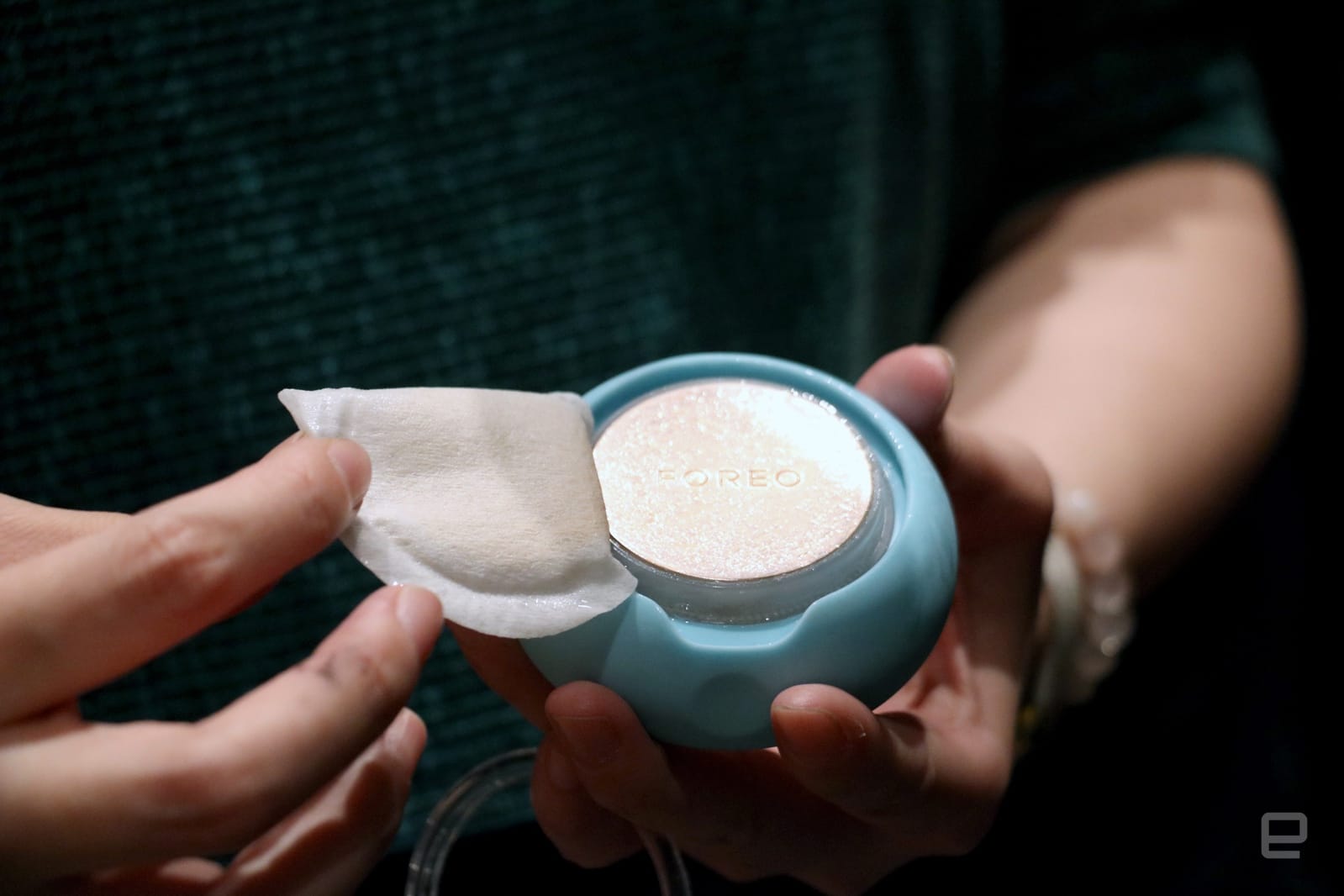
Still, the whole experience was immensely comfortable. The UFO will only go up to 120 degrees Fahrenheit and down to 40 degrees, so your skin won’t get scorched. I thought that having to rub the device all over my face would be troublesome, but since it’s only for 90 seconds, I wasn’t too bothered. I think the only reason to pick a traditional sheet mask over the UFO is if you’re feeling extremely lazy and want to put on a mask, lay down and not have to physically exert yourself at all.
The UFO’s battery should last for up to two weeks on a charge if you’re using it twice daily. Foreo is offering morning and nighttime masks at launch, with preset cycles catered to each. The UFO costs $279, while the Mini, which doesn’t have the cooling capability, is $179. That’s not money that I want to spend unless I know it will truly improve my complexion, but others might like the entire UFO pampering experience.
Click here to catch up on the latest news from CES 2018.
Putting Alexa inside a pair of smartglasses makes a lot of sense
Vuzix has been a regular at CES for years, crafting head-mounted displays and smartglasses often aimed at businesses — or very enthused wearable fans. The Vuzix Blade, its latest pair of augmented reality spectacles tries to balance that B2B / consumer sales pitch by adding a voice assistant. Amazon Alexa’s newest home is a pair of smartglasses.
Firstly, the crush of a CES evening show is never the best place to test out a voice assistant: you need a strong connection to make her receptive to your requests. So, pretty much all my Alexa queries fell on deaf robot ears.
Fortunately, the Blade worked in every other way — and most of us know how Alexa works by now, so I’m giving it the benefit of the doubt. A Vuzix spokesmen reiterated that the smartglasses work with every Alexa skill open to developers. If you can do it with a smart speaker, then you can do it with these.
The Blade has one advantage over your audio-only Echo speaker, however. In typical Vuzix fashion, there’s a floating screen running Android, offering visual assistance to your voice commands. Ask for directions, and the Blade smartglasses will show you the way. This is where the business uses shine too: with an AR app, a fictional engineer look at a broken circuit board, get the glasses to identify what’s wrong, and order the parts immediately through Amazon.
Here at CES, I was wearing prototype hardware on sale to developers. It’s a cool $1,800 for these, and the hardware is a little uncomfortable on the nose after a few minutes. Fortunately, the final version is expected to cost a nudge over half of that: $1,000.
Yes, of course an Echo Dot is still way, way cheaper, but Vuzix’s Blade demonstrates that Amazon Alexa has the potential to turn into something far more than a tech curio that gathers dust somewhere in your living room.
Click here to catch up on the latest news from CES 2018.
Motiv’s fitness tracking ring now knows even more about you
A year after we first saw it at CES 2017, the Motiv fitness tracking ring is back with a slew of new functions. The device can already measure many of the same metrics as, say, a Fitbit or Apple Watch with the goal of getting you on your feet and active for 150 minutes a week. But, at CES on Monday, the company revealed its plans for the new year — specifically, more nuanced sleep tracking, social sharing and finally (finally) Android compatibility.
To be clear, the hardware has not changed significantly since last Pepcom, but what the system does with the data it does collect has. The company recently rolled out Sleep Restlessness tracking which, as the name implies, monitors how much you toss and turn in a given night. It can now remember your last recorded heart rate value as well as the time it was measured.
In the first quarter of 2018, the ring will receive a significant feature boost. First off, you’ll soon be able to actively start recording data at the start of workouts in order to more accurately track your Active Minutes and better manage your weekly exercise regimen. The company also plans to add Apple Health integration so that the Motiv plays nicely with your existing health monitoring system. And when you’re really killing your workouts, the Motiv system will soon be able to broadcast your exercise achievements across social media.
Most excitingly, the Motiv ring should work with Android OS by the end of the first half of the year! What’s more, outside of the Apple Health integration, all of the features listed above will be included once the update goes live. July can’t come soon enough.
Click here to catch up on the latest news from CES 2018.
CES 2018: Western Digital Debuts New WD and SanDisk SSDs and Flash Drive
At this year’s Consumer Electronics Show, Western Digital is introducing several new products under both its WD and SanDisk brands, including new SSDs, software updates, and an ultra small flash drive.
The new WD My Passport Wireless SSD features wireless connectivity to allow customers to transfer photos captured on devices like drones or cameras without the need for a cable.
It features a rugged enclosure, read speeds of up to 309MB/s, 10 hour battery life, and a built-in SD card reader, making it a solid choice for on-the-go usage.
The My Passport Wireless SSD also has a one-touch transfer button to initiate content transfers, and it serves as a power bank for charging your devices with an integrated 6,700mAh battery. It’s available in 250GB to 2TB capacities, with pricing ranging from $250 for the 250GB model to $800 for the 2TB model.
Under its SanDisk brand, Western Digital is introducing the USB-C SanDisk Extreme Portable SSD, a small pocket-sized SSD with capacities up to 2TB and 550MB/s read speeds. It has an IP55 rating so it can stand up to splashes, light rain, and dust when in use outdoors.
Pricing for the SanDisk Extreme Portable SSD starts at $99.99 for the 250GB version and goes up to $700 for the 2TB version.
Along with the new SanDisk Extreme Portable SSD, Western Digital is debuting the SanDisk Ultra Fit USB 3.1, which it says is the world’s smallest 256GB USB flash drive with read speeds of 130MB/s. There are several versions of the Ultra Fit, with the 16GB model priced at $22 and the highest-end 256GB model priced at $150. Western Digital also has a 1TB Ultra Fit prototype on display at CES.

In addition to its new hardware products, Western Digital is announcing Smart Home media app integration that enables voice activation in its My Cloud Home. With the update, My Cloud Home can integrate with devices like Alexa and Chromecast.
More information on Western Digital’s new products can be found on the Western Digital and SanDisk websites.
Tags: SanDisk, Western Digital, CES 2018
Discuss this article in our forums
From TVs to automobiles, Google Assistant looks to make a big splash at CES 2018
Google Assistant is putting on its armor and heading into battle with Amazon Alexa, and at CES 2018, it’s proving just how many weapons it has in its arsenal. The popular virtual assistant serves as your personal version of Google, and over the course of the last 365 days, plenty of folks have opted for that degree of personalization. In fact, Scott Huffman, vice president of Google Assistant, noted in a blog post that the AI helper is now live on more than 400 million devices.
Over the course of the next 365 days, Google is looking to grow that number even further, and is doing so by bringing its intelligent assistant to more products across more industries than ever before. Here’s a quick peek at the many Google Assistant-enabled products we have to look forward to in 2018.
Speakers, displays
Google Home may have been the original Assistant-enabled product for your household, but it certainly isn’t the last. Smart speakers have increased in popularity in recent months, as evidenced by the fact that Google has sold more than one of these speakers every second since October. Consequently, Google is making Assistant even more available to other speakers, too, including those from Bang & Olufsen, Braven, JBL, LG, Knit Audio and more.
To compete with the Amazon Echo Show, Google is also bringing Assistant to smart displays. That means you can watch videos from YouTube, video call with Google Duo, find photos from Google Photos, and more, all by uttering a command. And later in 2018, Assistant will be coming to smart displays from four companies: JBL, Lenovo, LG, and Sony.
Televisions
Assistant is being rolled out to even more existing Android TVs, including models from TCL, Skyworth, and Xiaomi. Later this week, companies like Changhong, Funai, and Haier will be debuting Android TVs with Google Assistant. Google says that it’s also collaborated with LG to integrate the smart helper into a new line of LG televisions set to make an appearance in the next few months.
Google has made Assistant increasingly compatible with a whole host of home-control brands — 225 to be exact. It says 1,500 devices now work with Assistant, including new gadgets from Abode, Gourmia, Insteon, and Yonomi.
Headphones
If you’re looking to keep Google Assistant in your ear, 2018 is the year to do it. JBL, LG, and Sony headphones will soon be Assistant-optimized, which means that once they’re paired with your smartphone, you can talk to Assistant immediately with nothing more than the touch of an earbud. That means you can easily get notifications, respond to messages, or skip to the next song.
Car
Assistant is making its way to Android Auto to help drivers stay connected. Android Auto, which is already available in millions of cars on more than 400 models from more than 40 brands, will now be bolstered by Assistant. So whether you need to listen to a playlist from Spotify or get directions from Google Maps or reserve a parking spot with SpotHero, Google Assistant can help.
Using Assistant in Android Auto on your car display will require you to connect your Android phone to a compatible vehicle, or simply use Assistant on your phone screen in any car. Google says it’s working with automakers to integrate Assistant directly into their vehicles.
New nomenclature
Finally, Google is also rolling out a new way to talk about all the things Assistant can do. They’re called Actions, and they “include features built by Google — like directions on Google Maps — and those that come from developers, publishers and other third parties.” As of today, there are more than a million Actions available with Assistant, and Google promises it’s always adding more.
Editors’ Recommendations
- The LG ThinQ is a new Google Assistant smart speaker taking aim at Alexa
- Best smart home product of 2017
- Everything you need to know about Google Assistant
- Samsung freezes out Alexa, opts for Bixby in Family Hub smart fridges
- Google Home Max now available to purchase, Mini on sale for $29
Watch Intel’s CES 2018 keynote here at 6:30 p.m. Pacific/9:30 p.m. Eastern
Kicking off a week of CES craziness, Intel will deliver its keynote presentation on Monday night, January 8. Intel CEO Brian Krzanich will be the presenter of the event with the description including how Intel is “using data to shape the future” and transforming from a PC-driven company to a data-driven company.
Regardless of what it announces, Intel has had a bit of a hard week to get over. With its chips still vulnerable due to the Meltdown and Spectre CPU bugs, there’s definitely a cloud hanging over the company (and the CEO) going into CES.
On the other hand, Intel’s recent partnership with AMD has brought a lot of excitement, so maybe we’ll see it bounce back.
Because you can only do so much with a keynote presentation on computer chips, Intel usually brings a sense of flair to its keynote presentations. Here’s to hoping we get a few fun demos at Intel’s CES 2018 keynote.
We don’t know all what Intel will be announcing or talking about, but it all starts at 6:30pm PST, and can be streamed in the video above.
Editors’ Recommendations
- Watch Samsung’s CES 2018 press conference live at 2 p.m. PT today
- Refreshed LG Gram laptops head to North America in January for CES 2018
- Lenovo’s updated ThinkPads include T480s with Nvidia MX150, affordable X-Series
- A metal chassis and new processor elevate Samsung’s new Notebook 7 Spin
- Switch it up — Nintendo reportedly set to produce 30 million consoles in 2018
HTC Vive Pro hands-on review
Research Center:
HTC Vive Pro
Today at CES 2018, HTC put the emphasis on its new premium, PC-based virtual reality. The Vive Pro takes the original and turns everything up to eleven, boosting the sound and visual capabilities of the headset. While the original Vive will still be sold as HTC’s entry-level headset, the Vive Pro is meant for gamers, developers, and anyone who wants the best VR experience money can buy.
The original Vive, though not without its problems, is currently our pick for the best premium VR headset on the market. We went hands-on with the Vive Pro to see if the upgrade is significant enough to take virtual reality to the next level.
HTC fulfills its New Year’s resolution
With the Vive Pro, HTC has clearly heard the complaints of its fans. When your eyes are an inch away from the screen, resolution matters. A lot. According to HTC, 89 percent of VR headset owners, and potential owners, say higher resolution is matters to them — and they’re getting it here.
Luke Larsen/Digital Trends
Luke Larsen/Digital Trends
The resolution has gone up to 2,880 x 1,600, which is a solid increase over the original. These are dual-OLED displays with a 78 percent increase in pixel count, bringing it up from 448 to 615 pixels per inch. Does the jump in resolution matter in overall experience?
Oh my god, yes.
Trying on the headsets side by side, the Vive Pro is clearly a big leap forward. Everything looks crisp and clear — not unlike seeing an HD television for the first time. When it comes to high-end VR, HTC has pushed the Vive Pro to the forefront, leaving competitors like the Oculus Rift in the dust. You might want to stay away from the Pro if you aren’t prepared to buy it, because it’s hard to go back to a “normal” Vive. We tried a number of VR experiences, ranging from fast-paced shoot-em-ups to training simulations — and they all benefit from the increase in resolution.
If you want the best VR experience, this is it.
However, we’re not convinced that resolution is the only thing holding people back from wanting to take the deep dive with virtual reality. In the same way that HDTVs probably didn’t convince anyone who didn’t own a TV to buy one, the Vive Pro still feels a bit niche. And while we don’t yet know the price, we doubt it’ll be affordable. The Vive Pro won’t bring many new gamers into the fold, but it will make VR enthusiasts happy.
The Vive Pro also throws in dual microphones and cameras, though we didn’t get to test either of them out. These are meant to improve the Pro’s ability to pick up voice, as well as its perception of the area its used in.
Three-dimensional sound
The Vive Pro doesn’t just try to impress your eyes. This time around, the headset comes with built-in earphones, which use an “in-line amplifier” to boost the quality. The output was nice, and did a good job of blocking out sound in the loud conference room we were in. What we like best, though, is how easy they are to use. Each earphone can be quickly clicked out, to get them away from your ear – similar to the Vive’s Deluxe Audio Strap, but more streamlined. It’s convenient to be able to quickly pull the earphone away for a second to hear someone talk.
Luke Larsen/Digital Trends
On the other hand, the decision to include earphones is a bit of an odd one. Most people who are serious about VR gaming probably have a decent pair of headphones — and probably ones they’d prefer to use. There didn’t appear to be a way for the built-in earphones to be detached or replaced. These are great earphones that make using the Vive Pro both intuitive and immersive, but we’re sure not everyone will be happy about being forced into using what HTC provides.
More comfortable than ever, but results still vary
The Vive Pro headset doesn’t much different from the original Vive. It has a slick new blue exterior, and of course includes the new built-in earphones and headstrap. With all those attachments, the Vive Pro could have become a bit of a mess of a design, but HTC has kept it clean and simple. Importantly, the Vive Pro didn’t get any heavier, and it feels more balanced than before.
The fit is more comfortable — and more snug.
We quickly strapped it on, and noticed the fit felt comfortable, but snug. The newly-designed head strap is to thank for that. It loops around the back of your head, with a dial in the back giving you quick access to adjustments. That, once again, is like the HTC Vive’s Deluxe Audio Strap. Though HTC mentioned that it’s worked to improve comfort for those with glasses, we still had to take ours off to fit. Mobile headsets such as Google’s Daydream View have taken strides in this department. The Vive Pro isn’t quite there yet.
You’ll still end up getting sweat all over the thing when you use it for more than 30 seconds at a time, but overall, it’s a comfortable and lightweight headset that doesn’t impede the VR experience in the slightest. The Oculus Rift still looks and feels more coherent, but it’s now quite far behind in technical capability.
Luke Larsen/Digital Trends
The Vive Pro becomes even better when paired with the new Vive Wireless Adapter. This new adapter, which also works with the original Vive, offers a new sense of freedom. It plugs in at the top of the headset and, powered by a USB battery pack, transformed the Vive Pro into a completely wireless VR headset. In our experience playing DoomVR, there wasn’t a hint of interference or lag, thanks to the use of Intel’s WiGig connection.
Viveport keeps getting better
Virtual reality is still a long way away from having its killer-app. A newer, better headset isn’t going to change that. However, HTC is doing quite a bit to provide a platform for more high-quality VR content. Through its own Viveport platform, you can find a bunch of different things to try out, both paid and free. As of the announcement of the Vive Pro, HTC also completely revamped Viveport to make getting through menus quicker — and more fun.
HTC Vive Pro Compared To
Sony PlayStation VR (2017)
Acer Windows Mixed Reality Headset…
Google Daydream View (2017)
Samsung Odyssey
Sony PlayStation VR
Oculus Rift
Google Daydream View
3Glasses D2 Vanguard Edition
HTC Vive
Samsung Gear VR
Homido
The store has been brought into VR, letting you discover new apps and get previews of the experiences while using the headset. HTC also offers an enticing subscription service model, ala Netflix or Spotify. For seven dollars a month, you get access to five titles that you can download and use. Considering that many games and are priced over $20, it’s not a bad deal.
But either way, the HTC Vive right now offers the most complete and thriving ecosystem for VR content, especially when you add in its support for SteamVR. It’s still got a long way to go, but it’s certainly on the right path.
HTC is holding pricing and shipping information off until later this year. You can count on one thing for sure, though. Expect this one to be more expensive than the $600 HTC Vive. You’re going to have to pay if you want the best.
High-end gaming comes to CES with MSI’s curved gaming monitors
Due to its involvement in the esports scene, MSI has become a serious player in the world of gaming PCs. Here at CES 2018, the company has brought a swath of new high-end PC gaming gear.
The Taiwanese company announced a number of new products, including two curved, gaming monitors, the Z370 Godlike Gaming motherboard, a couple of premium gaming components, and an updated desktop gaming PC.
Gaming monitors
Optix MPG27C / Optix MPG27CQ
These two monitors are MSI’s first shot at a curved monitor — both 27 inches and both with an 1800R curve. Most importantly, these curved monitors feature a 144 Hz refresh rate and a 1ms response time to make sure your gaming experience is as immersive as possible.
As for port selection, you have a lot of options: Two HDMI ports, one DisplayPort, one USB-B, and two USB-A ports. Missing, unfortunately, is USB-C.
The only real difference between the two monitors is the resolution: The MPG27C has a 1080p display, while the MPG27CQ has a 1440p “WQHD” display. Both monitors also have the fun color flashes on both the front and back, which come with support for SteelSeries GameSense for programming notifications to correspond to different lights.
Next Page
1 of 3
Gaming monitorsDesktop PCsGaming Components
Page
Foreo calls for end of sheet masks with smartphone-controlled skin care device
Face masks have become increasingly popular for any skin care woes — whether it’s dry skin, redness, or uneven skin tones. But Swedish beauty brand Foreo is attempting to make face masks even smarter with the introduction of its Foreo UFO.
Unveiled at the 2018 Consumer Electronics Show in Las Vegas, Foreo UFO is a smart mask treatment that’s controlled using your smartphone. The 90-second facial treatments uses LED light therapy, thermo-therapy, cryotherapy, and its T-Sonic pulsations.
The circular device can fit in the palm of your hand and comes in light pink, dark pink, or blue color variants. Its medical-grade silicone body is completely waterproof and includes a USB port for charging.
Rather than going through the usual routine of placing a sheet mask completely over your face, you’ll place the mask into the device instead. After turning it on, you’ll then apply UFO directly to the skin as it evenly distributes the active ingredients from the mask directly onto your skin.
Based on its features, the Foreo UFO sets out to address different skin care concerns. Meant specifically for photofacials, it includes a range of LED light therapy treatments: Red LED for anti-aging, green LED for brightening, and blue LED to help treat or prevent acne.
Using hyperfusion technology, heat to open up your pores, and its T-Sonic pulsations, the treatments’ active ingredients immediately soak into the skin. As the final step, cryotherapy seals the ingredients to leave the skin feeling firm.
As for the specific treatments, each UFO Smart Mask is made from soft microfiber-infused with plant and fruit extracts along with natural flower water and botanical oils. To start, Foreo released two masks at launch meant for either day or night use.
While both masks are already pre-programmed into the device, the UFO app allows you to have more control over the device. Available for both iOS and Android, you can use it to control light intensity, heating and cooling, along with how intense the T-Sonic pulsations are. That way, it’s settings are customized to meet your own skincare needs.
The Foreo app will receive updates so you’ll be able to access all of the future smart masks that are released. You’ll also be able to use it to reorder masks whenever you run out.
Both the Foreo UFO and the UFO Mini — a smaller version of the device — will launch in select retail stores this April for $279 and $179, respectively. For a limited time before its launch, you can also pre-order it on Kickstarter for half off the retail price.
 AIVAnet