


Samsung’s Notebook 9 Pen is a super-light Galaxy Note/laptop mashup
Samsung announced a handful of laptops before CES even started, but only one of the was really new: the Notebook 9 Pen. It isn’t Samsung’s first attempt at blending a laptop and a Galaxy Note, but after a little hands-on time, it’s shaping up to be one of the most pleasant.
As you might expect from Samsung, the Notebook 9 Pen is pretty understated in terms of design. Some may prefer the adjective “boring,” and I can’t really argue with that — its a nondescript silver machine with rounded edges and very little in the way of personality. As far as Samsung was concerned though, building an incredibly light machine was more important than impactful design. Thanks to the use of a magnesium alloy called Metal-12, the Notebook 9 Pen weighs in at a paltry 2.2 pounds — that’s a little more than half of what the MacBook Pro I’m lugging around Las Vegas and my back is already wishing I brought a different machine.
Of course, the devices name really says it all — there’s no point in picking up a Notebook 9 Pen unless you want to live that S Pen life. This isn’t the first Samsung to use that trademark stylus, but it’s still a remarkably handy thing to have around. Samsung is positioning the Notebook 9 Pen as a took for artists, and the S Pen — with its 4,096 pressure levels and its 0.7mm nib — is certainly quite good for sketching, especially when you have the screen folded back into tablet mode.
After using the thing for a while, though, the Notebook 9 Pen seems like a better tool for students: you’ll be able to jot down lecture notes in either OneNote or Samsung’s included Notes app, and invoking Air Command (as you would on a Galaxy Note) reveals shortcuts for marking up whatever you happen to be looking at? A new Voice Note feature uses a far-field microphone to capture conversations and lectures as they unfold around you, and you have to option to jot down written notes as the app records audio. And what better way to while away those precious moments between classes than using the S Pen to make GIFs by capturing snippets of video on-screen. (Pro tip: if you happen lose the laptop’s included S Pen, using one from a Galaxy Note works just fine.) As someone who fell harder for the Galaxy Note 8 than expected, being able to pull off some of the same tricks on an ultraportable notebook is highly gratifying.
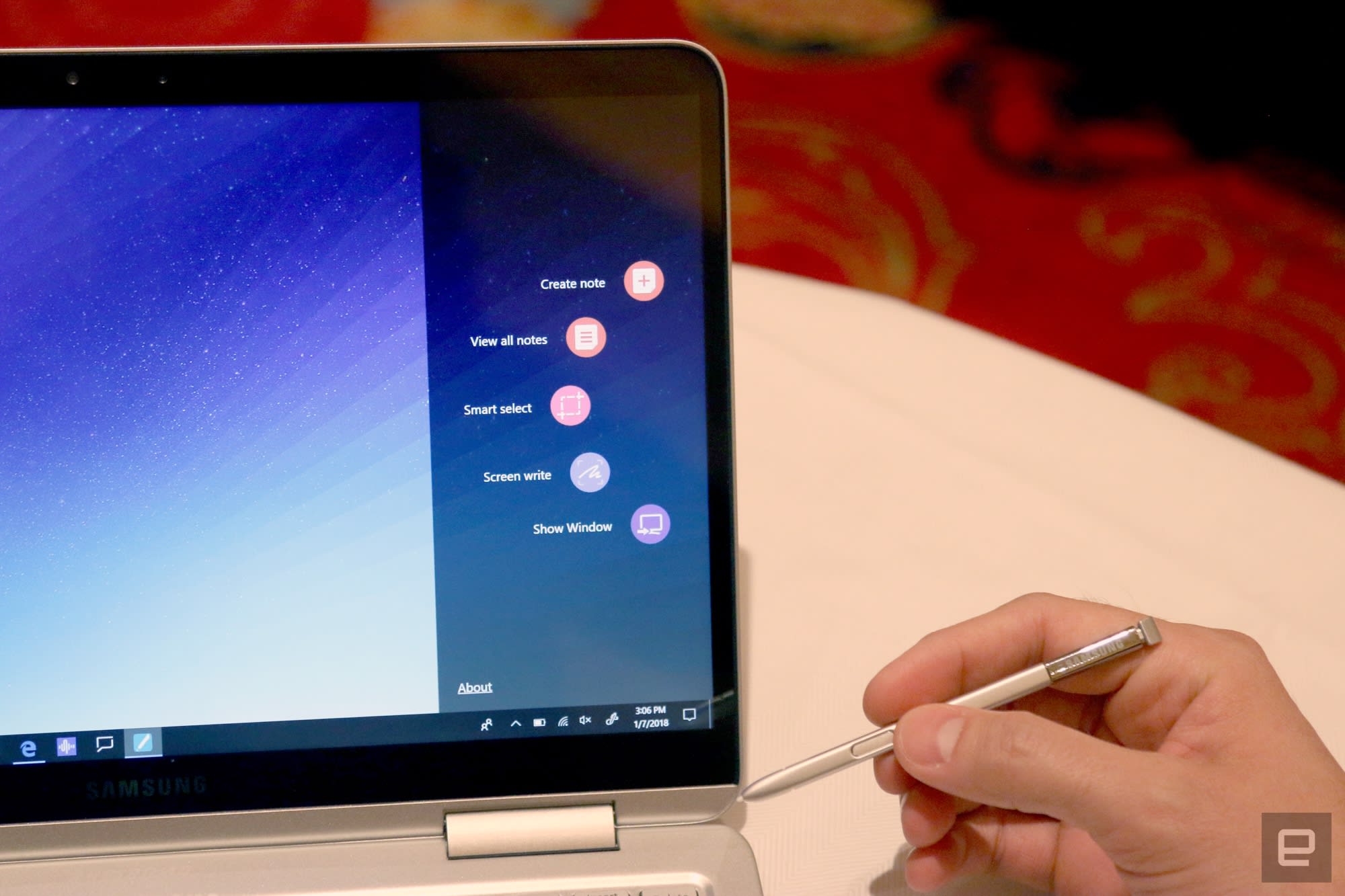
Beyond the S Pen angle, the Notebook 9 Pen is a pretty standard machine. There’s an 8th-generation Intel Core i7 chipset thrumming away inside, and you’ll be able to pick up models with up to 16GB of DDR4 RAM and a 512GB SSD, though Samsung is still keeping quiet on pricing. The moments I spent with the Notebook 9 Pen were perfectly snappy and indicated that it would slot into my daily workflow without issue, but this since this still non-final hardware, you’ll have to wait for a more complete verdict. Similarly, I had no real issues with the 13.3-inch 1080p display — my only real concern is that at max brightness, it’s not quite as bright as either of the other Notebook 9 models Samsung talked up ahead of the show. I also would’ve preferred a more robust selection of ports — there’s one USB-C port, one USB 3.0 port, a microSD slot and an HDMI-out — but here’s hoping the final price tag reflects this.
The Notebook 9 Pen might be lacking in style, but so far it seems like a solid blend of power and pen-based productivity tools. Whether it fulfills a need that actually exists is another story, and it shouldn’t be too long before we get the final hardware and find out for ourselves.
Click here to catch up on the latest news from CES 2018.
Whill’s new electric wheelchair is light, portable and fast
Whill’s electric wheelchair picked up the award for Best Accessibility Tech in last year’s Best of CES, and now it’s back with a newer, lighter and more portable version of that vehicle. The Model Ci uses a lithium-ion battery and can travel 10 miles on one charge, with a top speed of 5 miles per hour. (We took the Model Ci for a brief spin and we’re happy to confirm 5 MPH is plenty fast for everyday navigation — it’s a light jogging speed). That battery makes it lightweight, too; the entire thing weighs 115 pounds.
But the coolest part? The Model Ci is available today. It costs $4,000.
Another new feature in the Model Ci is its ability to break into three parts for easy packing. Whill’s wheels are specially designed, each one containing 24 separate rollers that allow the chair to move smoothly in any direction. All of this is controlled via a joystick on the right armrest, though the chair also connects to an app, which allows users to control it remotely via a smartphone.
Whill is continuing its award streak — it’s already won a CES 2018 Innovation award for the Model Ci.
Click here to catch up on the latest news from CES 2018.
Samsung’s 8K TV uses AI that ‘learns’ to upscale low-res video
In 2013 Samsung introduced a $40,000 85-inch 4K TV with an easel-like design, before showing off an 8K demo unit in 2014. Now at CES 2018 Samsung is showing off this 8K-resolution Q9S that continues the same design strategy, just with more pixels and AI inside. Combine that with LG’s 88-inch 8K OLED, and it looks like 2016’s LG vs. Samsung battle is ready to resume.
We don’t have details like a price or release date for the Q9S, but the 85-inch monster features a “proprietary algorithm” to upscale lower-res video for its Super Hi-Vision screen. The artificial intelligence comes in with its ability to “learn from itself” to improve over time — which could be interesting if it works well, and could also lead to some incredible self-created artifacts if something goes wrong.
Click here to catch up on the latest news from CES 2018.
Samsung’s 2018 4K TVs add Bixby AI
Even if you can’t spring for an 85-inch 8K TV or a screen large enough to be called The Wall, Samsung still has something new for your next TV. Its 2018 Smart TV platform is getting an upgrade with the addition of its Bixby AI voice control platform, as well as integrated SmartThings technology. That home automation hub support will “offer easier sharing, connectivity, and an overall simplified way to control the television and sync with other devices.” Finally, a new universal guide will keep up with the likes of Apple, Roku and TiVo by searching for content within apps and suggesting new things you to watch.
Click here to catch up on the latest news from CES 2018.
Samsung is ready to build a 146-inch TV wall in your house
Last year Samsung announced a 34-foot 4K LED TV that could challenge movie theater screens, and now it’s ready to sell a version for home use. The Wall by Samsung uses similar MicroLED tech that works without a backlight and can be assembled in extremely large sizes thanks to its modular design. We don’t have much information to go on yet, but the 146-inch 4K screen promises “outstanding brightness, contrast, and close-to- perfect viewing from any angle.” Just something to think about, if an 85-inch 8K TV isn’t big enough and projector screens aren’t bright enough.

Click here to catch up on the latest news from CES 2018.
Jabra’s newest wireless earbuds promise better sound and voice control
Apple’s AirPods aren’t the only truly wireless earbuds out there. In fact, Jabra is releasing the third generation of its own take on the technology: the Elite 65t and Elite Active 65t wireless earbuds. In addition to these two new models, Jabra is showing off a wired pair of Bluetooth earbuds, the Elite 45e, at CES this year as well.
The Elite 65t includes one-touch access to Siri, Google Now, and Amazon Alexa, and promises up to five hours of listening time. That figure bumps to 15 hours total thanks to the included charging cradle. There’s a built-in microphone for calls and voice commands with the Jabra Sound+ app handling any EQ tweaks. They’ll come in three color combos: Titanium Black, Copper Black and Gold Beige.
The Elite Active 65t model has all of the same features, but adds a special coating to keep them in your ears while you’re working out, an integrated accelerometer for use with the Jabra fitness app and an IP56 sweat, water and dust resistance. They’ll only come in Copper Blue and Copper Red color combinations.
The Elite and Active models will both be available for pre-order at Best Buy starting tomorrow (January 8th). Elite is priced at $170 while the Active version is $190 and both will ship next month. Jabra also has new Elite 45e wired Bluetooth headphones that will retail for $100, too. They come with a soft neckband with a memory wire and pack in a microphone for use in voice calls, however there’s no word on when those will arrive just yet.
Intel’s new NUC will show off AMD’s Vega GPU
We’ve called Intel’s NUC “the future of tiny desktops.” That’s truer than ever with the newest version of the device, which is powered by the company’s new 8th generation CPU with AMD RX Vega M graphics. In fact, it sports the fastest version of that chip, making it an even better desktop replacement. Intel claims it’s so powerful, the 1.3 liter NUC is the smallest VR-ready system so far. And based on its specifications, we’re inclined to believe them.
The new NUC, codenamed “Hades Canyon,” is a bit thicker and taller than the “Skull Canyon” version was saw in 2016. It comes in two versions: the most powerful includes a Core i7-8809G chip with powerful RX Vega M GH graphics, running at speeds between 3.1GHz and 4.2GHz. The other model is still pretty capable, with an i7-8705G chip, a clock speed between 3.1GHz and 4.1GHz and slightly slower RX Vega GL graphics.
Based on what we’ve seen from Intel’s benchmarks, the faster NUC should be speedy enough for most VR experiences (though complex games like Doom VFR might be a challenge). Overall, you should expect to see at least 60 FPS with modern games in 1080p. While the company tried position the last NUC as a gaming-oriented machine, this one actually has the potential to be a solid gaming PC for your living room.
Intel also packed in a bevy of ports to make this NUC much more useful to enthusiasts. Along its back panel, it sports two Thunderbolt 3 USB-C ports, two gigabit Ethernet connections, two Mini DisplayPorts, four USB 3.1 Type-A connections, HDMI and a hybrid 3.5mm/optical audio jack. Up front, it has USB-C, USB Type-A, USB Type-A for charging, HDMI, a headphone jack and an SDXC slot. That might sound exhausting, but that doesn’t even include the internal USB connections and dual M.2 SSD slots.
As usual, Intel will sell the NUC as a DIY kit. You’ll have to supply your own storage, RAM and accessories to get it up and running. Unfortunately, we don’t have pricing details yet, but Intel says they’ll be available in the spring.
Click here to catch up on the latest news from CES 2018.
Intel unveils its first chips with AMD’s Vega graphics
The fruits of Intel and AMD’s unprecedented partnership are finally here. Intel just unveiled its 8th generation Core CPUs with AMD’s RX Vega M, bringing together its fastest mobile processors with graphics capabilities that used to required a dedicated GPU. Together, they’ll lead to thinner and lighter laptops with decent gaming chops. While we got an overview of the chips back in November, we finally have more details at CES. And, simply put, gamers should be pleased.
Fittingly, Intel is plugging AMD’s RX Vega M module into the first batch of its high-powered “H-series” 8th generation Core chips. These are the processors that are typically paired with dedicated GPUs, like NVIDIA’s GTX 10-series line. Now, for the first time, Intel has a custom all-in-one solution.
Intel is offering two variants of AMD’s graphics: RX Vega M GL, which is meant for laptops, and GH, which is targeted at small desktop-like devices, such as Intel’s new NUC. Naturally, the GL variant has a lower clock speed and less graphics hardware than its more powerful sibling. It runs between 931MHz and 1,011MHz and has 20 compute units, while the GH clocks between 1,063MHz and 1,190MHz has 26 compute units. You’ll find the GL variant bundled with Intel’s new 8th generation Core i5 and i7 processors, while the GL will only come with an i7.
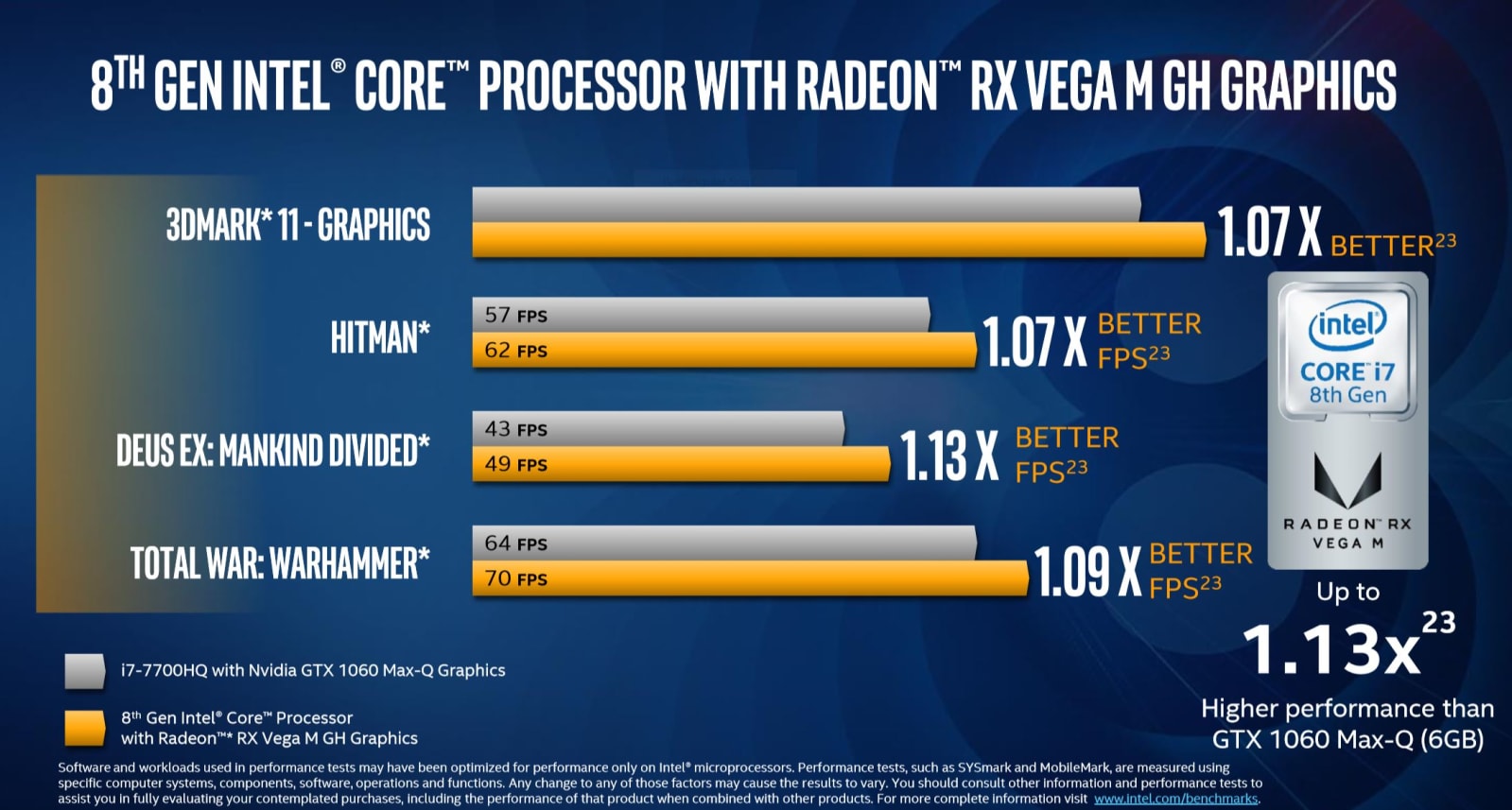
In laptops with the RX Vega M GL module, you can expect speeds around 1.4x faster than NVIDIA’s GTX 1050 while playing Hitman. And with the speedier GH graphics, you’ll see performance up to 10 percent faster than NVIDIA’s GTX 1060 running on a machine with a 7th generation Core CPU. That basically ensures that, in most modern games, you’ll see a smooth 60 frames per second in 1080p with high graphical settings. Those figures would be admirable from larger dedicated GPUs. For something bundled together with a traditional CPU, they’re honestly astonishing.

Intel
Intel crafted a unique custom chip to fit in the RX Vega M. It’s wider than the company’s typical designs, because it fits in both the 8th generation Core processor, AMD’s graphics and it makes room for 4GB of HBM2 (High Bandwidth Memory Gen 2). In particular, Intel focused heavily on the EMIB (Embedded Multi-Die Interconnected Bridge) between the memory modules and RX Vega M. It’s a high-speed method of connecting different types of chips on the same die, ensuring that there won’t be any memory bottlenecks for the GPU. Additionally, Intel is using eight lanes of PCI-Express Gen 3 to connect the GPU to its CPU.
As for the processor portion of these new chips, you’ll find them running from 2.8GHz to 3.8GHz with the i5-8305G, all the way up to a speedy range of 3.1GHz to 4.2GHz with the top of the line i7-8809G. They each offer four cores with eight computing threads. Surprisingly enough, you’ll also be able to overclock their CPUs, GPUs and memory modules. And just in case you were wondering, you’ll still find Intel’s HD 630 graphics integrated into the CPU. It’ll serve as an efficient way to drive your display when you don’t need AMD’s 3D hardware.

Intel
So what would a computer look like if it ran one of these chips? Intel says it could weigh around 4.6 pounds, measure 17mm thick and get around 9.3 hours of battery life. In comparison, a similar enthusiast-oriented notebook from there years ago would be close to six pounds, measure 33mm thick and get around 4.7 hours of battery life. As for the extra-powerful RX Vega M GH variant, Intel claims a tiny machine like its new NUC could deliver the same amount of performance as a mid-tower desktop from three years ago.
Since these chips are running AMD GPUs, they’ll also support the company’s Radeon Adrenalin Edition software and take advantage of features like FreeSync for smoothing out game performance, and ReLive for capturing your sessions. You’ll be able to use both Intel’s XTU app and Radeon WattMan to manage overclocking. Intel also promises that it’ll offer launch-day drivers for new titles at its new gaming site. You’ll be able to find Intel’s chips with RX Vega M graphics in upcoming laptops from Dell and HP, as well as the company’s new NUC when it launches this spring.
Yes, it’s still very strange that this partnership exists. It’s an admission by Intel that it needs some serious help with high-end graphics. In the short term, this is a quick fix. But it’s no surprise that Intel also stole away AMD’s former graphics head, Raja Koduri, who was responsible for the Vega GPU’s design. It’ll likely take a few years, but you can fully expect Intel to replace this “frenemy” solution with its own chip down the line. For now, though, it’s something AMD can use to market its superior graphics, while still competing with Intel in the processor market.
Click here to catch up on the latest news from CES 2018.
Source: Intel
These smart shoes alert you if your grandma falls
We’ve seen our fair share of smart shoes at CES in the past, including a pair you can “lace up” using your smartphone. And today, at CES 2018, we came across some more interesting footwear. What you see above are the “smart shoes with falling alert,” created by a French startup called E-Vone. As the name suggests, the kicks feature a system that will notify friends, family or medical services if the person wearing them happens to take a fall. The company says they’re designed for older adults (like your grandma or grandpa), as well as construction workers, hikers or anyone who feels like they may require assistance if they’re alone indoors or outdoors.
Inside E-Vone’s shoes, specifically the midsole, there are a slew of sensors: GPS, accelerometer, gyroscope and a pressure system that knows every time someone put on the shoe on and activates the alarm. According to E-Vone, they don’t need to be paired to a mobile device because the shoe processes all the information on its own, thanks to a GSM chip, GPS and LoRa antennas, which can send the bad news with “ultra-precise” geolocation details.
Unfortunately all the sample pairs here at CES aren’t working prototypes, but an E-Vone rep said we can get a demo in the next few days. The shoes are said to be available in about six months, with pricing expected to be between $100 and $150, plus $20 per month for the alarm service. We’re told there will also be an option to just pay $30 per month and nothing up front, and the goal is to launch them in the US in the near future.
Click here to catch up on the latest news from CES 2018.
Moen makes Alexa and Siri your shower concierge
Our bathrooms are about to get a lot smarter, if the latest technology being unveiled here at CES 2018 is any indication. Moen, which released its U by Moen smart shower system last year, is adding Alexa and Siri voice control capability to the series this year. With the new skills, you can tell Alexa to turn on your shower at a desired temperature or to a customized setting. Siri compatibility is coming later in the year.
The system consists of a digital valve that enables digital, to-the-digit temperature control, shower heads, handshowers, body sprays and other fixtures. You can already use the in-shower control pad or the U by Moen app to adjust your water temperature or pick a different preset, but the new integration lets you start a shower just by talking. The benefit here may not seem obvious, but it should offer an easily accessed method to pre-start your shower, which would be helpful to busy parents chasing after reluctant toddlers.
When you tell Alexa (or use the app) to turn your shower on to a certain temperature, the water will gush out until it reaches your desired level. Then, it will pause (the water will turn off) until you are ready to step in, and you can restart the flow by pressing the button on the digital controller. During my demo here on the show floor, the digital controller showed the water climbing from 86 degrees (Fahrenheit) to a toasty 98 degrees before stopping.

For now, the way to get Alexa to start your shower is still slightly clunky, as the feature is a third-party skill. You’ll have to ask Alexa to “tell Moen” to run the water, which somewhat of a mouthful. We don’t know yet what the Siri command will be. You can also ask the assistant to launch presets like “morning shower” or “post workout cooldown” for different temperature and showerheads, provided you had already specified them via the Moen app.
As a safety measure, the valve will only allow temperatures between 60 and 120 degrees, so those looking for a hotter or colder shower than that range might not like this system. Up to four shower devices can be connected at a time, so if you have a real fancy bathroom complete with showerheads, taps and body sprays, then you can use the new automation features to upgrade your setup.
Click here to catch up on the latest news from CES 2018.
 AIVAnet