


HP’s Z 3D camera brings Sprout 3D capture to any PC
HP’s Sprout all-in-one PCs have always been intriguing: they’re ideal 3D capture machines, thanks to their unique cameras. But they’re also inconvenient if you already have a powerful computer and monitor of your own. That’s where the new Z 3D camera comes in. HP basically ripped out the 3D capture feature from the Sprout Pro and turned it into a portable accessory that can be attached to almost any monitor (as long as it has a flat back). It’ll let VR artists and other 3D creators easily capture real-world objects, without needing to invest in a specialized PC.

Additionally, you’ll also be able to capture 2D documents and collaborate over live video with the Z 3D camera. Of course, it can’t fit in all of the features from the Sprout computers. There’s no desk projection, and consequently none of the unique multitouch features that take advantage of that. But it could still be useful for anyone who needs to add 3D capture to their workflow. Since it’s just an accessory, you can buy one and use it across several machines in your office or studio. While we don’t have many specifics to go on, HP says it’ll scan objects with “computer-graphics-friendly resolutions,” and it’ll offer individual texture maps for physical-based rendering and VR.
Unfortunately, we don’t know how much the Z 3D Camera will cost, or when it’ll be available.
Click here to catch up on the latest news from CES 2018.
Anker’s Bluetooth charger brings Alexa to your modern car
Some automakers are already planning to load their new models with Amazon’s famous voice assistant, but you don’t need to buy a new car to have Alexa as a road companion. Anker has launched a new plug-and-play Bluetooth smart charger at CES 2018 called Roav Viva, and it can give you access to the AI no matter what car you’re driving — as long as it supports Bluetooth 4.0 A2DP. The technology’s been around since early 2010s, so chances are your vehicle comes equipped with it if you purchased it within the past few years.
You can do anything you can usually do with Alexa through Roav Viva, such as checking for weather conditions or ordering a coffee. If you want to play music, you can ask Alexa to connect to iHeartRadio or Pandora. You can also listen to audiobooks on Audible, play Jeopardy with friends during a road trip and use voice commands to look up directions on Google Maps, Apple Maps or Waze. If you want to use Roav Viva as a charger, you can plug in two devices at once. Since it’s powered by Anker’s super-fast PowerIQ charging technology, you may even be able to quickly switch between the gadgets you’re charging if you need to.
Anker’s Roav Viva works with both Android and iPhone, including the iPhone 8 and iPhone X. Unlike Garmin Speak, which can also put Alexa in your car for $150, this one will only set you back $50. It’s now available for pre-order on Amazon in the US, and it’ll also launch globally early this year.
Click here to catch up on the latest news from CES 2018.
Source: Roav Viva
HP’s Spectre x360 15 gets the usual upgrades and a fingerprint reader
You’d be hard pressed to see a big difference between HP’s last Spectre x360 15, and the new version of the convertible it’s debuting at CES. Aside from the slightly edgier styling this year, with sharp corners and lines replacing friendlier rounded ones, they look pretty similar. Just like its smaller sibling, the new Spectre x360 15 is mostly an incremental upgrade, with faster hardware meant to make it a better MacBook Pro competitor. That’s unfortunate if you were hoping for something truly new, but it’s still a solid machine on paper for content creators.
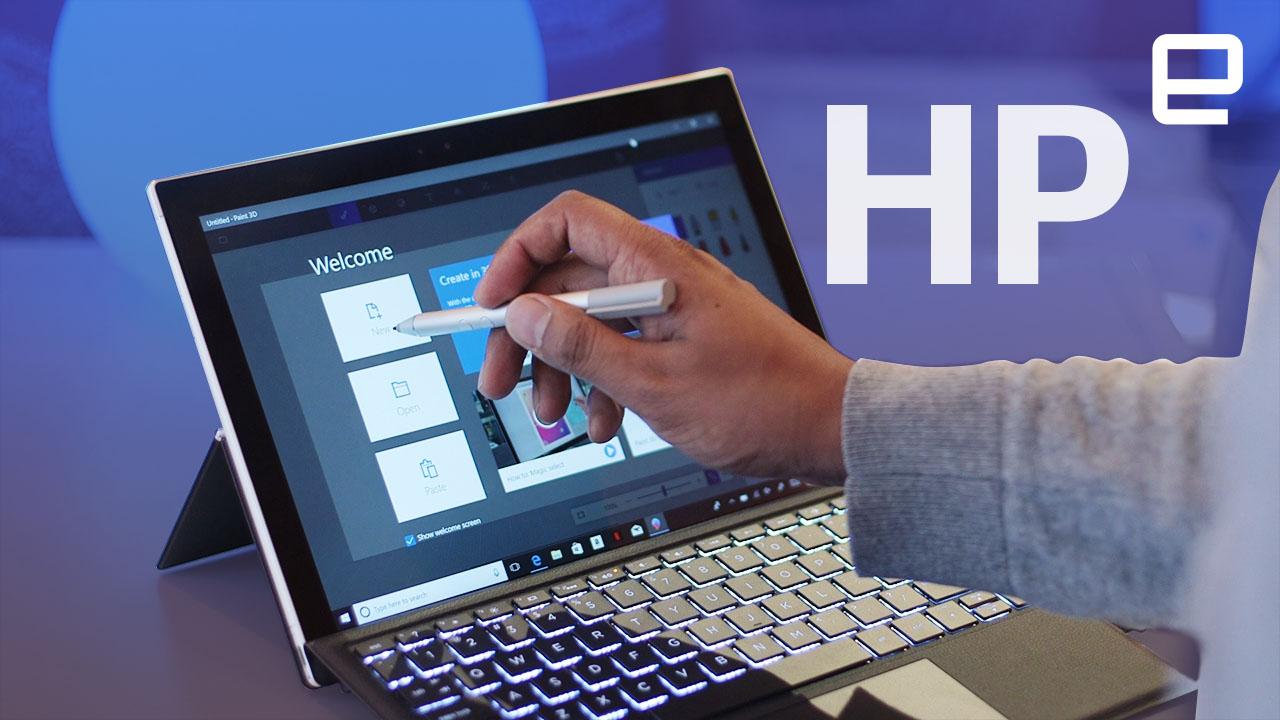
The big update this time around: 8th generation quad-core Intel Core processors, as well as your choice of Radeon RX Vega M or NVIDIA GeForce MX150 graphics. The GPU options are a bit disappointing if you were hoping to see more powerful components, like NVIDIA’s 10-series lineup, but they’re still a step beyond the GeForce 940MX from the last Spectre. HP has also added a fingerprint reader along the right side of the machine, as well as a full sized number pad on the keyboard. The 4K 15.6-inch monitor is intriguing, but that’s something last year’s model also offered. And of course, being a 2-in-1, you can flip its screen all the way around to use as a tablet.
You can configure the Spectre x360 15 with up to two Thunderbolt ports, and you can also choose from the black and copper accent HP has been leaning on for a while, or black and silver. The company claims it’ll also get 13.5 hours of battery life, and it can reach a 50 percent charge in just 30 minutes (while it’s shut down).
While it’s not exactly revolutionary, the Spectre x360 looks like a compelling option for anyone considering a stylish Windows workhorse. It’ll start at $1,370 when it lands on March 18th.
Click here to catch up on the latest news from CES 2018.
HP’s Omen PCs will let you stream games to slower computers
HP is getting into the game streaming arena — though probably not in the way you’d expect. With the aptly titled “Omen Game Stream” app, it’ll integrate the feature in all of its gaming PCs later this spring. Basically, you’ll be able to take advantage of the powerful hardware from an Omen machine to play games on just about any PC over the internet. It’s the sort of thing we’ve seen from NVIDIA and Valve, both of which offer in-home streaming solutions. With this app, HP could make life a lot easier for gamers who need their Overwatch fix when they’re away from their rigs.
At the heart of Omen Game Stream is technology from Parsec, which can deliver 1080p gaming at up up 60 frames per second. As usual with these types of solutions, what you’re actually seeing is a video of what the more powerful machine is outputting. In a brief controlled demo from HP, the app appeared to deliver a smooth experience while streaming some modern games. But of course, that was being shown under ideal internet conditions.
HP claims you’ll be able to stream games from anywhere with a “strong” internet connection, but it’s not offering any specifics about bandwidth minimums yet.

Click here to catch up on the latest news from CES 2018.
HP unveils an Intel version of its Envy x2 hybrid
It turns out HP has another Envy x2 hybrid laptop coming this year, in addition to the Snapdragon-powered model it unveiled last month. As you’d expect, instead of a mobile chip, it features an Intel 7th-generation Core processor (a pity HP couldn’t fit in an 8th-generation chip) along with optional LTE connectivity. It’s more of a traditional Surface competitor for people who aren’t yet ready to adopt a Snapdragon chip for their computing needs. And based on what we’ve seen, it’ll offer up some worthy competition to Microsoft’s machines.

It’s tough to tell the Intel-powered Envy x2 apart from its Snapdragon sibling. They both feature 12.3-inch 1080p screens, and well, they look like Surface clones. The big difference between the two is how their included keyboard cases connect to their screens. This model relies on an origami-like fold to prop up the tablet portion, like the iPad Pro, while the Snapdragon version houses an articulating kickstand. Honestly, that’s the one I prefer by a mile. Angling a screen to your liking is simply much more convenient than being stuck with one position.
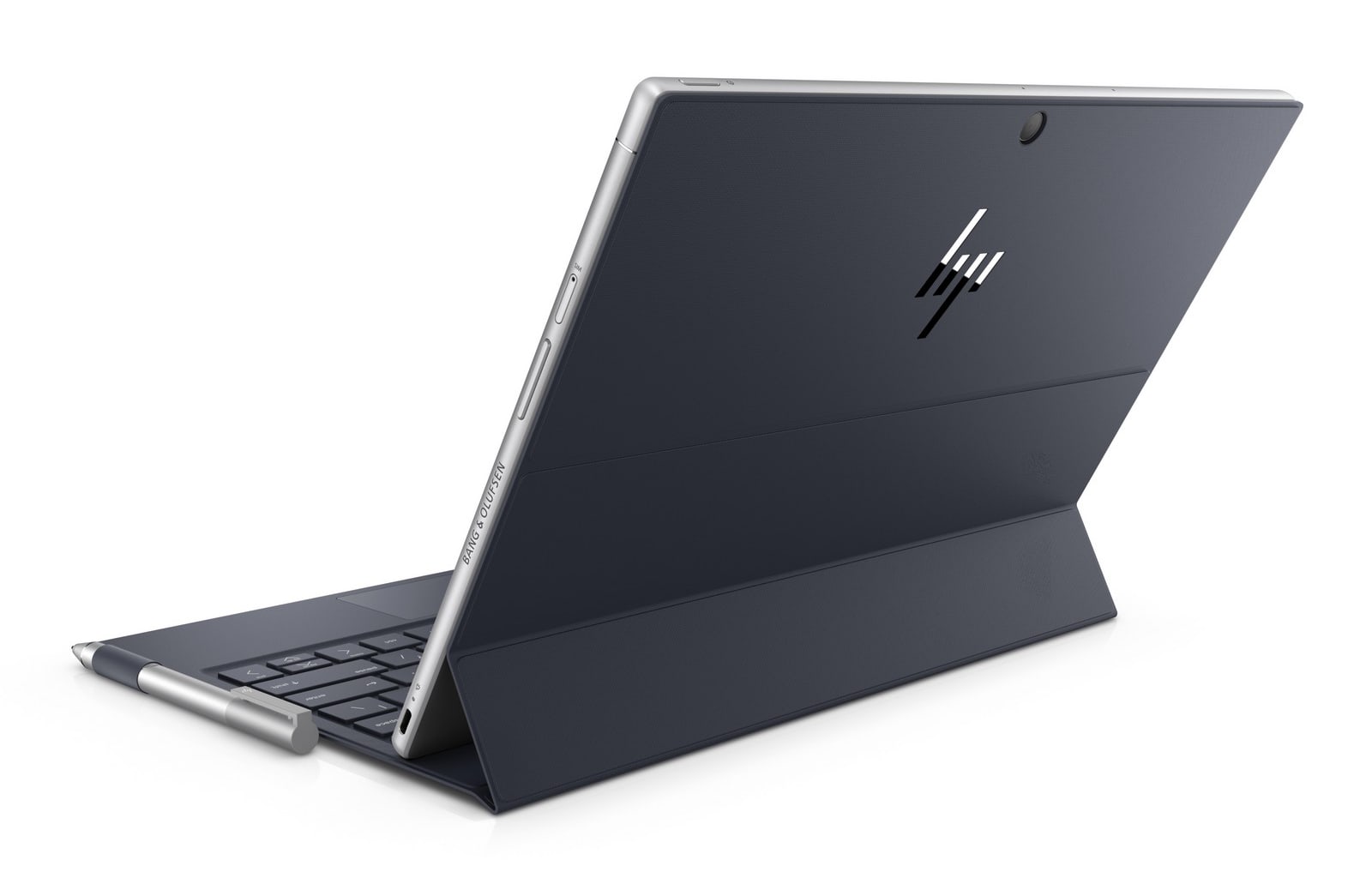
The Intel Envy x2 is also slightly heavier, weighing in at 1.65 pounds, compared to 1.54 pounds with the mobile-powered version. That’s not a hugely noticeable difference, and it still puts the new x2 slightly under the Surface Pro 4’s 1.73-pound weight. It features a fanless design, so it won’t get noisy once you get working, and includes a 13 megapixel rear camera and a 5MP front-facing camera. There aren’t many surprises with its hardware: It comes with HP’s Digital pen, and HP promises 15 hours of battery life. Notably, the company claims you’ll be able to charge it up to 90 percent in just 90 minutes.
In my brief time with the Envy x2, it felt like a fairly straightforward hybrid PC. The tablet feels sturdy and well made, and the keyboard had a satisfying amount of travel. And, surprisingly enough, it didn’t feel that much different from the Snapdragon-powered x2 when I held each in one hand. My biggest gripe is with its keyboard stand. It’s not very flexible, and, as usual with these types of cases, I had a lot of trouble getting the origami fold to hold up the tablet. It’s simply more trouble than it’s worth. That case design also makes it tough to hold the Intel Envy x2 on your lap, something that’s at least possible with the Snapdragon model.
HP isn’t divulging pricing on the Envy x2 yet, but you can expect it to appear in the spring. It seems like a decent hybrid, but I’m hoping HP offers up some alternatives to that wonky keyboard case.
Click here to catch up on the latest news from CES 2018.
Alexa is coming to Windows 10 PCs from HP, ASUS and others
Amazon’s Alexa recently arrived on headphones and even toilets, but it’s about to become much more ubiquitous by hitting Windows 10 PCs later this year. HP, ASUS and Acer have revealed that the voice assistant is coming to various models, including ASUS’s ZenBook and VivoBook lineup, the HP Pavilion Wave, and select Acer Spin, Swift, Switch and Aspire notebooks. Amazon will release a special Alexa app in the spring, and laptop builders are tapping Intel’s Smart Sound tech to make sure that the app can pick up your voice when you’re not right next to your PC.
“Hands-free access to Alexa on PCs can be helpful to customers in many ways, like making it simple to interact with your smart home, get news or weather, set timers, and more,” Amazon Alexa VP Steve Rabuchin said in a statement.
In August, Amazon and Microsoft unveiled a surprise alliance with the aim of integrating their respective Alexa and Cortana voice assistants by the end of 2017. The companies obviously missed that deadline, and the new Alexa Windows 10 app isn’t part of that. Instead, Amazon is working on a separate app that will let you access information in much the same way you do on Echo and third-party devices.

HP’s Pavilion Wave, one of the PCs that will have Alexa, looks more like a smart speaker than a PC. However, it will also appear on more classic laptop models from Acer (like the Switch, above), ASUS and other companies.
Unlike with other Alexa integrations, Alexa on PCs will be able to show on-screen, as well as tell you about the information you requested. However, some current Alexa features — like controlling security cameras and other smart home features, messaging and calling, Spotify and Amazon Video — won’t be available at launch.
Amazon and Alexa are in pitched battle over their respective Alexa and Assistant apps, with both companies trying to get them into as many cars, smart speakers, hubs, headphones, smartphones and other devices as possible. For example, Google recently announced an Assistant alliance with lock-maker Schlage, and Alexa is appearing in a Bluetooth car charger. Google does have one leg up with its Assistant: Its available in many more countries (in Europe and elsewhere) than Alexa.
Amazon hasn’t set an exact date for the release of the app, and it’s unclear so far if it will work on any old Windows 10 PC. Hopefully we’ll learn more details as the big CES 2018 show goes on.
Click here to catch up on the latest news from CES 2018.
Sennheiser’s latest wireless earbuds are an alternative to Beats X
High-quality audio company Sennheiser introduced new wraparound Bluetooth earbuds to its lineup to compete with Apple’s AirPods and Beats X. The company’s CX 6.00BT model features an integrated microphone, a three-button remote and six hours of battery life, and will be available this month for $100.
The CX 6.00 has a few unique tricks, like the ability to pair with two devices at once (so you can listen to audio from your phone and computer simultaneously, say) and support for 3-way calling. Otherwise, Sennheiser is introducing another pair of cans at CES: The HD 820, an update for the company’s lauded HD 800 line of headphones. The key new feature are discs of Gorilla Glass that cup the outside of each can to allegedly reflect escaping sound back toward ‘absorber chambers’ to minimize resonance. This audio ambrosia doesn’t come cheap, though: The HD 820 will retail for $2,400 in early summer.

Click here to catch up on the latest news from CES 2018.
Sony’s mid-range Xperia XA2 and XA2 Ultra are still all about the cameras
CES hasn’t been much of a smartphone show in recent years, but don’t tell Sony that. Rather than save the goods for Mobile World Congress, the company decided to reveal a trio of new Xperias meant to spice up its existing line of mid-range devices before the show officially kicks off.
First up is the Xperia XA2, which blends Sony’s classic Xperia aesthetic with one of Qualcomm’s Snapdragon 630 chipsets and 3GB of RAM. Unlike last year’s XA1, Sony’s sequel packs a 5.2-inch display running at 1080p — a much-needed bump in resolution that hopefully won’t affect the bottom line too much. And since the screen is slightly bigger than the XA1’s, that means the tweaked build of Android 8.0 here gets a little extra room to breathe.
Sony’s cameras have always been one of the biggest reasons to buy an Xperia, so it’s little surprise the company went with one of its impressive 23-megapixel sensors with hybrid autofocus and support for 4K video recording plus 120fps slow motion shooting. Low-light performance should also be at the very least respectable thanks to the camera’s ability to shoot at up to ISO 12,800. Flip the phone over and you’ll find an 8-megapixel wide angle camera with a 120-degree wide-angle lens just for good measure.
Curiously, the XA2 — along with every other phone Sony announced today — features a rear-mounted fingerprint sensor. That normally wouldn’t raise any eyebrows, but this shift in design is notable because of Sony’s historical inability to include fingerprint sensors in its US devices. Not so anymore: every version of the XA2 will have fingerprint sensors, and for that we’re grateful.
The XA2 Ultra, meanwhile, is a fascinating variation on a theme. It uses the same Snapdragon 630 chipset as the regular XA2, but instead pairs it with 4GB of RAM, either 32 or 64GB of internal storage and (most importantly) a much bigger 6-inch, full HD screen. And just above that display? Two front-facing cameras: the 8-megapixel wide-angle camera the XA2 uses plus a 16-megapixel sensor with optical image stabilization to ensure those selfies come out just right. It’s otherwise identical to its little brother, save for a slightly larger, 3,580 mAh battery — a nice bump to be sure, but we’ll soon see how it copes with that more expansive screen.
Rounding out the lineup is the more modest Xperia L2, which runs with a (currently unspecified) quad-core chipset clocked at 1.5GHz, along with 3GB of RAM and up to 32GB of storage. Beyond that, the trade-offs really become apparent: the L2’s 5.5-inch screen might be bigger than the XA2’s, but it only runs at 720p. It’s also going to ship with Android 7.1.1 Nougat onboard, not to mention a considerably less impressive 13-megapixel main camera.
None of these new devices have final price tags attached to them yet, but it won’t be long before Sony makes its revelations — all three phones are slated for launch this month.
Click here to catch up on the latest news from CES 2018.
Wearable home theater lets you see what’s outside
Home theater headsets have come a long way, but there’s still a common problem: they tend to dominate your face. It’s hard to know when someone wants your attention unless they tap on your shoulder. You might not be quite so cut off in the future, though. Kopin and Pico Interactive have unveiled a wearable home theater prototype, the Eagle, that promises the equivalent of an 80-inch screen while giving you better awareness of the outside world. You probably wouldn’t want to walk with this on your head, but it could give you a peek at an approaching person before they say hello.
Not surprisingly, the displays are key. Eagle revolves around a pair of newly unveiled 0.49-inch OLED screens that may be limited to 720p, but pump out a high 1,000 nits of brightness while consuming relatively little power. This doesn’t appear to be a convertible design like Avegant’s Glyph, though, so it won’t do as much good if you only want to listen to music.
As it stands, you’ll be waiting a while to try it — if you can try it at all. Pico is “initially” planning to release the finished version of Eagle in China through a subsidiary, and there’s no mention of whether or not it’ll be available elsewhere. Think of this more as a peek at how wearable displays are shrinking instead of something you’re likely to wear.
Click here to catch up on the latest news from CES 2018.
Source: Kopin (1), (2)
AMD talks details on second-gen Ryzen chips, teases Vega for mobile
AMD sought to start 2018 strong with an event that came just before CES began. The announcements include details on Ryzen’s second generation, new Ryzen and Vega mobile chips, and the company’s roadmap through 2020.
Ryzen takes a bow with its second generation
It seems like Ryzen was announced just yesterday, but AMD isn’t taking a break. Instead, it’s leaping right into the second generation of Ryzen. Now, don’t get too excited – this isn’t Ryzen 2, but instead a second generation of the original. That means the changes aren’t extreme. But neither is the wait! You’ll see these chips arrive as early as April of 2018.
Still, the second generation of Ryzen makes some notable improvements. It’s built on a new 12-nanometer production process (Ryzen is 14nm), which should net some improvements in efficiency. It’ll also offer Precision Boost 2, a series of technologies that try to optimize the processor’s performance and power draw. It improves over Precision Boost with a more “opportunistic algorithm” and more granular power stepping. Or, to put it simply, the processor should run faster and for longer.
The second generation of Ryzen will launch alongside a new X470 chipset. It’ll still use the same AM4 socket, as promised, so owners of the older X370 chipset can upgrade to the new processors. You’ll also be able to use Ryzen second generation with some old motherboards. AMD says it’ll issue a “AMD Ryzen Desktop 2000 Ready” certification, so you’ll know which motherboards support the second-gen out of the box.
Little was said about the X470 chipset’s features. That information will be revealed closer to its launch.
Ryzen 3 chips get some help from Vega
AMD wasn’t ready to talk about any specific second-generation Ryzen parts, but it did unveil two new budget-friendly, first-gen options. It’s a pair of APUs: The Ryzen 5 2400G and the Ryzen 3 2200G, each with Vega graphics.
These chips will launch on February 12.
Processor
Ryzen 5 2400G
Ryzen 3 2200G
Boost Clock/Base Clock
3.9GHz/3.6GHz
3.7GHz/3.5GHz
Cores/Threads
4/8
4/4
Compute Units
11
8
Price
$170
$100
These are extremely affordable parts – the Ryzen 3 2200G is only $100. That gets you 8 Compute Units, while the Ryzen 5 2400G has 11. That’s not a lot. The Vega 56 and 64 are named after the number of compute units on each. But hey, even the 2400G is only $170, so what were you expecting?
AMD says the Ryzen 5 2400G will offer performance similar to an Nvidia GT 1030 graphics card, so most games should be playable at 1080p. The company’s even bold enough to call it the “world’s most powerful graphics on a desktop processor.” Which, of course, is accurate — AMD’s only real competition in that arena is itself. The chips will also be unlocked, like all Ryzen hardware, so owners can overclock the snot out of them, potentially netting gains of up to 40 percent with the right settings and a bit of luck.
The original Ryzen gets a price drop
While the second-gen is incoming, the original Ryzen processors are getting a price drop — well, most of them, at least. This includes a $100 drop on the Ryzen Threadripper 1900X, to $449, and a $150 price drop on the Ryzen 7 1800X, to $350.
Processor
Original Price
New Price
Ryzen Threadripper 1900X
$550
$450
Ryzen 7 1800X
$500
$350
Ryzen 7 1700X
$400
$310
Ryzen 7 1700
$330
$300
Ryzen 5 1600X
$250
$220
Ryzen 5 1600
$220
$190
Ryzen 5 1500X
$190
$175
Ryzen was already considered affordable, so a price drop is nice to see. The fact Threadripper now starts at $450 is a bit nuts. Remember, too — AMD has promised not to change sockets for at least a couple more years, so if you build a discounted rig now, you should be able to upgrade soon.
These price drops should be going into effect over the week of CES 2018, and may even be live by the time you read this.
Ryzen 3 mobile chips target $500 laptops
Laptops will see a pair of new APUs based on the original Ryzen architecture. These should appear in laptops coming over the first quarter of 2018, though AMD didn’t mention any specific laptop design wins to mention at its event.
Here’s the scoop on the two chips:
Processor
Ryzen 3 2300U
Ryzen 3 2200U
Boost Clock/Base Clock
3.4GHz/2GHz
3.4Ghz/2.5GHz
Cores/Threads
4/4
2/4
Compute Units
6
3
You don’t have to study these long to figure out they’re meant for inexpensive systems. The company mentioned it expects the first laptops with Ryzen 3 2300U to come in around $500. That’s not much at all for a quad-core laptop with Vega graphics.
Still, it’ll be wise to keep expectations in check. The Ryzen 3 2300U only has six compute units and the Ryzen 3 2200U has just three. By comparison, the Intel 8th-gen Core with Radeon RX Vega comes in flavors with 20 or 24 compute units. Laptops based on Ryzen 3 mobile will play games smoothly, but most titles will need to see settings reduced to low, and the most demanding games may only be enjoyable at resolutions below 1080p.
AMD
AMD also has plans to introduce Ryzen Pro for mobile in the second quarter of 2018. These chips will support enterprise-grade features, such as Windows 10 Enterprise support and a AES 128-bit encryption engine. There’s no pricing or release date for them yet.
Vega for mobile is such a tease
AMD launched into its event with a big announcement: AMD Vega mobile. The crowd went wild! Unfortunately, the company’s intent to produce it is all we really know. AMD says it’ll target ultrathin workstations and ultrathin gaming laptops, but we doubt you needed a press release to figure that out.
The tease was made more unbearable with the announcement of Radeon Instinct, a version of Vega that’ll target machine learning. It’ll be built on a 7nm production process and, if all goes well, should be AMD’s first product built on that process.
Otherwise, we’re in the dark. We don’t know anything about pricing, availability, or how AMD expects Vega for mobile to stack up against competitors. All we do know is that Radeon Instinct will begin sampling — that is, shipping to PC makers so they can finish product designs — sometime in 2018.
AMD’s road forward
Aside from the truckload of info you’ve already sorted through, AMD said a bit about its roadmap for the future. It’s all vague, of course, but it does offer a glimpse of where Ryzen and Vega are going.
On the CPU side, AMD expects the second-generation Ryzen in April, followed by Ryzen 2 in 2019, and Ryzen 3 in 2020. Interestingly, Ryzen 2 and 3 are both planned for a seven-nanometer production process. That’s a big leap from the 14nm process used in Ryzen!
AMD
GPUs are quicker still because, as mentioned, a seven-nanometer version of Vega is expected this year. It’ll be followed by a GPU architecture refreshed called Navi in 2019, and an unnamed next-generation architecture in 2020.
This is undoubtedly an aggressive roadmap. It’s not crazy to think AMD might deliver consumer CPUs built on a seven-nanometer production node before Intel – if all goes to plan. Whatever happens, it’s good to see AMD plans to keep the pedal on the floor.
Editors’ Recommendations
- AMD’s upcoming Ryzen refresh won’t require a new motherboard, company confirms
- AMD crams desktop performance into ultra-thin laptops with its new Ryzen APUs
- Acer Swift 3 gets the AMD APU treatment, adding power to the bargain machine
- AMD is more than the Threadripper. Here are the best AMD CPUs on any budget
- Intel’s ‘Hades Canyon’ NUC packs gaming hardware into just 1.2 liters
 AIVAnet