


Best tip ever: Set up Find My Device as soon as you get your phone
Signing into Find My Device is one of the first things you should do after setting up your phone.
There are several options available for remotely tracking your phone, but Google’s own Find My Device service is one of the most convenient around. In addition to locating your phone, Find My Device lets you ring your device, lock it remotely, or even erase the data if your phone goes missing or stolen.
Find My Device isn’t enabled out of the box — you’ll have to manually set it up on your phone. Doing so is a straightforward process that doesn’t take more than a few minutes, so let’s get started.
Install and enable Find My Device

If your phone doesn’t already come with Find My Device pre-installed, you can download the app from the Play Store. The service is available for download even on older devices — all phones running Android 4.0 Ice Cream Sandwich and above are eligible.
Once the app is installed, you’ll have to sign into it with your Google account. Doing so allows the service to essentially link your phone to your Google account. As Find My Device relies on Wi-Fi and GPS to pinpoint the location of your device, it requires access to location services. Once you grant access to location services, you should be able to see a map with your phone’s location highlighted.
Find My Device: Everything you need to know
Track your phone with ease

If you need to remotely track your phone, all you have to do is head to the Find My Device site and sign into your Google account (the same you used while setting up the service). Alternatively, you can also perform a Google search with the query, “Find my phone” to start tracking your device.
Once your phone has been located, you’ll be able to ring your device so it plays a loud sound even if it’s on silent mode. This is handy if you’ve misplaced your phone inside your house. If you have a Google Home, you can just ask Assistant to ring your device.
Find My Device’s lock feature is useful if you haven’t secured your phone with a passcode or fingerprint, as it prevents access to the home screen should anyone else come across your phone. There’s also the option to display a message on the lock screen and add a callback number so that anyone that finds your phone can get in touch with you.
If you’re looking for additional features, there are several third-party apps available that let you remotely track and lock down your device.
How to find your lost Android phone
Remotely erase data when all else fails
As Find My Device relies on location services, your phone has to be connected to a Wi-Fi network or use cellular data for the service to accurately track its position. If you’re unable to locate your phone or if it’s been stolen, then the only option is to remotely erase all data on the device.
The remote erase command deletes all data on your phone — as well as any connected SD cards. If your phone is offline when you issue the command, it automatically kicks in the next time it goes online.
Make sure you’re always ready
Find My Device is one of those services that you won’t use often, and as such it’s easy to forget to set it up during initial configuration. If you’re picked up a new phone over the holidays or haven’t gotten around to enabling it on your existing device, now’s the time to go ahead and set it up on your phone.
AT&T will release true 5G service by late 2018
Some AT&T customers will get to use actual 5G before the end of the year.
There were a lot of developments in wireless 5G service throughout 2017, and now that we’re at the beginning of the new year, AT&T has announced that it plans on releasing a true 5G network to 12 different markets by late 2018.

The last major development in 5G last year was the finalization of its standards by the 3GPP. With these standards in place, AT&T says that it’ll be able to push out 5G before the end of the year now that OEMs and chipset manufacturers can create hardware that’s compatible with the new network.
Per AT&T’s President of Technology and Operations, Melissa Arnoldi –
5G will change the way we live, work and enjoy entertainment. We’re moving quickly to begin deploying mobile 5G this year and start unlocking the future of connectivity for consumers and businesses. With faster speeds and ultra-low latency, 5G will ultimately deliver and enhance experiences like virtual reality, future driverless cars, immersive 4K video and more.
This 5G network that AT&T is talking about shouldn’t be confused with 5G Evolution that the carrier launched last April. 5G Evolution was nothing more than bad branding on AT&T’s part to reference its enhanced 4G LTE service, but the 5G that’s scheduled to launch by the end of the year is real, authentic 5G.
Larger rollouts of 5G on AT&T and other carriers likely won’t be seen until 2019, but even just 12 markets getting a taste of 5G at some point before 2018 is over is quite exciting.
5G gets closer to reality as initial standard is finalized

Instagram is letting some users share their Stories on WhatsApp Status
The feature that Stories deserves.
Over the past couple years, it seems like everyone is trying their hand at their own ‘Stories’ feature. After Snapchat launched Stories in 2013, we’ve seen Instagram, Facebook, WhatsApp, and even Skype try to get in on the action as well. Now, Instagram has confirmed to be testing a new feature with users in Brazil that allows them to share their Instagram Stories on WhatsApp with just a couple taps.

Instagram confirmed to TechCrunch that it’s testing this feature out with select users, and the implementation looks very sleek. According to screenshots that were shared by a local blog in Brazil, tapping the “Your Story” button in Instagram will show the WhatsApp icon with an option to add your account details so you can share any Instagram Stories posts directly to WhatsApp Status. When this is done, any posts you share from Instagram to WhatsApp will show a small Instagram logo in the bottom right corner.
Speaking to TechCrunch, a spokesperson for Instagram said:
We are always testing ways to improve the experience on Instagram and make it easier to share any moment with the people who matter to you.

A post on Instagram Stories (left) shared directly to WhatsApp Status (right).
Stories on social networking apps have proven to be extremely popular, but one of the issues that I’ve always had with them is the fact that you need to pick and choose which app you’d like to share your moments on. We definitely won’t see any option of sharing Instagram Stories to Snapchat anytime soon, but if Instagram chooses to keep developing this new feature, we could one day have the option of sharing stories on Instagram to WhatsApp, Facebook, and Messenger at the same time.
Instagram is testing a standalone messaging app because why not
Tesla says its Model 3 production nightmare is nearly over
In 2016, Tesla managed to ship 83,992 vehicles, narrowly missing its target of pushing 90,000 cars out of its front door that year. Now, the company has revealed its 2017 figures, saying that it produced 101,312 Model S and Xs between January and December. That figure doesn’t include the new mass-market Model 3, of which the company was able to crank out 2,425 in the fourth quarter. Which, itself, is a big bump from the meager 260 it made when production began in Q3.
Tesla says that it has spent the last three months addressing the “production bottlenecks” on the Model 3 line, and production will now rise sharply. From a slow start, the company believes it now has the capacity to knock out 1,000 Model 3s each week, and 2018 will see even bigger milestones. The projection for the current quarter is that it will produce around 2,500 a week, and be producing 5,000 a week by the end of Q2.
Tesla has always set ambitious goals for vehicle production, like when Elon Musk claimed that Tesla would be producing 20,000 Model 3s a month by December 2017. Prior to that, he believed that Tesla could produce between 100,000 – 200,000 Model 3s between July and December of 2017. The estimate has been revised down since then, but it’s worth wondering how reliable Tesla’s latest claims will be. Coupled with the rumors surrounding production delays, it will be interesting to see how things are going by the summer of 2018.
Via: TechCrunch
Source: Tesla
The Velar is a Land Rover for (rich) tech-lovers
Land Rover and its family of Range Rover vehicles are known for rugged luxury. You can drive through a river in the woods during the day, rinse it off, and drop it with a valet at the opera that night. It appeals to a demographic that’s more interested in the Burgundy region of France and postcards than Burning Man and DMs. So to appeal to the tech CTOs instead of the Wall Street CEOs the company introduced the Velar, its “avant garde” Range Rover.
Starting at $50,000, the new high-tech Range Rover — with a plethora of displays and features — keeps the driver and passengers connected while pampering them in plush seats with enough room to drag your gear to the beach, mountains or even a certain festival in the desert.
To highlight its new focus on technology, the Velar features Land Rover’s new Touch Pro Duo dual-screen infotainment system in the center dash. With it you can adjust the climate control, change drive modes, and choose media from the bottom screen while navigating to your destination and keep an eye on the news and weather with the top display.

The navigation of both screens is quick to master, with tabs for the main sections always available (at the bottom for the top screen and at the top for the bottom screen). In addition to on-screen menus, there are two knobs on the bottom screen that, depending on the selection, control either the climate, drive mode or seat heater/cooler. While it’s great in theory to have physical controls for various settings that are contingent on what’s on the display, on a few occasions, I went to adjust the temperature of the passenger cab only to realize too late that I was changing the drive mode from Comfort to Snow and Ice. Whoops.
The dash cluster continues the futuristic look with a digital display that’s controlled by physical buttons on the steering wheel that change their operation based on what’s on the screen. They go from controlling your music, to delving into a huge amount of features for the digital display and how the car behaves. It’s in this area where I encountered the most latency while moving up and down feature lists. Nothing overly annoying, but enough to note. The setup also mirrored the issue with the dash with physical controls creating a situation where you believe you’re doing one thing (adjusting a feature) and end up doing something else (changing the music). Double whoops.
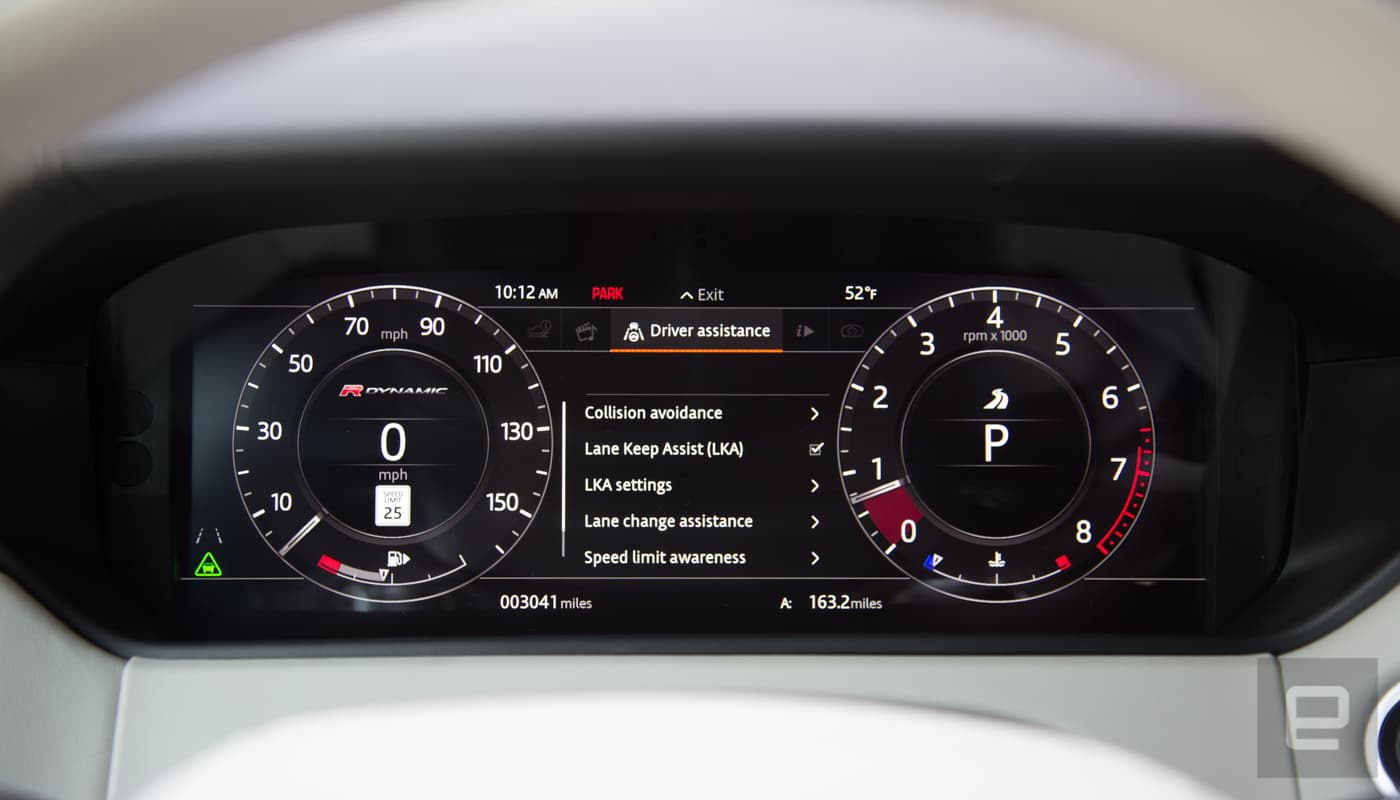
The whole set-up feels like the automaker created it for a concept car, then decided to go ahead and put it in a production car. It’s an impressive feat and feels more like the future than many cars on the market including anything from Tesla. I just wish it supported CarPlay and Android Auto since the navigation system doesn’t accept voice controls. It’s also very dense especially in the dash cluster and I found it helpful to just sit in the driveway and acclimate myself with everything that’s possible before adjusting features on the road.
And it’s on the road where the Velar reveals that it’s not just the cabin built for a younger demographic. The Velar feels sportier than the usual Range Rover. You’re not going to push it through switchbacks like a BMW X3 M40i, but it handles sharp turns on the freeway without too much body roll. The downside is that that stiffer suspension translates to a rougher ride. Comfort mode smoothes out the bumps, but if the road jostling was reduced an additional 15-percent, it would be outstanding.
For those wanting power along with a sportier ride, the Velar comes with either a 2.0 liter 247 horsepower turbocharged 4-cylinder, a 2.0 liter 180 horsepower turbocharged diesel or the 380 horsepower 3.0 supercharged V6. Land Rover sent us the SE trim level (starting at $67,400) with the top of the line engine and yes it was powerful and quick, but there’s something weird about a quick Range Rover. Yes I can see one flying down the 101 piloted by a CTO downing a latte, but I was happy to just cruise in the SUV and enjoy the experience of the Velar.
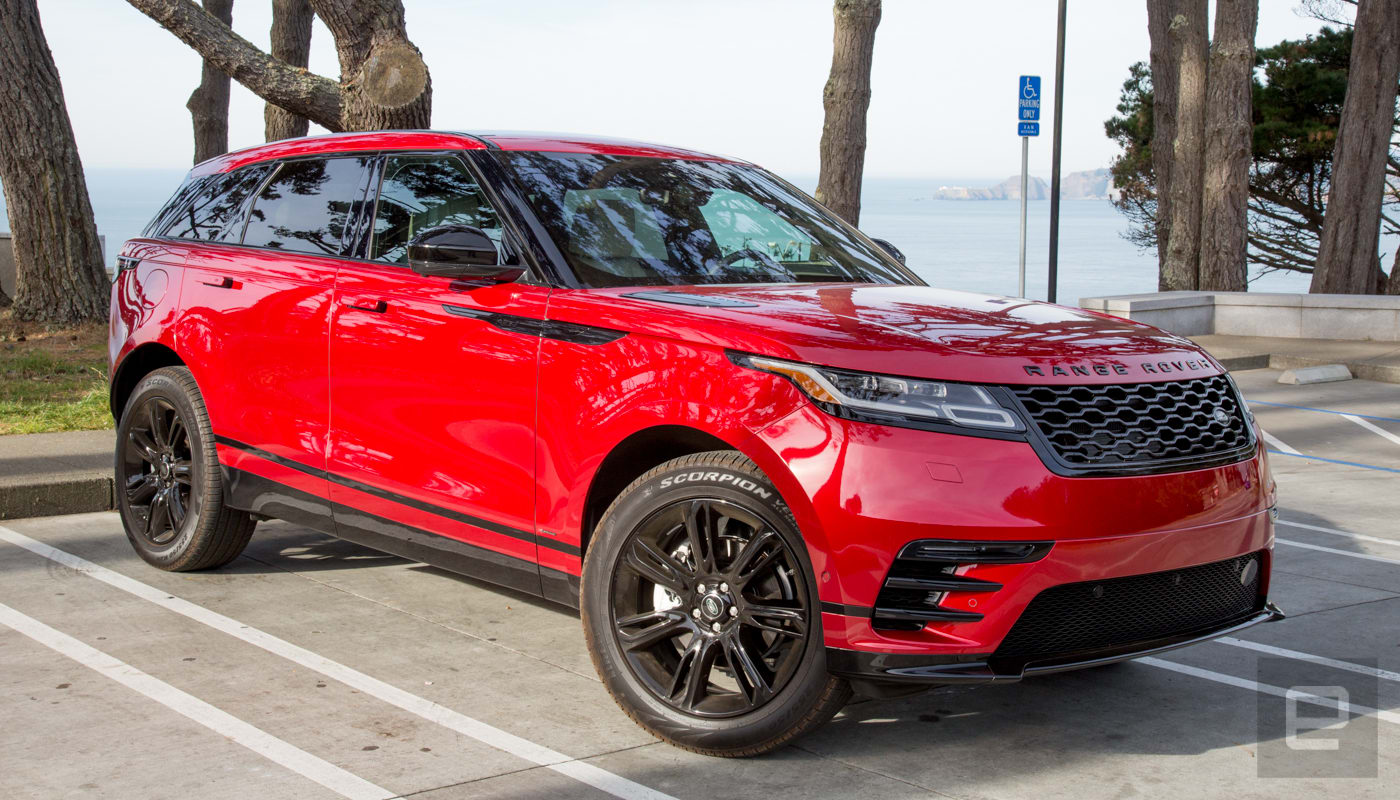
I drove the Velar offroad for a small amount of time. Although it wasn’t nearly long enough to gauge the full capabilities of the SUV. I also had zero chance of getting the Velar into any sort of snow and ice. But changing of drive modes was just a few taps away and going from a dirt road to pavement took only a few seconds of adjustment by the car. During the short moments driving through ruts during off-road, the SUV never felt anything other than at home in its environment. Something you can’t say for all sport utility vehicles aimed at an upscale market.
And the Velar is clearly meant for executives and those with the money and desire for something that’s different from the rest of the luxury SUVs in the company parking lot. The Velar delivers with its drivetrain, comfort and with most of its tech. It’s a stunning looking vehicle that stands out from the pack with an interior that’ll please both the CTO of a tech company and probably more than a few old-school Land Rover fans. It does exactly what Land Rover wants: It bridges the company’s rugged and luxurious past with its forward-looking future.
Source: Land Rover
Microsoft’s Cortana isn’t able to identify songs anymore
Microsoft didn’t have much luck in the digital music realm, from the Zune to its Groove Music service. At the end of 2017, the company switched all of its existing Groove users over to Spotify and shut Groove down. But now it turns out the move came with an unforeseen complication, as reported by Neowin. Cortana, Microsoft’s smart assistant, can no longer recognize individual songs.
Previously, users could use the song identification feature by pressing Cortana’s music icon while a song was playing. But now, because Cortana doesn’t have the Groove library to check songs against, it says “Song unrecognized” and informs the user that the feature has been retired. Jason Deakins, a Microsoft software engineer, discussed the issue in response to a Twitter user.
Hi John. What you are seeing is expected. Due to the shutdown of the Groove Music service Cortana music recognition has also been retired.
— Jason Deakins (@JasonDeakins) January 3, 2018
It makes sense that the lack of a music library would make the song identification feature unusable, but Neowin points out that the popular song recognition app Shazam is not available on the Windows Store. This means that Windows users no longer have a tool to identify music. It’s certainly not a great situation for anyone who used this feature regularly.
Source: Neowin
Mesh WiFi startup Eeros lays off a fifth of its workforce
Mesh WiFi pioneer Eero has laid off 30 employees in a bid to “focus on its core business”. The company, which launched in 2015, has played a pivotal role in changing the face of home WiFi with products that blanket spaces in coverage, designed to replace old-school systems of routers and extenders.
TechCrunch reports that the lay-offs equate to around 20 percent of Eero’s total workforce. According to a statement by the company, it seems the move follows a potentially financially-driven decision to scrap a new project. “Over the past year we explored several related projects, and we’ve now made the tough decision to eliminate one new project in favor of greater focus on our core business,” it read.
Eero, which has been at the forefront of mesh WiFi, hasn’t been short of capital since its arrival to Silicon Valley, raising $90 million at its start and a further $50 million in May 2016. But it’s seen significant competition in its time, too, with the likes of Google, Linksys and Samsung all promising the same services, and all, as evidenced by Eero’s lay-offs, with bigger names and budgets.
Source: TechCrunch
Apple Pay Promo Offers Free Delivery From Instacart Through January 10
Apple has launched a new Apple Pay promotion running through Wednesday, January 10 and centering upon grocery delivery app Instacart. With the promo, you can get free delivery on Instacart orders of $35 or more when using Apple Pay to checkout, and no promo code is needed.
The fine print for the new offer notes that free delivery will be subject to availability in certain areas, and service fees and taxes still apply to your order. If your area supports the promotion, you can save $5.99 or more on an Instacart order, with delivery fees starting at that price point and increasing when factoring in the size and time of your order.
In the same email announcement, Apple also highlighted restaurants that support Apple Pay, like Panera Bread, Jamba Juice, and Whole Foods. Additionally, the company mentioned a few food planning and delivery apps that might help users maintain their healthy eating New Year’s resolutions, like Thrive Market, Blue Apron, and Plated.
The Instacart email promotion follows previous Apple Pay offers launched over the past few months, including one for Fandango in December and another for Postmates in November.
Related Roundup: Apple Pay
Discuss this article in our forums
Tivo’s new TV platform will combine cable and streaming
TiVo has launched its new streaming service that promises big things for both consumers and cable or streaming operators. Called the Next-Gen Platform, it gives viewers a convenient, unified way to watch recorded content from both cable providers and streaming services like Netflix and Amazon Prime. Operators like Altice, meanwhile, can implement TiVo’s tech to provide consumers with “hyper-personalization, recommendations and voice-control” on multiple devices and screens, TiVo says.
The Next-Gen Platform, which uses TiVo’s rumored cloud service, has been on our radar since TiVo first flaunted it over a year ago. The company is promising “seamless integration of content across linear, over-the-top (OTT), on-demand and DVR platforms for multiscreen capabilities.” TiVo tells operators that by integrating its tech, they’ll provide a better user experience and “remain relevant amid growing competition.”
As part of the launch, TiVo says the Next-Gen Platform will run on quite a raft of products, including TiVo for Apple TV, Amazon Fire and Android TV. It has also launched smartphone, web and Linux-based set-top box (STB) software that can be integrated into smart TVs, cable boxes and other devices. Operators can implement software in both “managed” devices like set-top boxes, or unmanaged ones (Apple TV, Amazon Fire TV, etc.).

A lot of TiVo’s Next-Gen Platform news is inside baseball for industry folks, but it does have implications for the public, too. If it recruits major cable and streaming operators, it will no doubt result in a more streamlined viewing experience on TiVo apps and devices. However, it has to convince operators that letting consumers stray from their ecosystems is a good thing.
TiVo recently unveiled its Bolt Vox set-top box, which will almost certainly support the cloud DVR aspect of its services, though the company didn’t explicitly say so in its release. Past Bolt TiVo may support it too. Hopefully, TiVo will give us a clearer idea at CES 2018 next week as to how its new platform will work with its products, including pricing information and more.
Click here to catch up on the latest news from CES 2018.
Instagram experiments with cross-posting stories to WhatsApp
Over the past year, Facebook unleashed updates that make its Snapchat-like features less fractured and more streamlined. Based on a new test the company is running, it knows its job is far from done: according to TechCrunch, some users in Brazil are seeing an experimental tool that gives them a way to crosspost Instagram Stories to WhatsApp’s Status feature. A Brazilian blog has posted a screenshot of an Instagram Story showing the tool on the lower-left corner of its interface.
Facebook has multiple features that allow users to post decorated photos, videos and GIFs as ephemeral status messages across its properties. Since Instagram’s version is the most popular — it even has more users than Snapchat — and Facebook’s is barely used, the social network introduced a tool that makes it possible for the photo-sharing app’s users to crosspost Stories to its main website. The company also merged Facebook Stories and Messenger Day into a single entity simply called “Stories” late last year.
If it gives this new feature a wider release, then users can create a single Story on Instagram then share it on Facebook, Messenger and WhatsApp. That will make things so much easier for people who use all those platforms, though Facebook will have to conjure up a way to ensure users won’t get annoyed by seeing the same Story on multiple apps.
Source: TechCrunch
 AIVAnet