


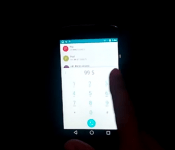
[VIDEO] Android L has been ported to the Nexus 4
 The question on many people’s lips, particular the ones who don’t own a Nexus 5 or Nexus 7, is when they will be able to try the Android L preview on their device. The question is even more pertinent for Nexus device owners who have had part of the preview uploaded to AOSP, but it may or may not be enough to go on to make complete ROMs. Still, that hasn’t stopped some geniuses out there as Android L has been ported to the Nexus 4. You can check out a video of their feat below:
As you can see, it looks to be working pretty with all the functions and apps for Android L working in this port, though there are some outstanding bugs that remain including NFC, Bluetooth, Camera and a few other niggling issues. There also appears to be an unfortunate one-off side effect of the ROM installation as the first time boot after flashing can take up to 15-20 minutes; as any flasher will know, the time taken for the first boot can seem like an eternity so make sure you stay extra patient for this one. If you’re interested in trying out the ROM, you can download it from the site below, or you can check out the original XDA forum post in the source links.
Let us know if you try out Android L on the Nexus 4, and how you find it.
Source: Galaxy Fit Update, XDA via Phone Arena
//<![CDATA[
ord = window.ord || Math.floor(Math.random()*1E16);
document.write('’);
//]]>
The post [VIDEO] Android L has been ported to the Nexus 4 appeared first on AndroidSPIN.

Korean Government Orders Apple and Google to Change ‘No-Refund’ App Store Policies [iOS Blog]
 Apple and Google have been ordered by South Korea’s Fair Trade Commission to revise their “no-refund” app store policies in addition to a number of other provisions, reports The Korea Herald. In response to the ruling, Apple reportedly stated that it would consider applying a revised App Store policy worldwide, with Korean officials requiring that Apple send a notice users when its terms and conditions have changed.
Following the FTC orders, the Google Play webstore will design a customer refund system based on Web developers’ refund polices. Apple’s iTunes app store will have to send a notice to users when it changes the terms in its contract.
“We expect the measure, aimed at protecting consumers, will have a ripple effect on similar cases throughout the world,” the Korea Fair Trade Commission said in a press release.
In 2011, the Taiwanese government also pressured Apple and Google to modify their app store policies, with Apple enabling a 7-day refund period. However, it was unclear at the time what changes were made by Apple in order to comply with the law, as the company may have simply addressed it by granting refunds upon request.
Under the current policy, Apple does not offer an automatic way to get refunds for apps. However, refunds have been made available on a case by case basis, as users are able to “Report a Problem” on their purchases to go through iTunes Support. In May, Apple began preventing updates and reinstallation of refunded App Store apps, which was also extended to the Mac App Store.
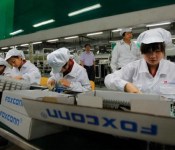
Foxconn Set to Deploy Robots to Help Assemble the iPhone
At a recent shareholder meeting, Foxconn CEO Terry Gou announced that the company will soon deploy robots to help assemble devices, noting that Apple will be the first company to use the service, reports IT Home (Google Translate, via GSMDome).

Named “Foxbots”, each robot will be able to assemble an average of 30,000 devices and costs anywhere from $20,000 to $25,000 to make. Gou stated that the assembly devices are undergoing their final testing phase, as Foxconn plans to deploy 10,000 robots to its factories.
Foxconn has been Apple’s longtime primary partner in assembling its iPhones, iPads, and iPods. In 2011, it was reported that Foxconn would be replacing a portion of its workers with 1 million robots, although it was not clear at the time how many jobs would be replaced by the robots.
As a part of its 2013 10-K annual report last year, Apple also revealed that it was investing a record $10.5 billion on advanced supply chain technology, with some of that investment going towards advanced machinery including assembly robots. A report earlier this year noted that Apple would be moving production of iPhone batteries to automated lines, allowing suppliers to reduce manpower demand and shift resources towards production efforts on other parts.
Foxconn has recently ramped up its production efforts ahead of the launch of Apple’s iPhone 6 this fall, with the company bringing on 100,000 new workers to help assemble the iPhone 6. Production of the new device is reportedly set to ramp up next month ahead of a launch around September. The iPhone 6 is expected to come in two sizes of 4.7-inches and 5.5-inches, and feature a thinner profile, an improved camera, a faster A8 processor, and more.

The TSA won’t let you board some flights unless your devices turn on

You know how airport security will occasionally ask you to turn on a phone or laptop to prove that it isn’t hiding explosives? Well, that’s no longer just a rare inconvenience — if you take certain flights, it’s mandatory. The TSA now requires that you power on your gadgets when flying to the US from “certain overseas airports.” If you have a dead battery, you’re out of luck. You’ll likely have to leave that hardware behind, and you might go through “additional screening” at the same time.
To no one’s surprise, the stricter approach is a direct response to short-term terrorist threats. The US is worried that al Qaeda operatives want to bomb an airliner, and the move theoretically prevents these attackers from using hollowed-out electronics to deliver their payloads. The TSA says it will “continue to adjust” procedures to balance convenience and security, so there’s a chance that these device checks will go away. Don’t count on it any time soon, however. It took years for the TSA to remove its all-too-revealing body scanners, and there’s no signs that the administration is eager to rescind its latest rules.
[Image credit: John Moore/Getty Images]
Filed under: Cellphones, Laptops, Transportation
Via: CNBC
Source: TSA
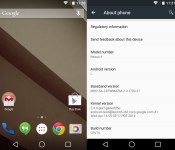
Install Android L “Lemon Cake” Developer Preview on Nexus 4

Nexus 4 owners jealous of those with a Nexus 5 or 7 (2013) running the Android L Developer Preview can get a taste of the next version of Android thanks to developers at XDA Developers forum who ported the rom over to the device.
Since Google only pushed part of the source code to the Android Open Source Project (AOSP) for the Nexus 4, the ROM is based on the Nexus 5 and 7′s (2013) Preview System Images and comes thanks to @sykopompos, @defconoi and @ben1066.
It should be noted that while it’s not fully functional yet, most things are working and it “can be used as a daily driver for the majority of Android users.” Although that’s the case, remember that some apps may not work as developers haven’t updated them yet for the Android L release and since it’s a preview, some things may not work until the official release in the coming months.
Currently noted to not be working is:
- Camera
- Bluetooth
- Swipe-to-Phone-Application not showing on lockscreen
- SELinux and Knox
- SuperSU/Root
To install the ROM, follow these instructions after downloading:
- Put the file onto your Internal Storage
- Reboot into Recovery (CWM/TWRP]
- “wipe data/factory reset”
- “mounts and storage” -> “format system”
- “advanced” -> “wipe dalvik cache”
- “install zip” -> “install zip from sdcard” -> choose the mako-bla-bla-zip and confirm flashing procedure
- “wipe cache”
- “advanced” -> “wipe dalvik cache”
- “reboot into system”
- first boot may take up to 10 minutes – be patient
At this time, it may be best to just install MultiROM and install the ROM that way, so that you can keep your daily driver. I found that the easiest way to install it is to download “MultiROM Manager” from Google Play and through the app, install MultiROM, recovery and kernel. When you boot into recovery, to install a ROM with MultiROM, you select “Advanced” >> “MultiROM” >> “Add ROM.” The settings I used were “Android” for ROM type, “Don’t share: kernel with Internal ROM and install to “Internal Memory,” then selected the ZIP file and flashed it. You can always delete the ROM then flash this ZIP in recovery to uninstall MultiROM. I included a video at the bottom of the post to show you a little bit more about installing a ROM with MultiROM.
For the latest version of the ported Android L Developer Preview for the Nexus 4, hit up the source link below.
VIA: XDA Developers
The post Install Android L “Lemon Cake” Developer Preview on Nexus 4 appeared first on AndroidGuys.
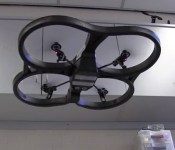
These drones learn about their world (and each other) as they fly

Flying robots can already spot some objects by themselves and occasionally improvise, but they’d ideally never need help — they should find their way around even if they’re in unfamiliar territory. The University of Sheffield may be close to fulfilling that dream. Its experimental quadcopters combine reference points in camera footage with barometric and ultrasonic sensors to not just map their environment, but understand it; they can detect interesting objects and investigate all on their own. This could be particularly handy for rescue crews and others in hazardous situations, since they could identify survivors or operate machinery while keeping human intervention to an absolute minimum.
Crucially, these drones also know how to deal with each other; they gradually learn to predict other robots’ behavior and coordinate so that they can pass by without collisions. Researchers believe they’ll eventually get entire copter squadrons collaborating on projects without requiring pre-programmed routines. The world-sensing technology is still young, but it hints at a future where airborne automatons handle riskier (or simply very complex) jobs without needing close oversight.
Source: University of Sheffield

Most of the NSA’s intercepted messages involve ordinary people

It’s no secret that the NSA’s surveillance efforts reach far and wide. However, we now know which sort of people get caught in that dragnet — and most of them, it turns out, are very ordinary. About 90 percent of users in a cache of Intercepted messages (leaked by Edward Snowden to the Washington Post) were innocents who either talked to suspects or simply happened to be in the wrong chat room at the wrong time. Some of the information is very personal, too, ranging from kids’ school records to couples’ love affairs.
The NSA has US authority to spy abroad, and the intercepted data shows that these large-scale sweeps can be effective in fighting hostile governments or terrorists. Some of the messages led to the capture of bomber Muhammad Tahir Shazad (aka Abu Hamza, pictured here), for instance. With that said, there are concerns that the agency is holding on to personal info that will never, ever be relevant to its investigations. It’s not held to the same standards for incidental content gathering as agencies like the FBI, which has to stop wiretapping if a family member is on the line.
There’s also a worry that the NSA isn’t doing enough to protect US residents’ privacy. While analysts masked 65,000 references to Americans in the cache, the Post believes that roughly 900 of the visible email addresses also belong to stateside users; it’s not known if they’re all legal targets. Whether or not they are, leaked internal chats suggest that NSA team members play fast and loose with their definition of “foreign.” They may only look at the languages in use, or make assumptions about the origins of chat room participants and internet connections.
The Office of the Director of National Intelligence is quick to argue that Snowden didn’t leak raw intelligence data, and insists that there are tight safeguards that limit access to trained agents; in theory, the unfiltered stream doesn’t get into the wrong hands. Snowden was trained, however, and he claims that his private contractor role offered a direct look at the content without supervision. The fear isn’t that information escapes into the wild, though. Rather, it’s that the material both represents a breach of regular people’s privacy and carries the potential for abuse — as we’ve learned in the past, NSA agents aren’t always on their best behavior.
Filed under: Cellphones, Internet
Source: Washington Post
Take a nap the right way with CatNap

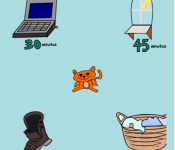
How many times have you been dead tired and said that you were just going to close your eyes for a minute and then end up oversleeping returning to either class or work late? That has probably happened to everybody at some point or another and a new app called CatNap plans on making it easier for you to wake up from that much needed sleep.
Let’s face the facts. With most alarm clocks out there, including the default one on your cell phone or even Timely, setting a quick 30 minute nap is a task that is not as easy as it should be. CatNap looks to change that and makes setting the alarm as easy as tapping a button.
Simple open the appropriately themed cat-themed app and drag the cat onto the desired time. The default options are 20 minutes, 30 minutes, 45 minutes, 1 hour, or a custom alarm. Upon having cat go onto the time you want, the alarm is set. You really cannot ask for something easier than that. When time expires the alarm sounds giving you the option to snooze or dismiss the alarm.
The app does exactly what it says it does and how it is supposed to do it. In fact this app is so great, the developer has dedicated it to Cinderella, who definitely could have used this alarm.
CatNap is a free app that is ad-supported on the Google Play Store.
The post Take a nap the right way with CatNap appeared first on AndroidGuys.

Inhabitat’s Week in Green: solar homes, ‘Soofa’ benches and a levitating transportation system

Solar Decathlon Europe is officially underway in Versailles, where 20 teams of students from 17 different countries are competing to build the world’s most efficient solar-powered homes. Like the American version, the European Solar Decathlon has attracted some truly innovative entries. For example, a team of students from Berlin presented a plan for refurbishing a turn-of-the-century apartment building with solar panels.
Preservation was a popular theme in this year’s competition; the Atlantic Challenge Team, which is based in France, presented a plan for rehabilitating a 120-year-old building into solar-powered, modular apartments. A team from Delft University of Technology designed and presented a renovation project that was inspired by greenhouses. The Rhode Island School of Design produced an innovative house that consumes 90 percent less energy than the typical home and is powered almost entirely by the sun. And the RhOME for denCity team produced a design for a top-floor apartment that incorporates a series of clever passive strategies.
Global renewable energy capacity has nearly doubled over the past nine years, with wind and solar energy carrying the biggest gains. According to a new report, China is far and away the world leader in wind energy, and Germany is tops when it comes to solar production. While renewable energy production continues to grow, clean energy storage technology is starting to catch up. Scientists at USC recently developed a new type of rechargeable battery that is cheap to build, water-based and made out of green components with no toxic chemicals and no metals. And in other renewable energy news, Boston officials announced plans to roll out a series of solar-powered “Soofa” public benches that will enable citizens to charge their phones while they rest. The attractive charging stations double as environmental monitors, and they can charge two phones at a time.
A high-speed, levitating, energy-efficient transportation system could soon be coming to the Israel Aerospace Industry campus in Lod, Israel. The “jet-like” vehicles employ state-of-the-art passive magnetic levitation technology, which could revolutionize urban and suburban public transportation. And after political wrangling, Tesla has received approval to build its first service center in New Jersey. This spring, the New Jersey Motor Vehicle Commission banned Tesla from operating dealerships within the state, but that is expected to change soon because the state Assembly just voted unanimously to allow Tesla to sell its cars directly to consumers.
It’s officially mosquito season in many parts of the Northern hemisphere, and one Sri Lankan newspaper has created the world’s first mosquito-repellant newspaper, so you can catch up on current events in peace. The Mawbina newspaper teamed up with the ad agency Leo Burnett Sri Lanka to create the mosquito-repellant papers as part of a public health campaign. Speaking of public health, a scientist just cooked up a new supervirus in a lab that could potentially wipe out humanity — don’t ask us why.
It’s also air-conditioning season, and Inhabitat has come up with three simple tips to help you save money on your energy bill this summer. Coffee drinkers in London can now feel a little bit less guilty about ordering a latte, because the world’s first recyclable paper cup is about to hit the streets in the United Kingdom. And a startup named Modern Meadow recently obtained $10 million in funding to bioengineer cow-free leather. The company uses a tissue-engineering technique known as “biofabrication” to grow leather from skin cells, and it doesn’t cause any harm to animals.
Filed under: Misc

Gadget Rewind 2005: Nabaztag

If robotic rabbits could multiply, we’d be overrun by “kawaii” (the Japanese word for “cute”) by now. Thankfully, Violet’s 2005 Nabaztag robo-bunny has kept its socializing strictly to the digital realm. This adorably designed, WiFi-enabled techno-pet was created as a hub for delivering streams of user data through color, motion and sound. In fact, interaction with this “smart object’s” ambient notifications and playful exterior aimed to provide a relaxing and peaceful experience. Did we mention it was also programmed to perform Tai Chi (with its ears)?
Nabaztag could communicate notifications and alerts to users in several ways, but perhaps the most soothing of these options was through color notifications on its face and belly. It could convey changes in the weather, air quality or even express its mood (a random selection) by displaying predefined color codes and moving around its ears.
It was more than just a silent companion for users — Nabaztag could also be set to read emails, text messages and news headlines from your favorite RSS feeds, and take over alarm clock duties in the morning. It even featured limited voice command abilities. But this robotic rabbit wasn’t all business. If you were feeling social, its “find friends” option could surprise you with random messages from other connected Nabaztags around the world.
While Violet would eventually push out an upgraded version of Nabaztag in 2006 that came outfitted with an RFID sensor, the fate of the line as a whole was not secure. It changed hands several times over the years and suffered several server outages that had the connected bunnies go offline — much to the chagrin of its global user base. Despite all that change and uncertainty, the robo-bunnies did eventually find a home in 2011 with owner Aldebaran, a new name in Karotz and a new stablemate in Pepper the robot.
Did you own a Nabaztag? Add it to your Engadget profile as a device you had (or still have) and join the discussion to reminisce or share photos of your device with other like-minded gadget fans.
Filed under: Household
 AIVAnet