



Comcast may roll out data caps for all customers within five years

Cohen isn’t convinced that caps will come up in the Time Warner deal’s approval process, as they reportedly have “nothing to do with [the] transaction;” but they may come up as the FCC drafts its new net neutrality rules. However, it won’t be surprising if opponents to the merger (and possibly regulators) bring up the possible restrictions in spite of the executive’s opinions. While caps are officially meant to reduce network congestion, critics argue that they’re frequently intended both as revenue generators and as weapons against online services that compete with TV. Comcast may have to show officials that it won’t use data limits to protect its traditional cable business — and that won’t be easy when the corporation is already getting flak for its connection deal with Netflix.
[Image credit: Getty Images]
Filed under: Networking, Internet, HD
Via: Ars Technica, DSL Reports
Source: Reuters (Shareholder.com)
Ahead of iPhone 6 Launch, One-Third of Smartphones Sold Have Screens Larger Than 5″
With the next iPhone widely expected to be available in larger screen sizes, Canalys reports that a third of all smartphones sold worldwide in the first quarter had screen sizes larger than five inches, a full inch larger than Apple’s 4″ iPhone 5s screen. The size of the five-inch market — some 90 million units in the quarter — shows just the competitive disadvantage Apple is facing the longer it goes without a large screened smartphone.
Internal documents released during the Apple v. Samsung trial show how Apple has been aware of consumer interest in larger screened smartphones for quite some time, and the iPhone 6 is expected to have 4.7-inch and 5.5-inch options to compete in this market.
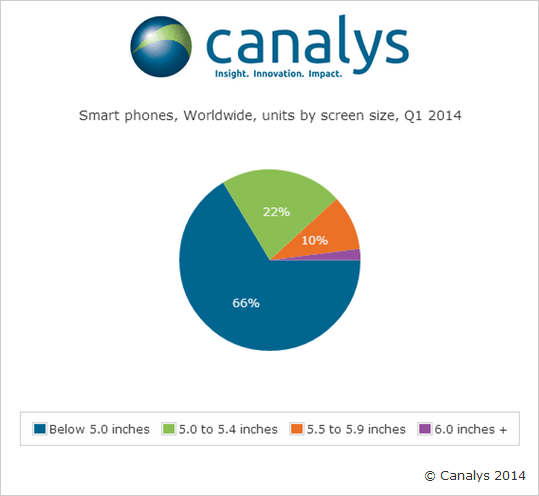
Smart phones with 5″ and larger screens grew 369% – a substantially greater rate of growth than the overall market. Worldwide, they represented just over a third of shipments (34%), and in Greater China the figure hit 39%, and 43% in Asia Pacific.
“This is still a market segment led by Samsung, but the trend is unmistakably toward larger-screen handsets at the high end of the market. It held a 44% share of devices with displays of 5″ and above, and 53% if the view is narrowed to look at 5.5″-plus displays,” said Canalys Analyst Jessica Kwee.
[…]
Consumers now expect high-end devices to have large displays, and Apple’s absence in this market will clearly not last long. It is notable that 5″ and above displays featured on almost half (47%) of smart phones with an unlocked retail price of US$500 or more. Of the remaining 53% of high-end smart phones, 87% were iPhones.
Only 12 percent of smartphones sold had screens of 5.5-inches or larger, with 22% between 5 and 5.4-inches and the rest smaller than 5-inches, including all iPhones.
The iPhone 6 is widely expected to be launched this fall with a a 4.7-inch option, perhaps at 1704×960 pixels, and a larger 5.5-inch version that may launch later due to supply constraints.

Jabra Rox wireless headset review

Up for review today we’re taking a look at Jabra’s latest wireless headset, the ROX Wireless Bluetooth Stereo Earbuds.
 We’ve been very pleased with Jabra’s efforts in the past; their speakers and headphones are some of our favorites. How do these fare? Suffice it to say, it’s another solid outing from the company and one we’ve been recommending to friends and family.
The Jabra Rox come with a number of rubber tips and stabilizers all of which can be mix-and-matched to create the perfect fit. Thanks to the easy snap on tips “Eargels” and rubber “EarWings” it took us all of a few minutes to find out which sizes would work best.
We really enjoyed the magnetic component that allows for us to put the headset to sleep. Simply align the two earbuds and they’ll turn off and conserve power. This is not only helpful, but it’s smart. We can’t count the number of times we’ve pulled headphones or earbuds off and just put them on the counter or hung them up. This way, they’ll power down and be ready when you need them.
 There’s an in-line volume and power controls, something that we appreciate having in a wireless headset. It makes sense to have the controls here and it feels more natural than something that sits on or behind the ear.
The earbuds don’t come across as being all that “premium” but we can’t knock any of the hardware. Rubber tips are never going to feel like a top quality component but it is easy to feel cheap. That’s certainly not the case here.
Battery life is listed at six hours which was pretty accurate in our testing. Out of habit we tend to charge headphones and accessories as soon as we are finished with them. With that said, we never heard a low battery message or had to charge them up ahead of using them. Between riding a mountain bike, mowing the yard, and some general usage at the park we were able to get more than four hours in without a problem. Charging the headphones is done via a hidden (under left earbud) microUSB port.

The Jabra Rox deliver an impressive sound and range; highs are crisp yet lows are also felt. Because of its design, the earbuds do very well to keep outside noise from interfering with your listening experience. The speakers don’t feel like they are overpowering you or pretending to offer deep, dark sounds. We enjoyed spoken word, electronic music, hip hop, podcasts, and everything else.
Learn more about the Jabra Rox Wireless Bluetooth Stereo Earbuds at Jabra’s website. Order a pair through Amazon for $129.99.
The post Jabra Rox wireless headset review appeared first on AndroidGuys.

Never leave bullet time in SUPERHOT, a unique take on first person shooters

Unlike your typical first-person shooter, in SUPERHOT, time only moves when you move. This gives you the ability to strategically plan out your approach. If you’ve played Braid before, the mechanics will feel familiar, as elements of the game speed up and slow down with each step forward or back. After completing the 7 Day First Person Shooter challenge, an event where teams from all over come together to build a new FPS in just a week, the team moved onto Steam’s Greenlight program, where it made it through in just a weekend. Now they’re turning to Kickstarter to help move the game further along. After just a few hours, they’re on their way to reaching their funding goal of $100,000. If you’re on the fence about helping out, you can try your hand at slowing enemies and bullets to a crawl with a browser-based demo. SUPERHOT isn’t the first game to use bullet time (remember Max Payne?), but the game offers a fresh spin on an otherwise repetitive genre. Who knows, maybe the game can even teach Zack Snyder a thing or two about slow-motion action scenes.
Via: Reddit
Source: Kickstarter

Tesla Motors’ Elon Musk will help fund a Nikola Tesla museum

You may recall The Oatmeal‘s (aka Matthew Inman’s) fundraising campaign to save Nikola Tesla’s former lab and get a museum built in the electrical pioneer’s honor. Well, it only partly succeeded; while the money was enough to rescue the property, Inman realized that it would take at least $8 million to build and maintain an actual museum. Thankfully, a little serendipity is coming his way. Following a public plea from Inman, Tesla Motors chief Elon Musk now says that he’ll be “happy to help” make the museum a reality and pay tribute to his company’s namesake.
The electric car maker tells us that it doesn’t have any more details to share at this stage, but Inman is understandably over the moon; he and many others feel that Thomas Edison stole the limelight that Tesla deserves. Tesla is responsible for discovering alternating current, resonant frequencies and the technology that ultimately led to the modern electric vehicle. In that respect, Musk’s support for a museum is bringing things full circle and giving credit to the man that made his business possible.
[Image credit: Dickenson V. Alley/Wikipedia]
@elonmusk THANK YOU SO MUCH! I want to hug you so hard right now it causes mild brain damage!
– Matthew Inman (@Oatmeal) May 14, 2014
Filed under: Transportation, Science
Via: Autoblog
Source: Elon Musk (Twitter)

Desktop construction gets a boost from the compact Nomad CNC machine

Desktop 3D printers have offered makers their building chops for some time now, and Carbide 3D is looking to do the same with a highly capable CNC machine. This is the Nomad 883: a mill that takes building beyond ABS and PLA plastics to wood, brass, aluminum and more. The unit wields a brushless DC spindle motor that routs designs on an 8 x 8-inch machining area. Sure, we’ve seen compact CNC options before, all with varying degrees of utility and durability. Here, a solid aluminum frame is enclosed on the sides with either bamboo or plastic and there’s a polycarbonate lid to keep noise and dust to a minimum — key downsides to most CNC equipment. In terms of exact size, the Nomad ticks the tape at 19 x 17 x 16in. (around 48 x 43 x 40cm) and weighs in at a somewhat hefty 50lbs/22.68kg (for comparison, a MakerBot Replicator 2X is 39.25lbs/17.8kg). If you’re looking to snag one, you’ll have to wait for the fourth production run (set to ship in November) and be willing to part with $1,999. That’s a $500 discount for Kickstarter backers, and the price tag includes a smattering of building materials and two software options to get things started.

Filed under: Misc, Peripherals
Via: Uncrate
Source: Nomad 883 (Kickstarter)

Autodesk is making a 3D printer to showcase its new software platform

The 3D printing process frustrates Autodesk CEO Carl Bass, so his company is looking to ease headaches with its new software project. Spark is an open platform effort that looks to create more reliable models while simplifying the steps needed to output them. By doing so, the outfit hopes to “set a new benchmark” for the production method, offering designers, manufacturers and others the tools needed to properly wrangle 3D printers. Not unlike what it has done with 3D animation and architecture, we’d surmise. In the days to come, Bass says Autodesk will work with other hardware makers to implement Spark on current-gen and forthcoming devices. What’s more, Autodesk aims to release its own 3D printer later this year — which the Wall Street Journal reports could be in the $5,000 price range. And just like Spark, the machine’s “design” will be made available to the masses as well, hoping to inspire more experimentation amongst its users. The unit is said to also employ “a broad range of materials,” but there’s no further info on exactly what that list includes. Although, PLA is probably a safe bet.
Filed under: Misc, Peripherals, Software
Source: Autodesk (1), (2)

Flappy Bird is coming back as a ‘less addictive’ multiplayer in August

If you got hooked on Flappy Bird just in time for the game to be pulled, you’re in luck. Creator Dong Nguyen told CNBC today that he’ll put the title back in the App Store in August. When it does return, Nguyen says it’ll be less addictive thanks to a new multi-player mode. And there are entirely new games the way too, including one that features a man hoping from building to building. No word on how he plans to keep folks from getting hooked on those just yet.
Flappy Bird’s Dong Nguyen: Flappy Bird is coming back. Multiplayer. August. @CNBC
– Kelly Evans (@Kelly_Evans) May 14, 2014
Flappy Bird creator Dong Nguyen tells @Kelly_Evans that he’s bringing back Flappy Birds, but not soon; it’ll have a multi-player feature.
– CNBC Social Team (@CNBCSocial) May 14, 2014
#Flappybird creator says he is creating lots of #games. Next one guy jumping from building to buildings. #CNBC
– Donna Burton (@DonnaBurton) May 14, 2014
Filed under: Gaming, Software, Mobile
Via: Business Insider
Source: CNBC (Twitter), @Kelly_Evans, @DonnaBurton

Flappy Bird to Return to the App Store in August, Will Be Multiplayer and ‘Less Addictive’
Flappy Bird creator Dong Nguyen today announced plans to return Flappy Bird to the App Store in August in a new interview with CNBC‘s Kelly Evans. According to Nguyen, the new version of Flappy Bird will be a multiplayer title that is “less addictive.”
Back in February, Nguyen unexpectedly pulled Flappy Bird from the App Store after it became wildly popular, due in part to the attention he was receiving. “Please give me peace,” he tweeted just a week before removing the app from the App Store. At the height of its popularity, the game was generating approximately $50,000 per day in revenue from in-app ads, causing a media frenzy.

In a March interview with Rolling Stone, Nguyen confessed that the reason he pulled the app was in part due to the overwhelming amount of attention he garnered from the media, but also because of troubling messages he received from Flappy Bird players about the game’s addictiveness. One woman told him he was “distracting the children of the world.”
Nguyen noted that he had trouble in school in his own youth because of an addiction to video games, and admitted to feeling guilty that Flappy Bird was an “addictive product.”
After Flappy Bird was removed from the App Store, hundreds of other Flappy-style apps flooded the App Store as developers attempted to clone some of Nguyen’s success, and at one point towards the end of February, one-third of new games released over a 24-hour period were heavily influenced by Flappy Bird.
Though the prominence of Flappy Bird clones has died down in recent weeks, fans will likely welcome the return of the original game. As Nguyen has said, “People can clone the app because of its simplicity, but they will never make another Flappy Bird.” While Nyugen has mentioned multiplayer as one new aspect of the game, it is unclear how he plans to make it “less addictive.”
During the interview, Nguyen also relayed some details about his next game, which is said to be a jumping game where players control a character jumping from building to building.

HTC One (M8): 1 month and counting

So its been a little over month since i’ve had my hands on my HTC One (M8) and all I have to say is, “Best phone I have ever used“. Sure you might be saying, “But David, you haven’t had the pleasure of getting your heart rate checked on my S5″ or “Hey David, Android has nothing on my iPhone’s finger print reader.” Ok, I hear you and all I am going to say is watch the Gary Oldman video here and let the video speak for itself.
However, I am going to do a quick recap of the One review I did last April and let you know if I have changed my thoughts on certain features of the device!
Design:
The phone is still beautiful as ever, but I have slapped a Tech 21 case on it just for good measure, I despise covering up this metal masterpiece. However, it is slippery and I feel that is might fall out of my hand! I haven’t dropped it yet, thank goodness. The phone fits great in my hand and I know some people have issues hitting the power button, but the double tap on the screen really eliminates the need for it.
Display:
The display has been fantastic, especially on sunny days at the beach! I have slapped on a Skinomi screen protector, just for good measure. HTC is still offering a free replacement screen if you happen to drop it within the first 6 months, through their “HTC Advantage Program.”
Hardware:
The One is wicked fast! I’ve throughly enjoyed being able to jump from one app or game to another without any hesitation. I’ve also preloaded about 20GB of music onto my microSD card which has performed flawlessly.
Battery Life:
I still find myself around 40% before I slap it on the charger at night. Now my daily routine is: up at 5:15am, drive to the gym (while playing music), workout with my bluetooth headset, go to work and return home around 5:00pm (medium usage) and having my Fitbit Flex connected and syncing in the background throughout the day. Overall the battery life couldn’t be better, compared with my previous devices, Nexus 5, Galaxy S4, Moto X, I feel that the One has surpassed them all.
I still haven’t received the “Extreme power saving mode” feature on my phone, but when I do I will let you know, but I have heard good things!
Software:
I have really enjoyed getting use to Sense 6. It is very easy to navigate and quite customizable compared to other headsets. I have never had to restart my device because it was frozen or locked up. I am a veteran user of Android, but I feel that even a beginner could easily navigate the settings to find whatever they needed. HTC has done a superb job at making it super easy to find what you are looking throughout the phone. No complaints here!
BlinkFeed:
I never thought I would use BlinkFeed as much as I do, but it is just so easy to get all my social media updates in one place. Even when the phone is locked I just swipe right and voila, BlinkFeed is ready to go and showing me everything I want to see! I have been very impressed with this feature!
BoomSound:
It’s loud, clear, and it BOOMS! Enough said!
DuoCamera:
I have really enjoyed the camera app on the One. It is easy to navigate and offers a host of filters and effects to create some really cool pictures. With all that aside, the camera in general performs great, low light, bright light, it doesn’t matter. The camera performs as a camera should. The below slideshow is a picture with some applied effects.


Overall:
The HTC One has performed flawlessly, as it should. I haven’t had any disappointments with the device and I still highly recommend it to anyone looking for an awesome device, inside and out! Let me know what you think of your One or if you have any questions, just post them in the comments below!
The post HTC One (M8): 1 month and counting appeared first on AndroidGuys.
 AIVAnet
