


OS X 10.9.3 Boosts Maximum VRAM of Recent Retina MacBook Pro and MacBook Air Models [Mac Blog]
OS X 10.9.3, released last week, boosted the maximum VRAM used by the Intel HD 5000/5100/5200 graphics chips used in the most recent 2013/2014 MacBook Airs and Retina MacBook Pros.
First noticed by French site Mac4Ever [Google Translation], updating to 10.9.3 increases available VRAM from 1024MB to 1536MB, boosting the size of the shared memory, possibly to further improve 4K performance on certain machines.
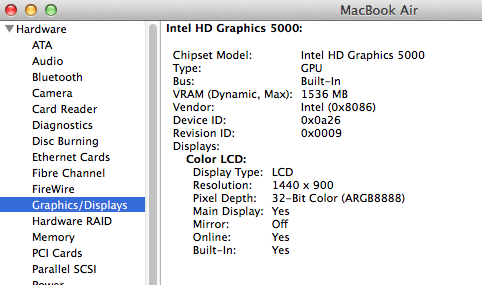
The change can be seen in the Graphics/Displays section of the System Report accessible via About This Mac. Apple has not yet updated its support page to reflect the new VRAM limits, continuing to list 1GB of system memory as the maximum. The update was also not mentioned in the 10.9.3 release notes.
The 10.9.3 update, available via the software update tool in the Mac App Store, also included enhanced support for 4K displays and restored the ability to sync contacts and calendars between Macs and iOS devices over USB.
(Thanks, Peter!)

Waterfield Designs Debuts ‘Mac Pro Go Case’ for Transporting 2013 Mac Pro [Mac Blog]
Waterfield Designs today introduced its new Mac Pro Go Case, a bag designed to transport the 2013 Mac Pro and necessary accessories. Created from padded ballistic nylon, the case is designed to fit snugly around Apple’s newest desktop computer.
The case cushions the Mac Pro with both internal padding and a plush liner, and there’s a heavy duty plastic plate to protect the bottom of the computer. An accessories pocket able to hold add-ons like a mouse, cables, and power cord fits on top of the bag and a side pocket has room for an Apple wireless keyboard.
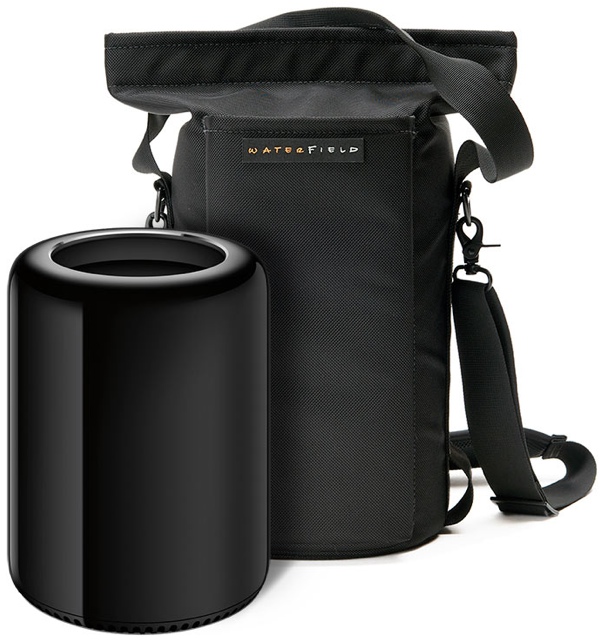
Just in time for the Apple World Wide Developers Conference (WWDC14), WaterField Designs introduces the Mac Pro Go Case to keep the Apple powerhouse Mac Pro and accessories safe in transit. Perfect for travelling gamers, developers, video editors and any others who take their systems with them, the rugged case holds just about everything–the Mac Pro and Apple wireless keyboard plus computer accessories: a mouse, cables and power cord.
At 7.5 inches in diameter and 12 to 14-inches tall, the Mac Pro Go Case can be carried using a nylon grab handle or a removable suspension shoulder strap.
The Mac Pro Go Case, which comes in black to match the Mac Pro, can be ordered for $129 from SFBags.com.

iWork for iCloud Updated With Interactive Charts, Improved Collaborative Capabilities
iWork for iCloud received an update today, adding a range of new features to Pages, Keynote, and Numbers, further boosting the real-time collaboration capabilities of the apps. It is now possible to collaborate with up to 100 people (previous limit was 50) on a single document and users are also able to create 2D and interactive charts in all three apps.
Larger documents, up to 1GB in size, can be edited, and larger images up to 10MB in size can be added to documents. Chart formatting is now available in all three apps, and there are new color options.

Keynote has also gained the ability to show and hide slide numbers, while Numbers now supports alternating row colors in tables and the ability to export to CSV. Pages supports exporting to ePub, object layering, and inserting and editing inline tables.
The iWork for iCloud software is available to all users for free, and it can be accessed through Apple’s iCloud.com website.

Spotify-based service puts an end to lousy coffee shop music

Chances are that the music at your local eatery sucks. If the owners aren’t just piping in elevator music or radio, they may be using CDs or internet stations. Soundtrack Your Brand has a better solution: it just launched a Spotify-based (and partly Spotify-funded) service that’s designed for public venues. The current platform lets companies stream an unlimited amount of music in five locations, with scheduled playlists and offline support; you won’t have to hear the same song every day at the coffee shop, even if its internet access cuts out mid-cappuccino.
The service is currently limited to Sweden, where it costs 349 Kronor ($53) per month. An upcoming 799 Kronor ($121) option will cater to larger outlets. There’s no word on a US deployment, but here’s hoping that it comes soon — if you’re like us, you’re probably a little tired of the recycled tunes at your favorite establishment.
Filed under: Internet
Via: TechCrunch
Source: Soundtrack Your Brand

Verizon’s next-gen voice service still planned for this year, will come with video calling

Verizon and AT&T, the two largest mobile operators in the US, have spent the last couple years in a race to deploy next-generation voice technology known as Voice over LTE (VoLTE). With its announcement last week, AT&T was the first to deploy the fast-speed VoIP network, but don’t count Verizon out of the race quite just yet: executives explained to us today that it’s still on track for nationwide deployment sometime this year.
Considering AT&T launched VoLTE last week, it appears that Verizon may be experiencing a few setbacks. (Of course, Verizon originally promised its network would be ready by 2012, so we’d argue that setbacks are nothing new for VoLTE deployment.) However, execs pointed out that its competitor’s offering is currently limited to just a few markets and devices, whereas Verizon will launch VoLTE nationwide from the very beginning. Nationwide availability will be crucial to the network’s success, as calls using the new tech can’t fall back to CDMA when you leave LTE coverage.
Unfortunately, the company won’t say specifically when this year we can expect the new network, but we were told that when it’s ready, several devices will be VoLTE-capable either through purchase or an over-the-air update. Fortunately, Verizon confirmed that its network will be interoperable with any of its VoLTE-capable competitors — since you’ll only be able to enjoy richer call quality when both callers have compatible devices, this means the service won’t be exclusive to in-network conversations.
The company also tells us that it will offer FaceTime-like video calling as soon as VoLTE launches, which means that you’ll be able to activate the service directly from your phone’s dialer, and you’ll be able to easily switch back and forth between video and audio-only calls. Additionally, it’ll also launch HD Voice by leveraging AMR-WB, a wide-band speech standard that’s already used by T-Mobile for its high-def voice service.
[Image Credit: Getty]
Filed under: Cellphones, Mobile, Verizon

LifeLock pulls its wallet apps, deletes data in light of security worries

The move will have big consequences if you’ve poured a lot of data into LifeLock Wallet. You may have to dig out cards that you could previously afford to leave at home, and you won’t be recovering any receipts if you tossed out their paper copies. However, this is a potentially wise gesture to protect customers who might not otherwise realize that their data is at risk. It may also be necessary to avoid a run-in with the government, for that matter — LifeLock has to meet certain security requirements following a 2010 FTC ruling that the company both misled customers with fear-driven marketing and didn’t do enough to secure identity information. In that sense, the move is as much about saving the company’s skin as your own.
[Image credit: Gettystock]
Filed under: Cellphones, Internet, Mobile
Via: Android Police
Source: LifeLock

Apple Forging Deals with ISPs to Bolster Delivery of iTunes, Apps, and iCloud Content to Users
Apple is moving forward on plans to develop its own content delivery network (CDN), reports well-known CDN and Internet Services analyst Dan Rayburn (via Ars Technica). The Cupertino company is reportedly negotiating deals with Internet Service Providers in order to ensure the efficient delivery of content to its customers.

Apple may control the media for iTunes and iCloud customers, but it currently outsources the delivery of this media to third-party companies like Akamai, ceding control over the quality of service to these other companies. Apple reportedly has been working for five years on its own CDN that would bring content delivery in house, ensuring its customers can access data reliably and quickly regardless of ISP or geographic location.
Apple has been deploying the necessary network hardware and recently started forging interconnection deals with Internet Service Providers as it prepares to shift content to its own CDN soon, claims Rayburn.
Apple has been very busy with their build out deploying a lot of boxes running Apache Traffic Server and buying a ton of transit, co-location, wavelengths and other infrastructure services. Their CDN is quickly growing, and it won’t be long before we start seeing a portion of their content getting delivered from their new CDN.
As part of their build out, Apple is currently negotiating paid interconnection deals with some of the largest ISPs in the U.S. I’m not going to disclose which ISPs they are talking to and what deals they have already done, but it’s interesting to note that with all the talk lately of net neutrality, peering and interconnect relationships, Apple isn’t out in the market making any complaints.
Despite concerns about net neutrality, these priority access deals are becoming common among big companies, such as Netflix, Microsoft and Google, that move large volumes of data across the Internet.
Wall Charger + Portable Battery Creates The Ventev Powercell 6000+ [Review]
Keeping our devices charged is, and sadly always will be, a battle. Until the day when our phones and tablets can remain on indefinitely, we will always need a way to charge the internal batteries. The market for such accessories is rather large. Nearly every company that can and plans to make accessories will be turning out car and wall chargers right along side portable battery banks. While I see plenty of innovation in design, number of ports, number of amps and watts, one thing seems to be consistent, very few companies ever try to break the mold. Why on earth should I have to have a separate accessories for the same job? Ventev has been working on consolidating our needs and I must say, I am rather impressed and happy to see it. So what happens when a wall charger and a portable battery bank get married? They create a hybrid dual-port wall charger that is also a portable battery bank.
What’s in the box
- Ventev Powercell 6000+
- User manual
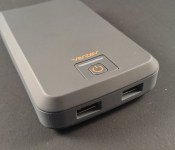
 The Ventev Powercell 6000+ is a 6000 mAh packing portable battery bank that goes beyond traditional battery banks. It offers dual-port charging, like others on the market. Both ports are 5v while one is a 1A (5W) an the other is a 2.1A (10W). On the top of the Powercell is a power button that you press and hold to turn on the battery pack. Just above the button is series of lights, in typical Ventev orange, that offers up the remaining battery levels at a glance.
 On the rear is where you start to notice the difference between most of the current battery banks on the market. Ventev integrated a flip down wall plug allowing you to directly charge the Powercell from the wall without the need for a USB cable or some other proprietary charging cable. It is quite brilliant really.

 Ventev went a step further though. The unit also offers built-in bypass circuitry that will pass the power through the unit to your device before it charges up the internal battery. In a nutshell, plug it in and your device and both will be charged in the morning. Leaving you with a full device and 6000 mAh of power on the go.
The testing
I put the Powercell 6000+ through my usual testing using Battery Monitor Widget from 3c. I set it to track every 1% charge and let each test run for approximately 15 minutes each. Starting with 2.1A Rapid Charge port first. I used the T-Mobile Sony Xperia Z which houses a 2330 mAh battery.
Here are the results with the Xperia Z on the 2.1A Rapid Charge port for 15 minutes.

 Seems pretty rapid to me. It boosted the battery 22%. That is 1.46% charger per minute. If the rate holds, and I left everything on, it should charge from 0% to 100% in 68 minutes. This is all math and not perfect by any means, but gives you a general idea.
Now the 1.0A port for 15 minutes.

 As you can see, and like we would expect, the 1.0 amp port charged at a slower rate. It only pulled in 8% battery in the 15 minute charge. I am certain their are devices out there that charge better or are designed to charge off 1.0 A.
I also charged up the Lenovo Yoga 8 tablet which houses a 6000 mAh battery. With the internal battery being the same size as this portable battery, it should come as no surprise that it charged a little slower. The charge rates were the same, the % increase over the 15 minute window was slower. More so to the tune of 5% or so in the 15 minute time frame on the 2.1A Rapid Charge port. I wouldn’t rely in the Ventev Powercell 6000+ if I were in a pinch with my tablet, or any other battery bank/tablet for that matter, but if I needed it to have sufficient charge from lunch until I was off work, 4 hours would give me a nice bump.
The next test I ran with just the battery portion was dual charging. Utilizing the numbers above and the same 15 minute window, I came out with similar results. The 2.1 port charged up the Xperia Z by 21% and wasn’t hindered by a second device being connected. (yes, it is 1% off. THat could be attributed to notifications, 45 second variance or a number of other potential factors.) I didn’t think screenshots of that were really necessary.
The final test I did have to run one set of tests on the charger its self when plugged into the wall. Just to see if the ports made a difference in charge rates. While my brain said that it shouldn’t matter because the Powercell is set to pass the charge through, I was still curious to see if the 2.1A and 1.0A rated ports was also the output while plugged in. It didn’t make a difference which port I used, the charge rate was the same. Also, when charging a device the light will stay constant until your device, or devices, are fully charged. Once charged the light will blink as it charges the internal battery of the Powercell. A constant light could be irritating to some, but the light is orange and not overly bright.
What I like about the Ventev Powercell 6000+
- The style and design matches all their other products. They keep with the same logo, same color scheme and same materials. It makes them easily recognizable and keeps them from blending in with all the other black and white boxes out there.
- The 2.1A port is also a Rapid Charge port that delivers the fastest charge possible for your phones and tablets. After the initial round of testing it is clear the Rapid Charge port is ideal for those quick fix charging needs.
- A 15 minute charge with my Xperia Z powered on, with Bluetooth and Wi-Fi active, delivered a fair amount of charge. Enough to boost me up XX%.
- I am very fond of the integrated flip down prong. It is stiff and after flipping it open and closed 75+ times, I didn’t notice or feel any degradation in its ability to click open and stay clicked closed.
- Paired with the battery size and the pass through technology makes this the perfect travel charger to take with you everywhere.


What I don’t like about the Ventev Powercell 6000+
- While the style and design are nice, I feel like they could have made it a little smaller. I didn’t tear it open to see how much wasted space might be inside, but compared to other battery banks of similar mAh or larger, the Powercell seems like it could have been a little more compact.
- I would like to see future models offer two universal rapid charge ports.
- The lack of micro USB charging. While I find the prong a positive, it can also be a negative. For instance, I won’t be able to charge this battery bank from a solar panel that offers USB out charging. I would like to see both charging options. Although I am not sure that is practical or cost effective.
Overall thoughts:
If you travel often having a dual port wall charger not only saves on space in your bag, but saves space on wall sockets. hotels are getting better, but there are often never enough outlets near where you want to actually charge things. Freeing up one socket and ditching one more charging block is a bonus. Cutting back on needing to carry a battery bank with you too also cuts down on needing to waste a wall socket to charge it up as well as the added weight and space that it takes up in your bag. I think Ventev did a great job with the product.
If the Ventev Powercell 6000+ sounds like exactly what you have been looking for o need, hit the Amazon link below to get one ordered. While you are at it, check out their flat band cables and the powerdash r900 car charger with a small battery bank inside too.
//<![CDATA[
ord = window.ord || Math.floor(Math.random()*1E16);
document.write('’);
//]]>

Google+ introduces Stories and Movies feature

Not only has Gmail received a very welcome update today, but now Google+ is also receiving some love with several updated features. The two most notable are Stories and Movies.
Stories (Auto Awesome Stories) combines all your photos, videos and the places you visited into a really cool travelogues. The sample provided by Google is really awesome, just make sure you take some quality pics and vids. Click on the Google+ Story below to see what its all about.

Movies (Auto Awesome Movies) is also available for Android, iOS, and the web. Google+ Movies can produce a highlight reel of your photos and videos automatically—including effects, transitions and a soundtrack. It is a really neat feature and the video below shows an example of how it is used!
To get started with Stories and Movies, simply back up your photos and videos to Google+. And that’s it. Auto Awesome will get to work in the background, and you’ll get notified when a story or movie is ready. If you’ve already got photos backed up, you probably have a few stories waiting on you!
Source: Google
The post Google+ introduces Stories and Movies feature appeared first on AndroidGuys.

Samsung Galaxy Note 4 display details leak

If Samsung is going to stick to its usual Galaxy Note release dates we still have over 3 months until the Note 4 sees the light of day. It’s definitely time for the rumors to start and in that light we have a rather big one to kick things off, although the kind of did with this possible design leak.
According to GSMArena’s tipster, Galaxy Note 4′s codename is “T (Muscat)”. Galaxy Note 4′s expected model name should be N910x, where the last digit (marked with an “x”) marks the subversion of the device (Exynos, Snapdragon, LTE, etc.). If this rumor is to be believed Note 4 should come with a 1,440×2,560 5.7″ QHD screen, which would make a 551 PPI. It is interesting that the screen remains the same size this time, not that we’re complaining though. Let us remind you that until now screens on the Note family were getting bigger by 0.2″ in each iteration. The screen on the Note 1 was 5.3″, Note 2′s screen was 5.5″ in size while the Note 3 came around at 5.7″. Note 4 is rumored to to be powered by an Exynos Hexa or a Snapdragon 801 chipset.
Do you think there’s truth to this rumor and do you plan on buying the Note 4 once it launches?
SOURCE: GSMArena
The post Samsung Galaxy Note 4 display details leak appeared first on AndroidGuys.
 AIVAnet