



Asus teases the next incredible “thing,” that’s also thin

With Computex coming up next week, Asus has taken to social media with a video that tells of a thin device coming without offering up much else. There’s no silhouette of a device, so your guess is as good as ours whether its a new tablet or smartphone, or both.
Computex 2014 will be taking place June 3 to 4 in Taipei, Taiwan.
What do you think Asus could have up its sleeves?
The post Asus teases the next incredible “thing,” that’s also thin appeared first on AndroidGuys.
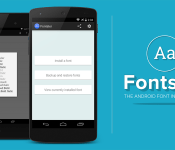
Change your Android system font with Fontster

Modifying your system font usually requires flashing complicated packages or completing change the ROM you’re running, but with an App called Fontster you’re able to quickly and easily change your Android system font.
Fontster allows you to browse hundreds of fonts and enables you to apply them replacing your entire Android system font. Your device must be rooted and works best with ROMs that are as close to AOSP as possible.
The simple Holo UI allows you to quickly browse fonts, preview them, and finally install the one you like. With a quick reboot, you’ll see all the typed elements throughout the Android system changed to your desired font.
Fontster is open source and available for free on the Google Play Store.
The post Change your Android system font with Fontster appeared first on AndroidGuys.
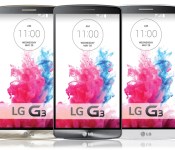
LG G3 specs revealed by official LG site ahead of launch

With only a few hours before the LG G3 is officially unveiled, yet another leak has confirmed what specs the upcoming device will have by non other than LG themselves.
Whilst there’s nothing that stands out, since a lot has already been revealed by previous leaks, it does confirm what to expect before the official unveiling.
Here’s the full specs:
- 5.5-inch 2560 × 1440 display
- 2.5GHz quad-core Snapdragon processor (Snapdragon 801?)
- 2GB of RAM, 16GB storage
- 13-megapixel rear camera with optical image stabilization, laser-assisted autofocus, 2.1-megapixel front camera
- 16GB storage and microSD card slot with up to 128GB
- 3000mAh battery
- Android 4.4.2
- WiFi, Bluetooth, NFC, 4G LTE, FM Radio
- DLNA and Miracast
- Metallic Black, Silk White, Gold Shine colors
- 146.3 x 74.6 x 9.1mm
In addition, there’s also mention of a metal housing for the LG G3, which is something that we’ve yet to hear about as it was suggested from previous leaks that the back would be plastic.
One thing’s for sure is that we won’t have to wait long until we officially see the LG G3.
SOURCE: LG
The post LG G3 specs revealed by official LG site ahead of launch appeared first on AndroidGuys.

Normandy landings recreated in Oculus Rift D-Day simulation

3D virtual reality headsets like the Oculus Rift are often lauded as the next big thing in entertainment, but they’re also helping to change the way we learn. To mark the anniversary of the Allied invasion of Western Europe on June 6, 1944, French 3D specialists Dassault Systèmes have painstakingly rebuilt D-Day relics in high-definiton VR using the original blueprints of vehicles and devices used in the assault on Normandy 70 years ago. In contrast to million-dollar gaming franchises like Medal of Honor and Call of Duty, which give players a first-person perspective of the fighting, Dassault Systèmes wanted to recognize the engineering prowess and technological advancements that helped soldiers to liberate France. To do so, a team of 30 specialists recreated the Allied forces’ Higgins’ landing craft, Waco gliders and Mulberry Harbor, the first (floating) deepwater port of its kind. The resulting animations are perfect for viewing on virtual reality headsets like the Oculus, digitally preserving innovations that have since been lost to the sea.
Via: Venturebeat
Source: Dassault Systemes’ D-Day
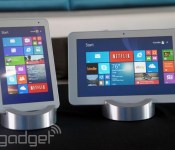
Toshiba’s new tablets are aggressively priced, especially its $110 Android slate

The last time Toshiba unveiled a bunch of tablets, it paid lip service to cutting-edge specs — things like screen resolution and processing power. This year, it wanted to push the price down low enough that you’d actually buy one. The company just announced two Windows tablets, the 8- and 10-inch Encore 2, along with the Excite Go, a 7-inch Android tablet. And while none of them might be memorable in their own right, they’re all worth a second look, if only because they’re so aggressively inexpensive. The Encore tablets, for instance, start at $200 for the 8-inch and $270 for the 10-inch. And mind you, they basically have the same specs (quad-core Intel Atom processor, 1,280 x 800 screens) as the original 8-inch Encore, which was originally priced at $330. (The 8-incher has been slimmed down, but that’s almost beside the point — it’s all about the price cut.)
Meanwhile, the Excite Go will retail for just $110, making Toshiba one of very few tier-one brands selling an Android tablet for quite that cheap. For the money, you get fresh software (Android KitKat 4.4), with a quad-core Intel Atom processor promising long battery life (up to eight hours, according to Toshiba). It also brings wireless display tech and comes with OfficeSuite Pro (a $15 app) pre-installed. The tablet does have pretty limited storage, with only 16GB of space built in, but even that’s a moot point, as the tablet houses a microSD slot that can accommodate cards as big as 128GB. All told, the biggest tradeoff is the display, which features a piddy 1,024 x 600 resolution. Even then, that’s par for the course at this price, so we can’t get too upset about a few visible pixels. Interested? This goes on sale in early July, as do the new Encore 2 Windows tablets.
Filed under: Tablets
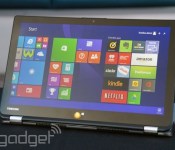
Toshiba is the latest PC maker to rip off Lenovo’s Yoga line

The last time we heard from Toshiba it was doing its annual back-to-school notebook dump. Turns out, the company wasn’t quite through: It just announced a trio of convertible laptops. Of the three, the closest thing to a flagship would be the Satellite Radius, a 15-inch notebook that essentially apes Lenovo’s Yoga line. Which is to say, it has a 360-degree hinge that can be positioned in one of five modes, including notebook, tablet, “Presentation” (upside down, keyboard in), “Audience” (screen out, keyboard tucked under) and “Tabletop,” with the entire machine lying flat on the table. Sound familiar? That’s because it is.
What’s curious is that Toshiba recently showed off something much more innovative: a “5-in-1″ prototype laptop with a snap-off keyboard, making it a cross between a dockable tablet and a Yoga-like convertible. According to Toshiba, that machine is still in development, so if we’re lucky, we might even see it later this year (one can hope). For now, though, the best thing Toshiba has to show in this space feels an awful lot like Lenovo’s offering, just with a bigger screen. If you’re thinking of picking this up ahead of the new school year, the Radius will ship in early July, with prices starting at $926 (in the US, at least, it’ll be sold exclusively at Best Buy). For the money, you get either a Core i5 or 7 processor, 8GB of RAM, up to 1TB of storage space, 802.11ac, Harman Kardon audio and Toshiba’s usual “Sleep & Charge” USB 3.0 port for keeping your other gadgets juiced.
Additionally, Toshiba refreshed the Satellite Click, its tablet/laptop hybrid that came out last year. The new version actually consists of two models, the Click 2 and Click 2 Pro, each of which includes a 13.3-inch screen and bundled keyboard dock. Though their similar names would suggest a family resemblance, the two differ in both design and processing power. As the clearly lower-end device here, the Click 2 makes do with an Intel Pentium processor, 1,366 x 768 resolution, a spinning hard drive (up to 500GB) and kind of a clunky hinge mechanism that requires you to put one hand on the latch and another on the tablet. The Click 2 Pro, meanwhile, steps up to an Intel Core processor, full HD display. 128GB solid-state drive. and a slimmer build designed so that you can un-dock the tablet with one hand. Also, the keyboard dock here will have an optional 500GB hard drive and spare battery – amenities not offered on the lower-end Click 2.
Both machines will ship in late June, according to Toshiba, with the Click 2 priced from $587 and the Click 2 Pro starting at $1,029 (the version with the spare battery/hard drive will cost $1,280). Oh, and everything will be sold exclusively in Best Buy, at least here in the US.
Filed under: Laptops
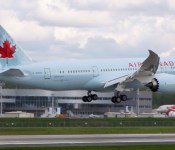
Canadian airlines will let you use devices during takeoff and landing

American airlines may let you use your mobile devices at every stage of flight, but their Canadian counterparts still insist that you power down until you’re in mid-air. That’s going to change shortly, though: Transport Canada has greenlit the use of electronics during takeoff and landing. As long as carriers can show that passenger gadgets in airplane mode (that is, with wireless off) won’t interfere with avionics, you’ll get to use your gear at any time. Of course, you’ll get to switch on WiFi for most of a given trip if you’re on an aircraft with internet access.
As with the FAA’s electronics ruling in the States, you shouldn’t expect the tech-friendly policy to kick in right away. Air Canada says it’s “finalizing measures” that will let it adopt the new rules, while WestJet expects to give the all-clear “early this summer.” All the same, the loosened regulations are good news if you’d rather not stop writing a report (or playing Angry Birds) just because you’re flying into Vancouver.
Filed under: Transportation
Via: MobileSyrup
Source: Government of Canada, Air Canada, WestJet
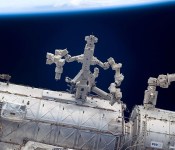
Robot fixes robot on the ISS so astronauts don’t have to (video)

When something goes wrong with the ISS, astronauts usually don their suits and brave the harsh conditions of space to do what needs to be done. But the space station’s Canadian robotic arm (aptly called Canadarm2) is currently attempting to fix itself with minimal human input, thanks to its very special passenger — a multi-limbed helper robot called Dextre. Canadarm2 carries the handymanrobot around to fix anything that’s broken on the ISS or to catch unmanned vehicles headed for the station, such as SpaceX’s Dragon capsule. This time, though, Canada’s Space Agency is remotely controlling Dextre to move and replace old cameras on Canadarm2 itself.
Apparently, this is the first time a task that typically requires an astronaut to spacewalk is being done robotically. CSA mission control supervisor Mathieu Caron says using robots to repair other robots on the ISS is ideal, since spacewalks are very complex and time-consuming. This method will give astronauts more time to perform scientific experiments and will reduce health risks at the same time. Dextre is slated to finish its task on Thursday, but it’ll take some time before astronauts can hand over all repair jobs to the robot-fixing robot.
Filed under: Misc
Source: CBC News
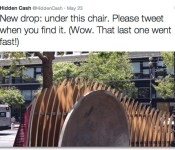
Anonymous Twitter user sends SF citizens on cash goose chase

If you need cash and don’t mind chasing Twitter clues around San Francisco, you’re in luck. A group called @HiddenCash, apparently led by a wealthy real estate developer, has decided to try a “social experiment” by sharing their good fortune with random strangers. They choose hiding paces around the city like the underside of a park bench or a parking meter, then cache money-stuffed envelopes labeled “@HiddenCash — Tweet when you find.” Though that makes our “PR stunt” antennae twitch, they told the Bold Italic that they have “no commercial interest” and just want to draw attention to the massive income inequity in San Francisco. For critics who though the money could be better used, they added that they already donate to needy charities and encourage those who find the cash to do the same. We’re not sure if we’re buying all that, but what the hell — judging by their Twitter feed, a lot of people have had fun with it so far.
Filed under: Internet
Via: The Bold Italic
Source: @HiddenCash (Twitter)

Japan is building a huge ‘ice wall’ to block Fukushima’s fallout water

No one can blame Tokyo Electric Power Co. (TEPCO) for the earthquake and tsunami that wrecked its Fukushima nuclear plant in 2011. Since then, however, the company has been accused of having a “weak sense of crisis” in responding to the accident’s many knock-on effects. This includes the leakage of contaminated groundwater that passes under the damaged plant and into the Pacific Ocean — something that is happening right now at a rate of 400 tons per day. This week, after more than a year of back and forth, the TEPCO has finally managed to get the Japanese nuclear regulator’s approval to create a massive wall of frozen soil to hold the groundwater back.
At the government’s expense, a refrigerant chemical will now be passed through an underground network of pipes, stretching for almost a mile underneath the plant, in the hope of cutting leakage down by around two thirds. A 10-meter test wall has already proven effective, but this is unlikely to be the end of the story: There’s a risk the frozen soil could thaw during the wall’s expected seven-year life span, or that it could cause areas of earth to sink. Meanwhile, nobody has so far been able to predict the long-term impact of the radiation that has already made its way into the sea, and much of the land around Fukushima is still home to nothing but ghost towns.
Filed under: Misc, Science, Alt
Via: PhysOrg
Source: Japan Times
 AIVAnet
