


Theft Alerts Introduced by Lookout to Help Prevent Phone Thievery; Well, at Least Recover Some Devices
According to Lookout, 3.1 million Americans have their devices stolen every year. I suppose I am lucky that in all my years of having a phone, any kind of phone, I have never had one stolen. Broke a few, but never stolen or lost. The fact of the matter is that it happens a lot more than I think it does. There are plenty of apps out there to help slow the numbers and thwart thieves. Heck, Android Device Manager isn’t to terrible at keeping track of your phone and then there is Ceberus who does quite a bit more. Another one is Lookout Mobile. They have announced an update to their app that will help catch the crook more so than help prevent them from high-jacking your device in the first place.
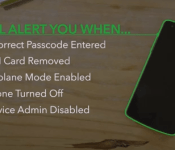
 With the update there are 5 Theft Alerts that can be triggered. These are the 5 most common things a thief would do after snatching your device.
- Entering the wrong password
- Removing the SIM card
- Turning on Airplane Mode
- Powering off the device
- Removing Lookout as a device administrator
If any of those things happen, Lookout will do a number of things. First it will take a snapshot with the camera. Which will only matter if the device is facing the culprit when they enter the wrong password, turn on Airplane mode or possibly power down the device. It will also pull the exact GPS location of the device. Then it will email them both to you.
Can’t blame them for trying, even if they are a little behind. Considering that lookout is a pretty standard install on device from carriers like T-Mobile, I am sure it will benefit the more standard end-user. That is assuming they choose to sign-up for a premium account for either $2.99 a month or $29.99 for a year. With the new update out Lookout is going to let current premium members have access to it now for the next week, that just means that free users won’t have a chance to try it out just yet. Once the week ends though, Lookout will be offering up free users a chance to give it a whirl through September 30th before being asked to sign up.
1.
2.
//<![CDATA[
ord = window.ord || Math.floor(Math.random()*1E16);
document.write('’);
//]]>
Pocket’s new paid service gives you a permanent reading collection

Read-it-later apps like Instapaper and Pocket are handy for digesting large articles, but they’re really just pulling up optimizing internet links. What if your favorite story disappears a few years from now? Pocket now has a solution to that long-term problem. Its new Pocket Premium service saves a permanent copy of any article you flag, giving you access even if the host site goes down or changes the content.
The upgrade also brings in a deep search option that scours entire texts, and it suggests tags to help you find what you’re looking for in the future. If archiving is your thing, you can sign up for Premium at either $45 per year or $5 per month. That’s a lot if you rarely look at something more than once, but it could be a bargain if you can’t bear to be without memorable reading material.
Filed under: Cellphones, Tablets, Internet, Mobile
Via: The Verge
Source: Pocket (1), (2)

Uber partners with AT&T to bring preloaded apps to your new phone

Uber’s growing like a weed, and it’s about to get a lot more exposure for people who may not have tried or heard about the ridesharing service. CEO Travis Kalanick announced a strategic partnership with AT&T on stage at Code Conference. Uber drivers will use phones running on AT&T’s network, but more importantly, the company’s app — which consumers use to call for a ride and track the cars — will be preloaded on an unspecified number of devices on the carrier. There’s no word on the financial obligations, nor did we hear when this transition will take place. If you haven’t used Uber before, be prepared to get to know the service a little better, whether you like it or not.
Filed under: Cellphones, Wireless, Mobile, AT&T

The $250 MOD-t delivers simplicity and beauty in a 3D printer

Affordable desktop 3D printing is imminent, and today another option began its crowdfunding campaign. The folks at New Matter are looking to simplify the process so that anyone can output the items they desire, and to do so they’ve built the MOD-t. Aside from the clear enclosure for easy viewing and dapper industrial design, the software component is where the ease of use really shines. The outfit worked alongside Frog to develop a user interface that allows for quick design downloads, applying tweaks like you would a photo filter, easily sharing with friends and beaming projects to the minimally-designed printer. “At the end of the day, we wanted to be a 3D printing experience that is meaningful to the way that you currently approach communicating with the people in your life. Create relationships, not just objects,” says Frog designer Christine Todorovich.
If you’re in need of a quick introduction, Frog has worked with GE, Microsoft, Nike and other Fortune 500 companies on the strategy and design for both products and software — including Sharp’s Feel UX for Android. The firm not only collaborated on the ecosystem and software for the MOD-t, it also helped tweak the overall design of the unit right down to the mechanics. Those came from New Matter’s Steve Schell, who engineered the 2-axis motion tech to use a third less parts than other 3D printers with moving platforms. And fewer parts keeps the cost down. If you recall, the Mirco is a $300 option that also takes up less space at a workstation, but offers a bit smaller print size. New Matter and Frog are banking on the experience here, which allows for artists and designers to sell their 3D-printable wares through the same online repository — similar to Makerbot’s Thingverse, but with the added e-commerce. The MOD-t also features WiFi connectivity, which is a feature that has yet to become standard on these output gadgets. What’s more, Frog is getting into the venture capital game, and this is the first effort from its Venture Design arm.

Filed under: Peripherals
Source: Indiegogo

Apple acquires Beats Electronics for $3 billion

Apple is making things official: Dr. Dre’s Beats Electronics belongs to Cupertino, and it cost them $3 billion. Rumors had circulated that CEO Tim Cook was interested in nabbing up the audio accessory and music-streaming outfit, corroborated by a beer-drenched video in which Dre himself declared that he had become “the first billionaire in hip-hop.” And now, after Financial Times had already let the cat out of the bag, we have Apple’s side of the story. As expected, co-founders Jimmy Iovine and Dr. Dre (Andre Young) will join Cook and VP of Internet Software and Services Eddy Cue, but their exact job titles haven’t been revealed just yet.
Despite rumors that Apple was only interested in Beats Music in an effort to boost a decline in iTunes numbers, the deal includes both the hardware and the streaming software sectors of Dr. Dre’s business. And it’s Apple’s largest purchase ever. “Music is such an important part of all of our lives and holds a special place within our hearts at Apple,” notes Cook. “That’s why we have kept investing in music and are bringing together these extraordinary teams so we can continue to create the most innovative music products and services in the world.” That doesn’t rule out selling the headphone and speaker portion of the acquisition down the road, but it seems that for now, the folks at Apple are interested in the whole lot.
“I’ve always known in my heart that Beats belonged with Apple,” said Iovine, who’s also Beats’ CEO. “The idea when we started the company was inspired by Apple’s unmatched ability to marry culture and technology. Apple’s deep commitment to music fans, artists, songwriters and the music industry is something special.” Of course, the purchase — which includes $2.6 billion in cash and $400 million in stock — is subject to the requisite regulatory approvals, but it’s expected to close by late September.
“I’ve always known in my heart that Beats belonged with Apple.”
As you might expect, the Beats duo will be tasked with the next wave of Apple’s music products, but in an interview with The New York Times, Cook didn’t offer up any details. “They’re going to be coming up with ways of features that blow your mind,” he said in the interview, “and products you haven’t thought of yet, and seeing around the next corner to articulate the way to take music to an even higher level than it is now.” While Apple was once at the help of the digital music age, it has lost considerable momentum to services like Spotify, Rdio and Pandora despite. For now, it seems that Beats and Apple will keep their products separate until those new projects are complete, as the Cupertino-based outfit isn’t sharing any preliminary plans for any hardware that it will release or exactly how a subscription service may factor into its existing audio efforts.
To celebrate, Beats Music has already updated its iOS app, dropping the cost of an annual subscription to $100 (a $20 discount) and extending the free trial window to two weeks. What’s more, Tim Cook has confirmed to Financial Times that the streaming service will still be available to folks on Android and Windows Phone after the deal goes through.
[Photo credit: Andrew Burton/Getty Images]
Filed under: Portable Audio/Video, Software, Apple
Source: Apple, Beats Electronics

Tim Cook says Apple could have built a subscription music service, but didn’t need to

“Could Eddy’s [Cue] team have built a subscription service? Of course.” That’s what Apple CEO Tim Cook told the New York Times today following the announcement that it had acquired Beats Electronics. But the fact of the matter remains, the company didn’t. Instead it went out and purchased a pre-existing service. As the digital music industry shifted away from paying for individual tracks and albums towards an all-you-can-eat model, iTunes stuck to its guns. That’s left Cupertino in the slightly odd position of not being at the forefront of innovation in the industry. Observers have been suggesting that Apple would launch it’s own Spotify killer any day now, but Tim Cook seems to believe the company’s resources would be better used else where. “We could’ve built those 27 other things ourselves, too,” referencing the 27 other companies acquired over the last year, “you don’t build everything yourself.” At least for now Cook appears content to let Beats Music be his hat in the subscription ring, but we imagine those existing licensing agreements and streaming systems will eventually find their way into an Apple-branded offering.
Filed under: Apple
Source: New York Times

Samsung Debuts Open Modular Health-Tracking Band and Cloud Platform
Ahead of the upcoming debut of iOS 8, which is expected to include Apple’s “Healthbook” health aggregating platform, Samsung has announced its own health tracking platform that envelops both open modular hardware and a cloud storage solution.
Called SAMI (Samsung Architecture Multimodal Interactions), the company’s cloud-based sensor data platform is designed to be entirely open to developers and “complementary” with Samsung’s S Health initiative.

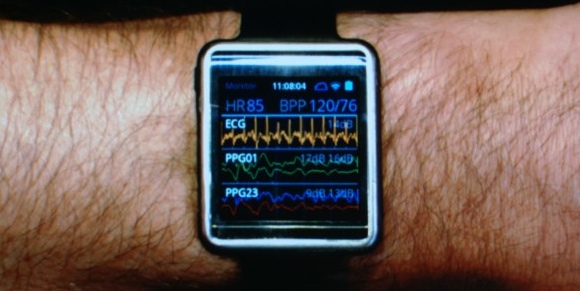
Alongside SAMI, Samsung showed off its Simband, a reference device that includes a multitude of wearable sensors with several different health-tracking functions. Designed to be an open reference sensor module, Simband offers the standard accelerometers to measure movement along with an ECG sensor and a sensor that measures skin temperature.
The device, which offers miniaturized electronics along with Bluetooth and WiFi, also shows off a removable “shuttle battery” that clips into the band to charge it while it’s being worn. As described, the battery allows the device to be worn 24/7, snapping in to charge it during sleep. The open device is multimodal and designed to be customized with interchangeable components, allowing hardware developers to create their own hardware able to be attached to the band.
Samsung’s cloud platform SAMI is designed to collect “any kind of data” from a range of devices. On stage, the platform was likened to a bank, storing and securing data privately.
Samsung president Young Sohn compared the company’s health efforts to a car dashboard for the human body, aimed at giving consumers an overall picture of their wellbeing. Simband and SAMI are both open and available to developers, and Samsung has paired with early partners like PhysIQ and UCSF to develop new wearable hardware. Developers will be given access to the SAMI SDK later this year.
The company also announced a $50 million digital health challenge aimed at creating new sensors and new health-related technology.

Samsung launches a flexible platform of sensors for wearables

At Samsung’s “Voice of the Body” event today, the company announced SIMBAND, a modular reference platform for wearable health sensors that it hopes will inspire a new generation of fitness products. The prototype device you see above has a multitude of sensors built right into it, including an optical light sensor that can detect the variation of light absorption through the skin in order to come up with your pulse and other data. There’s even an ECG sensor integrated into the watchband so that when you touch the clasp, an electrical route is completed.
Samsung says SIMBAND is completely multimodal — the optical, electrical and physical components can be swapped out, and it’s entirely built for customization. The company also wanted to drive home that SIMBAND is designed to be very power efficient (it has a new shuttle battery) while not taking up a lot of space — the prototype watchface on stage is only about half the size of an SD card. Additionally, it has a 1GHz dual-core ARM Cortex-A7 28nm chip along with WiFi and Bluetooth technologies.

SIMBAND is designed as an open platform that allows developers to create new applications, and the SDK is slated to be out in the next few months. Through several open APIs that it hopes to release later this year, Samsung is looking to integrate the platform with SAMI (Samsung Architecture for Multimodal Interactions), its internal data-collection initiative that attempts to make all that fitness data accessible to other services and devices, such as S Health, your phone or perhaps your scale.
The potential for the platform goes beyond just fitness trackers. Samsung also says it’s working on a partnership with UCSF’s Digital Health Innovation Lab to see if these huge data sets can create new predictive models of health and wellness for all of us, and not just on the individual level. This way, it could provide a “truly meaningful impact on health.” UCSF has said it’s happy to partner with startups to ensure that their application or device is doing what it’s intended to do.
To cap off the event, Samsung announced the Digital Health Challenge, which is essentially a $50 million investment fund aimed at startups so that they’ll adopt Samsung’s open platforms and the latest health technologies.
Source: Businesswire, Samsung Strategy and Innovation Center

Google to plug Play Music in UK’s first live music TV ad

Google’s run plenty of ads on UK TV over the years, but its next campaign is set to break new ground for the company and for British TV. AdAge reports that the search giant has teamed up with the UK’s Channel 4 for the first live music performance across a full ad break on UK television. On Friday night around 22:45 local time, singer Sam Smith will belt out his current single Stay With Me live from London’s iconic Roundhouse venue. Beyond Smith getting some priceless promotion for his album, Google’s using the spot to plug its Play Music download and streaming services. It’s on this very store that Google will host the live performance and exclusive tracks shortly after the ad airs. And, if you’re not a Smith fan, well at least it’s three-and-a-half minutes you didn’t have to watch tacky ads for things you don’t need.
Source: AdAge

NFL’s online network is coming to Roku, Fire TV and Kindle Fire tablets

The National Football League has yet to formally launch its new digital network, NFL Now, but there’s no doubt it will be fully prepared once it does. As such, the NFL has announced that Roku will join Microsoft, Yahoo and Verizon as distribution partners for its upcoming online video service. In other words, you can expect NFL Now to be available on Amazon’s Kindle Fire and Fire TV, as well as Roku streaming boxes when it launches in August. Apps for iOS, Android, Windows devices and “select” game consoles are also set to be ready from day one.
On a slightly similar note, fast food giant McDonald’s is set to become a sponsor for NFL Now, which, perhaps, signals that big companies are liking the NFL’s fresh idea — Verizon and Gillette have been on board since the original announcement, for example. The NFL says even more sponsors and distribution partners are due to be revealed in the days leading up to the launch of NFL Now. As a refresher, NFL Now will allow football fans to build out a personalized content experience on the web, based on what their favorite teams are and the players they follow. There’s going to be original content, press conferences, productions from each league team, highlights and on-demand game replays, to mention a few things.
[Image credit: Shutterstock/Ken Durden]
Source: NFL
 AIVAnet