


You can get LG’s first Chrome all-in-one later this month for $350

Five months is almost enough time for us to question whether a product announced at CES will become vaporware, so any news about the LG Chromebase is welcome. This morning, we learned that LG’s first Chrome OS-based all-in-one will be officially available at online retailers on May 26th for $350. The Chromebase comes with a 21.6-inch 1080p IPS LCD, an Intel processor that’s based on Haswell and 100GB storage space on Google Drive for two years. This was just one product out of several announced in tandem by Google and Intel today, all of which are reasonably priced and are aimed at competing against the PC industry.

Chrome OS will bring offline Play Movies later this year

One of the biggest concerns with Chrome OS is the fact that much of the platform relies on an internet connection to actually do what they’re supposed to do. Fortunately, Google’s aware of this and is working on it, one feature at a time. Today, the software giant announced that the Play Movies Chrome app will support offline movies and TV shows in the next several weeks. This feature has already been available on Android devices, so it’s nice to see it expand into the Chrome OS sphere, along with continued manufacturer hardware support for the platform.

This swatch book from 1692 puts modern Pantone guides to shame

We’re pretty tricky nowadays with our billions of colors, but Dutch masters weren’t exactly chopped liver. As spotted by This Is Colossal, one patient individual even created a volume with individually painted watercolor swatches showing nearly every conceivable hue. Housed at the Bibliothèque Méjanes in Aix-en-Provence, France, the sheer level of detail in its 800 pages is on par with modern Pantone guides. We can imagine how useful that would’ve been to fledgeling Rembrandts, though we doubt very many actually saw it. Since printing color was a big challenge back then, only a single copy exists, and it likely cost more than a painter’s wage to crack it. For a closer look, check the full version at the E-Corpus digital library.
Via: This is Colossal
Source: E-Corpus Library

Google aims for the mainstream with 20 new, more powerful Chromebooks

If you haven’t picked up a Chromebook just yet, you might want to wait a little longer. Intel has just announced that it plans to roll out as many as 20 new Chromebooks by the latter half of this year. This new set will be thinner, lighter, more powerful and generally more diverse in terms of design. It’s clear that Google is making a play for the mainstream.
Most of these will be based on Intel’s more powerful and efficient Bay Trail-M system on a chip.
“Bay Trail is optimized for power, performance and cost,” Intel’s VP and general manager, Navin Shenoy, said. “The first Chromebooks are also now available with over 11 hours of battery life, which is up from about 10 hours on Haswell.”
They’re also the first ever Chrome devices to be fanless, he said, and will be 15% lighter. Also expect a lot more different Chromebook designs and form factors. There’ll be some models with touchscreens, and some, like the Yoga, will have a folding display. In addition to just Chromebooks, Intel also introduced a tiny HP Chromebox that you’ll be able to hook up to any display and announced the availability of LG’s all-in-one Chromebase. Last but not least, Shenoy also announced that all of the Chrome devices released today will be made with the world’s first “conflict-free” microprocessors, that were not mined by slave regimes in the Republic of Congo.
At least a couple of them will be based on the company’s Core i3 processor, including an Acer version that’ll be available for $349 this summer and an updated version of Dell’s 11-inch model that should ship later in 2014. In addition, Intel is partnering with at least four major manufacturers — Acer, ASUS, Lenovo and Toshiba — to produce Bay Trail-powered devices. Lenovo has announced two of these last night: the N20 and N20p. Not to be left out, ASUS also rolled out a couple of new offerings. They include an 11.6-inch C200 and a 13.3-inch C300, both of which will begin shipping this summer.
Caesar Sengupta, VP of product management at Google, took to the stage to say that sales numbers for the Chrome devices have been great. “Chromebox is the number one selling desktop,” he said, “And the top six rated laptops on Amazon are all Chromebooks. They’re both the highest rated and the most affordable.” He also pointed out that eight of the top computer manufacturers offer Chromebooks, and that Chrome devices are available in over 20 countries and nearly 10,000 schools, with more coming in the future. Shenoy also showed off an education Chromebook reference design that he hopes will inform the next generation of Chromebooks for schools. In addition, Sengupta told us that not only are Google Now and voice commands coming to Chromebooks, but also Play movies will be available to view offline as well. “The momentum is solid and gathering pace,” he said.
Filed under: Google

Tumblr’s mobile apps finally get full-on customization tools

While Tumblr has had mobile apps for years, it hasn’t been easy to truly cut the PC cord; you’ve had to retreat to your computer to fine-tune every aspect of your blog’s look. You won’t be held back any more, though. The social service has rolled out new Android and iOS apps that offer the same editing powers you have on the web. You can now change colors, images and anything else that was once desktop-only, and your color pick will even change the interface’s look on others’ devices.
Tumblr sees personalization as both a way to accommodate its increasingly mobile audience (now half of all users) as well as a way to one-up rival social networks. As the company explains to Mashable, many profiles elsewhere (ahem, Instagram) are locked in a “cookie cutter layout” — the look doesn’t change much from person to person. It’s hard to say if this customization strategy will pay off, but you’ll want to check out the new app if you’re keen on standing out from the crowd.
Filed under: Cellphones, Internet, Mobile
Via: Tumblr Staff
Source: App Store, Google Play

Google Maps for iOS Gains Uber Integration, Lane Guidance, Improved Offline Maps [iOS Blog]
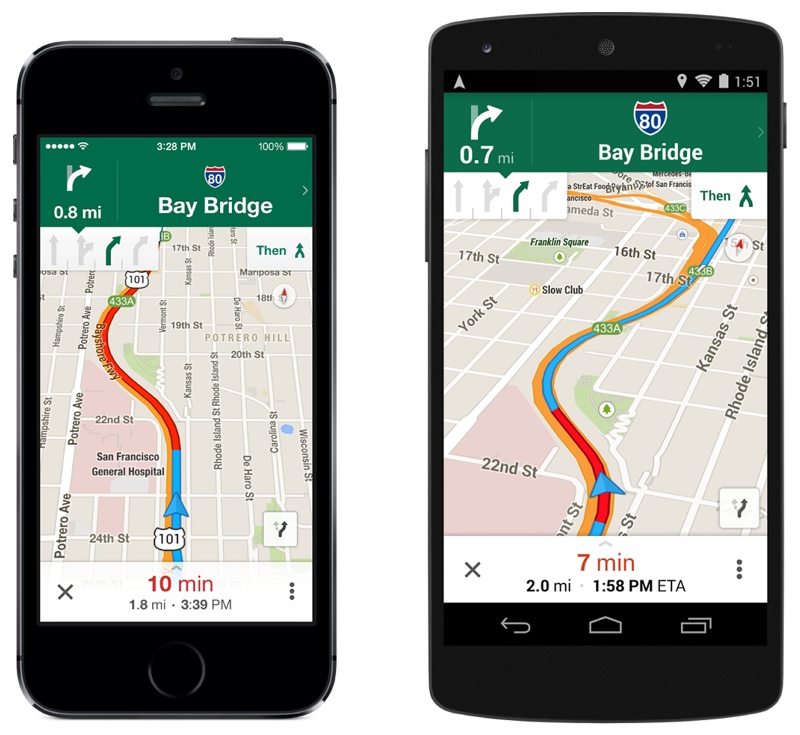
Google is updating its Google Maps app today, boosting the app’s turn-by-turn direction capabilities. Google Maps will now show drivers which lane to use through its new lane guidance feature and it’s also easier to access alternate routes while navigating.
While Google Maps has always supported the storage of maps for use offline, there’s now a specific “save maps to use offline” option within the app, making it easier to keep track of saved routes. The app has gained new filters to let users browse restaurant and venue selections based on hours, ratings, price, and more, and specific points of interest can be saved to the app.
Don’t worry if you’re not online. Before setting off on your next vacation, hike, or roadtrip, search for an area and tap on its place info sheet, then when available, you can select “Save map to use offline,” and give your map a custom name, like “Toronto Vacation.” To find your offline maps, sign-in, tap the profile icon next to the search box in the top right corner, and scroll to see “Toronto Vacation” and other saved maps.
In select cities, Google Maps will integrate with Uber, letting users compare an Uber ride option with transit and walking directions to determine the faster travel option. Google’s newest update is rolling out to users today and should be available on the iPhone and the iPad shortly.
Google Maps can be downloaded for free from the App Store. [Direct Link]
SSD Speed Variations in 2014 MacBook Air Still Due to Drive Brand Mix, Not Broader Changes
For many years, Apple has used different suppliers for the solid-state drives (SSDs) in its MacBook Air models, with drive performance varying among manufacturer brands. A recent study by Macworld demonstrated rather dramatic differences in SSD read and write speeds between tested 2013 and 2014 models, but at the time it was unclear whether the poorer performance for the 2014 models was still simply due to drive brand variances or if there was something specific to the 2014 machines causing an overall degradation in performance.
Other World Computing (OWC) has now performed some apples-to-apples testing between 2013 and 2014 models with SanDisk SSDs, and has found that performance is nearly identical.
In OWC’s testing using Blackmagic Disk Speed Test, the new MacBook Air model with a 128 GB SanDisk SSD reported read/write speeds of 705/315 MBps, while the 2013 version also with a 128 GB SanDisk drive scored similarly with read/write speeds of 711/316 MBps.

Macworld‘s testing of four machines (various combinations of 2013/2014 models at 11 and 13 inches) had included drives of two different capacities from three different manufacturers, making it difficult to determine the exact cause of the performance differences.
This variability in brand performance was noticed years ago, when Apple started using both Toshiba and Samsung SSDs in its MacBook Air models. Apple continues to use drives from different manufacturers in its 2014 models, including units from Samsung, Toshiba and SanDisk. How various batches of drives from the different manufacturers are assigned to various machines is unknown, and consumers are unable determine which brand of SSD is in their MacBook Air without opening the box and either booting the machine to examine system profile information or physically opening the machine.
Apple’s new MacBook Airs are available from Apple’s website beginning at $899, while the 2013 models are being sold at significant discounts through a number of retailers.

OhMiBod’s sex toy remote seeks funding on IndieGoGo

Now you can travel anywhere you’d like and still feel loved.
OhMiBod is no stranger when it comes to sex toys. With their huge line of luxury vibrators, they’ve been pushing the limits of what can be done with sex toys since 2006. You may remember blueMotion – the vibrator that connects to your smartphone through an app, giving the user unlimited customizable vibration patterns. Everything with the product worked very well, except for one thing – the vibrator wouldn’t work over long distances, unlike some others we’ve seen in the past.
That’s where their new IndieGoGo campaign comes in to play.
They’re working on an update to the app that would enable users to connect through WiFi, rather than having to stay in the same room as their partner. With the addition of WiFi capabilities, users will have real-time control over their partner’s vibrator whether they’re 10 or 10,000 miles apart. Adding WiFi capabilities to an app is no inexpensive feat, unfortunately. That’s why the company is looking for donations to hit their $20,000 goal.
The fundraising campaign just began today, May 6th, and will run until June 19th. Forty-five days is quite a long time to raise this amount, considering it is already 16% funded with over $3,000.
Once the app has been funded and developed, the WiFi-capable version will be available from an IAP in the original OhMiBod remote app. Check out the video below for more details.
What you get when you donate
Aside from the usual “your donation is appreciated” spiel, there are some perks that come along with your donation. If you pledge $89, you can get your hands on a blueMotion vibrator before it becomes available for retail. Considering that the original price of the blueMotion was $129, this is a pretty great deal.
Head here if you’d like to donate to the IndieGoGo campaign. If you’re interested in anything else from OhMiBod, visit their official website.
The post OhMiBod’s sex toy remote seeks funding on IndieGoGo appeared first on AndroidGuys.

MSI’s ‘3K’ gaming Ultrabook lands in the US for $1,999

When we reviewed MSI’s GS60 Ghost gaming Ultrabook, we suggested that you hold out for the “3K” (really, 2,880 x 1,620) display of its higher-end cousin, the Ghost Pro. Well, it’s here — you can now buy the Ghost Pro 3K in the US starting at $1,999, complete with that extra-sharp 15.6-inch screen and a 4.4-pound, 0.8-inch thick body that should be easy to carry. You’ll also get GeForce GTX 870M graphics that can handle the high resolution, and resource-intensive games should be happy with the quad-core 2.4GHz Core i7 processor, 16GB of memory, 128GB solid-state drive and 1TB hard disk.
The Ghost Pro is bringing company, too, in the form of the GS70 Stealth Pro. You’ll have to “settle” for a 1080p display and a heavier 5.7-pound chassis, but you’ll get a bigger 17.3-inch LCD alongside more video memory and an extra 128GB SSD. You won’t have to pay more, either, so it really comes down to a matter of personal preference — just what are you willing to trade for those 3K visuals?
Filed under: Gaming, Laptops, NVIDIA
Source: MSI

Major Google Maps update adds Uber integration, better transit info and more

Today Google announced a pretty hefty update to its Maps app, with improved navigation instructions, new search options and even the ability to jump into the Uber app to order a ride. Available for download now via Google Play and the App Store, the update includes lane guidance and easier access to alternate routes when you’re already in navigation mode. Another new feature lets you search for a specific area, such as Toronto, and save that place info sheet for offline use. For those traveling to a new city, there’s the ability to view places saved on Google Maps across all devices. You’ll also be able to star new locales to keep them bookmarked for the future.
Google’s added new filters to assist in your search for restaurants, bars and other places of interest. Sorting options include opening hours, rating and price, among others. And for those who are taking public transportation, the Google Maps update brings enhanced route options, with the ability to select “last train home” so you don’t get stranded. And finally, there’s that Uber integration we mentioned earlier — in addition to letting you order a ride, Maps will compare Uber’s options with transit and walking routes. Check it out for yourself via the download links below.
Via: Google Maps (Google Play), Google Maps (iTunes)
Source: Google Maps
 AIVAnet

