



Hipstamatic brings its retro filter editing to video with Cinamatic

Hipstamatic was early to the filter-driven photo editing fray, and now it takes aim at Vine with the Cinamatic app. The new offering allows users to long press on the screen to record videos that range up to 15 seconds in length — just like you’ve encountered before. Once the footage has been captured, a smattering of retro-inspired presets are available for punching up the vids. Unfortunately, there’s no way to delete portions of of the video right now, so you’ll have to start fresh when you drop an accidental expletive. Unlike Vine or some other popular apps, there’s no built-in feed. Cinamatic means for you to beam clips out to other social avenues for circulation. The price of admission is $1.99 and it comes with five filters to start, with the ability to make those tempting in-app purchases to pad the toolbox.
Via: The Next Web
Source: Cinamatic

OnePlus One review: a $300 smartphone has never looked so good

Look at your phone. If you can honestly admit that you love every single thing about it, I have good news: You can stop reading this review, since it won’t have an impact on your happiness. But if there’s even one thing you wish your smartphone could do better, it means you had to make compromises when you bought it. Everybody wants a perfect phone, but such a thing simply doesn’t exist. So, we settle on a phone that has only 95 percent of the features we want, and that… kinda sucks.
OnePlus believes it doesn’t have to be this way. Its motto, “Never Settle,” represents the fledgling Chinese company’s mission to build and sell the perfect smartphone. Its first attempt is the One, a premium-looking device that has customizable firmware and top-shelf specs. Oh, and it’ll sell for $299 unlocked and free of contract, which is even less expensive than Google’s Nexus 5. Seems a little over-ambitious for a small startup with no official track record, doesn’t it? Let’s find out if the One is too good to be true.
Hardware
The OnePlus One doesn’t look like a $299 phone. Its arched back, polycarbonate build, elegant chassis and top-of-the-line spec sheet could easily fool someone into thinking you paid $600 for it. That’s probably because a lot of other companies are trying to sell the same kind of device for that much money.
How is it possible, then, for a startup like OnePlus to sell a flagship device at a lower cost than many of its closest competitors? Easy: Use the same business model Google used with the Nexus 4 and 5. In other words, it doesn’t plan to make any money for a while. OnePlus has no track record to rely on aside from the fact that its founder and much of its workforce came over from Oppo, which has a reputation for making great devices (albeit at a much higher cost). Keeping the price down is an investment for the nascent company; it’s got a lot to prove, and the One is meant to be exhibit A.

There’s not much to hate for a first-gen product, unless you’re simply not a fan of larger smartphones. That’s because the One sports a 5.5-inch display and is 1.7mm taller and 0.6mm thicker than the Samsung Galaxy Note 3. It is, however, roughly four millimeters narrower and six grams lighter than Samsung’s 5.7-inch flagship. If you’re not used to holding phones bigger than a Galaxy S5 or Nexus 5, you may feel like you’re stretching hand muscles you never knew you had. I’m used to devices this size, however, and I found that using the OnePlus One was as pleasant an experience as you’re going to get with any phone larger than 5.3 inches. It features an arched back, which makes it rest more naturally in my hands, and its blunt edges give my fingers plenty of room to rest comfortably.
Doing the calculations, the One’s 5.5-inch 1080p IPS LCD panel has a pixel density of 401 ppi. The pickiest of pickies will automatically discount the quality of the screen based on the fact that it’s not quite as crisp as devices like the HTC One M8 and Samsung Galaxy S5, but I’m sure you won’t notice the difference. And dare I say, I actually enjoy the One’s display more than most flagship smartphones, and it’s leaps and bounds better than the Nexus 5. Because it uses an IPS panel, the One’s viewing angles are among the best in the industry, keeping pace with the One M8 and absolutely destroying the GS5. It’s not quite as bright as the GS5, but it’s still respectable for a flagship-caliber device; heck, even its whites are whiter than those three other phones. Most importantly, the colors are natural, making them more satisfying to stare at than the saturated GS5 and overblown Nexus 5. In case this isn’t your style, however, the firmware lets you customize the amount of color saturation, intensity and contrast.
The display rises slightly above the rest of the frame, which means it’s more exposed than most smartphone screens. Fortunately it features a slab of Gorilla Glass 3 for scratch resistance, which should help for those chance encounters with keys, pens and other similar objects. There’s a 5-megapixel front-facing camera near the top next to the earpiece and sensors, and you’ll also find a set of three capacitive buttons at the bottom, which can be turned off in favor of virtual soft keys (more on this in the next section).

A volume rocker and micro-SIM slot line the left side of the One, while a power button adorns the right. There’s a 3.5mm headphone jack on top, and you’ll find twin speaker grilles flanking a micro-USB port on the bottom. Some potential buyers might complain about the lack of a microSD storage slot, but if that’s really an issue, you can just spend an extra $50 for the 64GB version. This is a fantastic deal compared to other flagships that make you pay another $200 for that amount of space.
The gently curved back is minimal, featuring a 13MP camera with dual-LED flash, noise-canceling mic and logos for OnePlus and Cyanogen (unless you have the Chinese version, which doesn’t have the latter). The back cover is interchangeable, which gives you the ability to customize your hardware somewhat. Five plates have been announced so far, each with different colors and/or textures, but only two will be available at launch time. You’ll need the extra time to practice removing the back, though, because the process is about as painful as changing the oil in your car. To do it, you’ll need to first eject the SIM tray and then, using a mixture of fingernails, luck and prayer (if that’s your thing), pry open the back methodically. OnePlus made it difficult to take off on purpose, since nothing underneath the cover is removable — not even the 3,100mAh battery. Plus, think of the fine sense of accomplishment you’ll feel when you’ve actually succeeded.
The One will come in two variants: one for China (with Chinese-specific bands and TD-SCDMA) and another for the rest of the world. OnePlus has tried to cram as many connectivity options as possible into the One, with seven LTE bands (1, 3, 4, 7, 17, 38, 40), as well as penta-band HSPA+ (up to 42 Mbps) and quad-band GSM/EDGE. For US readers, that means you can use this on AT&T or T-Mobile, but not Verizon or Sprint. It also supports Bluetooth 4.0, USB OTG, WiFi 802.11b/g/n/ac, GPS/GLONASS and NFC.
As an aside, my review unit is a white 16GB model and is a pre-production device. OnePlus reps tell me the hardware and firmware are “almost final,” but improvements and bug fixes may be made between now and when the final units hit the assembly line. Once I have a final unit in my hands, I’ll take another look and update my review if anything gets fixed (or broken, as it were).
Before moving on, a disclaimer: Despite the company’s “Never Settle” mantra, a few of you may still feel like you’d be settling with the One. OnePlus couldn’t realistically pack every possible feature that now exists into its perfect phone — especially at such a low price — so if you want something with wireless charging, a microSD slot, waterproof design, aluminum build or a removable battery, this may not be the perfect phone for you.
Software

As if the One wasn’t unique enough, it also comes with a much more customizable Android experience than what 99 percent of users currently enjoy. This is because OnePlus is an exclusive partner with CyanogenMod, so naturally its very first phone comes with the firmware (build 11S, based on Android 4.4.2) directly baked in.
Hold up. What exactly is CyanogenMod? It’s custom firmware based on the Android Open Source Project (AOSP) and gives the user more freedom to fiddle around with settings, icons, themes and… well, nearly every aspect of the Android experience. Cyanogen’s one of the most popular pieces of third-party firmware in the Android universe and can be installed a wide variety of devices, but the experience is even better on the One because it was built into the phone; since CyanogenMod could work with the hardware early in its development, it was able to add a bunch of optimizations that you won’t find on other phones.
At first, it doesn’t appear that different from stock Android, save for a few style changes (think: icons and buttons). But don’t let its understated facade fool you: There’s a lot of power behind the scenes, and it becomes more evident as you continue to poke around. There are several new features, with tweakable settings thrown in everywhere. Many of you are simply looking for an inexpensive phone and don’t care about making dozens of tiny adjustments to your Android setup, and the beauty of CM is that it can fit your style just as easily as it can fit the preferences of power users — it’s completely customizable, and it’s fantastic. Here’s a crash course on what you can tweak.
Thanks to a healthy modding community, there are tons of different CyanogenMod themes to choose from. Prefer LG’s or Samsung’s interfaces for some weird reason? No sweat, just go to the Themes Showcase app and download what you want. Most of them aren’t perfect ports (some only feature select parts of the UI, like icons, buttons or fonts), but they will at least offer you some of the familiarity of what you’re used to. You can also choose to download a number of different fonts, sound packs, boot animations and wallpapers.
The One comes with a set of capacitive keys below the screen, but you can deactivate them and opt for a virtual bar of soft buttons instead. It may not make sense to do that if you’re trying to squeeze as much real estate as possible out of your screen space, however. If you choose to keep the on-screen bar, CM will let you add, take away and rearrange the buttons that appear there.
You can also customize the status bar to show the clock, battery percentage (and the type of indicator it uses) and the number of notifications for certain apps, like Gmail. You’ll also be able to adjust screen brightness just by sliding your finger to the left or right on the bar, and you can choose to add a double-tap-to-sleep option.

If you want to change which tiles show up in your quick settings menu (and the order in which they’re shown), you can do that by hitting a plus icon near the top. And by the way, instead of having to use a two-finger gesture to open that menu, it’s possible to pull down on the right side of the status bar to get there — pulling down on the left would bring up the standard notification bar. Finally, you can also change which shortcuts show up on the lock screen, as well as the quick launch shortcuts that appear when you slide up from the home button. I could keep talking about more stuff you can tweak, but you get the idea — you can do a lot. And part of the fun is discovering new settings to tweak.
The One lets you use gestures to activate different parts of the phone. Oddly, this is one of the few parts of the OS that isn’t customizable. A double-tap wakes the device; a V motion activates the LED flashlight; two fingers up/down will turn on your music; and a circular gesture gets you straight into the camera. These gestures were incredibly sensitive on my pre-release unit, so I would often hear music coming from the phone as it sat in my pants pocket. Hopefully OnePlus and Cyanogen will fine-tune this as the One gets closer to an official launch.
Lastly, during the course of my review I stumbled upon one of the One’s best features: always-listening voice recognition, thanks to Qualcomm. CM throws in a few modifications of its own to add more customization. After the phone learns your voice, you can say “Hey Snapdragon” to activate Google Now or any app of your choice.
Camera

The Nexus 5 has a lot of endearing traits, but the camera isn’t one of them. Sure, it has its moments of greatness, but I can’t help think this is a case of settling. The OnePlus One, on the other hand, uses a 13-megapixel rear camera with a Sony sensor, six-element lens setup and f/2.0 aperture for lower-light shots. Additionally, the front-facing camera tops out at 5MP — a sizable improvement over the 1.3-megapixel sensor on the N5.
The camera app is a special flavor made by the CyanogenMod team. It consists of three circular buttons on the side for taking stills, video and panoramic shots. Along the top sits some settings, scenes and a toggle for the front-facing camera. In addition to HDR, night mode, landscape and a few other standard options, the One has less-traditional scenes like snow, sunset, party and theatre. These may offer some fun ways to experiment with your camera, but I found that auto mode took care of most scenarios perfectly well. But if you want to switch back and forth, all you have to do is swipe your finger up or down on the viewfinder.

When it comes to performance, the camera is decent, but hardly stellar. Colors appear more natural than on the Nexus 5, but they’re still slightly less saturated than they should be. The sky isn’t as blue as I’d like, and some of my sample images suffer from soft focus. For low-light shots, the large aperture didn’t help the camera capture as much light as I expected, as the level of detail is nowhere close to what I got from the HTC One M8 or high-end Nokia Lumias. It’s also quite noisy. Compared to the N5, it gets about the same amount of light, but the One’s white balance is much better at night. Lastly, HDR mode is a little too strong; it does so well at highlighting the shadows that it ends up making the rest of the picture look a tad cartoonish. All told, the camera is one area in which flagship devices still outperform the One, but at least it’s a slight improvement over the Nexus. (I’ve added an album of full-res photos to Flickr, and will continue to add more as new updates come out.)
That said, the built-in editing software has some serious chops, in case your photo needs a little post-production flair. If you feel the HDR effect is too strong (or you want to bump it up even more), you can change filter strength or switch to a different preset style. You can also adjust the color, focus, sharpness and brightness. Even better, you can select certain areas of each image that you want to tweak. There are also heaps of filter options thrown in for good measure.
Video recording here is solid, with up to 4K resolution and a bit rate of 20 Mbps. You can also film in 60 fps slow motion at 1080p and 120 fps at 720p. Since the One doesn’t have optical image stabilization, CM had to tweak the software to ease the pain a bit. It certainly helps, because footage is noticeably smoother. It can’t fully replace actual hardware, of course, but the software enhancements at least make a difference. The front mics seemed to pick up more sound than the rear ones, so when taking movies of my children, my voice came out much stronger unless they were close by; when filming them outdoors, however, they sounded muffled when they were more than a few feet away.
Performance and battery life

It’s hard to believe that a $300 device like the One has as much muscle underneath the hood as the Galaxy S5 and Oppo Find 7. In fact, you technically can’t get any faster, since the phone sports a 2.45GHz quad-core Snapdragon 801 (MSM8974-AC), a 578MHz Adreno 330 GPU and 3GB of RAM. Until the Snapdragon 805 comes out later this year, this is the absolute best silicon that Qualcomm has to offer. But what does it mean to you? Smooth everything, fast everything and no lag as far as the eye can see. If you don’t mind my nitpicks: The gaming experience is still slightly sluggish with the occasional frame skip, but it’s not very noticeable unless you’re paying close attention. Additionally, since the phone’s still running on a pre-release build, there are a few kinks that OnePlus needs to iron out before it releases the One to the world.
CyanogenMod’s firmware gives you the option to change your performance profile to one of three modes, ranging from power conservation to battery sucker. If you don’t want to use any presets, you can adjust some of the settings manually, such as minimum and maximum CPU frequency. This is definitely in advanced territory; I don’t recommend you try it unless you know what you’re doing.
One such issue is soft audio output, both on the external speakers and in the earpiece. All of my conversations were much quieter than they should have been, and I could barely hear music blaring at full volume. (OnePlus tells me this will be resolved in an upcoming update, and I’ll amend my review as soon as that happens.) Fortunately, none of this was a problem when I used headphones; in fact, I often had to turn down the volume to make my ears feel comfortable. In addition, the One has an equalizer app called AudioFX, which lets you fine-tune the audio.

Battery life, at least, is a bright spot. The One has a 3,100mAh non-removable cell that’s just a tad smaller than the battery inside the Note 3. What’s more, it’s actually larger than what you’ll find in the GS5 and One M8. On most days, I made it to the end of the evening with around 5-10 percent life remaining. (On average, this constituted 14-15 hours of solid use, and roughly four hours of screen-on time.) These were days full of emails, calls, travel, social networking and a little bit of gaming. All told, our standard video rundown test yielded 10 hours of life. This isn’t the best I’ve seen, but I’d consider it well above average for a smartphone — and I’m hard-pressed to ask for more from a $300 device.
The competition

Good things come to those who wait. Phones with lower asking prices often come with excruciating delays, and OnePlus’ first handset is no exception. The company is going to have a difficult time meeting demand right away, which is one reason why it’s offering the One on an invite-only basis at the beginning. The $299 16GB option, which will come in white, will go out to the first batch of invites in mid to late May; the $349 64GB model, offered in black, starts shipping in early June. For the rest of you still waiting for an invite, OnePlus is hoping to send one your way by the end of June.
At launch, the OnePlus One will be available in 16 countries: Austria, Belgium, Canada, Denmark, Finland, France, Germany, Hong Kong, Italy, Netherlands, Portugal, Spain, Sweden, Taiwan, the UK and the US. Once it’s ready, the One will face intense competition. The most notable device in its price range is the Nexus 5, which you can get for $349 (16GB) or $399 (32GB). It comes unlocked and has the full native Google experience, but admittedly, it doesn’t have as extensive a spec list as the One. The Nexus 5 is still the best option if you want timely updates, but CyanogenMod has a good track record of pushing updates quickly, and since the ROM is baked into the device (rather than requiring a separate install), it makes the chances of getting prompt refreshes even more likely. CM’s also pledged that it will support updates for the One for at least two years.
Wrap-up

It doesn’t make sense that the OnePlus One should be this inexpensive. It looks elegant, feels solid and performs smoothly, and it doesn’t show any signs that it’s a first-generation product from an unknown company. Regardless of how well it sells, the industry will see this as a benchmark for what an affordable phone really can be. All told, it outperforms Google’s Nexus 5 in nearly every way — and it does so at an even lower price. Heck, it’s better than many flagship phones that sell for twice as much.
The OnePlus One gets close to the perfection it’s aspiring for, but it’s not for everyone. Many will despise its large form factor, non-removable battery and lack of external storage. To a nitpicky reviewer like myself, a truly perfect device would also include wireless charging and some type of waterproofing. But let’s be real: It just isn’t going to happen in a $299 device, especially one that’s already filled to the brim with flagship features.
Here’s the thing: The One doesn’t have to be perfect for me to recommend it. A few missing features? Sure, no problem. What matters is that it’s perfect for you, and it fits all of your needs. Besides, imperfections make us eager to see what’s around the corner. In the meantime, we keep dreaming of perfection, and perhaps one day we’ll actually find it.
Edgar Alvarez contributed to this review.
Filed under: Cellphones, Mobile
Facebook says it only needs Moves’ data to help build the app

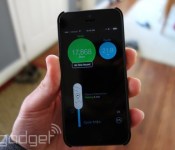
When Facebook initially addressed concerns about Moves’ new privacy policy, it raised more questions than it answered: just what does it mean when it says Moves will share data? Does that mean advertisers will see your fitness routine? Well, the company has since given us a clarification — and it looks like the sharing is more innocuous than it seemed at first blush. The new policy only exists so that Facebook staffers can “actually work on building the app.” The social network needs access so that it can bolster Moves’ small development team and maintain the software as necessary.
Meanwhile, the social network has also elaborated on the “commingling” it wants to avoid. Simply put, there are “no plans” to bring any data from Moves into your Facebook account. The company doesn’t want to identify people who use both services and open the door to a myriad of privacy issues. You shouldn’t see unusually well-targeted running shoe ads in your News Feed, then, but it would have been great to have this clarity from the get-go.
Filed under: Cellphones, Internet, Mobile, Facebook

An avalanche of new Snowden documents will go online next week

Way to bury the lede, Glenn Greenwald! Scroll to the bottom of this blistering response to recent remarks by just-retired NSA chief Keith Alexander, and you’ll find some very interesting news indeed. Greenwald, who recently won the Pulitzer Prize for his coverage of Edward Snowden’s NSA surveillance revelations, says he plans to publish previously unpublished NSA documents online next Tuesday, May 13th, with free access. The timing, it should be known, is not a coincidence: Greenwald’s book, No Place to Hide, comes out that day. In fact, the documents that will go online next week are ones he mentions in the book, but which weren’t previously reported in the media. So, if you were expecting the entire trove to go public (and even Snowden has advised against that), you might still be disappointed. But if you’ve been following this Edward Snowden-NSA-Big Brother saga closely and have an appetite for even more revelations, you’ll want to mark your calendars (and pre-order Greenwald’s book, if we’re correctly reading between the lines).
Image credit: U. Baumgarten via Getty Images
Source: The Intercept
Belkin’s Ultra-Slim QODE Thin Type Keyboard Now Available for iPad Air [iOS Blog]
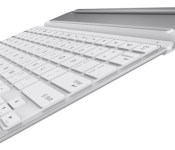
Belkin today announced the availability of the QODE Thin Type for iPad Air, adding an ultra-slim keyboard option to its popular QODE line of tablet keyboards. QODE Thin Type for iPad Air features an anodized aluminum design, 79 hours of battery life and iOS specific keys that pair nicely with the iPad. The keyboard’s main selling point is its 4mm thin profile that barely adds any heft to the already slender iPad Air.

An early review of the device from ZDNet’s James Kendrick is favorable, noting that the keyboard is “different in a good way” from competing iPad tablets from Logitech, Kensington and Annker.
The Belkin is a simple cover with a keyboard on one side. The metal cover is not flat like the competitors’ models. There is a hump toward the back of the cover that gives the Belkin three advantages over the competition. The hump houses a large battery that Belkin claims gives six months of use on a charge. This is double that of other iPad keyboards. Having this hump on the cover provides an ergonomic tilt to the keyboard, perfect for typing. Last but not least, the protrusion provides a secure grip for handling the tablet in the cover.
The QODE Thin Type keyboard for iPad Air is available now for $99.99 at Belkin.com and will land soon at select retailers worldwide.
Some iOS Users Reporting Apple ID Error Messages When Updating Apps
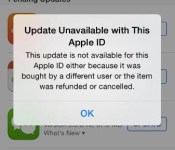
A number of mostly international iOS users on MacRumors forums, Apple’s support forums, and Twitter are reporting issues with failed app updates today. According to affected users, the process of updating apps in the iOS App Store produces a warning that “the update is not available for this Apple ID either because it was bought by a different user or the item was refunded or cancelled.”

Reader Vinamra on MacRumors forums:
“I go 4 app updates today and as soon as I clicked the update button, the App Store app popped up with the following message:
“Update Unavailable with this Apple ID – This update is not available for this Apple ID either because it was bought by a different user or the item was refunded or cancelled.”
I have always used a single Apple ID and this phone (5S) was bought new and have never had this problem in the past.”
Member Albertus8898 on Apple Support Forums:
i didnt change or log out from my apple id at my iphone 5. But when i wanted to update one of my apps it said “update is not available for this apple id either becuase of using different id or….” then i checked my apple id’s apps and most of my apps gone. what should i do to make them back to my apple id account? and i tried to delete those apps and redownload them but it gave the same message.
One user contacted an Apple Support representative, who confirmed there was a server issue on Apple’s side that was affecting app updates. Apple is working on the problem, but the company has not provided a timeline for the fix.
At this time, this issue that you’re experiencing with updating apps is being investigated. There are no possible fixes at this current time, as [it’s] an issue with our servers, but we are working on it and should have it functioning properly later today.
While such an error message may appear when users are managing multiple accounts or changing countries, the number of complaints surfacing today and reports from several users indicating that they are only using one account with no changes in country suggest that there is indeed a broader issue with Apple’s systems today.

Galaxy S5 Dx spied briefly on Samsung website

Another leak from @evleaks on Twitter has revealed what seems to be yet another device that Samsung have in the works dubbed the Galaxy S5 Dx.
The Galaxy S5 Dx will be available in more colours than the standard Galaxy S5 and will come with a model number of SM-G800, but any specs of the device are still undisclosed.
According to the leaked screenshot, the Galaxy S5 Dx looks pretty much ascetically like the released Galaxy S5, but available in a greater variety of colours. If that’s the extend to which the differences go then it will be interesting to see how Samsung market yet another variant of the same device along the Galaxy S5 and the Galaxy S5 Prime.
Samsung Galaxy S5 mini? [via tip] pic.twitter.com/tErdv1EdRA
— @evleaks (@evleaks) May 7, 2014
There is some speculation that the Galaxy S5 Dx is actually the real name for the heavily rumoured Galaxy S5 Mini which is set to feature a 4.5-inch Super AMOLED display with a 720p resolution, 1.5GB of RAM, and an 8-Megapixel rear camera.
That just leaves the question as to why they chose the name Galaxy S5 Dx? Perhaps it’s a codename? Let us know your thoughts in the comments below.
The post Galaxy S5 Dx spied briefly on Samsung website appeared first on AndroidGuys.

LG intros 5.5-inch Quad HD display ahead of G3

LG have just announced that their new 5.5-inch Quad HD (or QHD) display will be released for the first time on their upcoming flagship, the G3. If you remember, the LG G3 is set to be released on May 27th.
This new display has a 2560×1440 resolution, four times the image resolution of HD panels, and 1.8 times higher resolution than a Full HD panel. Adding a little bump up in design from last years G2, this display enables the phone to have a mere 1.15mm bezel.
This is looking up to be one of the best displays we see this year. If you didn’t catch it before, the G3 is rumored to have a Snapdragon 805, 3GB RAM, and a 13MP camera. Not only is the display looking great, but the whole phone seems better and better every day.
Seoul, Korea (May 8, 2014) – LG Display announced today that its 5.5-inch Quad HD (QHD) AH-IPS LCD panel for smartphones was certified as a QHD display after passing verified tests by NEMKO, the Norway-based international testing and certification organization for electrical products. The certification comes shortly before the new Quad HD LCD panel will be unveiled with theforthcoming LG’s flagship smartphone to be launched in the first half of the year.
The certified 5.5-inch QHD AH-IPS LCD panel has 2560 x 1440 pixels, four times the image resolution of HD panels and 1.8 times higher resolution than a Full HD panel. With 538 pixels per inch, this panel also meets the 100 percent RGB color reproduction standard.
This panel, which will go into mass production shortly, will offer superior performance to other existing smartphone panels. This is an ultra-slim panel with a mere 1.2 mm thickness and has a 1.15 mm bezel, which will be the narrowest available and 0.05 mm less than panels introduced last year.
In addition, the panel has achieved the same level of brightness as a Full HD panel. It is difficult to raise penetration ratio in higher resolution panels since they have more pixels. However, LG Display successfully achieved higher brightness by improving the penetration ratio through enhancing the pixel structure design and aperture ratio in the LTPS backplane.
The Quad HD display produces images in sharper color and contrast than regular displays because of the greater amount of pixels. This means that high resolution images and videos in the Blu-ray format can be viewed in a fully vivid and realistic manner. The display retains the readability of letters and images without distorting them when they are enlarged while surfing the internet or working on documents.
“This product fulfills the core qualities of smartphone displays, which are high resolution and slim design, and I believe the consumers can enjoy vivid images that are close to real life with this display,” said Byung-koo Kim, Vice President and Head of LG Display’s IT/Mobile Development Group. “LG Display will continue to maintain technology leadership in the super high-resolution smartphone display market above 500 ppi resolution, which will take off this year.”
According to DisplaySearch, the shipment of premium smartphone displays based on LTPS backplanes is expected to grow to 780 million units by this year and 940 million units by next year. These products are going to maintain sufficient competitive advantage in premium product categories where large size, high resolution and low power consumption are key factors.
The post LG intros 5.5-inch Quad HD display ahead of G3 appeared first on AndroidGuys.

Samsung, Nokia join 5G trials in Japan, but crazy speeds still far away

Source: NTT DoCoMo

Litely looks to improve mobile photo editing by focusing on simplicity

“The best photos don’t look edited; it’s all about the story and the moment,” photographer Cole Rise quips while walking me through his new mobile image editor. You may not recognize his name, but if you’ve used Instagram, you’ve seen some of his work. Rise created the Hudson, Sierra, Sutro and Rise filters for the popular social snapshooting app. But he’s quick to tell you that the features in Instagram and other mobile editing software help mask bad photos and are generally too heavy-handed to churn out truly compelling images. So with that in mind, and with a library of presets for Lightroom, Photoshop and Aperture already in his toolbox, he set out to make a non-destructive editor with a simple UI and subtle tools. Something to make film-like tweaks good photos rather than improve mediocre ones. He created Litely for iOS.
When you first fire up Litely, you’re greeted with a photo library to which you can add shots from your Photo Stream and other iCloud folders. Of course, you can take a new shot as well, and the app leverages the iPhone’s (or iPad’s, should you so choose) built-in camera chops to do so. Ever notice how photos look better in some apps as compared to others? Well, that’s largely a software issue and having spent some time at Apple, Rise is quite familiar with the camera on the 5s. That said, Litely doesn’t employ its own tweaks behind the scenes here, but rather it lets the native hardware do the heavy lifting. This means that you can snap a load of images with the phone’s camera and save the editing for later on it or an iPad, thanks to easy access to the cloud-stored files. Or you could drop a few JPGs from a DSLR and edit them slate-style whilst on the train.

Upon selecting a file, you’re launched into the main edit screen. The overall design of the app keeps its promise of simplicity, and that’s definitely evidenced here. While you can certainly swipe up and down on the list to toggle the presets, doing so on the image itself achieves the same result. Each of the options is applied at 50 percent by default (again, subtlety) and a slider appears above the list allowing for adjustment. “That’s important because subtlety means longevity. I wanted to create an app that enhances your photos today, but keeps them looking just as beautiful and timeless in 50 years’ time,” Rise notes. What’s more, if you swipe across the image with two fingers, you can gaze at a before/after split-screen preview.
“Subtlety means longevity.”
The presets are also colored-coded to give you an idea of the hues they employ and each has a regular, high-contrast and faded setting for further editing options. A single tap on the image serves up a zoomed-in view, which can be panned around using the gyroscope of an iOS device. Not only can you take a closer look, but also you can maneuver around the edges of the photo for a better view of all the edits. During my time with Litely, I found that I preferred my iPad mini over the iPhone 5s if I had some time to sit down to edit. The increased screen real estate was more comfortable and enhanced the use of the aforementioned movement. Of course, the smartphone was the choice if I needed to take a quick shot to edit before beaming out to Twitter.
Along the bottom of the UI are menu items for corrective adjustments, a crop tool and sharing options. Once inside that secondary editor, exposure, sharpen, vibrance and vignette tweaks are all there, with another intensity slider for each. During our chat, Rise dwelled upon that last feature for a few minutes. He says that while the vignette option in most apps just adds black to the outside of the image, Litely actually adjusts the exposure for the desired effect. “It’s technically right,” he adds.

Perhaps the most compelling feature is the way the software handles files. Litely is non-destructive, allowing you to step back from an edit and start fresh. It also makes adjustments to the full-resolution images and allows the exporting of those files without losing quality — a must for photographers needing to keep photos as large as possible for later use. When you’re all done, the app offers sharing to AirDrop, iMessage, Mail, Twitter, Facebook or just saving out that full-size file. If you’re looking to share images to Instagram or another social outlet, you’ll have to save ‘em and then open the desired shot in that app. While this is an inconvenience, Rise maintains that Litely isn’t meant to be social, but rather a tool focused on editing.
For those that aren’t after the more detailed tweaks that Adobe Lightroom for mobile offers, this could be an attractive option. That more pro-minded app requires a monthly subscription though, and is really more of a complement to the full-on desktop software. At launch, the free version of Litely for iPhone and iPad will house nine presets and users will have the option of making in-app purchases of a dozen at time for $1.99 per pack.
Filed under: Cellphones, Cameras, Tablets, Software, Mobile
Source: Litely (iTunes)
 AIVAnet

