



Dish will soon let you pay your bill with bitcoins

While some companies are steering clear of Bitcoin, others, like Dish, are now getting ready to welcome the digital currency into the fold. Today, the satellite provider revealed that it plans to start accepting Bitcoin later this year, allowing customers to easily pay their bill online using virtual money. Dish is teaming up with Coinbase to handle the processing of these payments, which are expected to begin taking place during the third quarter of 2014. “We always want to deliver choice and convenience for our customers and that includes the method they use to pay their bills,” Bernie Han, Dish executive VP and COO, stated in a company release. “Bitcoin is becoming a preferred way for some people to transact and we want to accommodate those individuals.
Along the same lines, Coinbase recently announced a new featured called Payment Pages, which, as the name suggests, will let you use its platform to receive payments or donations with Bitcoin. To kick this off, hip-hop artist Nas already has his very own hub — one that he’ll be using to take bitcoins and donate them to Watsi.org, an organization that provides medical care for people in need. With that, we’d say the past couple of days have been good for the social acceptance of the renowned digital currency.
[Image credit: AFP/Getty Images]
Source: Dish

Google Maps v8.1 Rolling Out, Brings Back Terrain Mode and Other Minor UI Tweaks [APK Download]
A day late, but not a buck short. Another Google app has updated, this time it is Google Maps. Maps is now at version 8.1 and brings back something that hiker, bikers and outdoor enthusiasts probably missed most, Terrain Mode. Terrain Mode is an alternative map view to satellite that offers a topographical look at the mountains, hills and valleys in a given area.

 Terrain Mode is the most significant aspect of the update. The rest of the update seems to be at some UI changes in various sections. Each navigation card offers up the navigation type via an icon, car, bike, person ect. They moved the time and mileage to the right and made it a little smaller too. In the transit view times and travel time have been made a big bolder so they stand out a bit more. Lastly, biking and Walking views look the same.
They also managed to shrink the file size a little bit from the previous maps version too. In typical Google fashion the update is rolling out in stages. If patience is NOT one of your virtues, hit the link below to go download the APK.
Download: Google Maps v8.1 APK
Via AndroidPolice
//<![CDATA[
ord = window.ord || Math.floor(Math.random()*1E16);
document.write('’);
//]]>
Apple Removes Sidebar Link to iPod Classic in Several Refurbished Stores [Mac Blog]
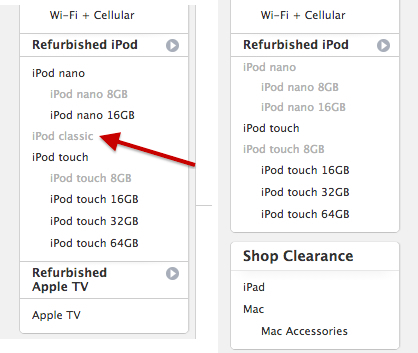
Apple today removed the link to the iPod classic from the sidebar of its U.S. and Canadian refurbished stores, perhaps offering an indication that the ancient hard drive-based MP3 player is finally on its last legs. Though the link is gone, the actual page for the refurbished iPod classic remains on Apple’s website.
The sidebar link is still present in Apple’s international refurbished stores for the time being, but it is greyed out, indicating that no units are available to purchase. It is not entirely clear when Apple’s refurbished store last had iPod classic models in stock, but it seems to have been quite some time ago and today’s removal of the sidebar link suggests that Apple has no plans to bring them back to the store.
The iPod classic is the successor to the original iPod introduced in 2001 and is the only remaining MP3 player in Apple’s lineup that uses a hard disk drive for music storage. As highlighted in our Buyer’s Guide, Apple hasn’t updated the iPod classic since 2009, and no further updates are expected given the device’s age and the fact that hard drive manufacturers are no longer producing the 1.8-inch hard drives used in the iPod classic. Seemingly every year, a new crop of rumors claims Apple is discontinuing the device, but the venerable iPod classic has hung on year after year as an option for those looking to carry larger music libraries on the go. Speculation has suggested that once the iPod touch becomes available in a 128 GB option, Apple may finally choose to retire the iPod classic, but the company has elected not to increase the maximum capacity of the iPod touch since 2009 when the third-generation model became the first to offer up to 64 GB of storage.
Sales of Apple’s iPod lineup have been declining as customers turn to the iPhone to meet their music needs. In its latest quarterly earnings for Q2 2014, iPod net sales contributed only 1 percent to Apple’s overall revenue, while the iPhone accounted for 57 percent. The iPhone may have crippled iPod sales, but the iWatch may be the death knell. According to analyst Christopher Caso of Susquehanna Financial Group, sales of the iPod will continue to decline precipitously as consumers choose the wrist-watch device instead of a stand-alone player.
While we don’t expect AAPL to discontinue iPod for some time, we also don’t expect an iPod refresh this year, and believe iPod could post Y/Y unit declines as a result as consumers purchasing iWatch as a substitute.
Besides the iPod classic, Apple also recently removed the 17-inch MacBook Pro from its refurbished store after discontinuing the notebook in 2012.

Virgin Media’s ‘quad-play’ phone, TV and net bundles now available to all

Virgin Media launched the UK’s first ‘quad-play’ packages earlier this month, which wrap all of its mobile, landline, broadband and TV services up into neat, pay-monthly bundles. These were only available for existing customers to upgrade to initially, but right on schedule, new customers can now get in on the action, too. Furthermore, there are two additional “Big Bundles,” as they’re called, that complement the £35 per month Big Bang and £50 per month Big Kahuna packages (excluding line rental) Virgin announced previously. The new entry-level Big Easy bundle starts at £25 per month, and for those that need the absolute fastest, biggest and best of everything, the Big Daddy package can be had for £100 per month (again, both prices exclude line rental). You can also create your own custom bundle by bolting “Big Extras” onto the standard ones, if getting everything from the same provider and on one bill is just that little bit too simple for your taste.
Filed under: Cellphones, Home Entertainment, Wireless, Internet
Source: Virgin Media

HTC One’s plastic cousin officially shown off with M7 design, M8 guts

It’s no secret that HTC’s prepping a plastic variant of its flagship One (M8) phone, but we’ve never taken a proper look at it until now, courtesy of the company’s China website. And no, this isn’t a leak. Ahead of the device’s June 3rd launch, HTC’s limited edition giveaway campaign unveiled almost everything about the M8 Ace, aka “Vogue Edition,” of the One. The clear product renders — shown in black, white, blue and red options — indicate that this upcoming phone carries a similar design language as the metallic, award-winning M7 from last year; but the new plastic-only construction means you get a cleaner look on both the back and the profile sides.

The page also confirms some main specs that are identical to that of the flagship M8: a 2.5GHz Snapdragon 801 SoC (the M8 for Asia is clocked at 2.5GHz instead of 2.3GHz, by the way), a 5-megapixel front-facing camera, BoomSound front-facing stereo speakers, Motion Launch gestures and extreme power-saving mode. As we already know, the M8′s funky Duo Camera is replaced by a single 13-megapixel camera here, and it appears that the TV remote feature is also absent on the power button. On the flip side, we can just about make out China Mobile’s 4G LTE logo on the back of the phone, which is good news for the locals. There’s no mention on the screen size, but we’ve previously heard from our sources that it’ll be the same 5-inch 1080p panel as found on the M8. The leaked dummy in the above picture, courtesy of Sina Weibo user ASAMKI, suggests the same.
The ultimate question is: How much will HTC be charging us for this so-called Galaxy S5 competitor? Its “mid-range flagship” Desire 816 costs ¥1,899 (about $300) in China, whereas both the M8 and the Galaxy S5 cost ¥5,299 ($850), making for a midway point of ¥3,599 ($580). HTC will really need to stick to the lower half of the price segment to threaten not only Samsung, but also other local brands like Smartisan, Oppo, Vivo, Huawei (all mainly in the ¥3,000 sector), plus the notoriously aggressive duo: Xiaomi and OnePlus (from just below ¥2,000). Will HTC be able to surprise us? Tune in next week to find out.
Filed under: Cellphones, Mobile, HTC
Source: HTC, Sina Weibo

Google takes American ISPs to task over video buffering

You don’t like when YouTube videos pause during playback, and neither does Google. More often than not, your internet connection is to blame, shifting the responsibility to provide consistent performance from Google to your ISP. In an effort to increase transparency (and perhaps highlight your own service provider’s bandwidth limitations), Google’s making its Video Quality Report available in the US. The tool launched in Canada earlier this year, and should be making its way to other countries within the next few months, detailing streaming quality and local consumption trends, graphed by time of day. Google’s also endorsing certain providers as “HD Verified,” making it clear which ISPs meet YouTube’s standards, and which do not.
Filed under: Home Entertainment, Internet, Google
Source: YouTube

Exploring the best of the best at this year’s White House Science Fair

The annual White House Science Fair is, above all else, an amazing public relations play. President Obama hangs out with a few dozen of America’s brightest students who show off their latest work and get celebrated for it. Everyone wins, right?
In this instance, yes: everyone wins. Regardless of the good publicity, the annual White House gathering — now in its fourth year — is one of the few events we attend that’s completely genuine. It’s hard to keep up a facade of bullshit when brilliant, driven, passionate kids are literally surrounding you with their accomplishments.
There were too many smart kids with neat projects for us to cover everything. And President Obama’s dog, Bo, was running around, so you’ll forgive me for getting distracted. Dogs, right? Here are a few standouts among the standouts:

Deidre Carillo’s project is an electric kit car that she drives. Carillo, 18, is part of the team that built the project, and she’s also its pilot. She’s pretty good at both, as not only is her team’s car, Dragon 1, a formidable competitor, but she took home first place in this year’s Emerald Coast Electrathon. Her team’s car was created from a Blue Sky Design kit, though as you can see above, it got plenty of custom work.

In the next room, what looked like a miniature, futuristic wrecking ball was attached to a machine resembling the Mars Curiosity rover. Rather than a destruction vehicle for martian structures, the rover is a remarkably easy to use rescue tool. How easy to use? So easy, I could pilot it. Heck, it uses a Logitech game controller for operation. Pretty easy! The idea is that the wrecking ball end — a ball with waterproof lights and two cameras — can be lowered into iced over waters to assist with search-and-rescue missions. Rather than sending human divers into dangerous conditions, the 120 pound device can be remotely operated. More than just a science project, the Natick, Mass-based team is working on patenting and licensing the tech.
Outside, while Bill Nye (“The Science Guy”) and Mythbusters‘ Kari Byron goofed with student attendees on the White House livestream, 20-year-old Parker Owen represented Alabama by barely breaking a sweat while presenting his project: an amazing prosthetic leg made solely from bicycle parts.

Owen got the idea when speaking with a family friend who raises funds for prosthetic limb donations in Honduras. When Owen found out how much money each leg cost (around $2,500 apiece), he began work on a cheaper solution that could be made from materials found in developing nations. Rather than looking to natural resources, Owen looked to bicycles — a resource found in even the poorest countries. He got the cost of manufacturing down to just $30 per leg.
President Obama’s speech was the only element that rang hollow at the fair. He related a few stories from his own dalliances with science fairs in his youth, he celebrated a few of the participating students by name, and he announced a few new initiatives in his administration’s STEM (Science, Technology, Engineering and Mathematics) program. His speech, sadly, was nowhere near as passionate and impressive as the students themselves.
Of course, the White House Science Fair isn’t really about President Obama. It’s about the kids. As he said himself, “I want to make sure that every young person across America knows what their peers are doing to inspire even more work in science.” In that sense, mission accomplished.

Get “physical” with Fusion [App of the Day]

Aspiring physicist or just a student looking to learn more about astrophysics? Fusion is an addicting game that makes learning fun.
The game starts where you are in control of creating your own universe by colliding the elements together. These reactions create larger elements and raises the temperature of the core of the star. Be careful and move quickly because the star is constantly cooling. You goal is to get the temperature to the top of the thermometer to complete the level.
As the elements are flying across your screen be quick to pair them together to create the reaction. The game isn’t fantasy, it’s based upon real astrophysics. The reactions in the game are somewhat representative of how they happen in reality, building elements through fusion.
Some of the highlights of this fun, addicting, and challenging game are that you can create 110 different elements and isotopes from Hydrogen-1 to Uranium, unstable isotopes will decay into more stable isotopes, and create rare isotopes via neutron capture.
After creating your star, you get to play through a star’s full life cycle from birth until death. If you are lucky, you might even be able to die in a massive supernova. The route a star takes during life to death is different every time ensuring a fun game experience that will never get dull. When your star dies, new stars are formed.
The game doesn’t end there though, you are able to expand your universe. You can create up to 17 different star and remnant types including all types of dwarfs, giants, supergiants, nebulas, neutron stars, quark stars, and black holes. Fill up your galaxy and new galaxies will form. Be creative though because you can customize the name of each galaxy and star.
A future update will allow players to track which elements and isotopes they have made on an interaction periodic table of elements.
Fusion is a free app that is ad-based on the Google Play.
The post Get “physical” with Fusion [App of the Day] appeared first on AndroidGuys.

Watch Edward Snowden’s interview with NBC right here

Did you miss last night’s epic Brian Williams interview with Edward Snowden? Well you can catch it in all its six-part glory after the break. We can’t say that anything particularly revelatory came out of the conversation, but it does give you a chance to get to know the world’s most famous whistle blower.
Filed under: Internet
Source: NBC News
With Beats, Apple faces the music

So the Apple/Beats deal is done. But, what most people really want to know is “why?” We got an official answer surprisingly quickly. But, let’s face it: Of course the execs are going to wax lyrical about how important music is to the brand and spew other such meaningless soundbites. The only reason a company buys another is to make more money. That could simply be through acquiring a profitable company, which Beats is believed to be by most estimations (if we consider the hardware and streaming entities as one). The bigger question is, with music streaming still largely unproven as a revenue stream, has Apple bought itself an expensive lesson in business?
When Rdio’s then-CEO Drew Larner told NPR his firm “will absolutely be profitable” once it gets to 25 million to 30 million subscribers, we got a small insight into the inner workings of your average music-streaming service. Larner actually added “wildly profitable,” suggesting the real figure to turn a profit is somewhere south of that.
We don’t know Rdio’s current subscriber numbers, but we do have a fairly good idea about Beats Music, if a recently leaked document is to be believed. As of March of this year, Beats Music only had around 110,000 paying subscribers. Although recent claims are more optimistic, putting that figure at around 250,000. Going by the current monthly subscription costs for regular and “Family” accounts, at best those 110,000 users would have been generating $16 million a year in revenue. That’d take a fair while for Apple to see a return on its investment if music streaming was its primary focus. This is the best-case scenario, as none of this accounts for the fact that many of those Family subscriptions are likely taking advantage of AT&T’s 90-day free trial.

Competition in this market is tough, and thanks to the multitude of different approaches, it’s nigh on impossible to make direct comparisons. What we do know, however, is that music streaming is on the rise (up 32 percent between 2012/2013). Music downloading (purchasing), on the other hand, actually declined to the tune of 6 percent over the same period. The uptick in streaming fits with the latest figures from Pandora and Spotify, which both claim a continued growth in users (75 million and 40 million, respectively, a quarter of Spotify’s being paying subscribers).
As for actually selling music, that isn’t something Apple struggles to do. Not too long ago, Apple claimed 15,000 tracks a minute were being downloaded through iTunes. Even a 6 percent drop in that figure still makes for an impressive number. It’s likely Apple hoped to balance out that small decline with iTunes Radio and its “listen free, but buy if you like” model. But that doesn’t appear to be working — no matter how close it puts that purchase button to the play icon — if recent reports are to be believed. The question, then, is: Will Apple merge iTunes Radio and Beats Music together in the hope that it can increase those conversions? Or will it axe iTunes Radio completely, installing Beats in its wake? A drastic measure perhaps, but with a reported 40 million users on iTunes Radio, if it can get even a fraction of those committed to Beats’ paid platform (no ad-supported option exists), then it certainly stands to make more than our estimated $16 million best-case scenario. If Apple could get 10 percent of its iTunes Radio users to sign up with Beats Music, then the numbers suddenly look a lot more promising. If it can convince just 4 million users to pay $10 a month, that annual subscription revenue jumps to a much healthier $480 million.
The same site that leaked Beats’ subscriber figures also points to another interesting figure — the low amount of royalties that Beats pays to songwriters (approximately $0.000126 per play). Beats has previously stated that its strategy is to make sure content owners get a good deal and to work with them more closely than other services. So, in many cases that content owner could well be the songwriter. But, this is, perhaps, a good indicator of where the purchase of Beats Music offers its best return, and where Beats co-founder Jimmy Iovine’s reported industry sway could really pay off. Has it paid off to the tune of $3 billion? Well, that’s the million (billion?) dollar question.
Source: The Trichordist
 AIVAnet