


Enable “OK Google” on 3rd party launchers on any device

One of the cool features of the Moto X is the always listening “Ok Google” feature which allows you to prompt a voice command in Google Now without even having to touch the device.
Now a mod for the Xposed Framework has been created over at XDA Developers to enable “OK Google” on all 3rd party launchers on KitKat and above, and also on a per app basis.
The requirement is that you need the Xposed Framework and also version 4.4+ of the Google Search app for it to work properly.
The developer has said it has been tested on the following stock devices/launchers with no issues, and mentions that pretty much every 3rd party launcher is supported:
- Xperia Stock Launcher
- HTC Sense 6 / Blinkfeed
- TouchWiz (S5 has this built in)
- LG (untested – G3 has this built in)
So if you want to implement “Ok Google” on your device with a 3rd party launcher then just download the .APK package from here, run the App, and enjoy the handsfree Google Now control.
VIA: XDA
The post Enable “OK Google” on 3rd party launchers on any device appeared first on AndroidGuys.
Ditching the MacBook Air for Microsoft’s Surface Pro 3

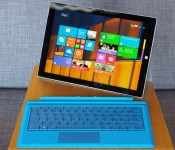
I, like many others, participated in what could be called the unofficial Surface Pro 3 challenge: trading in my regular laptop for the company’s new device for a week, with the intent of doing all my work on the new notebook-tablet hybrid. Well, here I am, six days in, back writing on my MacBook Air. I didn’t want to give up or cheat, but there are deadlines to meet, and I simply don’t have enough hours in a day to pound out posts on the Pro 3′s flimsy Type Cover keyboard.
Those may sound like fighting words, placing me firmly in the “not a fan” camp when it comes to Microsoft’s latest, productivity-focused product. But I actually think this is a great device for everything except typing. For someone who writes for a living, the Pro 3 is — for lack of a better description — a great laptop that’s just missing its keyboard.

I have the $999 model, with a Core i5 processor and 128GB of storage, and the Type Cover that will retail for an additional $130. That’s not cheap, but this is supposed to be your laptop and your tablet, and Redmond has refined the design a ton compared to the previous generation. Though the keyboard itself is mushy, with barely any travel, the trackpad is actually quite solid this time around. Microsoft made it bigger than the version on the Surface Pro 2, for one thing, and gestures such as swiping and pinch-to-zoom work well. The only glitch came on the day when two-finger scrolling stopped working, and the problem couldn’t be solved with anything short of a full system update. Harmless enough, I suppose, but I did spend about an hour trying to fix the issue by tinkering with settings in the control panel to no avail.
It’s a great laptop that’s just missing its keyboard.
I encountered one other strange bug while using the Surface Pro 3 on a flight: The WiFi driver appeared to be missing until I rebooted the machine. After that, I was able to connect to Gogo, but the problem itself was pretty confusing. It’s a lot easier to forgive such hitches in a tablet, rather than a laptop, too. If Microsoft has its way, this is the only gadget you’ll be traveling with, and it would be a pretty big problem if critical functions weren’t working reliably.
Speaking of using the Pro 3 on a plane, the kickstand design was a bit difficult to handle with a tiny tray table; it would only fit if I propped it up at a very steep angle or titled it to the right or left. Luckily, though, the machine’s made to be comfortable in your lap — remember that whole “lapability” spiel at the Microsoft event last week? — with a magnet system that allows the Touch Cover to be used at an angle.
Finally, that 12-inch, 2,160 x 1,440-pixel display is gorgeous, and I especially enjoyed it when watching HD video. Watching something in standard resolution, on the other hand, wasn’t as great; an episode of the original House of Cards streamed on Netflix looked soft and pixelated. It’s the same problem you’ll encounter with any high-res screen like Apple’s Retina panel, though, and I’m certainly not complaining that Microsoft made this one so bright and crisp.

Over the course of six days, I wrote countless emails, sent several tweets and wrote one Engadget post on the Surface Pro 3. The fact that I could do that much says a lot about how much progress Microsoft has made in its quest to reduce our dependency on two separate gadgets: one for work and one for play. That said, I still had to cheat when I needed to get work done quickly. If I had copious amounts of time and patience, I could probably train myself to be a great typist on the Surface Pro 3′s keyboard cover. I have neither, though, so that’s why I won’t be packing the device when I leave for a work trip tomorrow.
Simple.TV’s streaming DVR now sends shows to your Chromecast

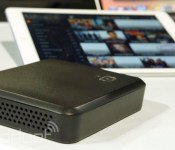
Simple.TV’s streaming DVR is handy if you want to catch up on shows while on the road, but what if you want to watch on a friend’s TV, or don’t have an internet connection at all? Neither should be a big issue following an update to the company’s Android, iOS and web apps. You can now send both live and recorded TV to a Chromecast, so that big-screen experience will follow you outside of the home. And if you travel to a place where internet access isn’t guaranteed, you won’t be deprived of viewing material — it’s now possible to download recordings to a computer (sadly, not mobile devices) in advance. They’re not the biggest improvements, but they make all the difference if you’re scrounging for something to watch while on vacation.
Filed under: Cellphones, Home Entertainment, HD
Source: App Store, Google Play
Surprise: Microsoft’s working on a smartwatch of its own

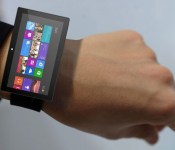
Apple’s reportedly working on one, Google’s developing an entire ecosystem and hundreds of smaller companies either have products already on the market, or currently under development. The question isn’t who’s building a smartwatch, it’s who isn’t building one. And as expected, you can count Microsoft out of that latter camp. The software giant turned computer manufacturer is working on its own wearable concoction (not pictured above), according to a Forbes report, with Kinect engineers even pitching in with the project.
The unannounced device will reportedly collect health data day and night, such as your heart rate, and will work with Android, iOS and Windows Phones alike. It’s also said to sport a design similar to Samsung’s Gear Fit, a color touchscreen facing a wearer’s wrist and a two-day battery. Opening the device up to multiple platforms would be a key selling point, and continuous monitoring could make the Microsoft wearable a fit for casual users and fitness buffs alike.
Filed under: Wearables, Microsoft
Source: Forbes

Apple’s smart home plan rumored to be a boring certification program

When rumors of Apple’s smart home efforts broke Monday, expectations for the future of home automation began to soar. According to sources speaking with Gigaom though, Cupertino’s connected household project has more to do with fragmentation and the “Made for iPhone” label portion of the initial rumor. It seems that the focus of the program is to certify those smart devices that are scattered around residences rather than building automation controls into iOS or some such. The process is said to keep both WiFi and Bluetooth connectivity alongside voice control as key items for linking all those gadgets together, but as of now, a universal control system or a list of partnerships doesn’t seem to be on tap for WWDC next week.
Filed under: Household, Software, Mobile
Source: Gigaom

Apple’s ‘Smart Home’ Initiative Focused on ‘Made for iPhone’ Certification, Not Deep Integration
Earlier this week, a report suggested Apple has plans to unveil a new smart home initiative at WWDC. This platform would allow the iPhone to directly control lights, security systems, and other household gadgets, with Apple giving third-party device makers official approval for integrated devices.
Gigaom has some new information on how the smart home program will work, confirming that it is a fairly simple program that will certify both connected devices already on the market and upcoming devices under the existing “Made for iPhone” certification process currently used for iOS accessories like iPhone cables and gaming controllers.

The program will not include an Apple-made software interface that overrides the existing apps tied to current iOS-compatible home accessories like the Philips Hue lighting system or the Nest thermometer, and will instead focus on connecting devices via WiFi. There’s also the possibility for voice control using Bluetooth.
The MFi certification will essentially be used to notify consumers about which products will integrate well both with the iPhone and with other home automation accessories, suggesting the program introduced next week will feature several home automation product manufacturers that have agreed to work with the MFi standards for quality and compatibility.
Instead of worrying about hubs and what might work with other devices, consumers can look for the MFi label and be assured that they can pull their smart home setup together — and control it from their iOS device.
It’s technically possible that the user could control some device functions from a handset or tablet without opening the app, or that the app would open automatically based on a voice command or eventually through presence detection.
Apple is expected to unveil more information on its smart home initiative on Monday, when WWDC kicks off with an opening keynote.

Google’s cutesy cars are a ‘serious threat’ to the auto industry, says GM

There’s no doubt about it: for a company that makes most of its money from web ads, Google knows how to make an adorable self-driving car. The search giant’s automotive prowess isn’t going unnoticed by the industry’s more established players, either. Mark Reuss, GM’s executive VP of global product development, told recently told Bloomberg that he could see Google becoming a “serious competitive threat” in the motoring realm.
Yes, that seems like a “well, duh” confession to us too, especially now that Google will roll out at least 100 of those cutesy, two-seater prototype cars for some real world testing later this year. It certainly doesn’t hurt that California’s Department of Motor Vehicles just gave a thumbs up to self-driving car tests on public roads, a decision that’ll take effect in September. Of course, Google can only become a competitive threat if it wants to be, and it’s still unclear just how it plans to bring these motors to market. A separate Google Motors division? A slew of partnerships with existing manufacturers? Our crystal ball is on the fritz, and car crafters aren’t quaking in their boots just yet. Reuss noted that “anybody can do anything with enough time and money” – Google’s definitely got plenty of the latter, but major auto makers haven’t just been sitting on their laurels. GM and Nissan both have self-driving car projects underway in China and Japan, respectively, while Volvo has been testing its own on the open roads of Sweden.
Source: Bloomberg

Facebook is the latest coup victim in Thailand, where the selfie reigns supreme

Foreign governments have been blocking Twitter and Facebook off and on for years, and now Thailand’s responsible for some social service downtime. The country’s Information Communications Technology (ICT) Ministry disabled access at the military’s request, taking the site offline for about 30 minutes yesterday afternoon. According to a Reuters report, Surachai Srisaracam, an ICT official, said the action was intended to “thwart the spread of online criticism of the military” following the recent coup. The official added that the government planned to meet with other social sites, such as Instagram and Twitter, “to ask for cooperation from them.” Meanwhile, many Thai citizens are using sharing sites for more innocuous purposes, such as posting selfies with soldiers, which they are once again free to do.
[Image credit: Bloomberg via Getty Images]
Filed under: Internet, Facebook
Source: Reuters

US officials reportedly duped into friending Iranian spies on social networks

A fair few government officials will be poring over their personal LinkedIn, Facebook and Twitter accounts today, following a warning about an elaborate hacking campaign that appears to stem from Iran. According to iSIGHT Partners, Iranian hackers have spent the last three years creating a fake news outlet — Newsonair.org — and then posing as journalists to give the website an air of credibility (even though all its content was simply plagiarized from elsewhere on the web). Over time, these impostors are alleged to have linked, friended and followed US military, diplomatic and congressional personnel who were attracted to Newsonair‘s stories. Once a basic connection had been established via a social network, the cyber-spy would then share another interesting-looking story with their target, but this time the shared link would be a so-called spear-phishing site designed to steal login credentials.
The US has repeatedly complained of high-level hacking from both Iran and China, but this particular espionage ring looks to be unusually broad, also targeting journalists (real ones, that is), defense contractors, outspoken supporters of Israel, and also people in the UK, Iraq and Saudi Arabia. In total, around 2,000 individuals have been affected to some degree, according to iSIGHT Partners, although that doesn’t necessarily mean all those people have been hacked: They may simply have become “connected to false personas.” Meanwhile, Newsonair is still very much alive, pirating content from AFP, Reuters and other sources and spuriously asking you to submit your email address in order to subscribe to its RSS feed. (In other words, if you choose to visit it, be careful.)
Filed under: Internet
Via: Washington Post
Source: iSIGHT Partners

Netflix has a new original series for kids, courtesy of DreamWorks

The relationship between Netflix and DreamWorks is one that just keeps on giving. Accordingly, the video-streaming giant has announced that it is partnering with the studio yet again, this time to bring DreamWorks Dragons to the platform as an original series for kids. Dragons, based on the popular How to Train Your Dragon franchise, will debut next year on Netflix and is said to “bridge the gap” between the first feature film and the sequel that’s slated to premiere this summer.
Netflix says that the idea to work with DreamWorks Animations on securing the exclusivity of Dragons was a no-brainer, as it believes that these are a “beloved set of characters” and kids “will be enjoying them for years to come.” When it arrives in 2015, DreamWorks Dragons is going to be available worldwide, including places across the globe where Netflix is due to launch later this year.
Filed under: Home Entertainment, Internet, HD
Source: Netflix
 AIVAnet