


LA Times: Steve Ballmer agrees to buy the LA Clippers for $2 billion

So what’s Steve Ballmer up to now that Satya Nadella is running things at Microsoft? According to the LA Times, he’s just made a tentative agreement to buy the Clippers for about $2 billion. After NBA commish Adam Silver (pictured above, with Ballmer at a Clippers game on May 11th) announced the league will force current owner Donald Sterling to sell the team after racist remarks he made leaked out, a number of potential bidders have appeared. According to the Times report, Ballmer bit out several other bids, including one from a group led by entertainment exec David Geffen for $1.6 billion. The ex-Microsoft CEO has a reported net worth of between $15 – $20 billion, so he can certainly afford it, with change left over to switch the mascot to something more familiar. There’s no official announcement of the deal, and according to TMZ, negotiations are still under way with several bidders. Others like Grantland / ESPN’s Bill Simmons are hearing the deal is just about done, with caveats that there are several hurdles before it’s approved.
[Image Credit: Noel Vasquez/GC Images]
Source: LA Times

‘Infinity Blade II’ Named App of the Week, Available for Free [iOS Blog]
 Chair’s hit sequel Infinity Blade II has been named Apple’s App of the Week and as a result, it is free to download for the second time since its initial 2011 release.
Created as a followup to the original Infinity Blade game, Infinity Blade II has enhanced graphics with detailed environments, character textures, and ambient light touches like sharper shadows and atmospheric effects.
The Infinity Blade series is known for its impressive graphics, action RPG gameplay, gesture-based combat and console-quality experience. In addition to improved graphics, Infinity Blade II also offers deeper character customization and new styles of combat.
The God King has been defeated, an unlikely hero has emerged and now you must discover the truth behind the secrets of the Infinity Blade. The continuing journey of young Siris unfolds as you delve deeper into the world of the Deathless tyrants and their legion of Titans. Can you unlock all the mysteries and successfully wield the power of the Infinity Blade in this timeless swordplay adventure of champions and villains?
The third and final game in the Infinity Blade series, Infinity Blade III, is also available at the discounted price of $2.99 for a limited time.
Infinity Blade II can be downloaded from the App Store at no cost for the next week. [Direct Link]
Infinity Blade III can be downloaded from the App Store for $2.99. [Direct Link]

Beats Breakdown: Apple Paying $2.5B for Beats Electronics, $500M for Beats Music
Apple yesterday announced plans to acquire both Beats Electronics and Beats Music for a combined total of $3 billion, but a new report from The Wall Street Journal breaks those numbers down further.
As it turns out, Apple is paying slightly less than $500 million for the Beats Music streaming service, with the bulk of the money ($2.5B) going towards the purchase of Beats Electronics, which includes the company’s popular line of headphones and speakers.
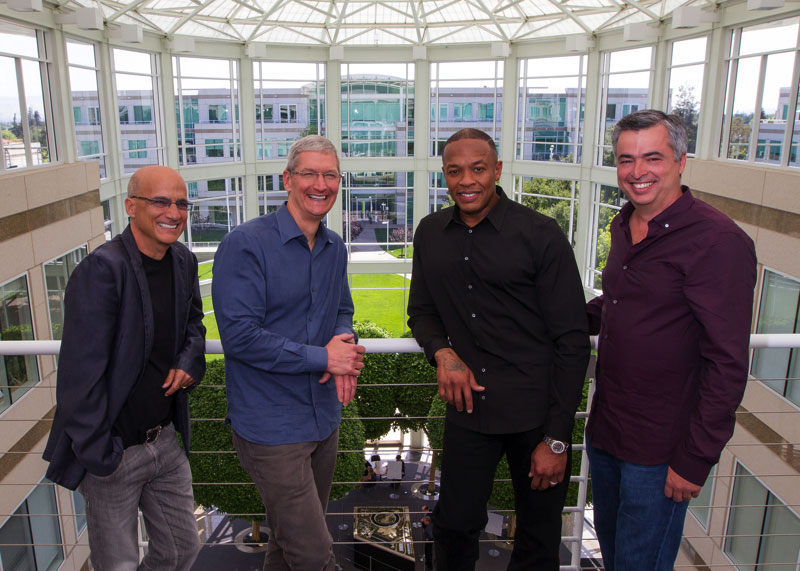
At yesterday’s Code Conference, Beats co-founder Jimmy Iovine revealed that the service has 250,000 subscribers in the United States, a small number compared to Spotify’s 10 million worldwide listeners. Beats Music’s relatively modest size explains why it was so much cheaper than the company’s Electronics division, which pulled in $1.5 billion in sales in 2013 according to a source that spoke to The Wall Street Journal.
Leveraging iTunes and iTunes Radio, Apple may be able to grow Beats Music significantly in the coming months. Apple’s existing streaming music service, iTunes Radio, has a total of $40 million listeners and via iTunes, Apple has sold 35 million songs. The company also has more than 800 million iTunes accounts, most with credit cards attached, along with a wealth of data on customer listening habits.
“We think all of those things, when you put them all together, it’s on steroids with us together,” said iTunes Chief Eddy Cue.
Under the terms of the deal, Beats co-founders Jimmy Iovine and Dr. Dre will both be joining Apple to work under Cue, while marketing head Phil Schiller will oversee the Beats headphone business. Apple CEO Tim Cook has called Iovine and Dre’s talent and skills “really unique” and “very hard to find.” He also stated that Apple felt Beats Music was the first music service to “get it right” through the use of human curation.
Following regulatory approval, Apple’s purchase of Beats is expected to close during the fiscal fourth quarter.

A return to American-made TVs, by way of the bathroom

It’s a story we’ve heard from Apple, Google and Amazon. From humble beginnings, those companies grew into global giants. But countless other American companies start the same way; they just aren’t household names. Yet. Séura, one of the few consumer electronics manufacturers still operating in America, traces its roots to the garage of Gretchen and Tim Gilbertson in Green Bay, Wisc.
The couple started tinkering with an idea for a product-and an entire company-after Gretchen had a “light-bulb” moment in 2003. “There was a big trend at that time for moms to create this personal sanctuary within their homes,” she says, especially when it came to bathrooms. “They were spending so much money on these spaces that they didn’t want to put ugly technology in the room, so this was a really great idea for us to be able to capitalize on that trend.”

The idea? Hide the ugly television behind a mirror. When it’s on, the television picture comes through specially designed glass. When it’s off, it’s just another mirror in a bathroom. Nice idea in a world where technology and gadgets are invading every part of our daily lives. But neither Gretchen nor Tim was a technologist. Or even knew much about what would go into creating a prototype. In college, they focused a lot on football. Gretchen had been a cheerleader at the University of Wisconsin and Tim was Bucky Badger, the celebrated team mascot. After graduating, Gretchen worked in marketing for Kimberly-Clark, maker of toilet paper among other things. And Tim honed his skills in product development working for a company that made icemakers and wine coolers.
Not knowing much about TV technology didn’t stop them, however. The couple sketched their first design in their car coming back from a home showcase where they were doing market research. With just a pad of paper, a pen, and a calculator to figure out sizes and costs, they drafted up what the product should look like. Four months later, they had a prototype made with glass coating they found from a local store, a custom-made metal housing and a television they bought off the shelf. Less than a year after cobbling together the prototype, they hired their first official employee, Air Force veteran Pat Sheahan, and moved their offices from their basement to the garage.
Chapter 1: Wisconsin Born

A decade later, Sheahan still works at Séura assembling their bathroom mirror televisions. The work he does could have been shipped overseas years ago. It’s time-consuming, methodical and detailed. But the company has beat the competition by assembling products in America, allowing them to give customers high quality and fast turnarounds on delivery times. “Pat is an artisan,” Gretchen says. “At Séura, we put quality above all else. That means quality of the electronics, the glass, and the technology. In order for these to come together perfectly, our residential units are assembled individually with a lot of care and expertise.”
Another 29 people have joined Sheahan and the Gilbertsons at the company’s Green Bay headquarters. At 50,000 square feet, it’s nearly 100 times the size of the 600-square foot garage they once worked in. There’s a sales team and research and development. That’s a far cry from when the Gilbertsons were in startup mode. They handled everything themselves, even as they managed to avoid revealing that there were only three people working at the company back then. “The phone would ring and I would pick it up, ‘Hello, Séura,’ and they’d say ‘Can I speak to accounting?’,” Gretchen remembers. “And whoever they were looking for on the other end, Tim had to be that person or I had to be that person.”

But even as the company has grown, the Gilbertsons have stayed in Green Bay, although they now source some of their new products from Asia. The choice to stay in Wisconsin has been a conscious one, even if Green Bay is far away from a big city-or most of their customers. “In the first three to four months of us starting our business, I remember a consultant in the industry who had said, ‘You really need to move your business to a major gateway city,” Gretchen says. “Obviously we didn’t listen to that. There’s a lot to offer here.”
Staying in their hometown is important to them, particularly because as the company has grown-an average of 65 percent increase in sales each year-they have been able to hire people in a community whose industrial core has all but moved overseas. “The quality and the craftsmanship of what we’re able to deliver here in Green Bay, Wisconsin is second to none,” Gretchen says. That does mean that Seura’s products are more expensive than the televisions you’ll find at Costco or Best Buy. They start at about $2,000, but most are built to order, many of them still by Sheahan himself.
Chapter 2: A Natural Evolution
In the 1950s, more than 90 television manufacturers operated in the U.S., including storied names such as RCA and Zenith. By the mid-1990s, television manufacturing had literally disappeared, making it impossible for a company like Seura to build its sets with all American-made components. They have to import the display panels and some electronics from Asia, because those things simply aren’t made in America anymore. But the Gilbertsons try to find everything else they can to make their televisions within reach of Green Bay, including metals and glass. They do all their product development and their final finishing at the U.S. factory. It’s that attention to detail that has given Seura the edge against global competition.
Asian factories typically don’t accept small-batch orders, while Séura has much more control over assembly at its headquarters. It can take a customer’s own frame and fit a television into it, creating a personalized product out of what has basically become a commodity. Instead of a hulking piece of black glass overpowering a living room, Seura sets are in many ways works of art. Which makes sense considering the company’s name is an homage to Georges Séurat, the French impressionist who is credited with creating a technique called pointillism. He painted millions of colored dots to make up a larger image, much like the painting and pixel technology in Séura’s televisions.

From the bathroom sets, Seura has evolved into building televisions for virtually every room in the house. As people have added more and more technology to their homes, the tech clutter has taken over. Seura’s stylish sets offer a streamlined solution. An off-the-shelf set in the bathroom would take up precious counter space. So Seura sets can be mounted on the wall. In a bedroom, a 100-inch flat screen might make some people giddy, but put a custom frame around it and a mirrored glass in front of it and everybody is happy.
Seura paints hard coatings on the glass screen, and customizes it for whatever room it’s in. So in the bathroom, it’s more reflective so the mirror is usable. In a living room, it’s more “transmissive” — meaning you can see the television better. And then there’s the whole great outdoors. Normally televisions and the outdoors don’t mix, but Seura may have solved that problem, too.
Chapter 3: Moving Outdoors

A few years ago, customers began asking the Gilbertsons if they could make an outdoor television. Seura’s first television was for the bathroom, so the idea seemed possible. But an outdoor set has to withstand much colder temperatures than a bathroom-and a lot more water than the mist from a shower. So the team developed the Storm, a television that can survive temperatures between minus-30 degrees and up to 140 degrees Fahrenheit. It uses aircraft grade metal to protect the internal circuitry and a cooling system that filters cool air through the bottom of the television. To keep the set weatherproof, the developers took a cue from the automotive industry using sealers like those used in car doors to keep out moisture.
While the Storm was developed in Green Bay, it’s produced in Asia to help keep manufacturing costs in check. Most people put the sets, which aren’t cheap at between $5,000 and $10,000, in their open-air living rooms, the next big thing in home decorating. But probably the most impressive and for football fans like the Gilbertsons, the most satisfying installation was at Lambeau Field in 2013. For those not familiar with the iconic stadium, Lambeau is home to the Green Bay Packers. Green Bay is the smallest city with a national football team, but it’s got one of the biggest and most ardent fan bases in the country. Now it also has 330 Storm screens painted “Packers Green.”

“In Green Bay they are our “hometown” team in every sense of the word,” Tim says. “For any company to be a part of the Lambeau experience is to be a part of what made this community Titletown. It’s about team, it’s about excellence, and it’s about Green Bay.” After waiting for years, Tim’s name finally came up to be able to buy season tickets for the Packers this year. It’s a list many diehard Cheeseheads can be on for decades.
For the Gilbertsons, a family that feels so connected to the city of Green Bay, being able to watch every home game in a stadium housing televisions they developed is particularly gratifying. Not that it’s really gone to their heads. As Tim jokingly points out, although he may have scored season tickets, his kids are probably still 84,000 on the waitlist.
Photos and video by Josh Kufahl.
This Built America is a project devoted to the people and companies re-imagining and rebuilding American manufacturing. Every week, Aol will feature their stories, their struggles and their successes as they forge a new path in this country’s future.
Filed under: Home Entertainment
Source: This Built America – Séura

Engadget HD Podcast 400 – 5.29.14

Welcome to the 400th HD Podcast! Similar words were typed back in February 2006, when the fledgling HDBeat Podcast was launched, with a slightly younger Ben Drawbaugh at the helm. Richard is no slouch himself, having racked up over 200 episodes in the series, and we’re also joined by former editor and HD host Steve Kim, who has a habit of dropping in on these occasions. The crew does some reminiscing, but won’t be stopped from getting down to the details that have kept this show afloat for so long. There’s discussion of Cox’s gigabit internet rollout, Google Fiber’s business plan and Amazon’s Fire TV deal, which Steve is pressured into acknowledging as a must-have deal. Richard has some tips to keep your classic Xbox 360 in top shape, but it somehow manages to dredge up memories of the unending flow of quarters which Donkey Kong and its arcade brethren used to command. Please join us for this quadricentennial celebration of the Engadget HD Podcast and its nostalgic look at how far things have come since this all began.
Hosts: Richard Lawler, Ben Drawbaugh
Guest: Steven Kim
Producer: Jon Turi
Hear the podcast:
15:12 – Cox will start its gigabit internet rollout in Phoenix, Las Vegas and Omaha
17:10 – Google Fiber won’t charge content providers for quicker access
18:58 – Sony’s PlayStation 4 is already profitable and on course to beat the PS2′s success
22:22 – Xbox One’s June update adds your friends’ real names and external drive support
31:11 – Old console, new tricks: Getting the most out of your Xbox 360
39:55 – Amazon invites customers to try Fire TV free for a month
41:23 – Amazon’s Prime Instant Video gets its first HBO shows, right on cue
45:51 – Normandy landings recreated in Oculus Rift D-Day simulation
52:48 – This treadmill lets you walk in any direction
54:40 – ESPN mulls streaming Major League Soccer to fans without cable subscriptions
59:21 – What’s on your HDTV this week: Watch Dogs, The Life Aquatic, Wil Wheaton, Mario Kart
Get the podcast:
[iTunes] Subscribe to the Podcast directly in iTunes (MP3).
[RSS – AAC] Enhanced feed, subscribe to this with iTunes.
[RSS – MP3] Add the Engadget HD Podcast feed to your RSS aggregator.
Contact the podcast:

NSA claims Snowden only sent one email questioning surveillance tactics

The man behind the biggest leak of United States government secrets in history, Edward Snowden, is having his reputation challenged by the very entity he sought to call out, the National Security Agency (NSA). According to the agency, only one email can be found which relates to him raising concerns internally about government surveillance overreach. That stands in stark contrast to what Snowden told reporters Glenn Greenwald and Laura Poitras in Hong Kong last summer, where he first detailed his history and the wealth of information he’d taken. “They would say ‘this isn’t your job,’ or you’d be told you don’t have enough information to make those kinds of judgments,” Snowden says in Greenwald’s recent book, No Place to Hide. “You’d basically be instructed not to worry about it.”
Specifically, the email released today by NSA allegedly shows Snowden asking for a hierarchical clarification. In what is said to be an email Snowden wrote in April 2013, he’s shown asking about the standing of executive orders (EOs) — directives ordered by the president which hold the “force and effect of law.” It’s fairly innocuous, but the revelation is intended to bring Snowden’s credibility into question. “If he lied about reporting issues to his bosses, what else did he lie about?”

The issue with this logic is we have no way of verifying whether Snowden recorded any other instances of flag-waving when employed by the Central Intelligence Agency or National Security Agency. Additionally, if he did make any other internal efforts, who’s to say they were conducted over email rather than, say, in person?

It also stands to reason that he would’ve raised an alarm internally much earlier given his history with various US intelligence agencies. As reported by Greenwald, Snowden’s disillusionment with US surveillance methods began to evolve into a whistleblowing plan as early as late 2009. For its part, NSA points out that the alleged Snowden email it released, “did not raise allegations or concerns about wrongdoing or abuse.” Further, the agency has “searched for additional indications of outreach from him in those areas and to date have not discovered any engagements related to his claims.” And us? Well, this is a game of he said/she said involving a highly secretive organization and a highly secretive individual. The organization has repeatedly been caught lying, as proven by classified documents revealed by Snowden. Do with that what you will.
[Image credit: Laura Poitras, The Guardian]
Filed under: Cellphones, Household, Networking, Internet, Software

Rumored Split-Screen Multitasking Feature for iOS 8 Not Ready for WWDC Preview
The rumored split-screen multitasking feature said to be coming with iOS 8 is still a work in progress and won’t be previewed at Apple’s upcoming Worldwide Developers Conference, according to Brian Chen of the New York Times.
Designed for the iPad Air and possibly a larger-screened iPad to be released in the future, split-screen multitasking would allow two apps to be displayed at the same time on a single screen while in landscape mode. It might also include a feature that allows users to share information like links, images, and text between two apps.
Split-screen multitasking concept, not rumor-based
The iPad’s inability to display two apps at once is a lack that Microsoft has used to heavily advertise its Surface tablet, which does have the ability to display multiple apps on the screen at one time.
While the multitasking feature will reportedly not make its debut at WWDC, it is still slated for inclusion in iOS 8. It appears multitasking will be limited to the iPad Air at launch, and it is unclear whether the smaller Retina iPad mini and iPhone might also gain the functionality.

Amazon to Introduce Streaming Music Service This Summer, Only Offering Songs 6-Months or Older [iOS Blog]
 Amazon will be launching a music streaming service offered free to customers paying for its $99/year Amazon Prime service. The service will launch in June or July according to a new report from Buzzfeed.
The news follows yesterday’s acquisition of Beats Music by Apple, and a report from February that claimed Amazon was investigating the possibility of a music service to accompany Prime.
Amazon’s streaming catalog will only include songs older than six months, likely saving the company on royalty costs. Spotify, Beats and Rdio all offer new releases to their subscribers.
The company will expand its Prime membership offerings by adding a stockpile of old and newish music for subscribers to stream on demand. The Prime music service, which is scheduled to launch this June or July, will not include recent releases but instead restrict its catalog to songs and albums that are 6 months old and older, five music industry sources familiar with the company’s plans confirmed to BuzzFeed.
Amazon has some 20 million paying Prime members and offers them a library of movie and TV shows via its Netflix-esque Prime Instant Video service along with free 2-day shipping on most items the company sells.
Recently, Amazon signed a deal with HBO to stream older original content from the cable network to Prime subscribers.

Apple Nears Completion of WWDC Decorations at Moscone Center
Apple is nearly finished decorating the Moscone Center ahead of its annual Worldwide Developers Conference in San Francisco next week. Decorations began appearing earlier this week with a larger banner that says “Write the code. Change the world.”
MacStories editor Federico Viticci has shared selection of images from San Francisco. Giant Apple logos are nearly finished on the sides of Moscone, with large square panels in the same style as the other banners have appeared on the Metreon building across the street.

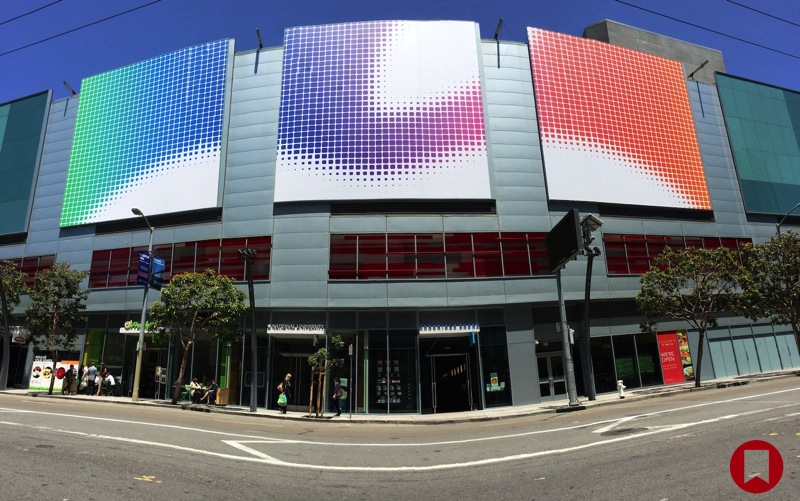

Finally, MacRumors reader Joseph sent in this image of an empty banner bracket inside Moscone West. In past years, Apple has draped black tarps over banners that were then revealed following the Monday morning keynote address.

Apple’s WWDC keynote kicks off on Monday at 10:00 AM Pacific Time, and the company will be providing a live video stream of the event.

Google Maps 8.1.0 update brings terrain view

Google has updated their Maps app bringing the version number to 8.1.0 from the previous 8.0.0 having already updated their camera app to version 2.2.
With the update comes terrain view which will display 3D elevation of various geographic features such as mountains, making it extremely useful for hiker or cyclists to determine a route elevation directly on the Maps mobile application.
The Google Maps update is steadily rolling out to various countries in the Google Play Store so if you haven’t got the update yet then check back soon as you may not have been involved in the initial wave.
Let us know what you think of the new terrain view in the comments below.
The post Google Maps 8.1.0 update brings terrain view appeared first on AndroidGuys.
 AIVAnet