



Netflix’s first show from the UK could be a £100m drama about the Queen

Netflix is going big on original programming: House of Cards and Orange Is The New Black are proof of that. However, no such content has so far come out of the UK. That could be about to change, after the streaming giant reportedly beat both the BBC and ITV to secure a new 20 episode biopic of the Queen, corgis and all. According to Broadcast Now, Netflix is on the verge of finalising a £100 million deal for the series, titled The Crown, which will centre on the Queen’s “ascent to the throne at the age of 26, to the present day.”
While recent releases depicting the royal family, including Diana, were widely panned, Netflix’s new commission has a fair shot at success. It shares the same esteemed writers and directors that were behind the critically-acclaimed 2006 film The Queen, starring Helen Mirren. A monarch-filled drama might not be on the top of everyone’s binge-watch list, but Netflix is set to go hard by allocating a £5 million budget per episode — besides, who doesn’t like a bit of royal scandal?
[Image credit:bisgovuk, Flickr]
Filed under: Home Entertainment, HD
Source: Broadcast Now

Spotify warns Android users to update their apps following hack

It’s not all good news over at Spotify HQ. The music streaming service says it’s just investigated a security breach in which one unlucky user’s account was hacked. Despite the apparently limited scale of the attack (at least compared to what happened to eBay last week), Spotify evidently considers the incident to be pretty serious: Over the next few days, it’ll start asking users to re-enter their login details, and it’ll also push out an update to folks who use the Android app — a step that will additionally require any offline playlists to be re-downloaded. Meanwhile, if you’re the person whose account is at the center of all this, then by now you should have received some special instructions all of your own.
Filed under: Cellphones, Portable Audio/Video, Tablets, Internet, Mobile
Source: Spotify

Uber shows defiance following pressure from London’s black cabs

Uber’s used to taking heat from traditional taxi organisations that’d rather the new breed not muscle in on their turf; including in London, where black cabbies are expected to protest against the car service next month. Even Hailo, which for years has given the capital’s iconic cabs an app-based platform for finding customers, suffered backlash last week after announcing its intention to include private hire services in the future. Without referring to either of these events specifically, Uber’s taken to its blog today to “clarify a few things,” or rather, tell black cabbies where to go. Most poignantly, Uber reiterates that it ticks all the appropriate regulator’s boxes, and that calculating fares using smartphones is neither the same as having a taximeter, nor is it illegal — one of the main arguments cabbies are trying to use to shut Uber down. Beyond that, the service points out the convenience factor and its commitment to safety, commenting also that wider choice and competition for customers shouldn’t be considered a bad thing. Basically, this is Uber’s veiled rebuttal to all the arguments against it, but it’s still got some love for black cabs, it seems. Uber calls them “arguably the best taxis in the world,” adding afterwards, however: “there is room for more and better.”
Filed under: Transportation
Source: Uber

GE helps old wind turbines increase power production by lengthening their rotor blades

Building new fleets of windmills isn’t the only way to meet increasing demand for breeze-based energy, it seems. General Electric plans to get more renewable energy out of some of its existing turbines by lengthening their blades. You see, shorter rotors need a stronger wind to turn them, so GE figured out how to make existing blades longer — without reducing their strength — to increase their electrical production by over twenty percent.
Lengthening the blades was no small feat, either. Because they’re made of composites to keep weight down, GE’s boffins were able to cut the 120-foot blades in half and seamlessly insert a 23-foot extension in the middle. You can see one such surgery happen in time-lapse fashion in the video above, but bear in mind that the most important bits are blurry — the process has yielded 16 patent applications thus far, so we won’t know the particulars until the USPTO publishes them.
Filed under: Science
Via: Gizmag
Source: GE Reports

Asus teases the next incredible “thing,” that’s also thin

With Computex coming up next week, Asus has taken to social media with a video that tells of a thin device coming without offering up much else. There’s no silhouette of a device, so your guess is as good as ours whether its a new tablet or smartphone, or both.
Computex 2014 will be taking place June 3 to 4 in Taipei, Taiwan.
What do you think Asus could have up its sleeves?
The post Asus teases the next incredible “thing,” that’s also thin appeared first on AndroidGuys.
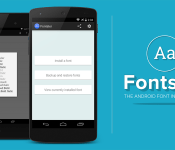
Change your Android system font with Fontster

Modifying your system font usually requires flashing complicated packages or completing change the ROM you’re running, but with an App called Fontster you’re able to quickly and easily change your Android system font.
Fontster allows you to browse hundreds of fonts and enables you to apply them replacing your entire Android system font. Your device must be rooted and works best with ROMs that are as close to AOSP as possible.
The simple Holo UI allows you to quickly browse fonts, preview them, and finally install the one you like. With a quick reboot, you’ll see all the typed elements throughout the Android system changed to your desired font.
Fontster is open source and available for free on the Google Play Store.
The post Change your Android system font with Fontster appeared first on AndroidGuys.
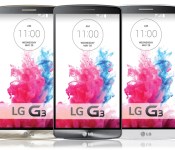
LG G3 specs revealed by official LG site ahead of launch

With only a few hours before the LG G3 is officially unveiled, yet another leak has confirmed what specs the upcoming device will have by non other than LG themselves.
Whilst there’s nothing that stands out, since a lot has already been revealed by previous leaks, it does confirm what to expect before the official unveiling.
Here’s the full specs:
- 5.5-inch 2560 × 1440 display
- 2.5GHz quad-core Snapdragon processor (Snapdragon 801?)
- 2GB of RAM, 16GB storage
- 13-megapixel rear camera with optical image stabilization, laser-assisted autofocus, 2.1-megapixel front camera
- 16GB storage and microSD card slot with up to 128GB
- 3000mAh battery
- Android 4.4.2
- WiFi, Bluetooth, NFC, 4G LTE, FM Radio
- DLNA and Miracast
- Metallic Black, Silk White, Gold Shine colors
- 146.3 x 74.6 x 9.1mm
In addition, there’s also mention of a metal housing for the LG G3, which is something that we’ve yet to hear about as it was suggested from previous leaks that the back would be plastic.
One thing’s for sure is that we won’t have to wait long until we officially see the LG G3.
SOURCE: LG
The post LG G3 specs revealed by official LG site ahead of launch appeared first on AndroidGuys.

Normandy landings recreated in Oculus Rift D-Day simulation

3D virtual reality headsets like the Oculus Rift are often lauded as the next big thing in entertainment, but they’re also helping to change the way we learn. To mark the anniversary of the Allied invasion of Western Europe on June 6, 1944, French 3D specialists Dassault Systèmes have painstakingly rebuilt D-Day relics in high-definiton VR using the original blueprints of vehicles and devices used in the assault on Normandy 70 years ago. In contrast to million-dollar gaming franchises like Medal of Honor and Call of Duty, which give players a first-person perspective of the fighting, Dassault Systèmes wanted to recognize the engineering prowess and technological advancements that helped soldiers to liberate France. To do so, a team of 30 specialists recreated the Allied forces’ Higgins’ landing craft, Waco gliders and Mulberry Harbor, the first (floating) deepwater port of its kind. The resulting animations are perfect for viewing on virtual reality headsets like the Oculus, digitally preserving innovations that have since been lost to the sea.
Via: Venturebeat
Source: Dassault Systemes’ D-Day
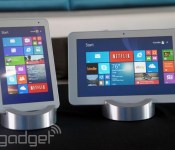
Toshiba’s new tablets are aggressively priced, especially its $110 Android slate

The last time Toshiba unveiled a bunch of tablets, it paid lip service to cutting-edge specs — things like screen resolution and processing power. This year, it wanted to push the price down low enough that you’d actually buy one. The company just announced two Windows tablets, the 8- and 10-inch Encore 2, along with the Excite Go, a 7-inch Android tablet. And while none of them might be memorable in their own right, they’re all worth a second look, if only because they’re so aggressively inexpensive. The Encore tablets, for instance, start at $200 for the 8-inch and $270 for the 10-inch. And mind you, they basically have the same specs (quad-core Intel Atom processor, 1,280 x 800 screens) as the original 8-inch Encore, which was originally priced at $330. (The 8-incher has been slimmed down, but that’s almost beside the point — it’s all about the price cut.)
Meanwhile, the Excite Go will retail for just $110, making Toshiba one of very few tier-one brands selling an Android tablet for quite that cheap. For the money, you get fresh software (Android KitKat 4.4), with a quad-core Intel Atom processor promising long battery life (up to eight hours, according to Toshiba). It also brings wireless display tech and comes with OfficeSuite Pro (a $15 app) pre-installed. The tablet does have pretty limited storage, with only 16GB of space built in, but even that’s a moot point, as the tablet houses a microSD slot that can accommodate cards as big as 128GB. All told, the biggest tradeoff is the display, which features a piddy 1,024 x 600 resolution. Even then, that’s par for the course at this price, so we can’t get too upset about a few visible pixels. Interested? This goes on sale in early July, as do the new Encore 2 Windows tablets.
Filed under: Tablets
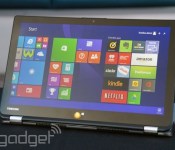
Toshiba is the latest PC maker to rip off Lenovo’s Yoga line

The last time we heard from Toshiba it was doing its annual back-to-school notebook dump. Turns out, the company wasn’t quite through: It just announced a trio of convertible laptops. Of the three, the closest thing to a flagship would be the Satellite Radius, a 15-inch notebook that essentially apes Lenovo’s Yoga line. Which is to say, it has a 360-degree hinge that can be positioned in one of five modes, including notebook, tablet, “Presentation” (upside down, keyboard in), “Audience” (screen out, keyboard tucked under) and “Tabletop,” with the entire machine lying flat on the table. Sound familiar? That’s because it is.
What’s curious is that Toshiba recently showed off something much more innovative: a “5-in-1″ prototype laptop with a snap-off keyboard, making it a cross between a dockable tablet and a Yoga-like convertible. According to Toshiba, that machine is still in development, so if we’re lucky, we might even see it later this year (one can hope). For now, though, the best thing Toshiba has to show in this space feels an awful lot like Lenovo’s offering, just with a bigger screen. If you’re thinking of picking this up ahead of the new school year, the Radius will ship in early July, with prices starting at $926 (in the US, at least, it’ll be sold exclusively at Best Buy). For the money, you get either a Core i5 or 7 processor, 8GB of RAM, up to 1TB of storage space, 802.11ac, Harman Kardon audio and Toshiba’s usual “Sleep & Charge” USB 3.0 port for keeping your other gadgets juiced.
Additionally, Toshiba refreshed the Satellite Click, its tablet/laptop hybrid that came out last year. The new version actually consists of two models, the Click 2 and Click 2 Pro, each of which includes a 13.3-inch screen and bundled keyboard dock. Though their similar names would suggest a family resemblance, the two differ in both design and processing power. As the clearly lower-end device here, the Click 2 makes do with an Intel Pentium processor, 1,366 x 768 resolution, a spinning hard drive (up to 500GB) and kind of a clunky hinge mechanism that requires you to put one hand on the latch and another on the tablet. The Click 2 Pro, meanwhile, steps up to an Intel Core processor, full HD display. 128GB solid-state drive. and a slimmer build designed so that you can un-dock the tablet with one hand. Also, the keyboard dock here will have an optional 500GB hard drive and spare battery – amenities not offered on the lower-end Click 2.
Both machines will ship in late June, according to Toshiba, with the Click 2 priced from $587 and the Click 2 Pro starting at $1,029 (the version with the spare battery/hard drive will cost $1,280). Oh, and everything will be sold exclusively in Best Buy, at least here in the US.
Filed under: Laptops
 AIVAnet