



Android 4.4.3 could be out soon after internal build existence is leaked Out
 We’ve been expecting the release of software build Android 4.4.3 for some time now, but the rumours have died down greatly. Today, however, is our lucky day as it appears a screenshot of Android 4.4.3 being released internally at Google has been leaked out (despite the obvious irony of the screenshot). The device being updated appears to be a Nexus 5, and we have heard that one of the fixes rumoured to be in the new software update is supposed to specifically address a bug only found on the Nexus 5 camera.
Apart from fixing the Nexus 5 camera bug, Android 4.4.3 is supposed to address quite a few more issues such as data connection and Wi-Fi dropout issues, Bluetooth fixes and many more (see a partial list of the changes here). While we do see the internal rollout of the software update here, there’s no telling when the public build will be made available, but here’s to hoping it will be sooner rather than later.
Are you excited to hear that Android 4.4.3 may almost be here? Are you affected by any of the issues that required the update to fix? Let us know in the comments.
Source: Google+ via Android Ice Cream Sandwich
//<![CDATA[
ord = window.ord || Math.floor(Math.random()*1E16);
document.write('’);
//]]>

Apple and Samsung Negotiating Agreement to Settle Patent Disputes Out of Court
Apple and Samsung may be close to reaching an agreement that would settle all patent infringement lawsuits out of court, claims Kim Yoo-chul of The Korea Times (Via Fortune). This account follows a previous report from late last week that Apple and Google/Motorola have reached an agreement to drop all ongoing litigation between the two companies.

Samsung and Apple are reportedly in the early stages of negotiation with some key details on royalty payments still under negotiation.
“Samsung has recently resumed working-level discussions with Apple and the key issue is how to dismiss all lawsuits,” one source said, declining to be named.
[…]
“Some more time will be needed to fix terms of details such as royalty payments in return for using patents owned by each before reaching a full agreement.”
Apple and Samsung recently faced off in a California court as part of the second US patent infringement lawsuit between the two companies. In the case that concluded earlier this month, the jury found that Samsung willfully infringed on three of the five Apple patents involved in the lawsuit and ordered the Korean company to pay Apple a sum of $119.6 million. Apple also was found guilty of infringing on one of Samsung’s patents with damages totaling $158,400.
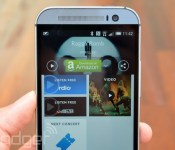
Shazam baffles UK users by dropping Spotify integration

If you, like us, regularly use of Shazam to tag and add tracks to Spotify for later listening, we have some bad news: you may now find that option has gone. It comes as one of the unexpected consequences of a deal between the music discovery company and streaming service Deezer, which has now replaced its bigger rival in free versions of Shazam in Germany, Mexico, UK and Brazil. TechCrunch spotted that Deezer and Rdio now hold the two main “free” positions within the Shazam app, but also notes that the ad-free premium version Encore retains Spotify integration. In our tests, Shazam had removed Spotify tagging from the Encore Android app, despite still displaying the feature in screenshots on both the UK App Store and Google Play.
Given Shazam’s response, the move appears to be a purely business decision: “The streaming space is getting extremely competitive and we are excited to see a lot of companies in this space interested in working with Shazam,” company CRO told TechCrunch. “Every country is different and is its own market and its own opportunity, which is why streaming companies – as well as Shazam – need to take a country-by-country approach as we evaluate integration.” The company’s support pages suggest that it may be part of a trial and that “Spotify integration (which we’re currently working on to improve) may be returned at a later date.” But, if you’d rather not wait for Shazam to figure out its allegiances, rival Soundhound will suitably handle your tagging and Spotify playback needs.
Filed under: Internet, Software, Mobile
Source: TechCrunch
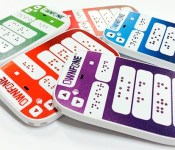
‘World’s first’ braille mobile phone goes on sale in the UK

Touchscreens may have kicked-off a mobile computing revolution, but they didn’t do much for the visually impaired. OwnFone, which launched a customizable mobile phone for kids and the elderly back in 2012, is now offering its stripped-down handset with braille or raised text contact buttons. The 3D-printed hardware lets you select up to four contacts that can be assigned to the device, making it ideal for emergencies and people who need to stay in touch with family or carers on a regular basis. It’s available right now for a base price of £60, plus an additional monthly charge of between £7.50 and £15.00 per month — depending on how much call time you want or need.
Filed under: Cellphones, Mobile
Via: BBC News
Source: Ownfone
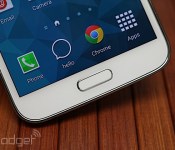
Samsung plans to bring biometric security to its low-end phones

The Galaxy S5 was widely tipped to launch with iris-scanning capabilities. When the crunch time came, Samsung played safe with only fingerprint sensor support. According to the Wall Street Journal, the eye-centric tech is still on the company’s radar and could soon debut in new high- and low-end phones alike. “We’re looking at various types of biometric [mechanisms] and one of things that everybody is looking at is iris detection,” Samsung executive Rhee In-jong admitted today, adding that it would likely be included in flagship smartphones first. Like fingerprint recognition, iris scanning would likely form another link in Samsung’s Knox platform, putting it in good stead with big organizations like the US government. Samsung’s desire to “follow the market trend” often causes it to beat rivals to market with features that customers rarely use. Iris scanning could well be the next example.
Source: Wall Street Journal

Intel CEO ‘Guarantees’ Broadwell Chips by This Holiday Season
Intel CEO Brian Krzanich has stated that Intel’s next-generation Broadwell processors will launch during this holiday season, reports Reuters (via MacG).
“I can guarantee for holiday, and not at the last second of holiday,” Krzanich said in an interview. “Back to school – that’s a tight one. Back to school you have to really have it on-shelf in July, August. That’s going to be tough.”
Originally expected to launch in Q3 2014, Krzanich noted that new manufacturing technologies are responsible for the delays surrounding Broadwell, but maintained that Intel is now on schedule to ship its new chips to manufacturers later this year. The statement comes after a leaked Intel roadmap surfaced this past February, which appeared to show an uncertain timetable for Apple’s 2014 Mac updates.
 A leaked Intel roadmap for 28-watt chips appropriate for 13-inch Retina MacBook Pro
With Intel’s Broadwell chips launching near the end of this year however, it is possible that Apple could either choose to wait until next year to integrate Broadwell chips into the Retina MacBook Pro or launch updated models with slightly faster Haswell chips. Apple updated its standard models of the MacBook Air last month with a faster 1.4 GHz dual-core Intel i5 processor while cutting the price by $100.
It is also possible that Intel’s new Broadwell chips could be used in the rumored 12-inch MacBook Air, which may coexist alongside or replace the current MacBook Air line. However, it is uncertain which specific chips Apple would use for the new notebook, as prior reports have pointed to the machine coming out towards the end of the third quarter.
As far as a next-generation iMac goes, Apple could also choose to hold off on an update until the appropriate Broadwell chips are out. However, a report last month claimed that Intel’s faster Haswell desktop CPUs could arrive in May, with Apple perhaps launching updates sooner rather than later.
Apple is also rumored to have a low-cost iMac in the works, which could utilize more cost-efficient chips. According to KGI Securities analyst Ming-Chi Kuo, the low-cost desktop computer could boost sales in critical foreign markets and increase shipments by up to 30 percent.
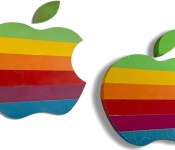
Original ‘Rainbow’ Apple HQ Signs Up for Auction, Bidding Starts at $10,000 [Mac Blog]
The original “rainbow” Apple logo signs that were used at Apple’s Cupertino, California headquarters are set to be auctioned off in June for somewhere between $10,000-$15,000, reports Design Taxi (via The Verge).
The signs will be auctioned off by British auction house Bonhams, with the larger, 46 x 49 inch version made out of foam and the smaller, 33 x 36 inch version made out of fiberglass. According to the auction, both signs were given to a longtime Apple employee after their removal in 1997.

Two original exterior office building signs, approximately 46 x 49 x 1 1/2 inches and 33 1/2 x 36 x 6 inches, each with separate stem piece; the larger sign made of stiff foam with 6 vinyl applied colors; the smaller sign made of fiberglass backed with metal, vinyl applied colors; edgewear to both signs, some colors with slight pealing at transitions, larger sign with one color showing significant craquelure, both with stray marks and outdoor wear.
 (Image credit: Glassdoor via Logo Design Love)
In use from 1977 to 1998, Apple’s rainbow logo was designed by graphic artist Rob Janoff. According to Janoff, the logo was designed in two weeks after an examination of physical cross-sections and real apples, with the multi-colored stripe design personally approved by Steve Jobs. Appearing on every product from the Apple II to the Newton PDA, the rainbow logo was retired in favor of a monochrome version, which is still in use today.

ABI Research: Samsung catching Apple in tablet shipments in 2014
 Apple pioneered the tablet device market and has had a headstart on its competitors for years, opening up a huge lead in the number of devices sold. That gap is gradually closing, however, and the latest statistics to support this comes from ABI Research who has just released its latest findings. According to the findings, in the first quarter of 2014, Apple still led with 16.4 million units shipped with Samsung in second place with 13 million units shipped, marking the first time the two giants have been so close in these figures. The key here is that Apple’s shipments in this quarter were actually down by 10.1% since a year ago, whereas Samsung has experienced a 10.80% increase in the same period.
Interestingly, while Android has a market share of tablet shipments totalling 56.3%, Samsung and Apple alone made up for 71.3% of the 41.3 million tablets shipped in Q1 this year. To put that in perspective, ASUS, who is a distant third in these standings, shipped 2.1 million tablets in Q1, which already takes into account the Nexus 7 tablets. Tablets may remain iOS’ realm for another quarter, but it won’t be long before Samsung overtakes them in the near future, and hopefully the other Android manufacturers can take a bit more of the cake too.
What do you think about these tablet figures? Are you surprised an any of these numbers? Let us know your thoughts in the comments.
Source: ABI Research via Phone Arena
//<![CDATA[
ord = window.ord || Math.floor(Math.random()*1E16);
document.write('’);
//]]>

Report: YouTube and Google have purchased Twitch for $1 billion, turned down bid from Microsoft
 What a day for the video streaming industry. Earlier today, we heard tentative rumours that YouTube (and by extension, it’s parent company, Google) were looking to acquire live streaming platform, Twitch, for $1 billion. Perhaps ironically, it was Google who purchased YouTube in 2006 for the sum of $1.65 billion, with YouTube now hoping to expand its audience and platform. Well, The Verge is reporting that those rumours are true and that YouTube and Google have purchased Twitch, and its sources also say that Twitch turned down several other suitors, including Microsoft.
One of the sources is quoted as saying there were several other bidders, including Microsoft, however Twitch could not see themselves being put on Xbox in any deal with Microsoft as the streaming platform is already on the Sony PlayStation 4. It is also said that Twitch would have turned down a $1 billion bid from anyone other than YouTube and Google as it sees Google as the backer who will help them become the absolute go-to live streaming platform. For those who haven’t heard of Twitch (or Twitch.tv as it’s also known as), it’s one of the fastest growing live streaming platforms on the internet in recent times, helped along by its almost religious adoption by e-sports and video gamers everywhere.
What do you think about Twitch’s sale to YouTube and Google? Let us know your opinion in the comments below.
Source: The Verge via gameindustry
//<![CDATA[
ord = window.ord || Math.floor(Math.random()*1E16);
document.write('’);
//]]>

Glasses-free 3D projector offers a cheap alternative to holograms

Holograms are undoubtedly spiffy-looking, but they’re not exactly cheap; even a basic holographic projector made from off-the-shelf parts can cost thousands of dollars. MIT researchers may have a budget-friendly alternative in the future, though. They’ve built a glasses-free 3D projector that uses two liquid crystal modulators to angle outgoing light and present different images (eight in the prototype) depending on your point of view. And unlike some 3D systems, the picture should remain relatively vivid — the technology uses a graphics card’s computational power to preserve as much of an image’s original information (and therefore its brightness) as possible.
It’s not a flawless system, at least not right now. While the modulators work at a speedy 240Hz, the resulting output is just 40Hz. That’s fast enough for movies and TV shows, but a far cry from the 60Hz-plus that many regular TV sets can manage. To get wider viewing angles, MIT has also built a special screen using lenticular lenses like those you find in toys and children’s books. However, perfection isn’t really the point here. So long as the technology keeps advancing, it could lead to projectors with a “good enough” holographic effect that tides people over until real holography is within reach.
Filed under: Displays
Via: Phys.org
Source: MIT News, MIT Media Lab
 AIVAnet