


Join the Engadget HD Podcast live on Ustream at 9:30PM ET

It’s Tuesday, which is time for the Engadget HD Podcast and we hope you’ll join us for the live recording at 9:30PM. It finally happened, Microsoft dropped the price of the Xbox One. We’ll discuss what that means for HD geeks, and perhaps even more importantly, how big a deal it is that streaming content to an Xbox no longer requires a subscription to Xbox Live Gold. Of course we’ll also talk a bit about net neutrality, and some Netflix, before we get into other home theater and entertainment news. And finally we’ll finish up with what we’re watching this week. If you’ll be joining us, take a peek at the topics after the break and then get ready to participate in the live chat.
Microsoft lowers Xbox One price to $400 without Kinect
Netflix, Hulu, YouTube and other services will be open to all on Xbox One, Xbox 360
The hidden value of Amazon’s Fire TV
Netflix begins raising prices, but current users get a two-year freeze
FCC’s new net neutrality rules opposed by 100+ internet companies
FCC may revise the new net neutrality rules, but it’s unlikely to satisfy critics
NBC’s $7 billion Olympics deal will keep the games tied to cable TV until you’re old
Rumors say AT&T is close to a $50 billion deal for DirecTV, unless it isn’t
Sony reportedly puts its OLED TV efforts on hold
Major League Soccer to stream out-of-market games on ESPN3
PBS gives parents a way to monitor what kids are watching on its site
Breaking Bad in 4K coming to Netflix in June
Must See HDTV for the week of May 12th: Her, Crocodile Dundee and so many finales
Filed under: Home Entertainment, HD

Experimental navigation system swaps satellites for quantum physics

GPS can be useful when you’re trying to navigate to that hot new bar — as long as your travels don’t take you somewhere its signal can’t reach. A new so-called quantum positioning system could pick things up when satellites fail, and help guide your way using super-cooled atoms. Aside from better directions, the solution might even make travel safer. While existing accelerometer-based systems can track location underwater within a kilometer, quantum positioning can do it within a meter, making it 1,000 times more accurate. With submarines, that could be the difference between staying safe and drifting into hostile waters.
The device, known as a quantum accelerometer, is actually based on a discovery made in 1997. Back then, scientists realized that when you trap a cloud of atoms in a vacuum with lasers, it can be cooled to just above absolute zero. Fast forward to 2014, and a group of researchers at the UK Defense Science and Technology Laboratory at Porton Down found the frosty atoms can be easily disturbed by an outside force. When you point another laser in the vacuum, you can track the atoms and determine their location based on the force of their movements. In the case of that submarine we mentioned, the “force” it’s tracking is the sub rocking back and forth under the sea. The group will test a prototype of the device, which is about the size of shoebox, on land in a stripped-down form in September of 2015. If those trials are successful, we could eventually see the technology used in future vehicles, planes and even smartphones.
Image source: Getty
Source: New Scientist
Motorola Alert app for the Moto E in the Play Store not quite ready for the Moto G or X
Motorola Mobility has released a new app to the Play Store today called Motorola Alert. the new app is free in the Play Store for Moto E devices but isn’t quite ready for prime time on the other Motorola devices like the Moto G or Moto X. Not sure what they were thinking on that one. The app is basically a simple location alert trigger app that sends your location data to the people you have designated.

 It will periodically send location updates to those people to help them find you as fast as possible in case of an emergency. Which means you should probably put people in the list that are close enough to actually help you and not so much your mom that lives across the country. The app does a little bit more than emergency location though. It also can create geo-fences so that you can get an alert for when your kids get to school, leave school, get home or what not.
The app is only available for the Moto E currently, but Motorola is said to be bringing it to the Moto G and Moto X later with no real plans to make it ‘just an app’ that everyone can have. However, the recipients don’t have to have the app or a Moto device to receive the alerts. It isn’t a bad concept really, Motorola is definitely trying to capture the youth / parents market with the Moto E and this app. having a teenager my self, I know it would come in handy. however there are a number of other apps that do similar things and a whole lot more and aren’t device specific.
You can check it out on the Play Store at your leisure, but Motorola doesn’t share much of anything on the app in the description section. Shame on you Motorola.
Via Phandroid
//<![CDATA[
ord = window.ord || Math.floor(Math.random()*1E16);
document.write('’);
//]]>

UC Irvine School of Medicine outfits students with Google Glass

Medical schools have been eyeing Google Glass for some time, but the UC Irvine School of Medicine is making the device a standard tool for its four-year program. Starting this month, third- and fourth-year med students will sport ten of Mountain View’s headsets during surgery and emergency training situations. In August, 20-30 more pairs of Glass will join first- and second-year students to enhance anatomy labs, simulations, ultrasounds and more. As you might expect, instructors will have access too, giving a first-person perspective during instruction and the ability to transmit patient info in real time. Of course, that former scenario works in reverse, offering faculty the student’s view when needed. In terms of privacy, the high-tech spectacles will feature proprietary software to keep all coursework HIPAA compliant.
[Image credit: David Paul Morris/Bloomberg via Getty Images]
Filed under: Wearables
Via: Android Central, 9to5 Google
Source: UC Irvine

How to get started with home automation through Z-Wave

For many of us, smart homes seem like a far off concept from a science fiction novel set hundreds of years in the future. Imagine things like appliances that learn our schedules, lights that turn off after we leave a room, locks that can be remotely triggered to let yourself (or others) into your house and more. You know what though? The future is here. Engadget reader Dignan17 shows us what it takes to get started with home automation using Z-Wave compatible devices.
Have questions? Head over to the forums and ask away or share your own experiences with home automation.
Filed under: Household

Engadget Daily: futuristic Army helmets, Sony Alpha 6000 review and more!

You might say the day is never really done in consumer technology news. Your workday, however, hopefully draws to a close at some point. This is the Daily Roundup on Engadget, a quick peek back at the top headlines for the past 24 hours — all handpicked by the editors here at the site. Click on through the break, and enjoy.

Future Army helmets make for cooler soldiers, terrified enemies
What you’re looking at is not a mask from Halo, it’s part of the US Army’s new “soldier of the future” concept. As of now, the helmet is just a render, but this design could one day protect our forces from heat, humidity and even chemical agents.

Russia threatens to disrupt GPS navigation in fight over sanctions
Today, the Russian government threatened to end cooperation with America on maintaining the GPS network, unless the US promises to house stations supporting the competing GLONASS. Gee, thanks Putin.

Sony Alpha 6000 review: a do-it-all mirrorless camera that’s worth every penny
Once again, Sony’s hit the nail on the head with its Alpha 6000: a well-rounded camera with speedy performance, fit for the novice and advanced photographer alike. At only $800, it packs the most bang per buck of any mirrorless shooter around.

A PC component maker in a post-PC world
Creative Labs has deep roots in the PC market. But as our world becomes increasing mobile, how does such a company adapt? Well, the audio specialist’s betting on its new $200 Bluetooth speaker, the Sound Blaster Roar.
You also might like:
Filed under: Misc

Comcast may roll out data caps for all customers within five years

Cohen isn’t convinced that caps will come up in the Time Warner deal’s approval process, as they reportedly have “nothing to do with [the] transaction;” but they may come up as the FCC drafts its new net neutrality rules. However, it won’t be surprising if opponents to the merger (and possibly regulators) bring up the possible restrictions in spite of the executive’s opinions. While caps are officially meant to reduce network congestion, critics argue that they’re frequently intended both as revenue generators and as weapons against online services that compete with TV. Comcast may have to show officials that it won’t use data limits to protect its traditional cable business — and that won’t be easy when the corporation is already getting flak for its connection deal with Netflix.
[Image credit: Getty Images]
Filed under: Networking, Internet, HD
Via: Ars Technica, DSL Reports
Source: Reuters (Shareholder.com)
Ahead of iPhone 6 Launch, One-Third of Smartphones Sold Have Screens Larger Than 5″
With the next iPhone widely expected to be available in larger screen sizes, Canalys reports that a third of all smartphones sold worldwide in the first quarter had screen sizes larger than five inches, a full inch larger than Apple’s 4″ iPhone 5s screen. The size of the five-inch market — some 90 million units in the quarter — shows just the competitive disadvantage Apple is facing the longer it goes without a large screened smartphone.
Internal documents released during the Apple v. Samsung trial show how Apple has been aware of consumer interest in larger screened smartphones for quite some time, and the iPhone 6 is expected to have 4.7-inch and 5.5-inch options to compete in this market.
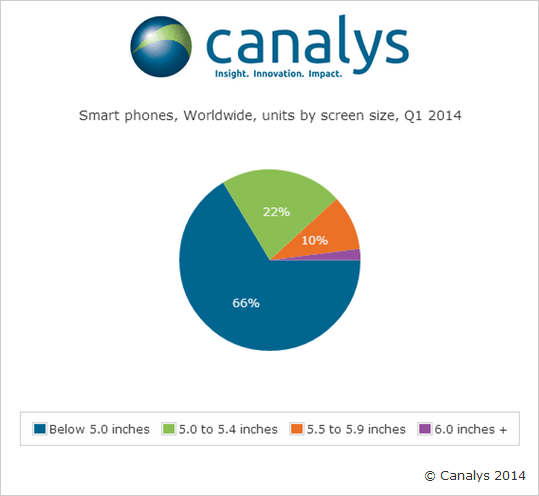
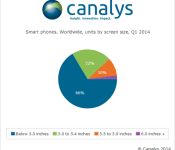
Smart phones with 5″ and larger screens grew 369% – a substantially greater rate of growth than the overall market. Worldwide, they represented just over a third of shipments (34%), and in Greater China the figure hit 39%, and 43% in Asia Pacific.
“This is still a market segment led by Samsung, but the trend is unmistakably toward larger-screen handsets at the high end of the market. It held a 44% share of devices with displays of 5″ and above, and 53% if the view is narrowed to look at 5.5″-plus displays,” said Canalys Analyst Jessica Kwee.
[…]
Consumers now expect high-end devices to have large displays, and Apple’s absence in this market will clearly not last long. It is notable that 5″ and above displays featured on almost half (47%) of smart phones with an unlocked retail price of US$500 or more. Of the remaining 53% of high-end smart phones, 87% were iPhones.
Only 12 percent of smartphones sold had screens of 5.5-inches or larger, with 22% between 5 and 5.4-inches and the rest smaller than 5-inches, including all iPhones.
The iPhone 6 is widely expected to be launched this fall with a a 4.7-inch option, perhaps at 1704×960 pixels, and a larger 5.5-inch version that may launch later due to supply constraints.

Jabra Rox wireless headset review

Up for review today we’re taking a look at Jabra’s latest wireless headset, the ROX Wireless Bluetooth Stereo Earbuds.
 We’ve been very pleased with Jabra’s efforts in the past; their speakers and headphones are some of our favorites. How do these fare? Suffice it to say, it’s another solid outing from the company and one we’ve been recommending to friends and family.
The Jabra Rox come with a number of rubber tips and stabilizers all of which can be mix-and-matched to create the perfect fit. Thanks to the easy snap on tips “Eargels” and rubber “EarWings” it took us all of a few minutes to find out which sizes would work best.
We really enjoyed the magnetic component that allows for us to put the headset to sleep. Simply align the two earbuds and they’ll turn off and conserve power. This is not only helpful, but it’s smart. We can’t count the number of times we’ve pulled headphones or earbuds off and just put them on the counter or hung them up. This way, they’ll power down and be ready when you need them.
 There’s an in-line volume and power controls, something that we appreciate having in a wireless headset. It makes sense to have the controls here and it feels more natural than something that sits on or behind the ear.
The earbuds don’t come across as being all that “premium” but we can’t knock any of the hardware. Rubber tips are never going to feel like a top quality component but it is easy to feel cheap. That’s certainly not the case here.
Battery life is listed at six hours which was pretty accurate in our testing. Out of habit we tend to charge headphones and accessories as soon as we are finished with them. With that said, we never heard a low battery message or had to charge them up ahead of using them. Between riding a mountain bike, mowing the yard, and some general usage at the park we were able to get more than four hours in without a problem. Charging the headphones is done via a hidden (under left earbud) microUSB port.

The Jabra Rox deliver an impressive sound and range; highs are crisp yet lows are also felt. Because of its design, the earbuds do very well to keep outside noise from interfering with your listening experience. The speakers don’t feel like they are overpowering you or pretending to offer deep, dark sounds. We enjoyed spoken word, electronic music, hip hop, podcasts, and everything else.
Learn more about the Jabra Rox Wireless Bluetooth Stereo Earbuds at Jabra’s website. Order a pair through Amazon for $129.99.
The post Jabra Rox wireless headset review appeared first on AndroidGuys.

Never leave bullet time in SUPERHOT, a unique take on first person shooters

Unlike your typical first-person shooter, in SUPERHOT, time only moves when you move. This gives you the ability to strategically plan out your approach. If you’ve played Braid before, the mechanics will feel familiar, as elements of the game speed up and slow down with each step forward or back. After completing the 7 Day First Person Shooter challenge, an event where teams from all over come together to build a new FPS in just a week, the team moved onto Steam’s Greenlight program, where it made it through in just a weekend. Now they’re turning to Kickstarter to help move the game further along. After just a few hours, they’re on their way to reaching their funding goal of $100,000. If you’re on the fence about helping out, you can try your hand at slowing enemies and bullets to a crawl with a browser-based demo. SUPERHOT isn’t the first game to use bullet time (remember Max Payne?), but the game offers a fresh spin on an otherwise repetitive genre. Who knows, maybe the game can even teach Zack Snyder a thing or two about slow-motion action scenes.
Via: Reddit
Source: Kickstarter
 AIVAnet