



Apple Awarded Patent for Contact Aware User Interface in Messaging Applications [iOS Blog]
Apple has been awarded a patent by the U.S. Patent and Trademark Office (via AppleInsider) that details a user interface in messaging apps that dynamically changes its background based on conversation participants. The patent details how this interface would adapt to both single and group conversations, and how it would work with specific data to generate images.

Outlining the “Generation of a user interface based on contacts”, the patent describes how a conversation can be displayed over a background image associated with a contact. Users have the ability to assign a photo to a single contact to serve as a background, while the image itself can be adjusted to be dimmed or alpha-blended with a background color to ensure greater message readability. If an image is not assigned, the interface could also generate a default male or female image based on contact information.

The concept also carries over into group chats, as one user can be highlighted while others are greyed out to display who sent the last message. Alternative methods described in the patent also include showing contact thumbnails in a Cover Flow or carousel fashion, as well as layouts that center and increase the thumbnail of the most recent contacts with animations for emphasis. The patent also describes a potential API for third party developers to integrate the user interface into their own apps.
As with other software patents, it is unknown whether Apple plans to include this dynamic user interface in future versions of Messages or other apps. However, Apple could make changes to the Messages app in iOS 8, which is expected to be unveiled next month at the annual Worldwide Developers Conference (WWDC). Recent rumors have suggested that iOS 8 will feature a focus on health-related applications along with enhancements to Maps and Siri.

Vudu’s ‘Share My Movies’ lets up to five friends peek into your library

While Ultraviolet digital copies have been pitched as a way to make watching videos online easier, so far they’ve lead to frustration for many users. A recent incident involving the early release of Veronica Mars for Kickstarter backers was a low point, Apple, Google and Microsoft all have yet to tie their services in, and now Disney is finally rolling out its own Movies Anywhere system. To get back on the positive foot, Walmart’s Vudu streaming service is shining a light on Ultraviolet’s ability to let users share their library with up to five friends (no, it’s not quite as easy as sharing a PS4 game). Now available within Vudu under the title of “Share My Movies” it lets users add friends to their library just by sending an e-mail invite. Ultraviolet supports up to three simultaneous streams, so you can even watch movies at the same time. According to the FAQ, once your Vudu account is linked to another person’s library, any TV shows or movies you purchase will be added to that library, so you may want to be careful which ones you add. Done right between a few friends, it can probably add up to a decent online library of movies to watch just from Blu-ray discs and DVDs you already own — check the blog post for more information.
Filed under: Home Entertainment, HD
Source: Vudu Blog, Vudu Share My Movies

Google’s ambitious London HQ delayed until at least 2017

For Google, when it comes to building a new home, it doesn’t matter how long it takes as long as it’s been done right. After the search giant halted plans to break ground on its new 950,000 square foot Kings Cross HQ at the last minute, it now looks like Google employees won’t be able to enjoy perks like running tracks, connected cycling ramps and swimming pools until at least 2017. That’s according to the company which had been contracted to build the new HQ but which has now been left in the cold while everything goes back to square one. Part of the reason for Google’s change of heart may be a desire to match the look of its new 1.1 million square foot Googleplex in California. Despite the company’s massive global footprint, the new London and Mountain View developments are set to become the first built-by-Google buildings that it’ll be able to call home.
Filed under: Google
Source: City AM

Facebook is testing cards feature for mobile experience

Facebook has recently been testing a new feature similar to Google Now cards on its iOS mobile app. Essentially, when you interact with your Facebook account, relevant information will be displayed for you to view and swipe away. From the picture we’ve seen, the information doesn’t look as detailed as Google Now’s traffic updates, package tracking, and sports.

We could be in for a surprise and I think it would be interesting to see Facebook take on a similar approach in the social media world, just like Google has already done in our daily lives. Nothing has been updated for Android users to get their hands on it, but I’m sure it won’t be long before we see a beta apk come along. Tell us your thoughts in the comments below!
Source: Gigaom
The post Facebook is testing cards feature for mobile experience appeared first on AndroidGuys.

Xiaomi’s 49-inch Android TV boasts 4K for just $640

The Mi Pad wasn’t Xiaomi’s only announcement today. Following the Chinese company’s first smart TV from last September, today it has unveiled a slightly larger model with a nice surprise: 4K for just CN¥3,999 or about $640! Like its affordable predecessor, this 49-inch TV comes with built-in Android (with MIUI TV skin), though you can easily side-load other TV apps. On the hardware side, you’ll find a 4K 3D panel made by either LG or CSOT within a 6.2mm aluminum bezel, and underneath that lies a MediaTek MStar 6A918 chip (1.45GHz quad-core CPU, Mali-450 MP4 GPU) plus 2GB of RAM to drive all those pixels. On top of the built-in 8GB space, you also get to add up to 64GB of storage via microSD.
The MI TV 2 comes with a few nice goodies. Most notably, it has a Bluetooth LE remote instead of the old infrared version, and should you lose it in your room, you can even tap the bottom of the TV to make the remote beep. Alternatively, you can also install the remote app on your phone, with which you can use gestures and voice to control the TV, as well as read up related info — some of which comes from IMDB — about the show you’re watching.
Another nice feature here is the audio part. CEO Lei Jun said that in order to keep the TV’s thickness at 15.5mm, his team decided to store the speakers in separate parts: a wired audio bar with the mid-range and treble drivers, and a Bluetooth subwoofer with the 8-inch driver. Better yet, you can also use this kit with your mobile devices via Bluetooth.
As for availability, Lei admitted that his company didn’t do so well with the production rate of the original MI TV, but this time he said this should no longer be a problem, partly because he’s teamed up with Wistron and Pegatron. Folks in China will be able to order one on May 27th, but for the rest of us, chances are we’ll never see one outside China any time soon.
Filed under: Home Entertainment, HD

AI algorithm takes seat on investment company’s board

The coming robot apocalypse will need robot executives to rule over it, but it looks like they’re going to have to start with more mundane business first. A Hong Kong venture capital firm has just “appointed” an artificial intelligence tool called VITAL to its board of directors to help find promising investments. It’ll scan things like financing, IP and clinical trials from prospective companies, share that info with the board and even cast the sixth vote. So far, it’s helped find two promising outfits already, though it hasn’t voted yet. Still, the main goal is to “draw attention to it as an independent decision maker,” according to the company. And draw publicity to itself, no doubt.
Via: Business Insider
Source: Beta Beat

Minnesota calls first on “kill-switch” law; California cries

In what is ensured to create chaos to manufacturers as a multitude of states now plan to pass their own “kill-switch” bills, Minnesota becomes the first state to sign the bill into law, narrowly beating out California who passed a similar law last week. It would go into effect one month after California’s proposed effective date (June 1, 2015) and start on July 1, 2015.
This new law may have a strong impact on the the wireless industry forcing carriers and manufacturers to support the “kill-switch” service on a state by state basis. There are some major differences in this law as the law now bars retailers from paying cash for used devices and they are required to keep records of all transactions. The records that are required to keep would be the sellers identification, the seller confirming that the phone is not stolen, and the device information. In addition payments can only be made by a mailed check, store credit, or electronic transfer to deter thieves from trying to make a quick buck. The bill goes so far as to say that merchants must have video security cameras installed at their store locations. According to the text of the law, internet retailers such as Swappa and Ebay would not be required to comply with this requirement. The full text of the law is currently available on the Minnesota State Legislature website.
As with California’s bill, CTIA has been critical of the new law calling it unnecessary due to steps the industry has taken. The CTIA believes that chaos will occur if each state creates their own kill-switch laws. The association further feels that there needs to be a unified front with the “kill-switch” having a single standard to cover the whole country. Besides California and Minnesota, Indiana and New York are debating their own versions of the law and it is being discussed on the federal level as well.
The only remaining question about the bill How do you feel about these laws? Are you for or against the laws? Do you want it on a national level or state by state? Be heard! Give AndroidGuys your feedback below and voice your concerns about these industry changing laws.
The post Minnesota calls first on “kill-switch” law; California cries appeared first on AndroidGuys.

Dixons and Carphone Warehouse merge to form Dixons Carphone

Dixons and Carphone Warehouse have just completed a merger and will now be known as Dixons Carphone. The negotiations began in earnest some three months ago, but merger discussions between the companies have been ongoing since long before that. Dixons has some 950 Currys and PC World outlets, while Carphone Warehouse is England’s largest telecom retailer with over 2,000 stores and a 46 percent share of Virgin Mobile France. Dixons Carphone will therefore have nearly 3,000 stores and 35,000 employees, prior to any cost-cutting. However, Carphone Warehouse noted that the deal, which is still subject to shareholder approval, would save up to £80 million per year — meaning some chopping is no doubt in order. No money reportedly changed hands, and each brand will continue to focus on its traditional products.
Filed under: Misc
Via: Bloomberg
Source: Carphone Warehouse, Dixons

HTC’s One Mini 2 is an awkwardly named, cut-down version of the excellent One M8

There’s a lot riding on today’s announcement. A smaller, cheaper, perhaps more mainstream version of the lovely (but long) HTC One M8 could be a good thing not only for phone buyers, but also for HTC itself, which urgently needs to capitalize on the M8′s momentum. Well, the HTC One Mini 2 is here, and yes, its 4.5-inch display makes it significantly easier to hold in one hand, and it’s certainly going to be more affordable (although we don’t have exact pricing just yet). But this size-reduced handset is fundamentally different to the M8 in other ways too, especially on the inside. That’s why HTC has deliberately avoided calling it the “M8 Mini,” for fear of over-hyping it — a decision that probably deserves some praise for its honesty, but which has resulted in some pretty clumsy branding. We’ve just been hands-on with the European LTE version of the phone (the only variant that has so far been announced), so go ahead and read on for our initial impressions and the key specs.
On the subject of whether smaller phones necessarily ought to be lesser phones, it’s clear that HTC doesn’t agree with Sony, and it doesn’t want to tread the same path as the high-specced Xperia Z1 Compact. The One Mini 2 is aesthetically very similar to its larger sibling, which is a good thing, but internally it has been downgraded in every major department, not least in relying on a quad-core Snapdragon 400 chip (with 1GB of RAM and 16GB of storage) instead of the extremely battery-efficient Snapdragon 801 in the M8. On the other hand, those upgrading from a last-gen HTC One Mini might seem some improvement in performance, but the older phone’s chip was only dual-core, not quad.

The One Mini 2 also drops the M8′s secondary depth camera and Ultrapixel sensor in favor of a more bog-standard, 13-megapixel module — not a bad switch, perhaps, to those who regard HTC “Duo Camera” as a gimmick, but to our minds it’s a serious compromise that results in obviously worse low-light performance, and frankly we’ll miss the M8′s fast and enjoyable selective-focus effects.

Then again, other key parts of the HTC One experience are very much present and correct in this smaller model. That includes the generous dollop of aluminum that makes up much — although not all — of the phone’s chassis, and which is a huge help in giving the phone a premium air. The 720p LCD display (not 1080p like the M8) stood up well during our limited time with the phone, and the pixel density is fine. There’s room for a microSD drawer (phew!) as well as front-facing BoomSound speakers that provide audio quality you simply wouldn’t expect from a phone of this size. A healthy 5MP front-facing camera will take care of your selfies using HTC’s well-designed camera app, and of course you’re also going to get the same friendly, useful Sense 6 skin on top of Android, including Zoe Highlight Videos and BlinkFeed.
Expect to see the One Mini 2 in European stores from the end of this month, with the same three color options as the M8 (gunmetal gray, glacial silver and amber gold), and stay tuned for news of a US variant, which must surely be inbound soon. Meanwhile, we’ll get to work on a full review to test out things like battery life — the One Mini 2 only packs a 2,100mAh battery, but raw figures never tell us everything.
Filed under: Cellphones, Mobile, HTC
Xiaomi’s first tablet offers powerful gaming on the cheap

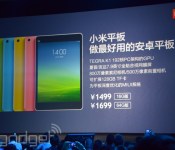
Just over two years ago, Xiaomi CEO Lei Jun told this author that he wasn’t sure about making a tablet at the time; but today, he confessed that he’d been developing one all this time. What we have here is the conveniently named Mi Pad, which was just unveiled in Beijing with super attractive price points: CN¥1,499 (about $240) for the 16GB version, and CN¥1,699 (about $270) for the 64GB flavor. To be honest, we saw this coming when MIUI was released for the Nexus 7 back in March, but what surprised us was that this new slate happens to be the first to feature the powerful Tegra K1 SoC. This follows Xiaomi and NVIDIA’s earlier collaboration on the Tegra 4 variant of the MI3 smartphone.
Xiaomi’s Android 4.4 tablet comes with a 7.9-inch display (made by LG or AUO) with a high resolution of 2,048 x 1,536, which works out to be a sharp 326 ppi density with a 4:3 aspect ratio. Underneath that you’ll find the Tegra K1 SoC, which includes a 2.2GHz “4+1″ core CPU plus a 192-core PC-class Kepler GPU. There’s also 2GB of RAM, 16GB or 64GB of built-in storage, microSD expansion of up to 128GB, a 6,700mAh battery and stereo speakers. Unsurprisingly, you can also take photos with this slate’s two cameras: 8 megapixels on the back and 5 megapixels on the front. These are all tucked into a 8.5mm-thick glossy plastic body (which does look a bit like a scaled up iPhone 5c), weighing a total of just 360g. By the way, there’s no 3G or 4G version announced just yet, but you’ll find the usual 802.11ac WiFi and Bluetooth 4.0 radios.
Unfortunately, no date’s been announced for the Mi Pad’s global availability. All we know now is that there will be a beta test program in China in early June, so it may be a while before the device actually hit the market anywhere on this planet.
Filed under: Tablets
 AIVAnet