



Outlook.com now lets you create extra-specific email rules

If you’re an email power user, you frequently know what to do with messages as soon as they hit your inbox — even if it’s just to avoid dealing with them until later. Microsoft is more than happy to accommodate your exacting requirements, as it just began rolling out a big Outlook.com update that allows for particularly complex email rules. You can now perform automatic actions based on time limits, the read state, email tallies and the familiarity of a contact. If you haven’t read a friend’s message for a day, for example, you can mark it as important so that it doesn’t get buried.
Whether or not you’re that demanding, there are a few other upgrades you’re likely to notice in day-to-day use. You can now respond in-line to an email thread, and it’s possible to undo mistakes in more places. It’s also much easier to sort people depending on whether they’re using Facebook or Skype messaging. You can even switch services in mid-stream; if you’d rather go straight to Skype chat, you can. The Outlook.com refinements will take a few weeks to reach everyone, but it might be worth the wait if you believe that small time-savers make a big difference.
Filed under: Internet, Microsoft
Source: Outlook Blog
Sonos’ revamped, search-friendly music controller is now available to everyone

Should you own any Sonos audio gear, you’ve probably been on pins and needles waiting for the company’s big (and frankly overdue) controller app revamp. Well, it’s here: starting today, both Android and iOS users can snag the redesigned remote without having to sign up for a beta test. As before, the centerpiece is a universal search that makes it easier to find music, whether it’s on your phone or a streaming service like Google Play. You’ll also get a truly modern-looking interface that’s far simpler for both finding your next tune and setting up multi-room sound. The app is available as we write this, so have at it if you’re a fan of Sonos’ wireless speaker tech.
Filed under: Cellphones, Home Entertainment, HD, Mobile
Source: Sonos Blog, App Store, Google Play

Care about an open internet? Tell the US government on Twitter today

Rumors that the FCC would let ISPs like Comcast or Verizon give an internet “fast lane” to well-heeled customers has become a debacle, with Google, Yahoo and a hundred other companies denouncing the idea. The FCC and chairman Tom Wheeler have been in damage control mode ever since, and now want to hear what you think about net neutrality. Starting at 2pm ET today, FCC Senior Counsel Gigi B. Sohn will take your questions over Twitter, submitted using the #FCCNetNeutrality hashtag. Then, you’ll just need to search Twitter using that same hashtag to follow the resulting dialogue. For instance, we’re curious to find out how it could allow such fast lanes without slowing down everybody else, something they’ve sworn not to do. And that’s just the tip of the iceberg — given the sudden swarm of interest in the subject, it should make for a fascinating hour if you can spare it.
Source: FCC

The Xbox One price drop isn’t just to boost sales, says Microsoft

This morning, less than a year after Microsoft unveiled its Xbox One, the game console’s price dropped from $500 to $400. How’s Microsoft making up for the price difference? By removing Kinect, of course. The camera/microphone peripheral introduced halfway through Xbox 360′s life cycle was a standard in every Xbox One sold since launch last November, but no longer. As of this June, a second option will exist on retailer shelves. A less expensive option. And Xbox marketing lead Yusuf Mehdi is all about that option:
“We have 80-plus million Xbox 360 users today who want an Xbox One, and many of them tell us, ‘For me, it’s an affordability issue. I’m gonna get there, it’s just a question of time. If you make it more affordable, then I’ll upgrade faster.’ So this is an opportunity to really make it easier for them to get there at their pace.”
Of course, providing that option is in the interest of spurring sales. The issue isn’t that Xbox One consoles aren’t selling, it’s that they’re not selling as fast as Sony’s PlayStation 4. Currently, Xbox One is a couple million units behind PlayStation 4, and it’s impossible to cite those numbers without considering today’s news as directly attributable. Mehdi doesn’t agree.

“For us, it has not really been about that,” he told us in a brief interview this afternoon. First, it’s about that aforementioned choice. Second, the folks at Xbox feel as though, at this point, they’ve completed their goal of “defining a next-generation console.” As such, moving on makes sense (to Microsoft, anyway).
The Xbox One is designed around voice control. You turn it on with your voice. You open games and browse Netflix and everything else, all through voice. For anyone who’s tried navigating Xbox One without Kinect, you already know the sad truth: it’s a mess. Microsoft is thankfully aware of this issue, and is working on a fix. “We do want to find ways to give you some of those shortcuts and make some of the things that we have with Kinect easier with the controller,” Mehdi said. “You can expect to see us do a bunch of things over the coming months to make the experience easier and easier, even if you don’t have a Kinect.”
The changes aren’t coming before E3, but not far after. “We’re still kind of working through that,” he said.

So, beyond pricing, what else inspired the price drop? Kinect voice localization “was not a factor,” Mehdi said, but the upcoming launch of Xbox One in China certainly seems a likely culprit in the removal of Kinect. At very least, it’s a major technical hurdle “You have to develop a local voice model for each country. That takes a bunch of time to get there,” he said. Should the Xbox One show up in new territories without Kinect, you’ll have to forgive the lack of surprise on our faces.
Filed under: Cameras, Gaming, Peripherals, Software, HD, Microsoft

TRANSFORMERS: AGE OF EXTINCTION, the game, headed to Android later this Year
 DeNA and Hasbro have a Transformer game headed our way later this year, TRANSFORMERS: AGE OF EXTINCTION. The new title will be the official game for the new movie that is hitting theaters June 27. The title is in active development but today’s press release clues us in a little to what the game will look like and how it will play out.
TRANSFORMERS: AGE OF EXTINCTION will be a combat runner style game with some of your favorite Autobots.
“The TRANSFORMERS: AGE OF EXTINCTION mobile game will deliver an explosive interactive entertainment experience on mobile devices for TRANSFORMERS fans and consumers looking to extend their movie experience after the credits roll,” said Barry Dorf, vice president of partnerships and alliances at DeNA. “This isn’t your typical runner game; this game puts the player in the middle of an action-packed Hollywood blockbuster where it’s destroy or be destroyed!”

 The title will come in the free-to-play format, so you can expect some degree of real money spending. I would imagine it will be tailored to unlocking other Autobot friends and upgrades like armor and weapons and such. Speaking of weapons, part of the press release offers up a freebie to those that want to sign up for pre-registration through www.transformers-mobile.com with their Facebook account. If you choose to do that, you will get a free Rare Transmetal Rocket Launcher.
 They don’t give us a solid date for the launch of the game other than “later this year”, we hope it is close too, or shortly after, the theatrical release of the new film though.
//<![CDATA[
ord = window.ord || Math.floor(Math.random()*1E16);
document.write('’);
//]]>

Motorola Moto E officially launched in India at INR 6,999
Motorola has officially unveiled the Moto E at a press event in India. The Moto E is targeted towards the entry-level market and comes with hardware specifications lower than that of the Moto G which was released back in November last year. The Moto E comes with a 4.5 inch LCD screen, dual-core Snapdragon 200 processor, 1 GB of RAM, Android 4.4.2 KitKat, 5 MP camera and 1980 mAh battery. The Motorola Moto E is priced at INR 6,999 ($117 USD) in India and will be exclusively available on Flipkart. Catered towards budget conscious users in the emerging markets like India, the Moto E comes with dual SIM card slots.

Motorola Moto E
Motorola Moto E Specifications
- 4.3 inch LCD display, qHD (960 x 540 pixels) resolution, Gorilla Glass 3, Anti-Smudge Coating
- 1.2 GHz dual-core Qualcomm Snapdragon 200 processor, Cortex A7 CPU, Adreno 302 GPU (400 MHz)
- 1 GB RAM, 4GB ROM, microSD card slot
- Android 4.4.2 KitKat, Stock Android UI
- 5 MP camera, FWVGA video recording (30 fps), No LED flash, No front-facing camera
- dual SIM, 3G + 2G, Wi-Fi b/g/n, Bluetooth 4.0 LE, GLONASS A-GPS, microUSB v2.0 port
- 12.3 mm thin (6.2 mm at edges), 142 grams
- 1980 mAh battery
The Motorola Moto E will compete with a host of entry-level Android and Windows Phone smartphones. In spite of its dirt cheap price, it comes with a decently high resolution screen, latest version of Android and anti-smudge coated Gorilla Glass 3 screen protection. The Moto E is surely to be a best-seller due to its value for money factor as well as a fact that most of the smartphones in its price range aren’t as decently equipped. Competitors in its price range are from local brands which are known for notorious build quality issues and lack of software updates.
//<![CDATA[
ord = window.ord || Math.floor(Math.random()*1E16);
document.write('’);
//]]>
Beats Music’s Subscriber Base Pegged at Just 111,000
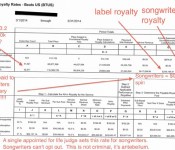
A new screenshot shared by The Trichordist (via The Guardian) allegedly reveals that the Beats Music service had only about 111,000 subscriber accounts during the month of March, indicating that Apple is indeed likely to be purchasing Beats for some combination of its headphones business, streaming technology, brand, and industry connections rather than the existing subscription service.
An acquisition by Apple would undoubtedly boost exposure for the Beats Music service, and potential tie-ins with Apple’s existing iTunes services would offer a strong platform for growth, meaning that Apple is likely relatively unconcerned with the small subscriber base.

The leaked royalty sheet breaks down the subscriber numbers according to the available plans, and of the roughly 111,000 accounts, just under 50,000 were individual accounts while 61,621 were joint “family” accounts available through a promotional arrangement with AT&T. Beats Music has not released subscriber numbers, but this leaked sheet appears to corroborate an earlier report from Billboard that claims Beats’ early subscriber estimates have been “disappointing” to music label executives.
Apple had reportedly been impressed with the subscription conversion rate for Beats, although it is not entirely clear from the chart where those users are accounted for. Roughly 70% of total plays fall under a “promotional royalty rate” category, with the remaining being subject to standard royalty calculations, although it is unclear what criteria cause a play to be placed in either of the two categories.
Looking at the individual subscriptions, the numbers show that Beats pays out approximately 65% of its revenue to rightsholders, similar to other streaming services, with labels receiving by far the largest chunk and songwriters receiving only a tiny slice through their performance rights organizations (PROs).
Apple is reportedly acquiring Beats Electronics for music industry veteran Jimmy Iovine and musician Dr. Dre, both of whom may play a crucial role in Apple’s future music strategy. The Cupertino company also will receive a high-margin headphone business that could be help Apple attract a wealthier and younger clientele.

LG’s Heart Rate Earphones and Lifeband Touch Launching This Month
Earlier this month, a clandestine report on anonymous sharing site Secret suggested Apple might be exploring the possibility of sensor-laden EarPods able to measure heart rate. The report was later revealed to be a hoax, but earphones with built-in sensors are a reality — for LG.
First introduced during January’s CES, LG’s fitness-oriented Heart Rate Earphones are designed to offer real-time heart monitoring. The earphones, which use sensors to measure blood flow through the inner ear, connect to a small medallion that is strapped to the arm or attached to a waistband, tracking metabolic rate and maximum oxygen consumption, while allowing users to listen to music.

The medallion that connects to the earphones is designed to work as a data processing hub, sending biometric information directly to the LG Fitness app or other popular third-party apps on an iPhone via Bluetooth. The earphones are said to offer hi-fi sound and they include a built-in microphone for making calls.
LG’s earphones are also designed to work alongside the company’s Lifeband Touch Activity Tracker, which is a full-fledged fitness band that measures a range of fitness-related statistics, including distance covered, calories burned, steps taken, and more.
LG’s Heart Rate Earphones are designed to provide accurate heart rate data by measuring blood flow signals in the ear via PerformTek sensor technology while also delivering excellent sound. Because of the unique physiology of the ear, wearers can get more accurate health and fitness metrics with LG’s Heart Rate Earphones than with other devices, especially when engaged in physical activity. LG Heart Rate Earphones can be used alone or with LG Lifeband Touch.
The Heart Rate Earphones and the Lifeband Touch can both be pre-ordered today from Best Buy and will see an official launch on May 18. The earphones retail for $180, while the Lifeband Touch can be purchased for $150.
Though the report of Apple developing EarPods with sensors was fabricated, the company has invested research into the concept, publishing several patents on the subject. It has also recently hired Eric Winokur, a researcher who developed an ear-worn vital signs monitor, likely for its wearables team. Despite this evidence, there’s currently no indication that Apple is working on or plans to work on EarPods with sensors, but LG has demonstrated that the technology certainly exists should the company choose to go in that direction.

Samsung Galaxy S5 Prime due in June, rumors suggest

Another day and another rumor for the new Samsung Galaxy S5 “Prime”. With a new teaser video from LG touting the “Simple is the New Smart” tagline, Samsung looks to be “Priming” a new high end Galaxy S5 which boast some impressive “rumored” specs.
Rumored Specs:
- 2560 x 1440 resolution
- 5.2-inch Super AMOLED display
- Octa-core Exynos 5430 CPU
According to Naver, the Galaxy S5 Prime could be hitting carriers in South Korea next month. The S5 is reportedly going to cost around $850 but the likelihood of that being true is slim. There is no mention of a worldwide launch at this time, but we can still hope!
Source: The Droid Guy
The post Samsung Galaxy S5 Prime due in June, rumors suggest appeared first on AndroidGuys.

Share keys and other small items with Hoard’s mini lockers

Everyone knows the ol’ key-under-the-rock trick for hiding your spare keys for guests, but it’s not exactly a secure method. Still, sometimes it’s preferable to the scheduling nightmare of arranging when and where to hand them off. Not so if Hoard has its way, however. Describing itself as a local drop box, Hoard is essentially like Amazon’s delivery lockers, except for your own stuff. Here’s how it works: You use the app to find the closest “hoard spot” to you and get the code for a tiny locker box, as seen above. You deposit the keys in the appropriate locale, send a confirmation to your guest, and then he or she will use the same code to retrieve them (bearing in mind the code is only good for 48 hours). They can also use the same method to hand the keys back to you.

We spoke to Anthony Forsans, Hoard’s co-founder, at a recent HAXLR8R event, and he says Hoard just started testing in Berlin and has plans to create more so-called “hoard spots” in San Francisco and New York. The service is free for now, though it does plan to charge around 3 Euros per use in Berlin at least. So far Hoard has already partnered with a Gloveler, a platform that lets folks rent out their homes, and CleanAgents, an European cleaning service, to help test the key-swapping service. Forsans tells us that Hoard isn’t just limited to keys, of course — anything that can fit within the roughly 10 x 8 x 10 cm cube is fair game. We’ll admit our minds immediately wandered to the potential illegal drug-dealing uses for this, but we’re hoping most people will use it for more legitimate purposes. To get a better idea of how Hoard works, hit the source link or watch the video below.
Your local drop box! from hoard on Vimeo.
Source: Hoard
 AIVAnet