



FCC may revise the new net neutrality rules, but it’s unlikely to satisfy critics

After pushback from a number of internet companies and even calls from within the FCC to delay a vote on the proposed new net neutrality standards, an FCC official has confirmed Tom Wheeler is making some changes. Detailed in a report by the Wall Street Journal, the (heavily criticized) general approach with the ability to sell faster delivery for some web content will be the same, but according to an unnamed official, will include language to make sure the FCC would have to make sure any deal doesn’t put nonpaying companies at an unfair disadvantage. That will probably not meet the bar sought by most net neutrality advocates, and the updated rules are also said to stop short of calling for the reclassification of internet providers as common carriers under Title II.

That said, the redrafted proposal will call for comment on the issue of reclassification, whether or not the paid prioritization deals should be banned entirely, as well as two proposed alternatives submitted by Mozilla and law professor/coiner of the term net neutrality/former senior FTC advisor Tim Wu. Wu suggested in a column on Friday that the chairman should firm his proposal by completely banning any kind of fast lane or degradation of traffic, but without initially attempting to reclassify the ISPs as the more heavily regulated “common carrier” title, or Title II. His argument is that passing tougher rules under the FCC’s existing authority (but with reclassification as a backup) would not only get the job done, but could ward off political or legal challenges altogether since any challenge could result in tighter regulation, which the ISPs would like to avoid.
According to the FCC official, the chairman’s proposal holds the same aim that he has claimed it does all along: putting new net neutrality rules in place as soon as possible to replace the ones struck down earlier this year, and avoiding a long legal battle. As always, your comments to the FCC on this issue can go to its inbox at openinternet@fcc.gov, or directly to chairman Wheeler. At this time, the vote is still scheduled to take place during the FCC’s meeting on Thursday, and if the draft is approved, then the public will finally be able to really look it over and comment on what it contains.
[Image credit: T.J. Kirkpatrick/Getty Images]
Source: Wall Street Journal
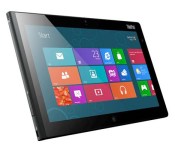
How would you change Lenovo’s ThinkPad Tablet 2?

When it comes to Windows laptops, Lenovo has the knack of making some of the best. It’s a talent that the company has put to good use in its tablet and hybrid devices, like the ThinkPad Tablet 2. When we reviewed it, we’d have handed it an editor’s choice — if we did that sort of thing. Great battery life, fantastic keyboard dock, a great pen and wide viewing angles, what more could you want? Admittedly, the Bluetooth was a bit wonky, Pen support too, and the USB port didn’t support external drives, but was that enough to turn you away? This is How Would You Change, where we ask people to… well, clue’s in the name, really.
Source: Engadget Product Forums

LG admits that one size doesn’t fit all with three new G Pad tablets

LG hasn’t quite pulled a Samsung with its new G Pad tablet family, but it’s coming close by offering the slate in three different sizes: 7-, 8-, and 10.1-inch. We liked the original 8.3-inch G Pad tablet just fine, but found it was a little too expensive compared to others in the in the 7- to 8-inch size range. Pricing details aren’t available yet so we don’t know if the company has addressed that angle, but the new tablets will include all of LG’s latest software tweaks like Knock Code unlocking, and QPair Bluetooth syncing of notifications with an Android smartphone. Information on availability is also TBA, but the public’s first chance to put their greasy palms on these screens will come at the MedPl 2014 trade show this week in Monaco — we’re sure you were already on your way there.

Source: LG Newsroom

So this is a thing: Mobile Phone Throwing World Championships proves the Finnish are a fun Bunch
 This might just be my favourite sport of all time. In the year 2000, in the picturesque town of Savonlinna, Finland, an event called the Mobile Phone Throwing World Championships was born. The event has since continued, now also being participated in by Belgium, Spain, the Czech Republic, Switzerland, Liechtenstein, the UK and there is now even an event in Massachusetts, America.
As you might expect, the event involves the hurling of mobile phones as far as you can, the current record being held by Chris Hughff at a distance of 336.9 feet or 102.68 metres. Categories for the championships include Original; Original Team, where all team members’ throws are added together; Freestyle, where aesthetics, style and overall appearance (read: costumes) are also judged; and even a Junior category for participants under the age of 12.
 Regarding the actual devices you will be throwing, you won’t be throwing your own devices as the world championship body will prepare a selection of devices for you to throw. Devices range from 220 grams to even over 400 grams including the battery, and you can choose from a variety of brands and models, which will vary depending on your strategy. The premise of the entire event is that mobile phones are generally relegated to toxic waste and this is an alternative, and fun, way to reuse old mobile phones.
What do you think about the Mobile Phone Throwing World Championships? Would you participate if there was one in your area? Let us know your thoughts in the comments.
Source: Mobile Phone Throwing World Championships via Phone Arena
//<![CDATA[
ord = window.ord || Math.floor(Math.random()*1E16);
document.write('’);
//]]>

Watch what happens when you pair an Oculus Rift rollercoaster with the real thing

It’s hard to imagine getting bored on a roller coaster, but a pair of English gents figured out a way to make riding the rails even more thrilling: adding VR to the mix. The duo took a publicly available model of an undisclosed UK theme park’s coaster, and imported it into the Unity game development suite. From there, the two smuggled a laptop, mouse, power supply, camera and an Oculus RIft past park security. After getting into the car and outside the unblinking gaze of the ride’s cameras, out came the VR headset. The idea of the experiment was to test real-life physical feedback synced with a virtual experience, sans a fancy home-built setup. Of course, the concept of riding a roller coaster while experiencing a virtual recreation of said coaster seems redundant, but the team’s ambitions go a bit beyond that surface idea.
If you check out the embedded video, you’ll see that in the VR version, the track is floating in outer space. The creators told Road to VR that possible augmentations could include sitting in the cockpit of a fighter jet and doing barrel rolls to avoid bogeys, or even having the roller coaster’s track crumble in front of you. For some (me included) the latter could be even more terrifying than the actual ride. The pair say that they’re hoping to explore furthering their idea with a theme park sponsor and that they have a new, similar, project in the works. Since I’m a tad squeamish, I’ll stick to being a virtual paperboy, thank you very much.
[Image credit: Beyond Neon / Flickr]
Filed under: Gaming, Home Entertainment, HD
Source: Road to VR
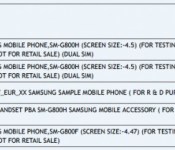
Galaxy S5 Mini Dual SIM undergoing testing in India
There have been multiple leaks of the Samsung Galaxy S5 Mini (SM-G800) recently but with contrasting information. Some leaks referred to Snapdragon 400 processor while others referred to Snapdragon 800 processor. But now, everything seems to be a bit more clearer after Indian import and export data site, Zauba has listed multiple units of Galaxy S5 Mini Dual SIM G800 units entering the country for R&D purposes. According to previous leaks, yet another variant of Galaxy S5 Mini (SM-G800A) would come with a much more powerful, Snapdragon 800 processor.

Samsung SM-G800 Import Details
The Samsung Galaxy S5 Mini is also being named as Galaxy S5 Dx and Galaxy K Mini. The dual SIM version of Samsung Galaxy S5 Mini will supposedly feature a 4.5 inch HD screen, Snapdragon 400 processor, 1.5 GB of RAM, 16 GB of internal storage, 8 MP camera with 1080p video recording, Android 4.4 KitKat and a 2100 mAh battery. It is expected to be officially announced this quarter and will feature 4G LTE or HSPA+ connectivity depending upon the market needs.
Source: Zauba
//<![CDATA[
ord = window.ord || Math.floor(Math.random()*1E16);
document.write('’);
//]]>

Dualshock 4 controller support for Xperia devices may be here Soon
 One of the coolest things about Sony’s PlayStation Certified Xperia devices is the fact that they can be linked up to Sony’s Dualshock 3 controllers from the PS3. With the recent release of the PS4, we’ve been wondering if Sony would be allowing the same capabilities to be added for the Dualshock 4 controllers. If the above picture is anything to go by, Dualshock 4 controller support for Xperia devices is well on its way.
As you can see, pictured with a Dualshock 4 controller is the Sony Xperia T2 Ultra, tweeted out my Sony Mobile’s Middle Eastern branch, implying that compatibility of Xperia devices with the controller should be available at some point in the future. This is definitely exciting news for Android and PS4 enthusiasts as Sony has gradually been improving its Sony-related gaming repertoire on Xperia devices under the guise of its PlayStation Certified program.
Are you excited by the prospect of playing mobile games with the Dualshock 4 controller? Let us know what you think about Sony’s efforts with mobile gaming.
Source: Twitter via XperiaBlog
//<![CDATA[
ord = window.ord || Math.floor(Math.random()*1E16);
document.write('’);
//]]>

Google sells Glass at a golf tournament, turns players into Explorers

Google Glass may not be permanently available for sale to the general public, but Mountain View recently promised to find new ways to expand the Explorer program. The pricey gadget’s first stop? The Player’s Championship in Florida, a golf tournament where many participants can easily afford the device’s $1,500 price tag. Despite the prime location, Google still bundled the eyewear with a free mini-camera that clamps onto a golf club to sweeten the deal. Sounds like the company’s plan worked quite well: according to Twitter user Richard Ranick, a sales associate claimed sales were much better than expected. Since Google has vowed to make Explorers not just out of sports lovers, but also out of optometrists, cooks and travelers, we might see more Glass booths (after the break) at various events in the future.
[Image credit: Google Glass/Twitter]
At The Players’ Championship Sawgrass? Come hit some balls with us #tpc14 #throughglass http://t.co/Lo4naeZgdq pic.twitter.com/n7sz3AwiYA
– Google Glass (@googleglass) May 9, 2014
@kylebrussell Google Glass display at #theplayerschampionship pic.twitter.com/fssBtVegRH
– Richard Ranick (@triple_r73) May 9, 2014
Filed under: Wearables, Google
Via: Business Insider
Source: Richard Ranick (Twitter)
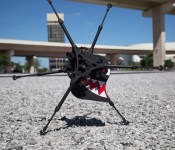
This remote-controlled robot can run faster than you (video)

RC cars and helicopters are cool and all, but if you want a combo breaker in your collection, here’s something different: a multi-legged robot that runs. At the moment, you can only get this remote-controlled sprinter called the OutRunner through Kickstarter, where its creators are trying to raise $150,000 to fund its production. It’s available in two different versions that can run on various terrains, including grass, asphalt and dirt. The basic model called the OutRunner Core is a 1.5-foot tall, 3-pound machine that ships with six legs and can move up to 10mph with a battery that lasts up to an hour. Too slow? Well, there’s also the OutRunner Performance, a slightly larger version (2-feet tall and 5 pounds) that ships with 12 legs, an HD camera, and can run up to 20mph for up to two hours. Also, the OutRunner Performance can be controlled with an app as well as with its remote control, and can live stream video and sensor data to a smartphone. Unfortunately for those whose expensive toy funds have run dry, neither of these come cheap — you’d have to pledge at least $249 to get a DIY kit of the basic model.
Filed under: Misc
Via: Gizmag
Source: Kickstarter
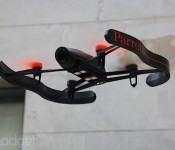
We take flight with Parrot’s new Oculus-friendly Bebop drone

Parrot still hasn’t released that MiniDrone we saw at CES, but its already got something new up it’s sleeve: BeBop. Unveiled Monday, the indoor/outdoor quadricopter has a new accessory for extended-range flights, and gives fliers the ability to control its camera using a virtual reality headset. Bebop isn’t expected to hit store shelves until later this year, but Parrot let us take one of its few prototypes out last week for a maiden voyage in San Francisco.
The first thing you’ll notice is that Bebop looks a little different than other consumer drones. When you’re flying in the living room, styrofoam bumpers attach to each side of the aircraft to prevent you from damaging the drone running into walls or ceilings (which, lets face it, we’re all prone to do). However, when you’re out later at the park the bumpers can come off for unfettered flight. Under the hood, the drone has a combination of sensors (a 3-axis accelerometer, gyroscope and magnetometer if you’re interested) that make for an ultra-smooth experience, even in windy conditions. That means if you’re trying to fly outside you don’t have to worry about a strong breeze accidentally throwing Bebop onto your neighbor’s roof. It was one of the most stable drone flights we’ve ever seen in action, even when it was forced to stand up to San Francisco’s winds and an untrained pilot simultaneously.
Regardless of where you’re flying, you won’t be in the air long. Flight time is just 12 minutes on a full battery charge.Much like Parrot’s previous drones, you control that flight using your iOS or Android device and Parrot’s controller app, FreeFlight. The application is getting an upgrade to version 3.0, that brings a streamlined experience, but still sports many of the same features you’ll find in the older version such as the ability to share videos or program flight paths.
Your iPhone connects to the drone using Wi-Fi, which means you can have up to 300 meters between the two at any given time. If you want to go a little further (and let’s be honest, who doesn’t?), Parrot has a new accessory called Skycontroller to make your dreams come true. It’s essentially a large brightly colored dock for your phone or tablet that gives you physical controls on each side and, more importantly, a giant antenna on top that extends your Wi-Fi range to a whopping 2 kilometers.

The camera is one of the things that make’s Parrot’s previous drones special, and Bebop is no different. The front of the drone has a 1080p/14-megapixel fisheye lens capable of capturing 180-degree view of the world below. The camera is mounted in a special shock-resistant way that makes video as smooth as possible. 8GB of built-in flash memory stores MP4 and JPG evidence of your high-flying adventure, and controls on your device’s screen allow you to turn the camera how you choose.
If you have a virtual reality headset like Oculus Rift laying around, it can be connected to the Skycontroller and pilot the drone’s camera as well. We were able to demo it a bit with the prototype, and while it doesn’t quite feel like you’re flying in the clouds, the experience is pretty interesting. Moving your head around with Oculus controls the drone’s camera, but not its movement. Using a VR headset means you’ll need to practice up with the Skycontroller beforehand, since you won’t be able to see it with something covering your eyes. Overall, it’s an awesome trick that’s bound to impress your friends if you happen to own both devices, but isn’t an experience we could see ourselves wanting very often.
If you’re anxious to get your hands on Bebop, you have a little bit of a wait ahead of you. Parrot plans to release the drone in the fourth quarter of this year packaged with and without the Skycontroller. However, the company isn’t quite ready to announce an exact date or pricing. A representative told us to expect an MSRP “on par with other consumer drones.” Our guess is something roughly in the $300-$400 range.
Filed under: Robots
 AIVAnet