


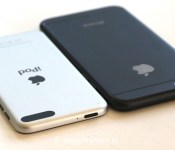
4.7-Inch iPhone 6 Mockup Comparison to iPod Touch Highlights Design Similarities
Italian site Macitynet, which previously published several photos of a fairly good quality physical mockup of the rumored 4.7-inch iPhone 6 based on design drawings from Japanese magazine MacFan, has now shared an interesting new photo set [Google Translate] comparing the mockup to a current-generation iPod touch.

The photos clearly show how similar the two devices are in design, from the curved edges on the rear shell to the style of speaker holes along the bottom edge. The iPhone 6 at 7.0 mm thick based on the design drawings is clearly thicker than the iPod touch at 6.1 mm, although the iPhone 6 would still be noticeably thinner than the iPhone 5s at 7.6 mm.

The iPhone 6 of course has larger height and width than the iPod touch, given that the body must accommodate a 4.7-inch display compared to the 4-inch display of the iPod touch.

The style is naturally also similar to the iPhone 5c, which itself took some design cues from the iPod touch, although the bright rear shell colors are the defining features of the iPhone 5c and they are unlikely to make their way into Apple’s flagship iPhone 6.
In addition to the 4.7-inch iPhone 6, Apple is rumored to be launching an even larger model with a 5.5-inch display, although that may follow several months after the smaller version. High-quality physical mockups of that device have yet to appear, although users with access to a 3D printer can print their own using files based on the design drawings published by MacFan earlier this year.

Galaxy S 5, Is It Really The Best? A Review

The Samsung Galaxy S 5 is disappointing in precisely one area, build quality. But even in that, it’s slightly better than the previous member of the Galaxy S line. Although even that complaint may soon be a non-issue in the wake of the rumors of the Galaxy S 5 Prime which has been confirmed here. On to the review.

Hardware
Powered by a Snapdragon 801 processor, with 2 GB of RAM, while there hasn’t been much progress since the Galaxy S 4, the device is no slouch. (Full Specifications here) Although the Galaxy S 5 is still made of plastic, it’s much higher quality feeling than it’s predecessor. New features to the Galaxy S 5 include a heart-rate sensor on the back of the device and the added fingerprint scanner functionality built into the home button.
The updated Galaxy S 5 is also waterproof similar to the Galaxy S 4 Active, with a plugged USB 3 charging port and rubber gasket-ed removable battery door. Aside from those details and the textured battery door, the device looks remarkably similar to its younger brother the Galaxy S 4.
Software
In the Software of the Galaxy S 5 we can see the result of Samsung’s agreement with Google to tone down the TouchWiz interface. Like the Nexus 5′s Google Edition launcher, the “Okay, Google…” command will activate Google’s voice search from the the new TouchWiz home screen of the Galaxy S 5. On the Verizon edition, at least, the TouchWiz web browser is gone and Google Chrome is the stoc browser (but this isn’t the case on all Galaxy S 5 variants.)
Unlike the Galaxy S 4′s categorized tabs, the settings menu on the Galaxy S 5 is automatically organized as a straight menu list, reminiscent of the Nexus devices. You’re able to switch to the new “Grid view” layout using the menu button at the top right.

When accessing the menu located on in the app drawer you’ll find the familiar options to edit and change views of the application list. New to this menu is the “GALAXY Essentials” option which will take you to a store dedicated to Samsung Galaxy apps. It seems that this option and a “GALAXY Essentials” widget are the only ways to access this market.

Lastly, although there isn’t much exciting and new about the camera app on the Galaxy S 5, The 16 MP sensor does perform admirably, I did a little comparison between the HTC One M8 and the Galaxy S 5 here:
Want One?
Take your pick!
Galaxy S 5 – T-Mobile
Galaxy S 5 – AT&T
Galaxy S 5 – Sprint
Galaxy S 5 – Verizon
The post Galaxy S 5, Is It Really The Best? A Review appeared first on AndroidGuys.

Blu Products Is An Exciting Company, My Thoughts

A lot of you might not be familiar with Blu Products. Blu is a mobile device manufacturer which started in Miami in 2009 whose smartphone offerings have been the perfect answer for people who want a sturdy device at a great price. Lately they’re been trying to break into the high-end market and there’s nothing better than watching another company bring out devices with power and a great price.
What Does Blu Have To Say?
I had a chance to interview Blu’s channel marketing manager, Carmen Gonzalez, here’s what she had to say:
Tony: How long have you been working with Blu?
Carmen: A little under three years.
Tony: When Blu started in 2009, what was the company’s goal? Were smartphones a goal of the company from the beginning?
Carmen: The company used to focus more on feature phones with a few androids, primarily in Latin America. The goal of the company has always been to provide the consumer everything they want in device, quality, style and amazing pricing.
Tony: How has Blu changed since then?
Carmen: The change has been dramatic, even when we started producing Android devices, they were very entry level, nothing compared to what we have now. I’m proud to say, we’ve come a long way and have made quite the impact along the way!
Tony: What Blu phone do you carry?
Carmen: I carry a Life Play in neon yellow. I haven’t switched yet because I just like this one so much, when we say “We have a Blu just for you” we really mean it.
Tony: What are your favorite features of the devices your company has been releasing?
Carmen: I know most people that I talk to are really going crazy over the LTE 5.0 enabled devices, but I’m really more impressed with the cameras and the displays, the Vivo 4.8 HD has a gorgeous HD Super AMOLED display and it’s the perfect size. When you capture and view photos with it, anyone can look like a superstar.
Tony: Can you provide any insight into Blu’s plans for growth as the smartphone industry gets more competitive?
Carmen: Well, the reason we bring out 5 to 10 new devices every quarter is because we know how competitive it is, and we know that everyone always wants a new device, so we want to provide new options every time someone browses our inventory. Aside from that, there are a lot of things in the works right now that I’m just not able to discuss yet, all I can say is, stay tuned, more are coming your way!
Who Knows What The Future Holds?
So, in this market, what future do we really see for a company like Blu? Is it good? I hope so, because this company is providing something we desperately need. The thing I hope the average consumer can learn is that not everyone needs a flagship phone. If we can start to accept that, then maybe we won’t feel the need to sign away two years of our lives just so we can have the best of the best at an affordable price. Check out this compelling Op-Ed piece Don’t Be A Spec Whore, This Isn’t A Spec War by Nick Schiwy.
Take the Galaxy Note series. Great devices, always leading Samsung’s Galaxy line, and often leading the market in specs, but for most people to get the new one without selling a minor organ will literally cost years of your life in the form on a contractual agreement with a carrier, or a financing plan adding a monthly fee to your bill until the retail price of the device is paid-in-full.
The question is, do the people who use the Note series all need the power that these expensive devices pack? I don’t think they do. Most of the people I’ve known who swear by the Note line are just in it for the screen size, and nothing more. Most don’t even play games or do anything much more taxing than watching Youtube videos and browsing the web. The Galaxy Note 3 has an MSRP of $699.99, but for what a lot of users need (I won’t necessarily say “most” but a lot) they would be better off with Blu’s new Studio 6.0 HD which is prices at $249.99 unlocked, out the door with no contract.
Now, don’t think I don’t know there are a lot of people out there who want the leading edge, but that’s not my point in the above comparison. Besides, for those of you who want that, they have a phone for you, which will be my next personal device, the Life Pure XL. With a 5.5 inch full HD display, 16 MegaPixel shooter in the rear and 8 MegaPixel front facing camera, a Snapdragon 800 processor, 3 GB of RAM and 32 GB of storage all priced at a meager $399.00 on Amazon, how can you say “no”?
The bottom line is, if we can rid ourselves of the contracts and start looking around outside of the carrier retail stores, there are companies like Blu that are eager and waiting to help you save a lot of money with your next smartphone purchase. They have a Blu just for you.
Website: Blu Products
The post Blu Products Is An Exciting Company, My Thoughts appeared first on AndroidGuys.
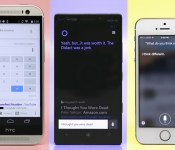
Smartphones for hire: Which personal assistant is right for you?

“Ring-ding-ding-ding-dingeringeding.”
This isn’t a standard job interview answer, but then again, “What does the fox say?” isn’t a typical question, either.
The top three smartphone platforms now feature fully functional personal assistants, and just like real-life assistants, it’s not so easy to pick one at random. Each has its own talents, weaknesses and personality quirks to consider. So, I conducted a series of “interviews” with Siri, Google Now and Cortana to get to know them better — and yes, they all know exactly what the fox says.
Siri

Apple’s Siri is a seasoned assistant with plenty of experience to back up its resumé. Now nearly 3 years old, the once-beta program has had time to squash bugs and add features. And thanks to the iOS platform, it’s integrated with social networks like Twitter and Facebook, as well as services like Yelp, Evernote, Fandango, OpenTable and WolframAlpha.
Siri has a jovial personality. No matter what you ask, just frame your question naturally — for instance, “How should I dress this weekend?” — and nine times out of 10, it’ll not only understand you, but also respond in a similar fashion. If you have follow-up questions or requests, Siri will continue the conversation with you. And if you ask something silly, expect a sassy answer.
Siri is a seasoned assistant with plenty of experience to back up its resumé.
Personality’s a nice touch, but it’s merely a party trick if your assistant lacks functionality. Fortunately, Siri’s not hurting in that area. It can dictate and send texts, emails and social network updates. It can make calls and read messages back to you. It has no problem setting (and canceling) reminders and alarms, and will display your upcoming appointments in a list. How about opening apps and changing settings? Airplane mode, WiFi, Bluetooth, you name it — Siri’s got you covered so you don’t have to dig around countless screens to find stuff.
Siri’s also good with watercooler talk. It told me when the next Giants home game was and how they’re doing this year. When I ask about a movie, the details show up in a card-like view; and I can even buy movie tickets through Fandango. Siri also can pull up music through your library or iTunes, and it’s able to pause, resume and skip songs. However, it doesn’t do a good job of pulling up concert information, opting instead for a web search.
Much like both of its competitors, it can set geofences for reminders. This means you can tell it to remind you to pay the rent as you pass by the landlord’s office, or stop and get a Mother’s Day present when you’re close to your mom’s favorite store (hint, hint). Speaking of location, it can pull up local listings, which you can then filter by distance or Yelp rating; you can also use Siri for all of your navigation needs, as long as you don’t have a strong aversion to Apple Maps. The service also remembers your home and work to help route your morning commute, but unfortunately, it doesn’t do well at determining other places you visit frequently.
Siri’s not all business though. It has a knack for finding your friends, as long as you and your entourage have the iOS app. If Steve’s late getting to your house, you can ask Siri to see where he’s at and it’ll pull up a map with his location. While you wait for him to show up, you might as well use Siri’s OpenTable integration to set up reservations for dinner.
Hire Siri if you’re looking for: Personality, dictation, social networking, music playback, sports, movies, changing settings, reading messages, finding friends.
Google Now

Of the three candidates, Google Now is the blandest. It’s the kind of assistant that takes everything a little too seriously, and on the rare occasion when it tries to be funny, it tries too hard. But it’s also very robust, knowledgeable and takes care of business when called upon — and you can call upon Google without touching the device. It works great on the home screen and in the Now screen, but you can’t activate it when you’re in an app, or even in the app tray. That’s still better than Siri and Cortana, however, which are activated by a long-press of a particular button.
It’s the kind of assistant that takes everything a little too seriously, and on the rare occasion when it tries to be funny, it tries too hard.
Sure, it comes with a few Easter eggs (me: “Make me a sandwich.” Google: “What? Get it yourself!”), but Google prefers function over friendliness. I can respect that — Siri’s and Cortana’s jokes aren’t technically all that useful anyway — but it’s disappointing that an engine like Google can’t understand questions unless they’re framed formulaically, such as “What’s the weather like today?” instead of “What should I wear this weekend?”
It’s not the most intuitive assistant, and it’s a mixed bag for basic daily tasks. Google can look through your email and remind you of upcoming flights and give you other information related to your pending trip. Of course, you can also use it to do the usual voice assistant stuff: Set reminders and alarms, visit specific websites, draft notes and make calls, as well as send texts and emails. For reminders, Google will ask you when and where you want to be pinged. And although it can set up appointments and alarms, it can’t change or cancel them. (If you ask, it doesn’t even understand your request.)
One of Google’s less job-specific strengths is its ability to name a tune. It’ll pull up information about the song you’re listening to and link you to the Google Play Store. It’s a talent Siri simply doesn’t possess, although rumors indicate that Apple’s looking into integrating Shazam. Lastly, if you’re interested in using your assistant to post on social networks, take note: You’re limited to Google+.
Hire Google if you’re looking for: Travel and flights, dictation, music discovery, hands-free voice activation and website shortcuts.
Cortana

Cortana is the only personal assistant in the trio that has a recognizable face, and the only one that has a resumé stretching 500 years into the future. Presently, the service is brand-new and technically in beta, but it’s fully functional. It’ll continue to improve over time as more people use it and Microsoft’s team adds functionality.
Like Siri, Cortana’s got the makings of a fun personality. Jen Taylor, the voice of Cortana in the Halo series, contributes to her Windows Phone namesake by providing a lot of the program’s clever quips, and you’ll hear more of her voice over time. The service doesn’t have quite as many quirky responses as Apple’s counterpart, but wit comes with experience. Currently, Cortana’s sass is limited to telling jokes, poking fun at the competition and responding to random questions about Halo and Microsoft. She’ll also keep conversations going as long as you’re making queries that are relevant to the topic at hand.
She can take care of nearly all of the essential tasks that a virtual assistant should have, many of which I’ve already discussed in earlier sections, but Cortana’s greatest strength comes with her Notebook. After all, your personal assistant would jot down information about you in his or her notebook, right?
Cortana is the only personal assistant in the trio that has a recognizable face, and the only one that has a resumé stretching 500 years into the future.
Do people even use real notebooks anymore? Well, Cortana does. She uses her Notebook to learn more about you. Sure, Siri and Google Now have shown small pieces of this feature: Both services remember your relationships and recognize where you live and work. Siri gets smarter as it gets to know you, and Google displays cards with information about your favorite sports teams, stocks, cable provider, news stories and so on. So far, however, Cortana’s implementation adds a lot more customization. Your list of reminders resides here, as well as your favorite places, music searches and preferred quiet hours.
But the most intriguing part of the Notebook is the section on your interests. This is a customized feed of information that keeps you posted on certain news stories and fills you in on things like your commute time, places to eat, upcoming flights, local weather and your favorite sports teams.
It’s also home to Windows Phone’s Do Not Disturb mode, known as Quiet Hours. A personal assistant would likely know not to bug you about things after a certain time of night, unless it’s incredibly important — but if your mother is trying to get ahold of you at midnight, it’s probably an emergency. Thus, you can set your quiet hours in the Notebook, as well as add a list of people (the Inner Circle) you don’t mind waking you up at the worst possible time in the morning.
You can rely on Cortana when you want to change settings and open apps, and it can even open up specific websites directly as long as you have a shortcut set up as a Live Tile. That’s still not quite as nice as Google, which can open sites without that caveat, but it’s a start. However, just like Google, Cortana can recognize music and offer links to buy the song you’re listening to. She can pull up whatever tunes you want, navigate through your playlist and pause songs currently playing. She’s also skilled at hooking you up with the latest weather conditions in a card-like view (which the others do just fine) and converting temperature between Fahrenheit, Celsius and even Kelvin. Conversely, I asked Siri to convert to Kelvin and it showed me how hot it was in Kelvin, Australia.
Unfortunately, the service’s beta status also means it’s not complete. Cortana doesn’t appear to have any attachments to social networking yet, though I wouldn’t be surprised to see this change down the road. She also doesn’t have hands-free activation, so you have to hold down the search button and then speak your voice commands. Finally, she also has trouble dictating punctuation, so “period” and “question mark” were transcribed as actual words instead of grammatical marks.
Hire Cortana if you’re looking for: Personality, navigation, appointments and reminders, weather, music discovery, changing settings, Do Not Disturb.
Who gets the job?
Don’t you hate it when there isn’t a clear-cut answer? Truth is, all three services do the basics quite well — appointments, reminders, dictation, making calls, sending messages and so on. But each one has its own array of talents to set it apart and its own obstacles to overcome. Between Siri’s experience, Cortana’s Notebook and Google’s hands-free functionality, you could hire any of the three and still be happy.
If you’re not looking for a specific feature or strength, however, you may need to bring them in for a follow-up interview.
Filed under: Cellphones, Software, Mobile, Apple, Microsoft, Google

The Engadget Podcast is live at 12PM ET!

Drunk Dr. Dre, y’all. That’s where we’re at this morning, having witnessed the hilarity of him and Tyrese celebrating the still unannounced $3.2 billion purchase of Beats by Apple. We’re down one beirdo, but Ben (that’s me) and special guest star Joseph are here to talk through the past week: Nintendo’s dreary financials, New York City’s biggest construction project in a century, and the aforementioned hilarity/enormity of the Beats purchase. Grab a pair of comfy headphones, your favorite burrito bowl with extra pico de gallo, and saddle up for this week’s show.
Filed under: Podcasts

Solar Highways wants $1 million to turn the US’ roads into an energy farm

At some point, you’ve probably sat back and said “Couldn’t we solve climate change and the broader energy crisis just by sticking solar panels to everything?” It’s not a bad idea, mind, but the cost and resistance to such a scheme would make it a nightmare to implement. But what about if we turned the nation’s highways into solar farms that we could drive along? Scott and Julie Brusaw have been working on that idea, and after a decade of partially-successful flirting with the US Government, they’re taking to Indiegogo to ask us to fund the next phase of their solar roadway.
Each interlocking hexagonal segment is covered with toughened and textured glass that’s capable of withstanding 250,000 pounds. Beneath that, you’ve got a solar panel, a series of LED lights and a heating element that’ll keep the ice and snow off the hardware in winter. The lights are used to replace conventional traffic lights, offering constantly updating safety warnings and guide lines that can adapt to traffic conditions on the fly.
The system would require a trench running down one side, which would hold the power cables, but could also be used as the backbone for a potential new high-speed data network. As each panel would also be connected, it’d instantly report a fault back to a maintenance engineer, and also track its location, should someone decide to steal one for their own nefarious uses.
Naturally, a nationwide, decentralized power grid could potentially guarantee energy independence and provide near-limitless power for our EVs and homes. That’s why the couple is asking for a whopping $1 million required to hire the materials scientists, civil and structural engineers necessary to turn the panels from neat idea to workable project. There are plenty of pitfalls, and we’re wondering if heating the ground to keep the roadway clear wouldn’t in itself cause more climate change, but hopefully that’s another issue that your cash could fix.
Filed under: Transportation, Science
Via: Fast Company
Source: Indiegogo

Google now lets you use Chrome apps to open files on your Mac

Although Google has quietly been working to bring Chrome apps to the desktop, you’ve not been able click a file and have it open inside a browser extension. According to Chrome tinkerer François Beaufort, that’s all about to change, after the search giant launched a new beta version of its Mac browser, which just so happens to add this kind of support for various file types. As you can see in the screenshot above, the Chrome extension Text can be assigned to edit (you guessed it) documents. Images are also supported, though it’s not clear what other file types Google may allow extensions to access. Imagine a YouTube app that’ll let you edit videos saved on your Mac while uploading them to the site: not something you can do currently, but Google could help make apps like that a reality.
Filed under: Internet, Software, Google
Source: François Beaufort

Apple’s Acquisition of Beats Met with Skepticism, but Jimmy Iovine May Be Key
Since the Financial Times broke the news yesterday, numerous publications are now claiming Apple is in the final stages of acquiring Beats Electronics, a headphone company and streaming music service created by hip hop star Dr. Dre and music industry veteran Jimmy Iovine. The response to the news is mixed, with some experts offering compelling reasons for the deal and other pundits questioning Apple’s rationale in pursuing what would be its biggest acquisition to date.
Iovine has strong ties to the music industry and a long history of working with Apple, having met with Steve Jobs to discuss a subscription music service in 2003 and more recently in talks with Apple’s Tim Cook and Eddy Cue about the Beats Music service before it launched earlier this year. In a recent interview with The Wall Street Journal, Iovine credits Apple as his inspiration for the idea of the Beats brand.
“The idea of Beats…to be very frank, I got from Apple,” he said, noting the “uniqueness of their blending of technology with popular culture.”
If the acquisition proceeds, Iovine may join Apple as a “special adviser” to Tim Cook on creative matters. Iovine would bring to Apple his knowledge of the music business as evidenced in a AllThingsD interview from last year embedded below, and his insider influence that Wall Street Journal sources predict could be used to boost advertising on Apple’s existing iTunes Radio.
Apple also would acquire Beats’ successful consumer electronics business selling high-margin headphones and its newly launched music streaming service. Apple could bring the Beats hardware brand under the guidance of Jony Ive and use it to create new music product lines and add new channels to sell Apple’s products, suggests Re/code. The Beats music service is likely a longer-term investment, allowing Apple to accelerate any plans to offer a streaming music service for its iTunes customers, which number in the hundreds of millions.
Analysts, however, are meeting the news of the high-priced acquisition with both contempt and confusion, noting that such an acquisition is out of character for the Cupertino company. One of the first to weigh in on the deal was Gene Munster, who called the acquisition a “bad idea” in an investor note.
We are struggling to see the rationale behind this move. Beats would of course bring a world class brand in music to Apple, but Apple already has a world class brand and has never acquired a brand for a brand’s sake (i.e., there are no non-Apple sub-brands under the company umbrella). Separately, we are not aware of any intellectual property within Beats that would drive the acquisition justification beyond the brand.
Apple pundit John Gruber of Daring Fireball was equally skeptical of the deal, saying “I don’t get it.”
On the surface, this doesn’t make any sense to me. I can’t see Apple keeping the “Beats” brand around for headphones. If Apple wanted to sell expensive high-end headphones, they don’t need to spend $3 billion. The Beats streaming service is interesting, but can’t Apple do that on its own, as an expansion of the iTunes Music Store and iTunes Radio?
According to the original Financial Times report, Apple’s acquisition of Beats could be announced as soon as next week. Negotiations are still ongoing with some final details yet to be ironed out, allowing for the possibility that “talks could still fall apart.”

LG announces global rollout of F70

Not long ago at Mobile World Congress 2014, we saw a glimpse of a new mid-ranger from LG called the F70. It’s plan is to bring 4G connectivity to “millions of users”, while offering some great LG software features. The time has finally come for that, as LG announces the F70′s global availability.
The F70 will be available in May starting in Europe, followed by Asia, Central and South America, and North America. There’s no telling the price in each respective market quite yet, but we’re sure that information will come soon enough. From the F70′s goal to LG’s “LTE expansion mission”, the F70 will most likely be pretty affordable.
If you need a refresher here are the specifications for the F70:
- Chipset: Qualcomm SnapdragonTM 400 (1.2 GHz Quad-Core)
- Display: 4.5-inch IPS (800 x 480)
- Memory: 1GB RAM / 4GB/8GB eMMC(depending on market) / microSD slot
- Camera: Rear 5.0MP / Front VGA(640 x 480)
- Battery: 2,440mAh (removable)
- Operating System: Android 4.4 KitKat
- Size: 127.5 x 66.4 x 9.9mm
- Weight: 129.6g
- Network: LTE/ HSPA+ 21 Mbps (3G)
- Connectivity: Bluetooth 4.0 / WiFi (802.11 b/g/n) / A-GPS / NFC (LTE only)
- Other: Knock CodeTM , Plug & Plop, Guest Mode
Source: LG
The post LG announces global rollout of F70 appeared first on AndroidGuys.

With Free, France shows the US what an open mobile market should be

If you hadn’t noticed, T-Mobile has been on a rampage lately in the US. It has offered cheaper contract-free plans, paid users cold hard cash to switch, and generally crashed other carriers’ parties. The result has been a wave of new customers for T-Mobile and cheaper, me-too plans from AT&T and Verizon — all a boon to US consumers. But over in France, an alternate-reality version of this scenario has been playing out. Until recently, old guard carriers like Orange and SFR have trundled along, milking customers while stifling innovation. Then, trampling over them on a white horse, came a Bizarro T-Mobile carrier called Free Mobile. It’s been a far greater competitive threat than T-Mo in the US and, thanks to its radical plans, France has become a wireless utopia with some of the cheapest rates in the world.
Let’s backtrack a bit to the bad old days of mobile in France, circa late 2011. The market was lorded over by Orange (the largest carrier with a 41 percent share), SFR and Bouygues Telecom. At that time, it was hard to find a plan under 40 euros (about $55) with 1GB of data or more. As shown here, when the iPhone 4S came out, a SIM-only contract could be had on SFR for 37 euros ($50) with 1GB of data, or 39 euros on Orange ($53). Calls weren’t unlimited on any of those plans, and tethering was strictly a non-non. 4G was nowhere in sight.

In early 2012, Free Mobile was launched by the French entrepreneur Xavier Niel (fun fact: he also owns the rights to the song “My Way”). The company hit the market with a revolutionary offering: 3GB for 20 euros ($28) with unlimited calls and texts, plus no fixed contract term. Though the company had limited infrastructure and leased spectrum from Orange to boost capacity, the offer struck a chord with consumers. That’s putting it mildly. Free grabbed four percent of the market, or about 854,000 subscribers in just three months.
Though the company has had teething problems with reports of slow download speeds, it has been on a constant growth curve since. (Full disclosure: I was on Free last year in France, but switched because I constantly had data issues.) As of the end of 2013, Free had 8 million customers, giving it a 12 percent share of the French market, just behind Bouygues. The company’s data plan is now even better, as well: 20 euros for unlimited texts and calling, with a borderline-ridiculous 20GB of 4G data included per month. To top it off, it’s about to start selling contracts and activated SIM cards directly from vending machines, as pictured below.

The benefits to the French public go way beyond Free. Rates are lower across the board, and Orange, SFR and Bouygues have all launched discount brands. Each offers 3GB of 4G data for the same 20 euros, a tempting offer for those who might be concerned about Free’s service (and don’t need 20 frigging GB). All four companies have aggressively built out their 4G networks as well, and have nearly as many antennas as permits issued, 11,890 — meaning most major centers in the nation now have high-speed LTE.

Whether or not this wireless paradise can carry on is another matter. SFR was just sold to broadband behemoth Numericable for 13.5 billion euros, pending regulatory approval. Other operators, like Orange and Bouygues, have seen steep revenue declines thanks to the price war, and may be looking at mergers or buyouts to stanch the bleeding. However, French consumers may be resistant to any resulting price hikes, having tasted some of the cheapest LTE in the world.
Back in the US, where comparable wireless plans are triple the price, there’s a critical auction coming up as a result of TV stations voluntarily giving up spectrum. If you’re all for competition, you may have mixed feelings. FCC chair Tom Wheeler has decided that the amount of frequency available to each company will be limited, so that Verizon and AT&T don’t use their much bigger war chests to buy it all up. That’ll help T-Mobile, Sprint and other smaller players address their main weakness: poor coverage, especially outside of big cities.

As you’d expect, AT&T and Verizon aren’t keen on this, with AT&T even threatening to pull out of the bidding (though it later backpedaled). They claim that the current rules will limit the auction’s revenues – and the purpose of the auction is to make money for the government. However, if the FCC caves in to their demands, the result could be far worse for consumers. AT&T and Verizon would strengthen their networks, making consumers even more likely to avoid T-Mobile, Sprint et. al. That could lead to even higher prices, and rates in the US are already some of the highest worldwide. Though that puts the Feds in a tricky position, they should take note of how quickly things changed in France with more competition. If similar consumer benefits can be had stateside, they’d make any billions gained at an auction look like chump change.
 AIVAnet