



Panasonic’s medical robot returns after the first-gen sold but two

Remember Hospi, the digital porter from 2004? We wouldn’t blame you if you didn’t, since Panasonic only sold two of the things in the better part of a decade. Now, the company is looking for a do-over, having redesigned the robot to actually provide some use to Japan’s hospitals. This time out, the Hospi is designed simply to transport medicines to patients and take medical records to staff members. Not that it’s just carrying around the odd beaker or folder, since Panasonic’s designed the gear to lug around 44 pounds of weight at any one time. Given that each robot costs almost $100,000, you’d think it might be cheaper just to hire some interns or plumb in a vacuum tube system — but it transpires that one hospital used the latter, and it cost almost $10,000 a month just to keep it running.
Filed under: Robots
Source: The Asahi Shimbun
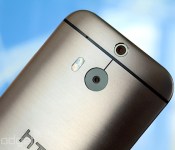
Here’s what the new HTC One might have looked like

The new HTC One may seem like a logical evolution of the original design, but that wasn’t guaranteed — just the opposite, according to company Creative Director Daniel Hundt. He tells Stuff in an interview that the original guideline was to “start with a chunk of metal” and go from there. As proof, the designer has early design sketches of the many concepts CEO Peter Chou told us about earlier, showing everything from a near-flat One body to a super-curvy front and back. Hardware should look like it’s the “natural result” of its material, Hundt says, and shouldn’t be guided primarily by specs like the battery size.
That’s not to say that HTC was unwilling to let a few hardware elements dictate its design. The antennas and speakers needed space, and the microSD card slot is a response to customer feedback. However, the goal when possible was to keep the smartphone’s basic shape intact. Hundt believes that the company made the “right trade-offs” to get the intended form factor, even if it ultimately led to competitors having a few features that HTC lacks.

The director also gives a few hints as to where the next One is going. The company has certain “signature elements” that it wants to keep, such as the chin, forehead and rear lines. It’s likewise pushing for even more metal next time around, and it’s “looking into” Galaxy S5-style waterproofing. Hundt isn’t revealing much beyond that, but it’s clear that the phone maker isn’t planning a radical break from its recent past. You’ll likely have to wait until next year to learn more about the One’s sequel, then, but you can check out our video interview with Peter Chou below if you’re looking for more insights on the smartphone you can buy today.
Filed under: Cellphones, Mobile, HTC
Source: Stuff

The Big Picture: Stormtroopers return to Tattooine
 Oung Jmel in Nefta, Tunisia is better known by many as an outcrop of Tattoine called Mos Espa. The above image was taken on location in preparation for a parade organized by the local tourist board as part of “Star Wars day” celebrations over the weekend. May 4th has been adopted by fans as a day to celebrate the movie franchise, but this year was of particular significance, as just days earlier the cast for Episode VII was confirmed to include a number of actors from the first three movies, and a recent crowdfunding campaign has been launched to save the location from being swallowed by the sands.
The Big Picture is a series of short features where the image takes center stage.
[Image credit: REUTERS/Zoubeir Souissi]
Filed under: Misc

Samsung Galaxy S5 Dx (Mini) makes an appearance in multiple Colors
The trend of manufactures seems to be aimed at taking a flagship device, making a bigger brother and a smaller brother. Sony has the Z2 and Z2 Compact, the Galaxy S4 had a mini and there have been talks of a S5 mini and HTC One M8 mini too. Obviously the mini aspect is to bring some of the great features of the flagship device and dial them back a little and offer it at a lower price point. We have been suspicious, basically known, that Samsung was working on a smaller brother for the galaxy S5. Seems like our old pal, @Evleaks, has acquired an image showing a little bit regarding he device.
 The image pretty clearly shows a series of Galaxy S5 devices with a label of “Dx” in the left hand side. The color options show off grey, blue, white, yellow/gold and a lime green. it is also missing the heart monitor found of the flagship version. You will also notice the Gear Fit and Gear 2 in the image, so I imagine that Samsung will be pairing them up with a promo price tag. We can only hope that this “mini” or “dx” version won’t take a huge cut in internal specs. A smaller screen would be fine, and even if they opted out of the waterproof side of things to cut costs back would be ok with me. The rumored specs talked of a 8MP camera, 16GB internal storage, a 4.7-inch Super AMOLED HD screen at 1280 x 720, a Qualcomm Snapdragon Processor and 1.5GB of RAM.
Any thoughts to be had about the Galaxy S5 Dx, or is it to early to really make a judgment.
//<![CDATA[
ord = window.ord || Math.floor(Math.random()*1E16);
document.write('’);
//]]>

Apple’s Move to Revolutionize Sapphire Manufacturing Likely to Leave Competitors Behind
Apple revolutionized aluminum manufacturing when it adopted the unibody design for its MacBook Pro line of notebooks, advancing the production process in a way that benefitted the industry as a whole. Now, the company is poised to change the nature of sapphire manufacturing in a similar way, but this time the sole beneficiary will be Apple, argues The Verge.

When Apple introduced the aluminum unibody MacBook Pros in 2008, the company was relying on third-party suppliers to provide the material needed for the notebook line. Backed by Apple’s cash, manufacturers were able to streamline and scale up production to meet demand for the new unibody machines. Once rare, processes like aluminum extrusion and forging became commonplace, with Apple “reinventing a whole new supply chain around the material.”
“Aluminum is now cheaper and easier to implement thanks to Apple itself,” says noted analyst Ming-Chi Kuo of KGI Securities. His assessment, shared by many others, is that Apple’s demand drove “related suppliers of aluminum casing to invest more on capacity and technology.” They were all competing for the lucrative prize of satisfying the MacBook maker’s need to extrude, machine, anodize, and recycle vast quantities of the metal.
Apple may have kickstarted the aluminum revolution, but it did not control the production processes it advanced and the adoption of the metal spread across a variety of industries. With sapphire, Apple is taking a different approach. The company is again poised to overhaul a new manufacturing industry, but this time Apple is in a better position to keep most of the benefits to itself.

Apple partnered with materials manufacturer GT Advanced Technologies to build a sapphire production plant in Arizona and is working on mass producing the material for use in its iPhone lineup and possibly the iWatch. Any advancements the company makes in sapphire production to make it more affordable and to scale its manufacturing output to support hundreds of millions of devices per year will stay within the walls of Apple and GT.
Competitors will have to pursue their own sapphire manufacturing endeavors or concede sapphire to Apple and pursue different transparent cover materials to use in their devices. Most companies will be left behind as they do not have the financial reserves that allows a company like Apple to invest in a full-scale production facility dedicated to a single material used in their devices.
Apple and GT have already started producing small quantities of sapphire in their Arizona plant, with approximately 100 furnaces online producing 2,220 kg of sapphire in early production runs. GT is expected to install more than 1,000 additional furnaces as the company ramps up production for the end of 2014 ahead of the release of the iPhone 6 and iWatch.
Recent reports suggest Apple may incorporate sapphire into its upcoming wearable product and may outfit its high-end iPhone 6 models with a sapphire screen. The company currently uses sapphire as a covering for its iPhone rear camera lens and its Touch ID sensor.

HTC One M8 Prime seemingly confirmed by HTC Product Manager’s hostile Response
 Yesterday, we heard the rumour of a potential HTC One M8 Prime device that would include several updated components compared to the original HTC One M8. These improvements allegedly include an upgrade to the Qualcomm Snapdragon 805, as well as an upgrade to the screen from 1080p to the vaunted 2K resolution. While it’s unknown whether this device actually exists or not, its existence may have inadvertently been implied by a hostile response from one of HTC‘s own Product Managers.
@evleaks it’s up your butt
— Leigh Momii (@jetleigh) May 6, 2014
Responding to an evleaks tweet that suggested that the HTC One M8 Prime has an interesting feature that isn’t perhaps something tangible, Leigh Momii, Product Manager at HTC, responded with “it’s up your butt”. Whether this retort related specifically to evleaks’ suggestion about the M8 Prime’s feature or a jibe at the man himself, this wouldn’t be the first time that a HTC representative has taken justice into their own hands (see Jeff Gordon’s reaction to a leaked video here). Still, it does seem like Momii’s response has touched a nerve regarding with the HTC One M8 Prime, so we’ll see if anything else develops in the near future.
Still, it’s intriguing to consider what evleaks might be referring to; is it some kind of software? What do you think evleaks might be referring to? Let us know in the comments.
Source: Twitter via GigaAndroid
//<![CDATA[
ord = window.ord || Math.floor(Math.random()*1E16);
document.write('’);
//]]>

Huawei pulls curtain back on flagship Ascend P7

Huawei on Wednesday pulled back the curtain for its latest flagship smartphone, the Ascend P7. Making its debut at an event in Paris, France, the handset is sleek, thin, sexy, and sophisticated.
Huawei was quiet on much of the hardware details but we do know it runs Android under the latest version of its own custom Emotion UI (2.3). Packing a 1080p HD display protected by Gorilla Glass 3, the backside also features glass coating. Thin as can be at 6.5mm, the Ascend P7 boasts a 13-megapixel camera with Sony sensor, back-side illumination, and a wide aperture of f/2. Huawei claims you can go from locked to photo-ready in 1.2 second.
Check out the Ascend P7 Gallery!
Around front, the Ascend P7 features an 8-megapixel camera capable of panoramic photos. Huawei has also included a software feature called Voice Photos for recording audio clips with images.
The phone is able to handle global 4G LTE networks and launches in a wide variety of markets later this month. It’s unclear as of today if or when it will come to the United States.
The post Huawei pulls curtain back on flagship Ascend P7 appeared first on AndroidGuys.

Huawei Acend P7 gallery

Here’s the latest flagship Huawei smartphone, the Ascend P7. Read more about its announcement here.


The post Huawei Acend P7 gallery appeared first on AndroidGuys.

LinkedIn and Evernote partner to make business cards useful again

Fact: everyone likes doing business with the guy who remembers them. With that in mind, LinkedIn and Evernote just announced a new partnership to bring the Rolodex into the 21st century, and it all starts with a photo of a standard business card. Evernote will instantly digitize it and bring in any relevant LinkedIn info. You’re then given the option to connect with that CEO, secretary or digital prophet on LinkedIn or add their contact info to your address book. However, things get interesting as your business relationship blossoms. Over time, you can add things like audio from a meeting, documents, or even key emails with him or her to the card’s page in Evernote.
Evernote and LinkedIn are already in the business of digitizing business cards with Evernote Hello and CardMunch, respectively. However, today’s joint effort will ultimately sunset LinkedIn’s offering and bring all those users over to Evernote. Want to give it a try? The feature is available now for iOS, Mac and Windows users, with Android support headed down the pipeline soon. Card scanning is free for everyone for one year (after which it will require a premium Evernote subscription). Existing CardMunch users can port their existing cards into Evernote and score a bonus year of free service before they have to shell out any cash.
Image source: Shutterstock
Source: Evernote

Can’t I help you? Shoppers are shunning store assistants in favor of smartphones

Although it often feels like you’re stealing, being able to walk into an store, pay for a product with your phone and leave without any employee interaction can be liberating. It’s an experience that an increasing number of consumers are starting to enjoy too, as evidenced by a new report from Deloitte that suggests shoppers would rather pull out their smartphone or tablet inside a store than speak to an associate. More than half of the people surveyed admitted they prefer using a mobile device to compare prices, gather more information or check availability, while just under half of respondents said they’d rather use complete a mobile payment than head to a cash register. Even unmanned kiosks (think touch displays or tables full of tablets) outranked small talk with a retail employee.
Deloitte isn’t suggesting retailers should immediately go ahead and give sales associates the boot (at least not right now), but instead reinforces the need for companies to support consumers’ digital shopping needs. People are now more aware and comfortable around technology, which has given rise to automated self-checkouts inside supermarkets and the need to prove to an Apple Store associate that you’ve paid for your item with your iPhone before you leave (even though you don’t need to).

Filed under: Cellphones, Internet, Software, Mobile, Apple
Via: Wall Street Journal
Source: Deloitte (PDF)
 AIVAnet