


XCOM: Enemy Unknown is coming to soon to Google Play

XCOM just took to their Twitter page to announce that the awesome game that is XCOM: Enemy Unknown will be hitting the Google Play Store and Amazon Appstore very soon.
The Award Winning XCOM: Enemy Unknown is coming to soon to Google Play and the Amazon Appstore! pic.twitter.com/5gFpPvPeCx
— XCOM (@XCOM) April 22, 2014
Whilst the extend of the tweet only mentions that it’s coming and nothing regarding a timeframe, the fact the you will soon be able to enjoy the awesome XCOM: Enemy Unknown experience on an Android device is awesome news in itself.
The post XCOM: Enemy Unknown is coming to soon to Google Play appeared first on AndroidGuys.

Android smartphones ranked by pixels per inch

It used to be a battle of Megapixels between smartphones to showcase their superiority in the market, but now that has moved over to Pixels Per Inch (PPI), manufactures are now looking at ways of packing more pixels into their displays.
PPI contributes to many factors, but most significantly it is how sharp and crisp the display looks. There is a certain amount of pixels per inch that the human eye can distinguish and this varies given the size of the display, and achieving a higher PPI count means users aren’t able to see those individual pixels during normal operating conditions.
We’ve taken the latest smartphones available on the market and ranked them in order of their PPI count to give an idea who is winning the battle of pixels.
Does PPI count of a device play a significant factor when purchasing your Android device? Let us know in the comments below.
The post Android smartphones ranked by pixels per inch appeared first on AndroidGuys.

Hand-held malaria tester sequences DNA, suggests meds quickly

Despite how far we’ve come with technology, malaria is still a serious threat for huge chunks of the developing world. A prototype tool from UK-outfit QuantuMDx, however, could help stave off mosquito-related deaths by giving health-workers the power to diagnose the disease in 10 – 15 minutes. As the team tells it, typical DNA sequencing can take days, weeks or even months, but its “lab on a chip” can rapidly diagnose a disease and accurately predict which drug and what dosage to administer — all based on the virus’ genetic code. That last bit is key because malaria has a nasty habit of being resistant to medications.
The device hitting prototype phase is one of the first steps along the way to mass-deployment, and its initial round of clinical trials is scheduled for later this year. QuantuMDx stresses that the device is a low-cost way for workers in developing countries to help battle the disease; the team’s aiming for, “around the price of a smartphone,” with test cartridges costing $5-10.
{Image credit: Dmitrijs Bindemanis/Shutterstock]
Source: QuantuMDx

Technology leaders form alliance to prevent another Heartbleed

Be honest, don’t you kinda wish we could just rub our collective eyes and all this Heartbleed business would just disappear? Tough luck hombre, it’s still here, and some kid’s trying to steal your vacation photos (probably). When we spoke to the open source initiative about it recently, we got a less than reassuring reply — that the problem is partly about resources. What is more reassuring this this: The Core Infrastructure Initiative. If that sounds like a conference you’d pay money to not attend, we’re with you, but trust us, it’s for your benefit. In short, some of the biggest names in tech (Facebook, Google, Amazon, Intel and many more) have pledged to work with the Linux Foundation to make sure something like Heartbleed doesn’t happen again. How? Mostly with cold hard cash, with each of the 13 company’s involved chipping in to the “multi-million” dollar project. But how’s it actually going to work?
The Linux Foundation claims that the OpenSSL project (that makes the software exploited by Heartbleed) has received about $2,000 in donations “in past years.” That’s barely enough to buy the team a new embroidered polo shirts. The Core Infrastructure Initiative will divvy up the cash to similar projects that have been identified as needing proactive assistance, something that it hopes could prevent the next Heartbleed. Unsurprisingly, the first project to benefit from the scheme is OpenSSL itself. Worried that your Facebook stock dollars are funding “free” open source projects? Don’t. So much of the internet relies on this technology that it’s not a question of commercial strategy, it’s common sense. As we’re all finding out now, the hard way.
Filed under: Internet, Google, Amazon, Intel
Via: Ars Technica
Source: Linux Foundation
Facebook buys smartphone fitness-tracking app Moves

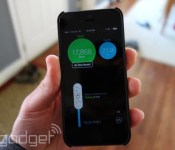
Facebook may already be tracking your usage to serve you ads, but how would you feel if it was able to log your movement? That’s exactly what could be on the cards after the company confirmed it’s bought Moves, the always-on fitness-tracking app that automatically records your daily activities using your smartphone’s sensors. Moves’ mission? It says it’s joining Facebook to “work on building and improving their products and services with a shared mission of supporting simple, efficient tools for more than a billion people.” Zuckerberg and co. intend to keep the iOS and Android apps independent, and the Moves team says there are currently no plans to “commingle data with Facebook.” The social network employs a similar policy with Instagram and Whatsapp, which is no surprise given their huge user numbers and combined $20 billion price tag.
Filed under: Software, Mobile, Facebook
Source: Moves

The Crystal Collection for Samsung Galaxy S5 is for the smartphone user who needs a bit more Sparkle
 Have you ever thought that the Samsung Galaxy S5 needed more crystals? No? Well, neither did we, but Samsung has nonetheless announced that it is going to be bringing out crystal encrusted devices to be called the “Crystal Collection for Samsung Galaxy S5“. If that’s not already too melodramatic for you, check out the 12 second trailer that Samsung has outed for the announcement:
Yes, those are Swarovski crystals embedded in the back of the Galaxy S5, which are sure to sparkle to your heart’s content (but not your wallet’s). While no pricing details have been formally specified, the Crystal Collection for Samsung Galaxy S5 is certain to cost a very pretty penny. This isn’t the first time that Samsung has produced a Swarovski collaboration device; the sparkly Galaxy S5 is preceded by a similar version of the Galaxy Note 3 and the Galaxy S4. The Crystal Collection is going to be available in Korea (no mention of other countries yet) come May, so make sure to save your pennies.
What do you think of this version of the Samsung Galaxy S5? Do you see any point to these devices? Let us know your thoughts in the comments.
Source: SamMobile via SammyHub
//<![CDATA[
ord = window.ord || Math.floor(Math.random()*1E16);
document.write('’);
//]]>
[VIDEO] Boot speed test between the Nexus 5 and OnePlus One shows some blistering Speed
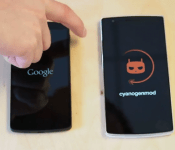
 Yesterday, the OnePlus One was officially announced to much fanfare, touting an impressive cocktail of performance and value that we ordinarily only see from Nexus devices; we imagine that this is probably more what Cyanogen Inc had mind when they first pitched the idea of a CyanogenMod device. Sure enough, the Qualcomm Snapdragon 801-toting device has the hardware to hang it with all the big boys on the market, but how fast is it exactly? Well, thanks to geek.com, we know now at least how fast the device is able to boot up in their boot speed test between the Nexus 5 and OnePlus One:
As you can see, the OnePlus One has an insanely fast boot time, booting up twice in the time that the Nexus 5 took to boot up just once. No doubt this is the result of close collaboration between the Cyanogen Inc team and OnePlus to ensure that the OS is optimized for their maiden smartphone. While the reboot does take what can only be described as a “normal” amount of time, it’s still pretty amazing to see that initial boot speed though we can’t help but wonder how the two best value Android phones shape up in general performance.
What do you think about the boot speed of the OnePlus One? Are you thinking of getting one if you get an invite? Let us know your opinion in the comments below.
Source: YouTube via Phones Review
//<![CDATA[
ord = window.ord || Math.floor(Math.random()*1E16);
document.write('’);
//]]>
‘Opera Coast’ WebKit-Based Browser Now Available for iPhone [iOS Blog]
Back in September, Opera Software released its Coast WebKit-based browser for the iPad and now the company is debuting a new version of the browser designed for Apple’s iPhones.
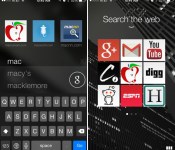
Like the iPad version of the app, Opera Coast for iPhone has been optimized for the touchscreen. Initiating a search is as simple as pulling down on the home screen, which brings up an input interface with an icon-based autofill that allows users to tap the site they want to visit.

Made for thumbs: The iPhone was made for having all screen real estate within a thumb’s reach, and Opera Coast takes this idea one step further. Gestures take care of practically all of the navigation needs, with the rest handled by a bare minimum of conveniently placed buttons. Two, to be exact.
Websites are displayed full screen, and swipe gestures let users navigate between pages. There’s a small toolbar on the bottom that brings up a visual grid of saved websites, which can be altered with a simple tap and drag gesture. Users can have multiple screens of saved websites, providing easy access to all favorite sites, and search is enhanced with related words and suggestions.

The app also recommends popular websites to visit in a “Stuff we like” section, and provides a sharing tool to send links via iMessage, email, or social networks like Facebook and Twitter. An info tool also provides safety information, letting a user know whether a website is secure. While there is a lot of competition in the browser space, with Safari and Google Chrome readily available, Opera Coast is well worth checking out for its unique touch-focused interface.
Opera Coast for the iPhone will be available today as a free download.
The iPad version of the app is also available as a free download. [Direct Link]
Amped-up ear implant helps to re-grow auditory nerves

Cochlear implants already help those with auditory damage to hear better, but what if they could also grow new nerves while they’re there? Scientists at the UNSW have discovered a way to do just that, at least in hamsters. After they introduced a gene therapy solution, a modified cochlear implant used electrical pulses to deliver the treatment directly to auditory nerve cells. That successfully re-generated so-called neurotrophins in the animals, which in turn aided nerve development and significantly improved the implant’s effect. Such therapy could one day help the hearing-impaired to pick up sounds better, especially the subtle tones in music. There’s a long ways to go prior to human trials, however, since it was only effective in the hamsters for a short time. But it could one day be included as part of cochlear implant therapy and even help other nerve-related conditions, like Parkinson’s disease or depression.
[Image credit: UNSW Translational Neuroscience Facility]
Via: The Verge
Source: UNSW

Sony to begin fixing combustible Vaio Fit laptops in May

It’s always sad when a company stumbles during its victory lap, but as Sony looked to gracefully exit the PC business, some spontaneously combusting laptops ruined the day. The company has now issued an update about the Vaio Fit 11A repair program, saying that reservations are now being taken and that battery replacements will begin part-way through next month. Until then, Sony’s line remains not to touch your device, and we add that you should probably shouldn’t store it next to those cans of gasoline in your office.
Source: Sony
 AIVAnet