



How Apple Could Make the Move to 4.7″ iPhone Displays
Amidst the flurry of iPhone 6 rumors coming from KGI Securities’ report last week, Ming-Chi Kuo presented the first possible screen resolution for Apple’s 4.7″ iPhone 6. Kuo lists it as a 1334×750 Retina display with a pixel density of 326 pixels per inch.
Historically, Apple has been very cautious with resolution changes in their iOS devices. The original iPhone was launched with a 320×480 resolution. Eventually, Apple moved to 640×960 Retina display, doubling the linear resolution in each dimension. That allowed existing apps to simply be pixel-doubled to fill the entire screen. Developers could then take their time to update their apps to fully support the higher resolution display. When Apple moved from 3.5″ to 4″ screens in the iPhone 5, they simply added vertical resolution. This allowed existing apps to run in a letterboxed format with black bars at the top and bottom of the screen.
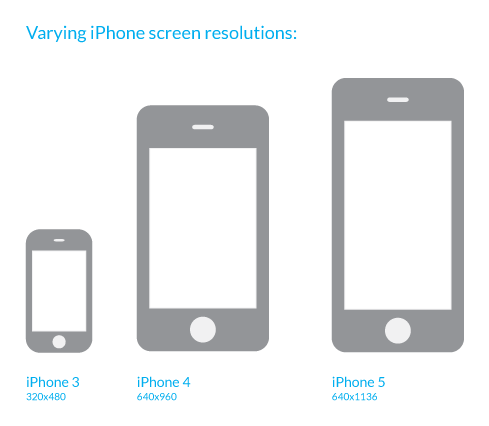
Relative iPhone display sizes by Redtech
Right before the 4″ iPhone releases, Apple began encouraging developers to use AutoLayout in designing their apps:
Auto Layout is a system that lets you lay out your app’s user interface by creating a mathematical description of the relationships between the elements. You define these relationships in terms of constraints either on individual elements, or between sets of elements. Using Auto Layout, you can create a dynamic and versatile interface that responds appropriately to changes in screen size, device orientation, and localization.
AutoLayout paves the way for apps to more easily adapt to changes in display sizes and resolution in the future.
If Apple were to adopt a 1134×750 4.7″ display as predicted by Kuo, it would preserve the same pixel density (326 ppi) as the iPhone 5s. That means that all existing user interface elements, such as icons, would be the same size but would allow for more screen space.
Our designer found that using the exact same icons and spacing them out to fill the screen, 1134×750 pixels allows Apple to fit exactly one extra row of icons onto the iPhone home screen. This mockup shows the relative size of the 4.7″ iPhone screen and how much extra room there would be using the exact same icons as on the current iPhone:
 4″ home screen (left) vs 4.7″ home screen (right)
Meanwhile, existing unoptimized apps could function in a “letterbox” style with black borders for unused screen space. TheVerge forum user Pi is exactly 3 created a mockup showing this exact scenario. This image shows how an “unoptimized” app would appear (left) compared to one that has been optimized for the 4.7″ display (right):
 Mockup by Pi is exactly 3
Given Apple’s past reluctance to blur or break existing apps, it seems that this resolution choice could provide Apple and developers a reasonable upgrade path for a larger factor iPhone. Apple has acknowledged that customers want larger iPhones and all iPhone 6 rumors are pointing to a larger iPhone device this year.
Cheero Power Plus Danboard Version Battery Pack Review: Danbo goes Mobile!
 Danbo, or Danboard, is a relatively well-known character around the world; if you don’t think you’ve ever specifically heard of Danbo, you’ll probably recognize him in one of these photos from the well known photo project called 365 Days of Danboard by Arielle Nadel (check out the whole Flickr album here). The Danboard character actually originated from a manga called Yotsuba&! who unsurprisingly plays the role of a robot made from cardboard boxes. I think Danboard is absolutely adorable, so when I saw Danboard featured on the cheero Power Plus battery packs, I had to take a look.
The three products we’re going to be looking at today include:
- cheero Power Plus 10,400mAh Danboard Version – MSRP $69.95 USD
- cheero Power Plus 6,000mAh Danboard Version – MSRP $44.99 USD
- Revoltech Danboard figurine, cheero Version – MSRP $49.99 USD
If you want to take a closer look at all the products in detail, I’ve put together a unboxing/review video to give you a better idea of how all these products look in person:
As you can see, some really great, well-made products to be seen, especially if you’re a fan of Danboard. As I mentioned in the video, I did do some more scientific testing of the battery pack charging performance which I’ve detailed below.
cheero Power Plus 10,400mAh Danboard Version
 Using Battery Monitor Widget to keep an eye on the charge rate, the 10,400mAh Power Plus managed to charge my Moto G from 20% to 50% in a pretty spritely 40 mins despite starting off quite slowly. According to the recorded results, this would result in about 45% charged in an hour, though we can see from the history tab that at its peak charge rate the Power Plus was pushing almost 53% per hour. Compared then to the uNu battery pack I reviewed a few weeks ago which could only achieve about 37.5% per hour, the cheero Power Plus has shown some pretty impressive charging performance.
cheero Power Plus 6,000mAh Danboard Version
 Likewise, like its 10,400mAh counterpart, the 6,000mAh starts off slowly, however does end up achieving quite a quick charge rate. Over the course of the brief test, the 6,000mAh Power Plus managed a very respectable 42% per hour which is likely more than enough for most people in need of emergency charging.
What I like about the cheero Power Plus battery packs
- As I mentioned at the start, I’m extremely fond of Danboard, so the styling of both the battery packs is a big win in my books, and will be in yours too if you’re a fan or looking for something a bit different.
- The charging performance from the battery packs is very impressive and is more than suited to your required uses
- Both Power Plus battery packs are quite small and very portable, especially with the addition of the pouches that each battery pack comes with.
What I don’t like about the cheero Power Plus battery packs
- While I’m sure it does require a bit more battery power, I’m a big fan of lights staying on or blinking while charging is occuring which the cheero battery packs don’t do; particularly with the Moto G where there isn’t a light to signify the device charging, it’s difficult to tell if the battery pack is charging or not.
- On the 10,400mAh Power Plus, I’m a bit disappointed that they opted to add lights and a button on the face instead of making the eyes lights like on the 6,000mAh version, but that’s probably just personal preferences
Closing Thoughts
 I really like both these cheero Power Plus battery packs; they perform the job they said they would and they look extremely unique. The fact that they’re themed and so well-made, you’ll definitely be the envy of every Danboard fan around.
If you’re interested in picking up any of the products featured in the review, we’ve provided Amazon links below. In addition to that, all the products are currently on sale on Amazon reduced by up to 43% so make sure to take a look. As an additional note, if you are hoping to purchase from outside the U.S., cheero has very kindly provided details on how to do so which we have included below as well.
Ordering on Amazon outside of the U.S.
- Search “cheero” on Amazon.com
- Click “~new from”

- Choose the seller’s condition “cheero offical seller for outside US market. As for shipping date and rates, please check “International & domestic shipping rates”.”

- Proceed to checkout as you normally would
//<![CDATA[
ord = window.ord || Math.floor(Math.random()*1E16);
document.write('’);
//]]>
Ahead of Supreme Court trial, Aereo opens lobbying and advocacy site

The United States Department of Justice says that streaming TV service Aereo is violating copyright law. Aereo, unsurprisingly, disagrees. In five days, the US Supreme Court will hear arguments from both sides. The former has already made its case to the Supreme Court in a filing; today, Aereo fights back with its own lobbying effort: a website named “Protect My Antenna” that both makes arguments for Aereo’s position and compiles various legal documents for the public to read. “We remain steadfast in our conviction that Aereo’s cloud-based antenna and DVR technology falls squarely within the law,” Aereo CEO Chet Kanojia said in an email to users announcing the site.
It’s no secret that over-the-air broadcasters are less than thrilled with Aereo’s live TV service. Customers pay annually to receive a dedicated antenna at one of Aereo’s hubs and DVR functionality, all of which exists in the cloud and streams to users. Sounds pretty okay, right? Not if you’re a broadcast TV outlet, apparently: the channels that Aereo carries show licensed content, and the companies that broadcast said content want their licensing cut.
Of course, it doesn’t help that the broadcasters in this story are the Goliath to Aereo’s David. Aereo only operates in a handful of markets — mostly cities, where using an antenna for OTA broadcasts is often unreliable — and the company is offering a unique service. It is of course growing, but remains nowhere near the size of the media giants it re-broadcasts.
The United States Department of Justice, however, argues that, regardless of Aereo’s size, it’s violating copyright law in re-broadcasting content from the likes of NBC, CBS, ABC, Fox, and other OTA signals (read our explainer right here). Whether the US Supreme Court agrees with that assessment is another question altogether — and it’s one that’s set to be answered in the not-so-distant future. The case begins on April 22nd, in just five days.
Filed under: Internet, Software, HD
Source: Protect My Antenna

My connected home turned me into a spy and an addict

Like any responsible New Yorker, I’ve entrusted a copy of my apartment keys to a close friend. This is done mostly to ensure that, should I die home alone, my body won’t be left to rot undiscovered for days. It’s also primarily done so that my mail is collected and my “children” (what you would call plants) are watered and sung to every other day when I’m travelling for work. And I travel often.
My apartment is also wired to the gills with SmartThings. These little, white, swappable sensors monitor temperature, motion, moisture, power and presence, and relay that data to me via an app — a crucial fact I’d neglected to tell my house-sitting friend many months ago. A small, yet ultimately fortunate, oversight that led me to uncover my house sitter’s true comings and goings. Or, should I say, the lack thereof.
Most people would probably expect their friends to lie about something as trivial as watering plants in your absence. It’s an easy and harmless enough fib to get away with. Plants are heartier than pets — they can survive neglect far longer. What you don’t expect is to have your fears validated; see them quantified by wireless technology. Wherever I was — L.A., Austin, Barcelona, Cologne — I’d fire up the companion SmartThings app on my phone and check the activity grid for a readout of when my door had last been opened and closed. I’d even monitor the temperature over a period of days to get a sense of how much my house sitter was blasting the A/C and, consequently, hiking up my electric bill.
I got hooked on the constant stream of connected home data flowing into the app
The truth, it turned out, was far uglier than I expected. By now, you should’ve sussed out that the apartment visits were infrequent, and that’s putting it diplomatically. But, as my SmartThings activity grid showed, when my house sitter did actually show up to tend to my plants, that visit would turn into an overnight or sometimes two-day, climate-controlled staycation chez moi. Armed with that hard evidence in hand and app, I confronted my friend, bracing for the barrage of excuses that would inevitably fly. Except, I didn’t get any. What I did get, instead, was a confession, an apology and a terse lecture about spying on someone who was “doing you a fay-vuh.”
And I deserved it.
In my defense, I didn’t do any of this to be an intentional creep. Honest. It’s just that I got hooked on the constant stream of connected-home data flowing into the app; data that was way more useful to me when it meant I could monitor someone else’s activity. Yes, SmartThings inadvertently turned me into a spy. And it almost ruined a long-standing relationship of mine. Thankfully, I have a sense of humor and, also, plant neglect is pretty low on the spectrum of friend offenses. You’d have to be a true-blue asshole to make it an issue.
My stream of SmartThings data freed me up to place my panic where it belonged: on trade show coverage.
Friend(ly) espionage isn’t the only useful measure of SmartThings’ worth I’ve found. Most of the time, the app serves as a kind of quantified-home Paxil, calming my security anxiety with real-time updates while I’m on the road. In January, for instance, when I was ferried away to that two-week marathon of consumer technology known as CES, a blizzard was descending upon New York City with the fury of a colossally giant yeti’s wet fart.

I worried that a pipe might burst and flood my apartment, or that my heat wouldn’t be on high enough to keep my plants from freezing to death. So, from time to time, I’d compulsively trigger the app and check the temperature of my Brooklyn digs to make sure it was cozy and that there was no spike in moisture levels under the sinks. All it took was just a few taps on my phone to make sure everything was okay… and, ultimately, it was. My stream of SmartThings data freed me up to place my panic where it belonged: on trade show coverage.
That kind of convenience, that flow of home-automation data is irresistible. It’s also highly addictive. So, you’ll have to forgive me for spying on my own apartment. That’s one habit I’m not willing to break.
[Image: Getty]
Filed under: Household
Nissan offers free electricity to entice EV customers

Though “fueling” an EV costs a pittance next to a gas-guzzler, hunting for that next compatible charging network can bring on cold sweats. Nissan Leaf buyers in 25 markets will soon be able to relax, though. A new “EZ-Charge” card will grant two years of free charging across four major networks: ChargePoint, Blink, AeroVironment and NRG’s eVGO. The automaker may have been motivated by its free charging trials in Texas, which led to a three-fold Leaf sales increase at one dealership. The expanded program will roll out to owners in ten markets this July, provided they bought their Leaf after April 1st. There are other restrictions too: just one hour max of free charging at a Level 2 station and a half hour on a fast charger. The latter option will give an 80 percent charge, but a level 2 station will only dole out 20 miles worth of electrons in an hour — so plan accordingly.
Filed under: Transportation
Source: Nissan

Install the Nokia X camera on your Android 4.1+ device

Whilst the Nokia X wasn’t exactly the flagship high-end spec’d out Android device we were hoping for from Nokia, the camera that is bundled with the device has some pretty nice settings, and we all know Nokia can make a pretty good camera (app).
If Google’s own camera app doesn’t quite do it for you, then the guys over at XDA Developers have managed to port the Nokia X camera software to pretty much any Android device running version 4.1 (Jelly Bean) or better.
These settings that the Nokia X camera app features include: ISO sensitivity control, the ability to display a live intensity histogram, configurable noise detection, redeye reduction, anti-banding, and more.
What’s more is you don’t even need ROOT access. Think this is something you fancy trying out? Download the file from here and install it on your Android device. Let us know what you think in the comments below.
The post Install the Nokia X camera on your Android 4.1+ device appeared first on AndroidGuys.
Looking for the longest lasting battery experience for your smartphone? Here’s the top devices

A smartphone that doesn’t last a day in the 21st century isn’t a smartphone worth having, and with devices now including more and more processor intensive features, the battle of functionality versus battery life is hotter than ever.
A great device can be let down entirely by the length of time it lasts between charges and it is important to know that you won’t be left without your device on a long day at the office or travelling.
That’s why we’ve compiled a list of the devices which have been proven to have the longest battery life between charges to enable you to make the best decision when choosing your next device. The devices are ranked according to the battery capacity they have, and ultimately the bigger battery capacity the longer it’ll hold a charge, together with user rating against how they performed when it comes to the claimed capacity.
There’s no denying that judging by the above graph that Android trumps both iOS and Windows Phone when it comes to both battery capacity in the devices and user rating for getting the expected life between charges.
Do you find yourself turning off GPS, Bluetooth, WiFi, and even dimming the screen to where it’s almost unreadable at the end of the day to conserve that last few percent of your battery? Let us know in the comments below which device you decided to get and if it lives up to the battery expectation .
The post Looking for the longest lasting battery experience for your smartphone? Here’s the top devices appeared first on AndroidGuys.

Apple to Honor Earth Day 2014 at Retail Stores, Main Campus
Apple will be celebrating Earth Day 2014 next Tuesday, April 22 throughout its various retail locations and at its main campus, reports 9to5Mac.

The company will color its logos in green for the occasion, as employees will wear special shirts with an event planned at Apple’s headquarters at 1 Infinite Loop in Cupertino, California. Apple last celebrated Earth Day in 2006 by holding a free computer takeback program in honor of the event.
Apple has remained active in its environment efforts throughout the past few years, which include powering its data centers with 100% renewable energy, expanding its recycling program, and reporting on its carbon footprint. Last May, Apple also hired former Environmental Protection Agency chief Lisa Jackson to lead the company’s environmental responsibility efforts.
Environmental activist group Greenpeace also featured Apple as a “green energy innovator” in its latest report earlier this month, praising the company for its commitment to renewable energy after taking issues with previous efforts.
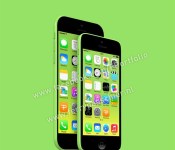
iPhone 6 Renders Reimagined as iPhone 6c [iOS Blog]
Last week we posted renderings of what the iPhone 6 might look like based on leaked design drawings of the unreleased device. Since that time, we’ve seen early cases and possible design molds for the device.
Ferry Passchier, the designer we commissioned for the original designs, has rethought the design as if it was modeled after the iPhone 5C with colorful plastic backings. Passchier produced these renderings with that in mind:


The original renderings assumed it followed Apple’s aluminum design of the iPhone 5S, though an all-aluminum design would introduce issues with Apple’s antenna design.
Apple is expected to release the iPhone 6 this fall, and we expect to see more design and part leaks as production starts ramping up.
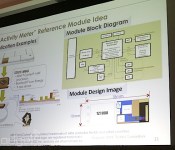
Toshiba envisions Project Ara as wearables, too

There’s no denying that Project Ara is an exciting project and one that will undoubtedly change the way we look at mobile devices. However, one spin on the project that hasn’t perhaps been considered until now comes courtesy of Toshiba who consider the project could extend to wearables.
Shardul Kazi, Senior VP and Technology Executive at Toshiba, said that devices like smartwatches could take advantage of the modular approach Project Ara will be based on, allowing a user to mix and match the components and features of their smartwatch…
READ MORE AT SmarterWatching.
Read the rest at the source, SmarterWatching.com
The post Toshiba envisions Project Ara as wearables, too appeared first on AndroidGuys.
 AIVAnet