


[LEAK] Code output alludes to existence of the LG G3 with a 2K Display
 Only a few days ago, king of leaks, evleaks, suggested the existence of a device codenamed the LG D850, and short of saying it explicitly, suggested that this device is most likely LG‘s next flagship smartphone, the LG G3. Today, we get another leak from our favourite leaker, this time showing what looks like code output from a database. The code again suggests the existence of a LG D850 device but also says that this device will have 2560×1440 pixel resolution display, i.e. 2K resolution. Seeing as most quite a few devices are touting 2K displays, we can only assume LG wants to join that party later this year with its LG G3.
There’s not much else to glean from the code, though it is noteworthy that the value for “VoiceInputCapable” is “No”, implying that the LG G3 won’t have any of that always-on listening that we’ve been seeing so much of lately. We’ve also heard previous rumours that say that an upcoming Nexus device, assumed to be called the Nexus 6, will be a lightweight version of this LG G3. That’s quite a few layers of rumours, but we hope at least some of it is true.
Rumours place the LG G3 getting announced sometime in mid 2014, possibly May or June, so there’s not long to see whether these rumours are true. What do you think about all this: think the LG D850 is the LG G3? Let us know your opinion in the comments.
Source: Twitter

EE takes 4G roaming to France and Spain, more destinations to follow

If you’re an EE customer, and reading this on the 12:15 from Euston International, then you can continue to do so — over 4G — once you emerge from the tunnel without it costing you un bras or une jambe. That’s because the UK network has just announced it’s offering 4G roaming in France and Spain. EE states that you’ll be able to get 100MB of 4G roaming data for £3, which is probably less than the price of a Eurostar coffee. While the deal covers just the two countries at the moment, EE states that this is the beginning of a broader scheme that will see similar agreements in the USA, Italy, Germany, Switzerland and Netherlands just in time for your summer vacation.
Filed under: Cellphones, Mobile
Usability Testing For a Social Media and Gaming Application
Every application has to go through a detailed testing phase in order to be released and accepted in the market. After all, no application is expected to survive the competitive market without ensuring that every aspect of the app is perfectly operational. However, at times application development companies keep testing of the apps restricted only to the functionalities, forgetting the importance of usability testing for all sorts of apps. Usability testing accounts for the efficiency and understandability of an application and the benefit it offers to its users. Without securing a good-to-go certificate on this aspect, no application holds valid ground to be launched into the market.
Usability testing encompasses a vast arena; so any trivial problem with the application can be considered to be a usability issue. The situation becomes all the more challenging as this sort of testing has no definite or strict guidelines for testers to follow. If there was a uniform checklist of task that could be performed while testing usability of applications, things would have been easy for testers. Moreover, the challenges increase with different kinds of apps that require differing approaches of testing. Testing application for social media and games, or any other types, will not involve the same approach. Neither will each testing pattern attempt to answer the same questions while testing these applications, nor will they undertake the same methods. Yet, the end-target for every sort of usability testing is ensuring a faultless app is offered to the users.
When it comes to testing the usability of social media applications or gaming applications, the first factor that you need to check is accessibility. Today, with the vast number of mobile devices and computers available in the market, it is of prime importance for users to test whether the application in question can be easily accessed by every sort of devices or not. Smooth and effective accessibility accounts for user friendliness, which makes sure the user experience or UX of the application is good enough to arrest the attention of the users. This has to be done with the help of screen readers, screen magnifiers, testing with keyboards and keypads, voice dictation tools, source code inspection and more. Defining a good balance of manual and automated techniques for testing, the accessibility of any application can be checked.
Once the accessibility is tested, you need to know how all the features of the application are working across various models. Cross-platform compatibility is one of the major aspects every user looks forward to when judging an application. If your social media app or gaming app, fails to load itself properly on all platforms and devices, there is a possibility that users can discard your app and move onto another option. To avoid this fate for your app, it is wise to ensure that all features perform to their optimum levels. In addition to this, every application should be checked for adherence to compliance standards like Section 508 and more. Failing to do so can result in involvement of regulatory issues for the application development companies.
Usability testing on the whole attempts to answer certain basic questions, based on the feedback received after the tests. Although getting automated results often works out for free applications, it is better to secure feedback from real users, when it comes to apps with specific goals. Such apps might be put under stricter scrutiny, in order to get proper feedback and improve all features and aspects of the app. This is done to provide a great user experience for all users. Some of the critical questions that usability testing attempts to answer are whether users understand the app and how to go about it, which features do the users find most enjoyable and engaging, what are the key aspects that will encourage users to come back to the app again and again. It is vital for any application to generate repeated and continuous user engagement, so any tester has to find out whether the application under monitoring is capable of doing that or not. In case it can bring back users time and again, the features that compels the user to return needs to be identified.
Other similar questions that usability testing provides answers to are what is the best medium for the application’s use – web, tablet or mobile; if it is a game, to what degree should social functionality be created into the game and so on. In case of testing gaming applications, there are certain additional queries that get answered with usability testing. These are; whether the difficulty level set for users are too complicated or not and whether players are able to manage and navigate through the level or not. Moreover, if a new feature is added to the later versions of an application, usability testing on real users can reveal how this new feature has been accepted by users. So, though this testing can definitely involve additional expenditure, it is something that you need to do. Even if you want to save on costs, it is essential to carry out usability testing in the simplest form rather than conducting no tests at all.
In addition to the cost factor, there are certain other considerations that testers have to keep in mind while conducting usability testing of social media, gaming and other applications. Primarily, this includes selecting an appropriate testing group who represent the target audience of the website. Only if the testing group matches the target audience, you can get accurate and effective results. This indicates that testing the application with relatives, friends, and employees within the organization would not give a clear feedback. This is especially true for employees within an organization who might be able to understand and use the app much better than the targeted audience, creating an illusion that the application is clear to the target users.
Thus, selecting the testing group, informing them about the procedure of testing, making a detailed plan and setting certain tasks, and paying attention to how users react, rather than what they say can help tester to get a better understanding about the usability of an application. Based on these feedbacks from real users, testers can try and implement improvements in the app to make it better.
About Author: Stella Holmes is a Professional content writer. She likes writing in blogs and posts about software testing. Stella has written a number of articles for various web-sites. Stella is a big fan of Manchester United football team and tries not to miss any match of them.

Building a Membership Site: A Detailed Overview
So you have decided to build a membership site for your business. Great news! But before you actually take the plunge, you need to have a detailed understanding on what goes behind developing such a website. Taking the decision to build a membership site is only the first step; however, there are more components that you need to take into account for creating your site. The first being, why you want to build a membership site at all. It is vital for you to realize whether you want to create a membership for the benefit of your business or just following the trend. The latter choice will hardly yield any results. However, if benefits act as the foundation of your decision, then you can surely taste success. Let us take a look at some of the benefits, membership sites entail with it.
 Benefits of Building a Membership Site
- Easiest way to create user interaction between committed members of a particular community, who have paid a certain amount for membership.
- Fastest medium to distribute your message via written content, audio, video and pdf downloads. So, it is one comprehensive product that is offered to the users, where they get to choose their preferred way to accept information.
- Allows quick and smooth updates. Membership sites make sure that adding or editing content can be done without any hassles.
- With time the product gets bigger and better. More user interaction on the latest information incorporated within the website ensures that the site becomes more valuable with the passage of time.
- Recurring income generation. Depending on the type of fee you will charge on your website, monthly or onetime fee, both will act beneficial for your business.
Now that you are aware of the benefits membership sites offer, you need to know how enthusiastic your target user base is. Only when you test your market properly and realize how worthwhile your idea would act, you can expect your website to hold its ground.
Ways to Test the Market
- Survey Audience Base – A properly conducted survey can reflect what exactly the users might be looking for. It is quite possible that the idea behind your website might have been something users were not even considering. On the other hand, they might provide feedback on something that they want to see or use the most. By doing this survey, you can clearly accept the information from the survey and craft a product that is more valuable and useful to your user base.
- Split Test – Once the idea behind your website is clear to you, you can start providing offers. Creating 2-3 sales pages with different set of features, copies and concepts can bring forth variations in user response. From these feedbacks, you can analyze which one converts the most visitors to consumers.
- Buy Traffic – The previous way can only work best if there is sufficient traffic to generate results. In order to do so, you can try buying adwords traffic paying a minimum amount of $50-100 and check the conversion rates. Only if you have couple of opt-ins or faux sales, your membership site can possibly tap a huge market.
- Keyword Research – This has been a tried and tested method to find out which keywords are searched maximum. Using this knowledge, you can try generating maximum traffic to your website.
Once you understand your market well enough, you can have your website built in the most optimum way possible. In addition to this, you can add elements such as interactive forums and comments, where you can allow users to have discussions and so on. Thus, with an overall understanding of whatever goes into a development of a membership site, you can try building it with the help of popular membership software.
About Author: Stella Holmes is a Professional content writer. She likes writing in blogs and posts about software testing. Stella has written a number of articles for various web-sites. Stella is a big fan of Manchester United football team and tries not to miss any match of them.

Sony could show off its long-rumored VR headset at GDC next week

The appearance of Oculus Rift on the scene has done a great deal to increase the potential of VR, but new rumors indicate Sony is going to show off a headset of its own. Sony launched several head mounted displays (including the HMZ-T3W shown above), but so far hasn’t released units with VR capabilities despite years of interest in the technology. Edge-Online cites unnamed developer sources claiming Sony will bring “Oculus Rift-beating” hardware to the Game Developers Conference 2014 next week, along with software developed by one of its first party studios. President of SCE studios Shohei Yushida, senior software engineer Anton Mikhailov and senior director Richard Marks are all scheduled to participate in a “Driving the Future of Innovation” panel where, according to the rumors, the device will be shown off. We’ve seen impressive gaming demos from Oculus including EVE: Valkyrie, but Sony brings significantly more resources and potentially developer support — whatever it shows, we will be on the ground in San Francisco to get our hands and if necessary, faces, on it.
Filed under: Home Entertainment, HD, Sony
Via: Joystiq
Source: Edge-Online, GDC 2014 schedule

Xiaomi’s next-gen budget phone shows up with octa-core chip, larger screen

Xiaomi’s sub-$130 budget line, the Redmi (previously known as Hongmi aka “Red Rice“), has been credited for accelerating the company’s expansion into Taiwan, Hong Kong and Singapore, with nearby countries like Malaysia, Indonesia, and Thailand soon to be added to the list. While this is a recent development, the company’s already prepping a follow-up model, according to four new listings on China’s TENAA certification database. As you can see, this upcoming device is marked with red Android buttons on the front, which gives away its Redmi identity. It’ll feature a 5.5-inch, 720p IPS display (a bump from the current 4.7-inch version), as well as Android 4.2.2, 1GB of RAM and an octa-core processor (our guess is MediaTek, again) coming in two versions: 1.4GHz and 1.7GHz.
As far as 3G radios are concerned, China Mobile users can pick the TD-SCDMA model, whereas folks elsewhere have the WCDMA option — we suspect the CDMA2000 version for China Telecom will arrive later. Other goodies include a more powerful 13-megapixel main camera, a beefed-up 5-megapixel front imager (though the TENAA listing also threw in an 8-megapixel mention) and the same old microSD expansion (up to 32GB).
Alas, there’s no LTE to be found here, which may give opportunity to local competitors like Huawei, Coolpad and Hisense, who are either expecting or already offering LTE phones in the sub-$130 segment in China. On the other hand, the current speculation is that Xiaomi will unveil this new Redmi at its “MiFan Festival” — a celebration for the company’s anniversary — in early April, so there’s still a small chance of seeing an LTE version pop up between now and then.
Filed under: Cellphones, Mobile
Via: Zealer (Sina Weibo)
Source: TENAA

Minimal Icon Pack by BladeXDesigns Review: minimal tries something New
 There are plenty of minimal icon packs already on the Play Store, whether by name or general theme, but BladeXDesigns has decided to produce his own take on the popular idea anyway, and we’re glad he has. The Minimal Icon Pack by BladeXDesigns (better known as Inder Deep on Google+) is a fresh take on the theme that involves some striking colours and unique icon arrangements. Let’s take a closer look:
As you can see, a very different approach to a minimalistic icon pack, but nevertheless interesting. As I mentioned, the icon pack does have over 1050 icons in its library and continuously growing, and is compatible with all the standard custom launchers. Add to that the massive on- and off-line wallpaper database (that’s 90 online and 11 off-line, not including inevitable future updates) and you have a very special icon pack.
If you’re interested in picking up the Minimal Icon Pack by BladeXDesigns, it’s only $1.50 on the Play Store now (links below), and be sure to follow Inder Deep on Google+ to get his updates on his existing packs as well as his new ideas.
Icons: Minimal Icon Pack
Price: $1.50
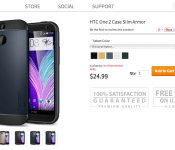
Spigen Lists Beautiful New Cases for the All New HTC One

It always happens: anytime a new phone is about to be unveiled, a company that makes specialty cases for that phone, lists them early. Spigen is no stranger to this, and they have posted new cases for the All New HTC One. Oh do they look glorious.
Spigen are naming these new cases “Slim Armor”, and I must say they are pleasing to my eyes. These new cases are going for $25, and they will be in stock come mid-April. So if you are thinking about getting yourself the All New HTC One, I suggest grabbing one of these bad boys to protect it. Head over to Spigen right now if you want to grab yourself one. Let us know if you do.

Watch the new, customizable Windows Phone 8.1 camera app in action (video)

Microsoft didn’t just equip Windows Phone 8.1 with a redesigned notification center and a Siri nemesis called Cortana, it also revamped its stock camera app. While many of the current app’s features remain intact, a video leaked by Unleash The Phones shows that the right side of the interface now features shortcut buttons for single photo, video and burst photo modes. The left side, however, is completely customizable, and a user can easily fill it with up to five shortcuts to settings (flash, lens picker, resolution, ISO among others) of their choice. Curious WP users who want to know how the updated app compares to Nokia’s camera software can watch the video after the jump. Of course, they might only have to wait a bit more to know everything about the OS… and to finally find out if they can install it on their WP8 devices.
)
Filed under: Cellphones, Mobile, Microsoft
Source: Unleash The Phones

Samsung Posts New Video Talking About ISOCELL CMOS Image Sensors

Ever wanted to know what ISOCELL CMOS Image Sensors are? Samsung to the rescue. The company that strives for the very best in camera quality, posted a new video today talking about the ISOCELL CMOS Image Sensor technology.
Samsung fit this new camera sensor into the Galaxy S5 naturally, and it will help in those low-light moments when you desperately need to snap those crazy moments or selfies in a dimly lit place. But don’t let me spoil the video for you, check it out below, and let us know if you plan on getting yourself a Galaxy S5.
)
 AIVAnet