


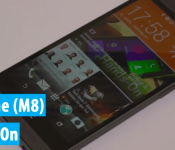
Another 14-Minute Review Video of the All New HTC One Comes from Germany

The All New HTC One just can’t stay hidden. Another hands-on video surfaces from Germany showing an in-depth look into the New HTC One. I don’t know what it is about this video, but as I was watching it, something about the New HTC One’s look got me all tingly. Sure, it doesn’t strive too far away from the original designed, but the way those rounded corners look gave my eyes a little candy. This guy also dives into the dual-camera, where he shows off a 3D capture mode, which is not a bad little added feature to the camera. The gestures that we saw in that Sense 6 video are also talked about, and we of course get a get look at the new UI. So check out the video below if you want more of the New HTC One. He does speak German so you might not be able to understand him.
//<![CDATA[
ord = window.ord || Math.floor(Math.random()*1E16);
document.write('’);
//]]>

LSTN headphones: helping people hear in style

LSTN is out to change the way you hear music. But, more importantly, LSTN is helping some people to hear anything, often for the very first time. The brand launched last year with the goal of creating headphones that look great, sound great and — as we’ll see — help you feel great. The first two goals are relatively straightforward. For example, design-wise, the use of reclaimed wood (cherry, ebony and beech) not only gives them a nice natural look, it also means every pair is unique. It’s LSTN’s recent work in Uganda and Kenya that should take care of that third goal, however. LSTN works closely with the Starkey Foundation so that every pair of headphones sold helps restore someone’s hearing. This weekend sees the conclusion of the most recent excursion, which saw over 5,000 people across the two countries receive help with their hearing through donation of hearing aids. This brings the running total of recipients (previous trips have helped people in Peru, and right here in the US) to 15,000. LSTN’s just made making the decision to help someone out (and yourself) even easier, too, with the addition of a zebra wood model to the flagship Troubador range (as seen above).
As for the headphones themselves, despite the charitable connection, the Troubador mode still costs a reasonable $150. The reclaimed wood we mentioned, gloss finish and embossed LSTN logo on the earcups definitely gives them an undoubted cool-factor. They’re super comfortable too. What about the sound? We’re pleased to say that this part clearly wasn’t an afterthought. The Troubadors are well balanced with not too much boosting on the low-end (as is often the case with style-conscious headphones), providing a sound quality that exceeds its price-point.
Filed under: Home Entertainment, Wearables
Source: LSTN

Weekly Roundup: the Moto 360, Sony’s Project Morpheus, NSA transparency reports and more!

You might say the week is never really done in consumer technology news. Your workweek, however, hopefully draws to a close at some point. This is the Weekly Roundup on Engadget, a quick peek back at the top headlines for the past seven days — all handpicked by the editors here at the site. Click on through the break, and enjoy.

This is Motorola’s new Android Wear smartwatch: Moto 360
Motorola’s new wearable, the Moto 360, takes smartwatch form factor back in time (har), boasting a seriously eye-catching design and circular watchface. Powered by Google’s Android Wear, owners can utilize the power of Now from their wrists. What’s more, this isn’t the Moto 360′s only design. It’ll come in a variety of styles once it launches this summer.

Using the PlayStation 4′s virtual reality headset, Project Morpheus
Last week at GDC, Sony unveiled Project Morpheus. We got to try out the company’s VR headset, destined for the PlayStation 4 — and yes, it’s pretty awesome. Engadget’s own Ben Gilbert donned a virtual sword and took the prototype for a spin while we caught the action on camera.

The NSA may release its own transparency reports
Earlier this week, NSA general counsel Rajesh De stated that companies like Apple or Google are fully aware of its data collection practices due to its “compulsory legal process.” Now, the agency may take that claim one step further by releasing its own transparency reports.

Peter Molyneux wants more from VR than what’s available
Without failing to realize how far VR has come, Peter Molyneux told us at GDC that the tech still leaves him wanting. According to the famed game designer, it’s all about innovation, and the latest next-gen tech, like Sony’s Project Morpheus, doesn’t push the limits.
You also might like:
Filed under: Misc

LG’s first smart light bulb flashes when you get a phone call

LG isn’t about to let household heavyweights like Philips corner the connected lighting space — it just unveiled the Smart Lamp, its first take on the concept. The 10W LED bulb gives Android and iOS users a familiar level of control over their illumination, including a light-based alarm clock and a security mode that pretends you’re at home. There are a couple of noteworthy tricks in this initial offering, however. The light connects through both Bluetooth and WiFi, letting it pull the sync-based stunts we’ve seen in a few other bulbs: it can flash when you get a phone call, or (with Android) pulse to the beat of the music. The Smart Lamp is more expensive than ordinary LEDs at 35,000 won ($32) in LG’s native Korea, but it could be a good deal if you don’t need the many-colored lighting of Hue and similar systems. Unfortunately, there’s no word on whether or not it’s coming to the US.
Via: Android Central
Source: LG (translated)
Pebble Steel reduced to $229 with leather strap
If you’re in the market for a Pebble Steel but have been put off by the price, then a recent price drop in the Pebble Steel with the leather strap to $229 might tempt you into the purchase.
Pebble have reduced the price of both the brushed stainless or black matte version to just $229 with the leather wrist-strap. It may be a pre-emptive response to the Android Wear announcement by Google and the impending release of a number of competitors for the smartwatch crown, but it certainly makes the Pebble Steel more enticing if you don’t mind about not having the steel strap.
[Via SmarterWatching]
The post Pebble Steel reduced to $229 with leather strap appeared first on AndroidGuys.
Report: Apple to release iTunes for Android
What’s the biggest fear of Apple? We all know that one, its Android. Recently, Apple saw a huge decline in their iTunes download, because of the strong competition. But it seems considering something we never thought is going to happen to fill that void. According to Billboard, Apple is planning to release the iTunes for Android to boost their revenue, which is actually a good idea, but it is not easy as Apple think it is.
The competition is really tough on Android, and brands like Amazon and Google itself are ruling the digital music market And not to forget services like Rdio, Spotify, Pandora and Google Music; so Apple has to come up with something that is good enough to go head-to-head with such services.
Do you think iTunes for Android is a good idea? Let us know in the comment box below.
Source: Billboard
The post Report: Apple to release iTunes for Android appeared first on AndroidGuys.

Switched On: Return of the digital hub
Each week Ross Rubin contributes Switched On, a column about consumer technology.

In the heyday of Palm organizers, when even the speeds of 3G data seemed like a distant fantasy, a debate raged as to whether the future of pocket devices could belong to one or two devices. Those who favored two devices argued that you didn’t really want all the bulk and battery consumption of a pocket computer in a small device that you wanted to use primarily to make calls. They failed to anticipate that technology’s relentless integration would enable these “pocket computers” to become the minimal-millimeter smartphones of today and that data networks would support access to apps ranging from social networking to mobile video that would trump voice for many users.
But at Samsung’s Unpacked 5 event at Mobile World Congress last month, the star of the now less ostentatious show was not the latest generation of the flagship phone running the world’s most popular mobile operating system. Rather, it was a small wrist device running a virtually unknown platform. And these products have no internet connectivity on their own. In fact, one of the benefits of the new line of Gear devices from Samsung is the broader variety of the company’s smartphones that support them. If you believe in the promise of the smartwatch or Google Glass, you’ve at least partially vindicated the two-device proponents from two decades ago.
The future personal mobile landscape, though, will likely incorporate not just one or two personal devices, but multiple ones that are not only on our person but also in proximity.
The future personal mobile landscape, though, will likely incorporate not just one or two personal devices, but multiple ones that are not only on our person but also in proximity. In 2010, Switched On discussed why the digital hub, as the vision once espoused by Steve Jobs for the future of the PC, gave way to the cloud as the centers of our digital universe. That mostly remains true as far as media is concerned as smartphones still lack the large amounts of vast storage reservoirs that can be embedded in a PC (or at least were prior to the SSD trend).
But a new generation of wearables and personal devices that provide feedback on our exercise, posture, food intake and simply offer silly sounds. Some, like Moov, already include adaptive scenarios for the use of multiple instances of the product worn in different locations on the body. The digital spokes of the PC focused on acquiring and sharing media while the new generation focuses on sending sensor and environmental data. While vastly different in function, size and design from the MP3 players and digital cameras that were once served as tethered outposts for acquiring and using PC-based media on the go, they still lack the native network connectivity of their forebears. That the smartphone has become a digital hub for a new generation of peripherals represents the passing of another torch from the PC.
Ross Rubin is principal analyst at Reticle Research, a technology, media and telecom advisory firm, and founder of Backerjack, which covers crowdfunded product innovation. He blogs at Techspressive.

App Store and iTunes Prices in UK May Increase Up to 20%
 Apple’s iTunes and App Store downloads may see a price increase next year when new UK laws take effect.
The Guardian reports that the most recently introduced budget closes a loophole that allowed digital downloads to avoid UK taxes.
The budget document said: “As announced at budget 2013, the government will legislate to change the rules for the taxation of intra-EU business to consumer supplies of telecommunications, broadcasting and e-services. From 1 January 2015 these services will be taxed in the member state in which the consumer is located, ensuring these are taxed fairly and helping to protect revenue.”
Digital download retailers such as Apple and Amazon presently avoid the UK’s 20% VAT by selling from countries such as Luxembourg where the tax rate is only 3%. Under the new law, downloads to UK customers will be taxed at the higher 20% rate.
The change appears to affect all digital downloads including music, apps, and e-books, and will take effect on January 1, 2015.
     |

IRL: Torque Audio t103z headphones

Hey, we’re not here to judge, OK? We won’t say anything about you using Apple’s pack-in EarPods and you can keep your thoughts to yourself about us paying $180 for in-ear headphones. Cool? Cool.

I came across Torque Audio at Engadget’s recent Expand conference and was genuinely impressed with its t103z headphones. As an avid musician, it’s unlikely you’ll find me without a pair of buds in my shoulder bag or back pocket. My addiction to quality audio is actually what first tempted me to ditch my iPhone 4s in favor of an HTC One. For me, it’s as much about evaluating the production of Ellie Goulding’s latest track as it is about casually enjoying the groove — and hopefully picking up a few studio tricks in the process. It only took one week with the aluminum-encased t103zs before they became my go-to pair of reference headphones.
The ability to “mod” headphones might seem gimmicky, but these have honestly filled a hole in my listening experience that I hadn’t realized existed. Torque’s t103zs have a seriously flat (read: unaltered) sound. The punchy stabs in Lady Gaga’s “Applause” and heavy mid-toned guitars of Switchfoot’s “Dark Horses” have never sounded so full and expansive, especially compared to the noticeable compression when played through Apple’s EarPods or the Beats headphones that came standard with the HTC One. Not to mention the t103zs offer a premium metal-and-polycarbonate feel that I completely geek out over.
The true appeal of the t103zs lies in their Passive Acoustic Valve Technology and interchangeable parts, dubbed TorqueValves. Each set of TorqueValves employs a technique known as subtractive equalization, which uniquely adjusts the EQ of your audio by physically cutting specific frequency ranges. For example, by reducing the volume of treble frequencies, the “perceived loudness” of bass frequencies becomes much more apparent in the mix. Without diving any further into the backend of digital audio, this process is innately different — and results in less distortion — than, say, selecting “Bass Booster” in the iTunes Equalizer window or toggling Beats Audio on an HTC One. To be fair, the amount of audible distortion and tonal coloration from the alternative — additive equalization –ultimately depends on the skill of the listener’s ear, but theoretically it’s always there.
Out of the three different pairs of TorqueValves that come in the box, I’ve found myself partial to the “sparkling crisp highs” of the Clear Valves. They do a great job at exposing delay tails and vocal stacks from my favorite Kimbra tracks I’ve only ever enjoyed through custom, triple-driver Westone Elite Series ES3X monitors. When I’m looking for an accurate, real-world audio reproduction of my latest studio project, Torque takes the cake. The t103zs are the best single-driver headphones that have ever graced my ears.
– Andy Bowen
Filed under: Portable Audio/Video

Apple Maps Flyover Adds 3D Views of Perth, Saint-Tropez, and Cordoba [iOS Blog]
MacPrime.ch notes that Apple has recently added three new locations to their Maps Flyover feature found in iOS.

The new locations include Perth (Australia), Saint-Tropez (France) and Cordoba (Spain).
The 3D flyover features was introduced in iOS 6 and based on the technology of C3 Technologies which was acquired by Apple in 2011. Apple has been slowly expanding coverage since its launch and maintains a list of 3D-enabled locations on their website.
| |
 AIVAnet