


HTC to release a smartwatch at NYC Event alongside new 2014 HTC One
Most partners who have adopted the Android Wear platform have teased their upcoming products, except HTC who despite being a partner of the platform, are yet to tease anything.
An interesting theory suggests HTC will infact use their upcoming event to showcase the new HTC One device to show off their new HTC smartwatch running Android Wear, consequently beating everyone to market.
HTC have yet to announce or even hint at any plans to release a smartwatch, yet they have been listed as an Android Wear partner. The only reason to hint at an upcoming product is to discourage consumers from purchasing over products released before it, and therefore wait for that offering. So what’s the reason not to hint at an upcoming product?
SmarterWatching suggest that the reasoning is due to the impending release of the HTC smartwatch and a teaser at this point would be relatively pointless given its upcoming reveal at the NYC event.
LG state their smartwatch will hit shelves in the summer, which isn’t too far away, and since HTC have a reputation of being able to turnaround manufacturing time and get a product to market quickly, releasing a smartwatch so shortly after the Android Wear announcement really isn’t a impossible possibility.
The post HTC to release a smartwatch at NYC Event alongside new 2014 HTC One appeared first on AndroidGuys.

Give Your Business a Boost with Message Blasting
Message blasting is one effective means of improving a company’s direct marketing efforts as it allows direct contact with the target market. This involves recoding a voice message that will be blasted to a list of numbers. Blasting a message is a big convenience for your company as it allows you to focus on more important tasks; instead of forcing you to have to make one call after another. With message blasts, you have more time to figure out how to boost your business.
 In addition to the time you free up by message blasting, there is also the benefit of knowing that your customers and clients received your message since it would be relayed with a phone call. This is in contrast with email blasting or email marketing, which delivers hundreds or thousands of emails which can easily be blocked by spam filters, buried under emails from other companies, or deleted due to lack of interest. Audio message blasts, however, leaves customers with no choice but to answer their phones, and see what you have to say. Furthermore, if the customer is unable to take the call, a voice message is left for them to listen to at their convenience.
Simple Blast offer message blasting services that is both easy to use and easy on the pocket. To launch your unique and effective message blasting campaign, all you need to do is:
- Purchase the number of message blasts you need
- Create a call list in your account
- Record your message
- Hit the button and send it
Once your message is sent, your next move is to move on to other important tasks, and simply wait for your inbound inquiry rate to go up and improve the chances of making more sales.
Find out how message blasting can help your businesses by visiting our website today. You can also call 877-482-5838 to get more details.

US Navy’s Triton UAV completes initial flight testing

One of Northrop Grumman’s new war/spy gadgets, the Triton unmanned aerial vehicle, just got closer to joining the US Navy’s reconnaissance fleet. After almost two years since the defense tech company announced the aircraft, the Triton has finally completed its initial test flight program and has now been cleared to fly at various altitudes, speeds and weights. The tests, which kicked off in May 2013, spanned 13 flights (including long-endurance ones) with a total of 81 hours flown at altitudes up to 59,950 feet. To put that in perspective, commercial airplanes usually fly at around 35,000 feet in the air.
While the company and the Navy successfully got through this phase, they still have to tackle more tests before the Triton goes into service sometime in 2017. They’re currently preparing to equip two Tritons with sensor systems designed to take high-res images, detect targets with radar and provide a means of communication between military units over long distances. These UAVs will take to the air this June or July to determine whether the sensors work as intended. In the future, the Navy plans to build 68 Tritons specifically to work with manned P-8 Poseidon patrol planes. If the latter sounds familiar, it’s because a deployed P-8 unit is currently involved in the search for the missing Malaysian Airlines flight MH370. When the Triton’s ready for primetime, it could considerably extend the P-8′s search range, making it better equipped to handle similar missions.
Filed under: Misc
Source: Northrup Grumman
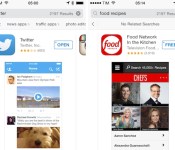
Apple’s latest App Store experiment makes finding apps easier

With more than a million apps available on the App Store, finding the right one is often more troublesome that is needs to be. In an effort to ease that burden, Apple has quietly begun testing a new related search suggestion feature that aids the discovery of new apps, displaying categories similar to your current search term. For example, when you perform a search for Twitter apps, the App Store displays related listings for “news apps,” “traffic apps” and “photo editors,” queries that loosely match what users might associate Twitter with (okay, maybe not traffic updates). In the past, app suggestions were limited to Genius recommendations and “Customers also bought”, but Apple’s latest experiment shows it may soon do more with the App Store data available to it. It’s not known whether the company is manually curating groups of apps or relying on tags and keywords provided by developers, but it’s a small peek at the future we first imagined when Apple bought app discovery service Chomp.
[Image credit: Macstories]
Filed under: Cellphones, Internet, Software, Mobile, Apple
Source: Macstories

Astronaut Training

If the Academy Award-winning film Gravity has you ready to pack your bags and head to NASA, then prepare yourself for years of rigorous training. Becoming an astronaut is an extremely demanding process that combines years of classroom instruction with specialized training in otherworldly environments. Of course, the training is well worth it when you can say that you’re one of the few people alive who has ventured out of this atmosphere. But seeing Gravity in IMAX 3-D is the closest most of us will ever get to being in outer space. On the other hand, if you want to skip the years of training and go right for the pleasures of space (and have $250,000 to spend), then consider Virgin Galactic for an all-inclusive space flight. Let’s take a look at the training process that goes into astronaut preparation, from day one to lift-off.
The first astronauts in the 1950s were all members of the military with extensive experience as pilots. Eventually, NASA discovered the need for astronauts with high levels of scientific expertise, especially in physics, engineering, astronomy, and biochemistry. This led to them broadening their criteria, and NASA now selects two different types of astronauts: pilots and mission specialists. Both types of astronauts must undergo the same rigorous training to prepare them for missions and operating the spacecraft. However, the main responsibility of pilot astronauts is to pilot and command the spacecraft, while mission specialists focus on the specific duties of the mission, such as experiments and launching satellites. Before they get into space for the actual mission, however, they undergo years of training to prepare them to handle any situation.
Even if you are accepted as an astronaut candidate, this does not guarantee that you will become a full-fledged astronaut on a space mission. Candidates report to the Johnson Space Center in Houston for primary training, which consists of two years of basic, classroom training. Sort of like medical school, the astronaut candidates must first learn about all the spacecraft systems and scientific fields, including engineering and meteorology, that are required for work in space. This technical and scientific training is paired with physical training as well, preparing candidates with scuba qualification and swimming tests that are required for military-level water and land-survival techniques. This physical training prepares them to handle emergency situations, such as an unplanned water landing.
Basic training is just the first step, as passing candidates are then paired with mentors who train them in all areas related to spacecraft operation, launch, orbit, and landing. Once the candidates have proved their proficiency, they are considered astronauts and are given mission assignments. Over a 10-month period, they train with their crew for mission-specific activities. This can involve underwater training, flight simulators, or work with tools, such as plastic welding equipment, that will be needed to complete the mission.
Once mission training is complete, it’s time for lift-off and the fun truly begins. One question you may never have considered about gallivanting in space is what outer space smells like. Astronauts have described the smell that hangs on their suit and helmet after a spacewalk as an odd combination of metallic welding fumes and roast beef stew. Definitely a peculiar description, but that’s just one of the perks that comes along with making it into the elite, distinguished company of spacewalking astronauts.
Please feel free to contact Ella Gray at ella.l.gray@gmail.com with any questions or concerns.
Droplet robotic gardener waters your plants with precision (video)

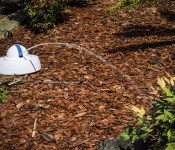
There’s a new helper robot for homes called Droplet, but it has no intention of usurping Roomba’s territory — in fact, you can think of it as a Roomba for your garden. It’s probably not capable of killing snakes like its badass indoor counterpart, but it can care for your plants without input. Technically, Droplet’s a smart sprinkler, but it’s actually more like an automated hose that aims only at plants (or anything you want) up to 30 feet away, since it was created as a means to conserve water. Of course, you’ll have to configure it a bit beforehand: after adding your plants’ names on Droplet’s interface using a phone, laptop or tablet, you’ll have to aim water at each of them, so the system can remember their locations. The robot then taps into various sources via WiFi to look up each plant’s needs to determine how often and how much it should be watered. In the event that rain’s coming your way, the device will hold off on doing its gardening duties, as it also gets real time data from thousands of weather stations.
Droplet’s creators claim it can lower water sprinkler consumption by up to 90 percent, which is huge if true, as lawn sprinklers are one of the top water wasters. They also claim that it can save up to $265 a year on water bills, almost enough to recoup your investment should you choose to pre-order a unit from Amazon right now for $300. As for the remaining $35, well, let’s just say that’s just the price you’ll have to pay for keeping R2D2′s Mini-Me as a gardener.
Filed under: Misc
Source: Droplet (1), (2)
Apple Begins Testing Related Search Suggestions Feature on App Store
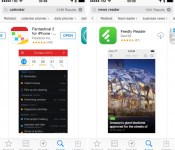
As first spotted by TIME Planner developer Olga Osadcha on Twitter (via MacStories), Apple has begun testing a related search suggestions feature for some users in the App Store.

The new menu appears to overlay itself on top of an existing search query, giving users search suggestions in similar categories – for instance, searching for “calendar” gives related suggestions for “calendar planner” and “daily planner”, while a search for “sports games” displays suggestions to “action games” and “RPG games”.
The suggestions box also appears to extend to some searches for specific terms, as searching for “twitter” will result in suggestions for “news apps” and the like. Suggested searches can also lead to more sub-suggested keywords, which can be made up of general phrases and specific company and product names.
The results appear in a similar fashion to queries in Chomp, which was an app search startup acquired by Apple in 2012. It is therefore likely that Apple could be using some of the suggestion technology utilized in Chomp, as Apple’s reported reason for acquiring the search engine was to improve the App Store search and app discovery. Apple added the single-tile styled result to the App Store in 2012, which was also based off of Chomp’s layout.
Currently, Apple’s new App Store search suggestions are not appearing for all users, however that is likely to change as the feature undergoes more testing. It is also possible that the new search suggestions will not require a full update for iOS, as Apple is expected to roll out the new feature on top of the App Store’s existing interface.
     |
Xbox One bundle price drops to $399 on Amazon (update: back to $450)

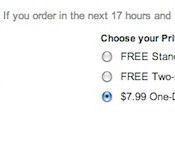
We’re not sure if this is a real price drop or a retailer error, but CheapAssGamer.com points out that the Xbox One is currently available on Amazon for $399 — the same price as a PlayStation 4, but obviously with the Kinect camera and a game packed-in. The Xbox One Standard Edition (with the Forza Motorsport 5 digital code) is currently listed for $450, but adding the discount code XIAMAZON — first seen last week as retailers cut prices on the Titanfall bundle to $450 — takes an additional $50 off of the price. Of course, this means you don’t get the console’s most anticipated game as a part of the deal, but at this price we doubt many will complain. It’s earlier than an anticipated and if it’s an error (of course, Amazon is starting a videogame Gold Box deal today…) then we don’t know how long it will last, but tell us — if they’re the same price which would you choose, an Xbox One or PS4?
Update: It looks like it was an error, as the bundle’s price has jumped back to $499, which comes down to $450 with the discount code. It was good while it lasted, but we guess Microsoft isn’t quite ready to make that level of sacrifice to catch the PS4 in sales.
Xbox One w/ Forza Motorsport 5 is $399 at Amazon with code “XIAMAZON” http://t.co/edRmLxkZ7h
– Cheap Ass Gamer (@videogamedeals) March 25, 2014
Source: Amazon

LG’s Knock Code unlock method bumps into G2 and G Flex next month

LG’s staying true to its word and updating the basic KnockON feature found on the G2 and the G Flex with its newer, more sophisticated Knock Code technology. The South Korean company launched the feature on the G Pro 2 in February, with a promise that it’ll eventually be available on older models. While the older knock technology only switches a screen on or off when you tap it, Knock Code lets you bypass the lock screen altogether. You merely need to configure a phone’s security setting to recognize a combination of up to eight taps made on four sections of the screen beforehand. The security feature’s slated to arrive on the handsets sometime in April through a firmware update — the bad news is, there’s no clear word on which countries will get it. Obviously, users in LG’s home turf will be some of the first to enjoy the feature, but everyone else will just have to cross their fingers.
Filed under: Cellphones, Mobile, LG
Source: LG

Bipartisan bill will stop NSA’s bulk phone call data collection, but it might not go far enough

Following Edward Snowden’s leaks about the NSA collecting massive amounts of data about phone calls flowing through several companies, President Obama announced limitations on the use of that data in January and said more reforms would follow. Now, the New York Times, Wall Street Journal and Washington Post report a bipartisan bill is about to be unveiled that makes several large changes to the NSA’s controversial bulk collection of phone call metadata. A bill that will be unveiled tomorrow in the House of Representatives by Mike Rogers (R-MI) and “Dutch” Ruppersberger (D-MD) will instead see phone companies store the data only as long as they normally would (18 months or so, under other federal regulations). If the NSA suspects a terrorism link, it can make requests for information from specific phone numbers, and related records up to two hops away.
What’s likely to disappoint privacy advocates however, is that the NSA is only required to send a copy of the directive to a court for review after record collection has already started. On the other hand, according to the Post, it would have the make a determination if a number is linked to terrorism “promptly” and if it does not decide that it’s linked “agent of a foreign power,” it will be expunged. We should find out exactly what’s in the bill when it’s introduced tomorrow but there’s one other note to remember — 90-day approval for the NSA’s current bulk collection program ends Friday, and is likely to be renewed at least one more time while this and other bills are sorted out.
Filed under: Cellphones, Internet
Source: Washington Post, New York Times, Wall Street Journal, The Guardian
 AIVAnet