



SkyShield protects airliners from missile strikes, completes testing in Israel

SkyShield, created by Israel’s Elbit Systems, has reportedly been under development for the better part of a decade, but the laser-based missile deflector has just now successfully completed live testing. The Multi-Spectral Infrared Countermeasure (MUSIC) device, which is mounted on an aircraft’s belly, uses a thermal camera paired with a laser to change the direction of approaching missiles, saving airliners and passengers from destruction. When the camera detects a missile, it rotates the plane so that the belly faces the approaching weapon. It then fires a laser beam, redirecting the missile so it can explode a safe distance away. It’s not clear when the technology will begin rolling out, but according to Haaretz, SkyShield will be used on all Israeli civilian aircraft, many of which operate around the world.
Filed under: Transportation
Via: Gizmodo
Source: Haaretz, Washington Times
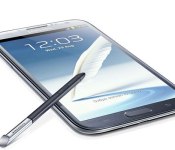
How would you change the Galaxy Note II?

In just three years, the Galaxy Note has grown from a niche device to a must-have, which is almost as eagerly anticipated as Samsung’s Galaxy S flagships. When we placed the Galaxy Note II in the hands of our tame phone driver, they had nothing but praise for the handset. Oh, except for its sky-high price, that is. But what of you, we ask? What particular things did you love or loathe about this particular slab of glass and plastic? Share your experiences on the forum.
Filed under: Cellphones, Mobile, Samsung
Source: Engadget Forum

Switched On: Understanding crowdfunding’s caveats, part 2
Each week Ross Rubin contributes Switched On, a column about consumer technology.

The last Switched On discussed how many of the Risks and Challenges sections of Kickstarter campaigns fail to portray an accurate picture of what might go wrong. This was true in the case of the Auris Wily. It, like many campaigns, used this section of the campaign page in the exact opposite way it should be used; they allay concerns about risks and challenges. If the Risks and Challenges section of Kickstarter campaigns reflected reality, they might include some of the following things you should keep in mind for any device project you back:
- The company could get sued out of existence for patent infringement or something else.
- The product may turn out to be impossible to make or cost so much to make that it exceeds the amount of funds raised.
- The product may unintentionally do something illegal.
- An explosion at the factory could wipe out production.
- The contract manufacturer could have lied about its capabilities.
- A critical component for the product could become unavailable.
- A defect could be found that makes the product unsafe or unusable.
- The app that the product requires could be denied by Apple or Google.
- A critical team member may get hit by a bus.
- The bus may be driven by another team member with whom there’s been a falling out.
- That apparently earnest guy humbly telling you “Here’s where you come in,” in the slickly produced pitch video could take the money and vanish to a comfortable retirement in Chile where he feigns a humble existence driving a bus.
And of course, even if the project creator delivers working products in a reasonable time frame, there’s no guarantee that it will be around to support the product long enough to honor any warranty, or that a competitor will not come out with something that does what its product does better at half the price. Given the extended gestation of many crowdfunded devices, that’s a genuine possibility.
Now, the odds of many of these things happening are very low. But so are many of the risks detailed in S-1s. And both kinds do occur. Indeed, many, if not all, of these scenarios have occurred with products in their early days and certainly happened with Syre and Jorno.
All project owners should not be painted with the cavalier brush.
All project owners should not be painted with the cavalier brush. Here are some good risks articulated by the developers of the impressive Dash earbuds that have raised more than a million dollars and pack a completely wireless MP3 player and fitness aid into a set of headphones:
“Due to the incredible small size of The Dash, we use miniature components. For some of these we only have a single supplier. Even though we have a close dialog with our suppliers, we are not in control of their actions. Every component is highly integrated into and optimized within the design, and an unforeseen component alteration can delay our launch.

As Kickstarter continues to contemplate the best way to protect consumers, it should require that these kinds of real risk factors be disclosed universally.
“The Dash has a complex Bluetooth setup that we have tested vigorously in our labs. We might encounter real life applications, where we cannot guarantee for the quality of operations. We will continue to improve our software throughout the launch to improve functionality.”
The bottom line is that making a hardware product to be delivered on a mass scale is extremely difficult and even the most experienced and resourceful companies in the world occasionally fail in attempting it. As Kickstarter continues to contemplate the best way to protect consumers, it should require that these kinds of real risk factors be disclosed universally. And if the project creators won’t do it, it should be stated on the campaign page or pledge page or both.
In the meantime, by all means we should continue to back the projects that we believe in. But like anyone giving money to a cause — be it a venture capitalist funding a startup or a pedestrian sizing up a street beggar — understand the risks, analyze the authenticity and accept that your investment may be squandered.
Ross Rubin is principal analyst at Reticle Research, a technology, media and telecom advisory firm, and founder of Backerjack, which covers crowdfunded product innovation. He blogs at Techspressive.
Filed under: Misc

Stephen Colbert’s Cloud Fog: ‘part cloud, part fog, all security’

Stephen Colbert has a lot to say about internet privacy, Edward Snowden and the NSA, and he shared his thoughts Friday evening at an Internet security conference in San Francisco. Privacy advocates had implored Colbert to skip the event, which was hosted by security giant RSA — a company that reportedly took $10 million from the NSA to give the agency a back door into its software. Said Colbert: “I looked at the signatures on the online petition, then I looked at the signature — my signature — on the bottom of the contract saying I’d be here today, and my conscience was clear, as long as the check clears. Well, it’s not actually a check. They gave me a Bitcoin voucher for Mt. Gox. And I’m sure it’s going to be fine.”
Colbert also used the event to unveil his own privacy solution, something he calls Cloud Fog. The service — which he describes as “part cloud, part fog, all security” — relies on a familiar “advanced polyhedral extruded polymer info solid” to generate random numbers. Hey, doesn’t seem any worse than many of the real security solutions out there.
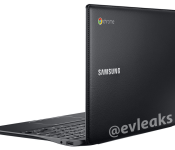
Evleaks Posts Image of the Samsung Chromebook 2

Mr. evleaks gave us a little treat today, and that treat is the new Samsung Chromebook 2. Yesterday, he teased us with just the corner of the new Chromebook, that showed that Galaxy Note 3-like faux-leather and stitching, that was also accompanied with the Chromebook logo. Now we get that full-nude backside.
I guess Samsung is just going to stick with the faux-leather look, which doesn’t exactly please my eyes, but Galaxy Note 3 users out there I guess dig it. It actually looks better on the a Chromebook than the Note 3 in my opinion, because it gives it that briefcase look to it. Not that a Chromebook is for the everyday business man, but hey, those guys need a small laptop to play around on too. Let us know what you think about the image.
Source: evleaks
HTC stopping its HTC Watch movie sales and rental service
HTC have just announced that as of March 31st 2014, HTC will be ceasing their HTC Watch movie sales and rental store.
The service had been slowly closing across a variety of countries including Spain, Italy, Sweden, Norway, the Netherlands, and Denmark, and now the United States of America, and the UK are set to follow suite.
As a user of the HTC Watch service we would like to notify you that from March 31st 2014 the store will no longer be available.
Up until this date, you willl still be able to purchase movies from the HTC Watch store as normal. Your library will not be accessible after March 31st, 2014.
Please download the movies you have purchased to your devices before the above mentioned date. If you do not find the HT Watch application in your device to download and watch the movies you have purchased, please kindly visit http://www.htc.com/support for more details.
We thank you for being a HTC Watch customer, and apoligise for any inconvenience caused.
Be sure to download your purchases from the HTC Watch App before March 31st 2014 in order to ensure they are not lost, because after this date, unfortunately they’ll fall into cyber space.
The post HTC stopping its HTC Watch movie sales and rental service appeared first on AndroidGuys.
Blackberry updating BBM to allow for larger file sharing
If you are one of the users who are still using BBM then there’s a big update coming your way which will offer larger file sharing and new features for group chats.
Bringing BBM in line with most other cross-platform messaging services, users will now be able to share photos in group chats and to assist with this the file limit for sharing files has been increased from 6MB to 16MB.
Blackberry have said that they are planning on making the emotions in the chat bigger too, so great news if that’s something you’ve been longing for.
Unfortunately, Blackberry have been scarce on an actual ETA for the update, but expect it to rollout shortly. Keep your eyes peeled to AndroidGuys for any further developments.
The post Blackberry updating BBM to allow for larger file sharing appeared first on AndroidGuys.

HTC shutting down its Watch movie service in the UK

When HTC pulled the plug on its Watch service in a number of European countries last year, it told us that it was merely streamlining its efforts, and that movie rentals and purchases would continue to be offered in places with the “highest engagement.” But now it looks like the closures are spreading to those areas too, with UK users receiving an email warning them that the Watch store will close on March 31st, by which point any purchased movies must be downloaded to a device in order to remain accessible. We’ve asked HTC for a fuller explanation, but in the meantime we’re left with the feeling that the company’s in-house streaming platform may actually have been dying a slow death this whole time, due to a lack of popularity. Either that, or the name “HTC Watch” has suddenly become very inconvenient.
Filed under: Cellphones, HD, Mobile, HTC

Up, up and down: The ephemerality and reality of the jetpack
Welcome to Time Machines, where we offer up a selection of mechanical oddities, milestone gadgets and unique inventions to test out your tech-history skills.

Born out of sci-fi cinema, pulp literature and a general lust for launching ourselves into the wild blue yonder, the real-world Rocket Belt began to truly unfold once the military industrial complex opened up its wallet. In the late 1950s, the US Army’s Transportation Research Command (TRECOM) was looking at ways to augment the mobility of foot soldiers and enable them to bypass minefields and other obstacles on the battleground by making long-range jumps. It put out a call to various aerospace companies looking for prototypes of a Small Rocket Lift Device (SRLD). Bell Aerospace, which had built the sound-barrier-breaking X-1 aircraft for the Army Air Forces, managed to get the contract and Wendell Moore, a propulsion engineer at Bell became the technical lead.
 Bill Suitor geared up and ready to demo the Rocket Belt for NASA and the USGS – circa 1966.
Bell Aerosystems Rocket Belt
The most viable design at Bell’s Buffalo, NY, facility was a hydrogen peroxide rocket-propulsion system, which offered a relatively stable fuel with no combustion. It was dubbed the Rocket Belt and was essentially a three-tank system mounted onto a fiberglass corset molded to fit the operator. The center tank was filled with nitrogen gas and the side tanks contained a 90 percent hydrogen peroxide mix. The nitrogen would force the fuel into a gas-generating catalyst that converted it into a highly pressurized mix of oxygen and water (steam), and then out of two nozzles on either side of the operator, providing 280 pounds of thrust (and a good deal of heat). After the thrust capability, one of the primary difficulties was in achieving a steady and stable flight. Phase one in Bell’s testing was completed by December 1960, and due to the experimental nature of strapping rockets onto the test pilot (Moore himself), they were all done with a safety tether attached.
 It was time to move on to phase two of the Rocket Belt’s testing, which meant free-form, untethered flights. After injuring his knee in one of the flight tests, Moore had to pass on the torch to his associate and engineer Harold Graham, who took over as test pilot. After significant testing, Graham made the first successful untethered flight with the Rocket Belt in April of ’61, managing to hit 10MPH during a 13-second flight and covering a total distance of 112 feet. It was a promising achievement, but fuel depletion and flight longevity were major concerns when considering potential field applications. In fact, about 10 seconds of the flight would need to be focused on making a landing. Early designs even included warning lights and a steady beeping that was piped into the pilot’s headset at the 10-second countdown, as if flying around with a rocket on your back wasn’t nerve-racking enough. Although, according to Bill Suitor, who later joined the team, they maintained a 100 percent safety record over the course of 3,000 flights between April 1961 and 1969.
 Bill Suitor mid-flight in the Rocket Belt at Hopi Buttes, AZ – circa 1966.
Graham’s successful flight with the Rocket Belt led Bell Aerosystems on a nearly decade-long series of demonstrations for the public, press and various government officials. In October 1961, Graham even demoed the Rocket Belt for President John F. Kennedy, launching from a boat to meet the president at shore nearly 200 feet away. With the number of appearances growing, Bell needed to find more pilots and the Army even requested that untrained personnel be among them. Moore decided to offer this exciting opportunity to Suitor, his 19-year-old neighbor, and it’s no great surprise that he took the job. After making 60 tethered training flights, Suitor was free to rocket about the place unrestrained and join the Rocket Belt flight team. As 1965 rolled around, already a veteran at state fair demonstrations, Suitor landed a role as stunt double for the James Bond movie Thunderball, replacing special effects with the real thing.
 Although the Rocket Belt had a degree of success with its tests, it failed to meet the standards of the Army and was never put into production. In 1966, Bell took the device out to Hopi Buttes, Ariz., to show it off to NASA and the United States Geological Survey (USGS) as a potential Lunar Flying Vehicle (LFV) for upcoming moon missions. By this time, the Rocket Belt was managing to stay aloft for about 21.5 seconds and approached a maximum range of 860 feet, and eventually hit top speeds of up to 80MPH. In 1968, NASA granted Bell Aerosystems a $250,000 contract (about $1.7 million in today’s market) to develop lunar vehicle concepts with its rocket system. This led to the development of various “pogo” type units, which had rigid frames and could carry up to two passengers. One of the primary avenues of research was to develop a LEAP (Lunar Escape Astronaut Pogo), which could be used as a backup plan to help astronauts stranded on the moon’s surface to return to the orbiting lunar command module. Problems with limited range and rapid fuel depletion reared their heads again and the designs were never adopted.
 The TAM Jetpack.
While the Rocket Belt never turned our armed forces into valley-leaping juggernauts, it continued to capture the hearts of the public. In 1984, Suitor piloted a version of the Rocket Belt during the opening ceremonies of the Los Angeles Olympics. Jetpack-type devices became a popular attraction at auto rallies, aviation shows and other high-energy gatherings. Inventors and hobbyists continued the work that Moore began at Bell Aerospace, creating their own variations of the hydrogen peroxide-powered pack, including a later model Jetbelt built by Juan Manuel Lozano Gallegos for his company Tecnologia Aeroespacial Mexicana (TAM). You can currently get one of the TAM Jetbelts built to your own custom specifications and it comes with a device that helps you make your own rocket-grade 90 percent hydrogen peroxide fuel mix. It’s considerably lighter than Moore’s version, using modern materials like carbon fiber and composites to accommodate slightly larger tanks for extending flight times up to 35 seconds. The TAM Jetbelt may set you back a modest $95,000, but that’s still cheaper than a fully loaded Tesla Model S and once you’re cruising through the air at $2,700-per-second on that first flight, money will probably be the last thing on your mind.
[Image credits: USGS (Bill Suitor 1966, Hopi Buttes, AZ); USPTO #-3021095 (diagram); Keystone/Getty Images (Pogo); TAM (TAM Jetpack)]

Today is Engadget’s 10th birthday!

Ten years ago today (in fact, exactly 10 years ago, if you’re reading this post in real time), Engadget was born. Our first post featured T-Flash, a new memory card format created to serve cellphone users who wanted extra storage — as long as they were willing to cap their needs at 128MB.

We followed that initial post with another 13 that day, all written by founding editor Peter Rojas in his New York apartment. Peter had recently left Gizmodo, which he also co-founded, and saw both of those sites as being at the forefront of a reinvention of journalism. As he pointed out in a recent conversation:
I liked writing about tech, and I wanted to write as a fan, as someone who was really into this stuff — not just as a journalist or a dispassionate observer. That’s one of the things that made blogging great; it was people who were talking about things from their own perspective as enthusiasts, not just telling you industry news.
The T-Flash brand featured in our first post was eventually dropped in favor of the better-known microSD. The latest iteration, announced by SanDisk just last week, has 128GB of storage space, a thousand-fold increase in capacity over the version we highlighted a decade ago.
Like those memory cards, Engadget has continued to grow. Fourteen-post days have given way to periods when our daily updates number in the hundreds, as we cover major product launches, breaking news and industry events like CES and Mobile World Congress. Along the way, we’ve added videos, a massive product database, user reviews and forums and our own reviews of thousands of products. We’ve also built a team that has included some of the most talented writers and editors in the tech space, including Peter’s successors, Ryan Block, Joshua Topolsky and Tim Stevens.
During the next few months, our 10 Years In series will commemorate our 10th year by highlighting the many ways the consumer electronics landscape has evolved during the past decade. Stay tuned for the final word on PDAs, PMPs and CRTs.
As we celebrate our 10th anniversary, one thing hasn’t changed: our obsessive approach to providing you with the best news and information about consumer electronics and technology. Thanks for joining us as we enter our second decade!
Coming tomorrow: The early days of Engadget, with more comments from Peter Rojas and an exclusive look at the evolution of Engadget’s iconic logo.
(Engadget birthday cake by Bruno)
Filed under: Announcements, Meta
 AIVAnet