


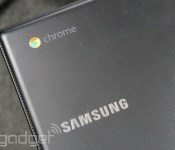
Samsung’s latest Chromebooks come wrapped in faux-leather, on sale next month for $320 and up

It’s been over a year since Samsung released a new Chromebook, and since then the competition has been heating up: Dell, HP, Lenovo and Toshiba all sell Chrome OS devices now, as does Acer, which has been at it from day one. Accordingly, Samsung is refreshing its lineup: the company just announced the Chromebook 2, which comes in 11- and 13-inch screen sizes, and will ship next month starting at $320 for the smaller version (the bigger one costs $400).
Perhaps even more interesting than any of the spec bumps, though, is the new design. Confirming some leaked photos that began circulating two days ago, the Chromebook 2 sports a faux-leather lid with a soft, rubbery finish and fake stitching at the edges — yep, just like the Galaxy Note III, Note Pro 12.2 and other recent Samsung devices. In-hand, it actually feels quite nice, and might even be easier for children to grip, assuming this ends up in classrooms. It also has a thin silhouette, which we’re told was modeled after the ATIV Book 9 Plus (formerly called the Series 9 Ultrabook). It’s generally a pleasing design, although the plain plastic underside makes for a mullet sort of look: premium on top, bargain-basement on the bottom.
If you wanna save money, the last-gen (safer-looking) model will still be around for $249, but you might choose to splurge anyway: the 13-inch Chromebook 2 steps up to a 1,920 x 1,080, 250-nit screen, with both sizes promising improved performance. In particular, they make use of an eight-core processor similar to the one found in a variant of Samsung’s new Galaxy S5 smartphone. As with the GS5, “octo-core” will sometimes mean running all eight cores simultaneously and other times just running a quad-core setup, with either the four powerful cores or the four weaker, energy-saving cores being used at one time, depending on the task. Largely thanks to that, Samsung is rating battery life at eight hours on the smaller 11-inch model, and 8.5 hours on the 13-inch version. Whichever model you choose, you’ll get 4GB of RAM (twice the allotment of the last-gen model) plus 16GB of local storage.
On the software side, these are also the first Chromebooks certified for Google Hangout, though really, any Chrome OS device can use Hangouts, not just these. Samsung also threw in a year of AirDroid service, which lets you wirelessly transfer files between your Android phone and Chromebook. Oh, and this isn’t a software tweak, but the Chromebook 2 now has Bluetooth 4.0, not 3.0. Also nice to have. In any event, it will ship sometime next month, priced at $320 for the 11-inch version (available in black and white), and $400 for the 13-inch model (“Titan Gray” only). We’ll be back with a review but for now, enjoy the hands-on photos.

Why should a company use digitaldownloading.co.uk to host and stream their multimedia content?
 In the earlier days of the Internet, the most effective way to host audio and video content was to host it online and allow users to download entire files – however, there were a number of problems with this. First of all, slow connection speeds would have sometimes made it near impossible to download the content (especially with video files), and there was also the problem of limiting the availability for a set period of time as files could technically be stored forever. The advent of streaming technology and faster Internet speeds have enabled multimedia publishers to have a greater amount of control over their content, and the specialists at digitaldownloading.co.uk can advise businesses about the best way to get their digital output viewed by the largest possible audience. At the same time, it is also possible to apply various levels of protection to streamed material that can prevent unauthorised viewing, storage and distribution, and it can be broadcast in various ways to generate additional revenue.
Compatibility with a variety of connection speeds
Within the UK, there are huge fluctuations in Internet connection speeds from one area to another. While built-up areas can now access a range of fibre broadband products, there are still many locations that are still only able to connect through an older DSL-based service. Digital streaming technology is adaptable to any speed of Internet access, and digitaldownloading.co.uk can show business how to take advantage of dynamic streaming services – these allow users to access material at a speed that is suitable for their broadband connection, and the image and audio quality will adjust itself in real-time.
Protecting content from unauthorised viewing, downloading and distribution
When hosting content with the assistance of digitaldownloading.co.uk, it can be protected with technology that prevents the user from saving it to their own hard drive for further viewing or distribution. If it is only desirable to keep it visible online for a certain period of time, it can taken offline as quickly as simply flicking a switch. If geographical concerns mean that it is desirable to block access to streamed material in certain national regions, geolocation technology can be incorporated into streaming services to prevent viewing in non-authorised areas.
Allowing audio downloads for further offline listening
In certain cases, it may also be advantageous to offer audio content for downloading, and digitaldownloading.co.uk can not only help with setting up a paid downloading business model – they can also apply sophisticated DRM techniques that prevent the buyer from transferring the paid content to other users. If a band wants to sell their music on an individual or album-only basis, it is possible to host this content without the need to go through one of the major distribution networks, and this gives the content owner a greater level of control over the process.
For more information about how a business can benefit from digital content streaming and downloading, the team at digitaldownloading.co.uk can be contacted by email at mail@digitaldownloading.co.uk or visit website digitaldownloading.co.uk
Martin Jonson is director of the UK’s Digital Downloading company providing exceptional quality at the lowest UK prices. He will complete your job quickly with the greatest care. You can connect with him on Google+.

Apple CFO Peter Oppenheimer Joins Board of Directors at Goldman Sachs [Mac Blog]
 Goldman Sachs Group today announced that Apple Chief Financial Officer Peter Oppenheimer will join the banking firm’s board of directors, effective immediately.
Oppenheimer will become the board’s 13th director and will serve on the firm’s Audit, Risk, Compensation and Corporate Governance, Nominating and Public Responsibilities committees.
“Peter’s 25 years of broad experience across important industries will add a valuable perspective to our Board of Directors,” said Lloyd C. Blankfein, Chairman and CEO. “We appreciate his willingness to serve as a director and look forward to benefitting from his judgment and counsel.”
Oppenheimer joined Apple in 1996 as the Senior Director of Finance and Controller and was promoted several times before being appointed as Apple’s Chief Financial Officer in 2004. Besides serving on the board at Goldman Sachs, Oppenheimer also is a board member for the California Polytechnic State University Foundation and Sacred Heart Schools in Atherton, California.
Oppenheimer isn’t the only Apple executive to serve on the board of directors at another company. Apple CEO Tim Cook is a member of the board at Nike, while senior vice president of Internet Software and Services Eddy Cue serves on Ferrari’s Board of Directors, a role he undertook in November 2012. 
     |

Photo suggests Oppo’s Find 7 smartphone might have a 50-megapixel camera

Oppo may have just stolen Nokia’s camera resolution crown. The Chinese company has posted a whopping 50-megapixel (8,160 x 6,120) photo that was reportedly taken with the upcoming Find 7 smartphone. On a surface level, the image checks out — there’s a lot of detail here, including street signs that suggest Oppo took the picture in Barcelona (despite the likely fake Florida license plate). However, we wouldn’t be too quick to praise the Find 7′s photographic abilities. Oppo is known to occasionally post bogus teasers that don’t translate into shipping products, so it wouldn’t be surprising if the company’s new flagship relies on more modest camera technology.
Filed under: Cellphones, Mobile
Source: Sina Weibo (translated)

Chrome OS may soon let you run multiple profiles at once

If you have a Chrome OS system, you know it can be a hassle to sign out just so that someone else can borrow the computer for a few minutes. That may not be an annoyance for much longer, though. A new developer version of Chrome OS includes experimental code for running multiple profiles at once; after others sign in, you can switch between users at the drop of a hat. You can even send windows to different profiles. There’s no certainty that Google will bring multi-account support to a polished Chrome OS release, but those willing to take some risks can switch to the Dev channel to try the feature today.
Filed under: Internet, Software, Google
Via: The Next Web
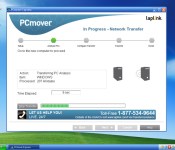
Microsoft tries to get users off Windows XP with migration tools and warnings

Microsoft really wants Windows XP holdouts to upgrade before official support ends in a month’s time, and it’s providing some last-minute incentives to get those people moving forward. The company will soon let XP users download a free copy of Laplink’s PCmover Express to migrate their data to newer Windows releases. The crew in Redmond isn’t just hoping that users will find the tool and update on their own, though. It plans to send an end-of-support notification to most XP users on March 8th; if they didn’t already know about the deadline, they likely will by this weekend. Microsoft can’t force its customers to use modern software, but these latest steps will at least make its intentions clear.
Filed under: Software, Microsoft
Source: Windows Experience Blog
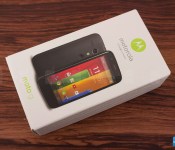
Moto G Stays Ahead of the Pack with Introduction of KitKat

For those mobile users out there savvy enough to have purchased the budget priced Motorola Moto G, because they were willing to overlook its name and less than glossy look for its high-end specs are about to benefit again. The Moto G has been slated to be the first non-Nexus handset to be upgraded to Android 4.4.3, KitKat. As the cheaper version of the Moto X (which is currently unavailable in the UK), the Moto G was launched in November for around £120. For those not familiar with the Moto G, Motorola was acquired by Google in 2012, and the Moto G was developed to provide a quality smartphone at a price everyone could afford. They promised smooth integration with Google as well, and this upgrade backs that promise.
Here is short breakdown of the Moto G:
Design – Though certainly not fancy, the Moto G is solidly built, and has a comfortable feel that betrays its ‘bargain’ status. It measures 129.9 mm x 65.9mm x 11.6mm, which doesn’t make it the smallest phone on the market, but it is a nice size. The default colour scheme is Black, but removable backplates and flip colors are available in six different colours. The front of the phone is dominated by its 4.5-inch, 720p HD screen. Above the screen is the speaker, the front camera lens and a notification LED. The buttons and jacks are well placed, and the phone should be easy for one handed operation by most users. The display comes in at an impressive 329 pixels per inch (ppi), and the brightness, contrast and color vibrancy are all excellent for a phone at this price.
Features – The Moto G is able to provide blazing performance, thanks to its 1.2 GHz quad-core Qualcomm Snapdragon 400 SoC, including a 450 MHz Adreno 305 graphics processor and backed up by 1GB of RAM. Internal storage options are 8GB and 16GB, but unfortunately, there is no MicroSD slot for external expansion. However, you are given an extra 50GB of Google Drive space free for two years. For connectivity, it is also off the charts for a low priced handset, offering GSM/GPRS/EDGE/UMTS/HSPA+ (and CDMA in the US). Also available are Bluetooth, GPS and an FM radio and single-band Wi-Fi. Unfortunately, dual-band Wi-Fi, LTE and NFC are not supported. The camera is also somewhere the Moto G decided to cut corners a bit. The 5MP front camera and 1.3 MP back camera certainly take decent snaps, but they hardly compare to high-end smartphones.
Overall, you can see that the Moto G isn’t going to live up to the likes of the Nexus 4, HTC One or the iPhone, but it wasn’t intended to. When the Moto G was launched, CEO Dennis Woodside said, “Most people can’t afford a $500 or $600 smartphone. In fact, the average price of a smartphone is close to $200 – the problem is, the experience that smartphones in this class provides is really, really bad.” This, quite simply, is the problem that the Moto G was designed to conquer, and it fills the task well. By no means a top-of the line smartphone, it has modern-day technology at an affordable price; rather than passing off a three or four year-old flagship phone as a nice value phone. The latest upgrade to Android KitKat 4.4.3, before the HTC One, and long before the Galaxy S4 (Samsung may not upgrade to KitKat until the release of the S5), proves that this is no joke of a phone, and can compete with the big boys without giving your wallet a beating.

Apple Targeted ‘CarPlay’ Trademark Protection Beginning in May 2013 [iOS Blog]
As part of Apple’s announcement earlier today regarding the launch of its new iOS vehicle integration at the Geneva International Motor Show, the company revealed that it has rebranded the feature from “iOS in the Car” to “CarPlay”.
Curious about whether Apple had previously sought to protect the CarPlay name with a trademark application, MacRumors has investigated the situation and determined that Apple appears to have registered a shell company by the name of Carplay Enterprises LLC on November 14, 2013.
 Delaware corporate registration for Carplay Enterprises
The company has no obvious link to Apple aside from the fact that it is headquartered at 1209 Orange Street in Wilmington, Delaware, where other Apple-related companies have also been listed. The building is, however, essentially a mail stop that serves as the headquarters for hundreds of thousands of companies seeking to take advantage of Delaware’s business-friendly laws.
Its occupants, on paper, include giants like American Airlines, Apple, Bank of America, Berkshire Hathaway, Cargill, Coca-Cola, Ford, General Electric, Google, JPMorgan Chase, and Wal-Mart. These companies do business across the nation and around the world. Here at 1209 North Orange, they simply have a dropbox.
Less than a week after its formation, Carplay Enterprises began filing for trademarks on the “CarPlay” name, with applications in Australia, Norway, and a number of other countries coming on November 19 and the United States and several more countries following a day later. Apple’s U.S. application seeks protection in three classes: Computers (including handheld devices, peripherals, and software), GPS navigation, and Computer programming.
The U.S. application lists as contact information a Gmail address and an attorney by the name of Robert Friedman who has no obvious connection to Apple, while the signatory on the application is listed as “not provided”, suggesting that Apple was working quite hard to cover its tracks. Prior to the introduction of the iPad, Apple was discovered to have filed for a trademark on the name “iSlate” under a different shell company, with one giveaway being that the application was signed by an Apple employee.
 U.S. trademark filing for “CarPlay”
Apple’s apparent efforts to protect the CarPlay name extend back even further, however, as the November trademark applications all cite a May 20, 2013 application in Trinidad & Tobago as priority. Apple commonly uses Caribbean countries such as Trinidad & Tobago and Jamaica to establish trademark priority, taking advantage of filing systems that receive little attention and are difficult to search.
Apple introduced “iOS in the Car” at its Worldwide Developers Conference in early June, but it remains unclear whether that name was simply a placeholder with Apple intending all along to launch the feature as “CarPlay” once relevant trademark applications had been made throughout the world. Alternatively, Apple may have been considering several possibilities for the name and filed the application in Trinidad & Tobago to preserve that option before moving forward with the CarPlay name late in the year.
| |

Apple’s iPhone Trade-In Program Launches in France Retail Stores [iOS Blog]
Starting today, Apple is expanding its iPhone trade-in program to French retail stores, making France the third country to offer Apple’s in-store recycling initiative. Though not publicly announced, an Apple spokesperson in France confirmed the launch to iPhoneAddicts.

The program allows customers to trade-in an older iPhone at a retail store and immediately receive up to €215 ($296) in a gift card credit that can be used towards the purchase of a new iPhone. French retail store employees have been briefed on the program and have been told to inform customers of the recycling option when they buy a new phone. Trade-in details already listed on France’s Apple Store website.
Apple’s in-store iPhone recycling program debuted in the U.S. in August 2013 and was rolled out to the UK a few months later. Apple has a similar online trade-in program that requires customers to send in their old iPhone before receiving a credit. This mail-in program may offer greater value for a used iPhone, but the in-store program offers the convenience of a no-hassle credit that’s immediately applied to the purchase of a new model.
| |
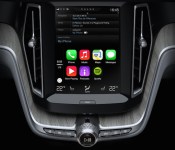
CarPlay Shown Off in New Promo Video from Volvo, Wi-Fi Connections ‘Coming Soon’
Following this morning’s announcement from Apple that it will officially begin rolling out its “CarPlay” iOS vehicle integration with Ferrari, Mercedes-Benz and Volvo on board as the first launch partners this week, Volvo has published its own press release announcing the launch. Volvo’s promotional materials include a new video briefly showing off CarPlay in action.
Volvo also goes a step beyond the basic CarPlay implementation to take advantage of the large portrait touch screen on the upcoming XC90 SUV, making both Apple and Volvo controls available simultaneously.
Volvo enhances Apple’s capabilities by linking them to a specially-developed interface that allows drivers to use voice and touch controls to access Apple features and services, ensuring the entire interaction is always safe and easy to use.
With Apple CarPlay, users will immediately recognise their basic iPhone applications, such as phone, messages, music and navigation. The initial offer also features third party audio apps including Spotify, the popular music streaming service.

Volvo’s press release also makes clear that while the initial implementation of CarPlay will require a wired connection using an iPhone’s Lightning connector, Wi-Fi connectivity will be “coming soon”.
| |
 AIVAnet