



Companies would be in charge of phone records under Obama’s new data collection proposal

The extent to which the NSA collects bulk phone call metadata has been one of the most prominent topics within the ongoing government surveillance scandal. President Obama promised reform, and not long after, a court approved measures that meant the NSA had to begin formally requesting access to records, and could only stray two degrees of separation from the original target. Today, news from the White House explains how the program could change further (much of which was revealed unofficially a couple of days ago). The proposal, which was drafted following a full review of the program, puts telecomms companies in charge of the data, not the government. They’d keep it for no longer than they currently do (around 18 months), but would be “compelled” under court orders to provide records in a “timely manner” and a “usable format.”
Once a data request has been court-approved, the powers that be have a window of time in which solicit records without needing repeated approvals. The hope is that, if approved “with the passage of appropriate legislation,” this tweaked program will alleviate some privacy concerns by taking the data out of the government’s hands, while still keeping the intel available for when it’s needed. As the proposal is only under consideration, the Obama administration will ask the Foreign Intelligence Surveillance Court (FISC) for a 90-day renewal of the current phone metadata collection program, February amendments included.
Filed under: Internet
Via: Reuters
Source: The White House

Turkish government bans YouTube following attempt to remove corruption videos

If you’re currently in Turkey, get ready to fire up that VPN. The Turkish government has just added YouTube to its list of banned websites, which as of last week also included Twitter (that site is reportedly back online). According to Webrazzi, the ban is already active with some ISPs, while other networks are in the process of blocking access as well. A Wall Street Journal report last week stated that Google declined a government request to remove YouTube videos that allegedly feature an audio recording of Turkish Prime Minister Recep Tayyip Erdoğan telling his son to hide money from investigators. It’s easy to speculate that today’s ban is a final attempt to curb the spread of the aforementioned corruption videos, but given that millions of viewers have already tuned in, this latest effort likely won’t be effective. We can only hope Turkey lifts the ban soon.
Source: Webrazzi, WSJ (Twitter), Mike Giglio (Twitter)
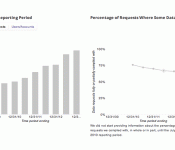
Google transparency report: government requests up 120 percent since 2009

Google’s been publishing transparency reports since 2009, but its disclosure of government requests has become especially interesting in the aftermath of revelations about PRISM and NSA surveillance. The company’s ninth report, released today, details a signifanct jump in requests for user information. Since the first report, the volume of government requests has increased by about 120 percent. Meanwhile, the percentage of requests where Google actually supplied user information has decreased slightly, to 64 percent in 2013 versus 76 percent three years earlier.
Google also notes that, as its number of users increases, so does the number of governments that exercise their authority to request information. In response, Mountain View’s transparency reports now include countries that make less than 30 requests during a period in addition to those that make 30-plus requests. Among the former group, you’ll find entries such as Bulgaria, Lichtenstein and even Vatican City, all three of which made only one request for user data between July to December 2013. Finally, Google’s responded to users’ questions about its response to search warrants with a live-action animation. Check it out below.
Filed under: Internet

Timehop comes to Android – “Did I really say that?” [App of the Day]
The popular iOS app, Timehop, is finally on Android, and it’s here to make you feel infinitely nostalgic.
Timehop gives it’s users an easy way to look back in time. It’s basically a feed of your favorite social networking sites, but only shows posts from a couple of years ago. If you’re unfamiliar with it, we’ll walk you through it.
The app is overall really easy to use. Login to your Facebook, Twitter, Instagram, or Foursquare accounts, and your feed populates with posts that happened around this time a few years back. It gives you posts that happened 1-4 years in the past, reminding you of your sleepless nights in college, or how excited you were when Ace Ventura came on television. Also, if you’d like to share any of these posts to Facebook or Twitter, you can do so with a few easy clicks.

Timehop is a simple application that doesn’t try to do too much for it’s own good, and that’s why we enjoy using it. Download it for free from Google Play!
Via: TechCrunch
The post Timehop comes to Android – “Did I really say that?” [App of the Day] appeared first on AndroidGuys.
Twitter enhances photo experience for mobile apps
Twitter this week is updating its mobile apps for Android and iOS with enhanced photo features. First, users can now attach up to four images to a tweet when composing a status update. What’s more, users can also tag up to ten friends in a photo; friends will be notified if tagged. For what it’s worth, tagging pictures does not affect your 140-character status limit. Feel free to upload and tag away! Whereas the iOS version of the app already has the new features, the Android client is expected very soon.
The post Twitter enhances photo experience for mobile apps appeared first on AndroidGuys.
Dell signs Android and Chrome royalty agreement with Microsoft
Dell has signed a patent-licensing deal with Microsoft which centers around the usage of Android and Chrome operating systems. Hardware maker Dell agrees to pay Microsoft for the integration of Google’s two platforms because Android employs some of Microsoft’s patents. This isn’t the first deal of its kind; plenty of other companies are doing the same with Microsoft. As for Motorola, however, that might not happen too soon. The Illinois-based company, which is now owned by Lenovo, contends their vast mobile patent library offsets any such scenario.
The post Dell signs Android and Chrome royalty agreement with Microsoft appeared first on AndroidGuys.

Equity Release: What Happens When You Die?

Faced with a retirement on today’s measly pensions, lots of us are looking for a way to boost our income so we can live out our golden years in a lifestyle we’re accustomed to. Currently, around 12 million workers face retiring on an inadequate income.
Equity release is a way of taking cash from your property, either as a lump sum, in monthly installments, or as a combination of both. For those already retired and living on a low income, this option could hold a lifeline during your golden years.
The major benefit of equity release over other plans to release cash from property, such as downsizing, is that you don’t have to move house. The advantages over taking out unsecured loans and credit cards is that there are no monthly repayments to be made. Any debt and interest accrued is settled with the sale of your home once you pass away.
There are two options available in terms of equity release, which have slightly different processes when you die.
Lifetime mortgage plan
A lifetime mortgage is an equity release scheme that allows you to take out a loan against your home. You retain the legal ownership of the property and the right to live there until you either die or move into a long-term care home. You don’t have to make any monthly payments.
When you (and your partner) pass away, your home will be sold to repay the loan along with interest accrued. Money left over will be passed on to your beneficiaries as dictated in your will. There is no way of knowing how much interest you will be charged, simply because you don’t know how long you will live. It is possible to pay the interest every month to reduce the amount you owe at the end of the plan, or you can let it roll up.
If your debt and the interest combined amount to more than what your property is worth, the outstanding would have to be settled by your family. To prevent this situation occurring you should only consider equity release schemes from members of the Equity Release Council. This ensures you are protected by the ‘no negative equity guarantee’ so you never owe more than what your property is worth.
Home reversion scheme
Home reversion operates differently to a lifetime mortgage in that you actually sell a portion of your home as opposed to taking out a loan against it. Again, you can stay in your home for as long as you wish, and you don’t have to make any monthly payments.
Once you pass away, if you have sold a percentage of your property under a home reversion scheme it would again need to go to market. Upon the sale of the property, the proceeds would be divided in the specified proportions between your estate and the equity release provider.
It is possible to sell 100 percent of your property under a home reversion scheme, but remain living in the property – again, for as long as you wish. In these circumstances, upon your death your home would be the possession of the equity release company and they may choose to sell it or rent it out.
Equity release is a viable option for homeowners facing retirement on a restricted income, but it is always recommended that you seek expert advice when considering it. Questions like “what will happen to my house upon my death?” enable you to obtain a clear picture, so you can make a decision that’s appropriate for your circumstances.
This article was written by Tom Williams on behalf of the equity release specialists retirement-experience.co.uk – a website dedicated to helping those in later life achieve the retirement they deserve.

Apple Patent Application Describes Use of Oleophobic Coatings on Sapphire Displays
Tim Cook confirmed in a recent interview with ABC News’ David Muir that Apple was manufacturing sapphire in its Arizona plant, but deflected any questions about how the company planned to use the material. Recent reports suggest the sapphire could land in the iPhone 6 or the iWatch as a display substrate, and a recent patent application lends some credibility to these rumors.

As noted by AppleInsider, the United States Patent and Trademark Office published an Apple patent application titled “Oleophobic coating on sapphire” that describes a method of applying an oil-repelling coating to a sapphire display for use in a mobile or portable electronic device.

The patent details a multi-layer display material with a base sapphire layer, a transition layer that serves to bond the surface layer to the base layer and finally a surface layer with an oleophobic coating.
Various embodiments described herein encompass a component with a substrate having an alumina base layer, a transition layer comprising alumina and silica, and a surface coating that preferentially bonds to the silica. The base layer may comprise a single-crystal sapphire. The transition layer may transition substantially continuously from about 100% alumina at the base layer to include substantial silica content at the surface coating, or to about 100% silica or silica glass at the surface coating.
A surface layer may be formed on the transition layer, with a substantially silica content, for example substantially 100% silica or silica glass, and the surface coating may be oleophobic. A portable electronic device may comprise the coated component, the portable device may include a window, the oleophobic coating may be provided on an exterior surface of the window, and the window may also include a touch screen.
Apple first used an oleophobic coating when it introduced the fingerprint-resistant material with the iPhone 3GS. The material has been used in subsequent products, including the current iPhone 5s, iPhone 5c, iPod touch, iPad Air and Retina iPad mini.
Apple last year signed a $578 million deal with materials manufacturer GT Advanced to produce sapphire in a new Mesa, Arizona plant currently under construction. Recent photos of the facility reveal significant building progress as the company moves closer to the plant’s target full operational date of June 2014.
     |

Western Digital Announces Thunderbolt-Powered My Passport Pro RAID Drive [Mac Blog]
Western Digital today announced the new My Passport Pro, the company’s first thunderbolt-powered, dual-drive storage solution. With user-selectable RAID functionality, the drive is suitable for graphics professionals looking for high performance or consumers who need reliable mirroring.

The aluminum enclosure accommodates two 2.5-inch drives, providing a total of 2 TB or 4 TB of storage space. Because it connects via Thunderbolt, the drive is powered by the bus itself and requires no extra cables and no external power source. It also delivers transfer speeds of up to 233 MB/s.
Superior to both FireWire 800 and USB 3.0, the integrated Thunderbolt technology of My Passport Pro makes video manipulation quick and easy—with the ability to copy a 22 GB high-definition video file in half the time typically required by a USB 3.0 drive working in RAID 0 format.
The My Passport Pro is available now at other major electronics retailers, including Apple, and online from Western Digital. The 2 TB My Passport Pro costs $299.99, while the 4 TB model is priced at $429.99.
| |

How the Internet Has Transformed the Psychic Medium Industry

The internet has changed the way that we do a lot of things, from shopping to dating to researching to choosing a holiday. These days, we can do almost everything online, which makes life a lot easier and more convenient. Also, one of the industries that the internet has transformed is the psychic medium industry.
The internet has changed the psychic medium industry in a number of very interesting ways. With the development of web cams and fast internet connections, it is now possible to speak to a psychic in real time online. There are many websites that will connect you with a range of different psychics, so that you can choose whom you want to talk to. This can not only make it more convenient to speak to a psychic, it can also have a number of other benefits.
Due to these benefits, online readings are becoming more and more popular and speaking to a psychic online has evolved into one of the most common ways to seek spiritual guidance.
How Does an Online Psychic Reading Work?
A live online psychic reading is very similar to a traditional psychic reading. The only difference is that it is conducted through online video chat services. When you use your webcam and microphone, you will be able to speak directly to a trained and gifted psychic – no matter where you live in the world. You are able to choose the psychic that you want to speak with and you will usually be charged by the minute.
One of the best ways to prepare for a psychic reading is to think about in advance what questions you would like to ask and what aspect of your life you would like insight on. Also, before your reading you should be open-minded and relaxed – so that you will get your best results for the reading. Some people even like to use relaxation techniques such as meditation and deep breathing – so that the spiritual communication with the psychic can be easier. Also, it is important to book your readings at a time when you won’t have to rush away or go somewhere afterwards.
What are the Advantages of Online Psychic Readings?
The development of the internet has made it so that online psychic readings are becoming more and more popular as a way to speak to psychics. What are some of the reasons why the internet has transformed the psychic medium industry in this way? What are some of the advantages of online psychic readings?
- Online readings are more convenient – there is no need to travel anywhere or spend money on fuel or public transport to reach your psychic. You can have a reading in the comfort of your own home.
- Online psychic readings are usually more affordable, because there will be no booking costs or transportation costs.
- When you speak to a psychic via an online chat, you will have a record of your exchange so that you can look back on their words later.
- Also, on an online psychic website you will find a number of experts in the field from all over the world. This means that you have more selection of high quality psychics to choose from, no matter where you live.
- Speaking to a psychic online can be very private and discreet – no one needs to know.
- Another advantage is that you will be able to get a reader whenever you need one. If you are up at 3 in the morning with a burning question, you will be able to find a psychic reader in a different time zone who is there to help you.
- Since you are in your home environment, you will be able to relax more easily, which will allow the psychic to tune into you more easily. This will make for a better reading because you will be able to open up more easily.
These are just a few of the advantages that online readings have to offer. With these perks, it’s little wonder how the internet is transforming the psychic medium industry. If you are interested in psychic readings, you might want to try the opportunity to speak to a psychic online.
Elizabeth Walker is interested in psychics, the afterlife and the supernatural. She often speaks to a trusted psychic online, consulting them when she needs guidance during difficult periods of her life.
 AIVAnet