


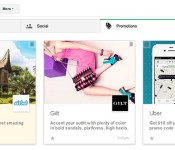
Gmail experiment shows promotional messages as image-heavy cards

The promotions tab in Gmail is basically a glorified spam filter. Sure, it’s not really spam, but you probably don’t bother to read many emails in there. At best you give it a cursory glance to make sure Caskers wasn’t offering “the bourbon that beat Pappy” again. But, more often than not, you probably just select all and delete without a second thought. Well, Google thinks that it might have a better chance at enticing you to click through on those deals if they were more visually appealing. Mountain View is trialing a feature that shows you promotional emails as cards with large images at the top and details of the deal on offer below. It’s not unlike Pinterest (it even introduces infinite scrolling to your inbox), except when you click through on these boxes you’ll be offered $10 off on a pair of Top-Siders. If you’d like to partake in Google’s little experiment you can click on this link. Yes, this one right here.
Source: Gmail (Google+), Official Google Blog
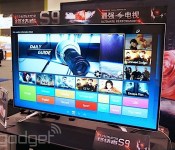
Lenovo’s new smart TV system grants greater processing power, more memory through swappable modules (hands-on)

Lenovo is best known for its ThinkPad laptops and newly acquired phone business, but the Chinese firm started making TVs a couple years ago, too. And now, it’s the first one to build a set utilizing NVIDIA’s new Tegra K1 chip. It’s that super-powered silicon that explains the TV’s presence at GTC 2014, so naturally, we had to spend some time with it while we were at the show. Called the Terminator S9, it’s a 50-inch 4K smart TV that runs a Lenovo-skinned version of Android 4.2 natively, but the real magic happens courtesy of a small plug-in module round the back called a Smart Card.

It’s roughly the size of a deck of cards (though half as thick), with a micro USB port and microSD slot on one end and a proprietary 70-pin connector on the other. That connector is how it plugs into the TV, while the USB and SD ports are for adding storage or connecting peripherals. Within the Smart Card’s relatively bland exterior lies the aforementioned Tegra K1, and other hardware (currently unknown) needed to run Android 4.4. All Lenovo smart TVs moving forward will ship with a 70-pin port built in, but only higher-end models will come with Smart Card hardware. That means the Smart Card is a way for Lenovo — and any other OEM who licenses the tech — to keep customers running the latest and greatest software and hardware on their TVs.

The Smart Card comes with a slick motion Bluetooth remote that has a pair of physical buttons: a red power button at the end and a spun metal voice control key in the middle, plus a circular touchpad located in a thumb friendly location. Navigation works using gesture control (a la LG’s Magic remote) to make selections, while swiping left and right on the touchpad scrolls through the menus. And, you adjust the volume via touchpad using the Seinfeld/Costanza special: clockwise or counter-clockwise swirl gesture. It’s simple and intuitive to use, and the remote’s shape and soft touch finish make it a pleasure to fondle.
Ready to plunk down your hard earned cash for Lenovo’s new TV system? Unless you call China home, alas, you don’t have the option to do so — though Lenovo’s looking at expanding to other regions should the Chinese market returns supply sufficient incentive to do so. Regardless, for those in the Far East, the Terminator S9 will set you back around 6,000RMB ($970), while the Smart Card costs less than 1,000RMB ($160).
Filed under: Home Entertainment, HD, Lenovo
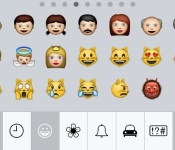
Apple Planning to Add More Diversity to Emoji Character Set
Apple has plans to expand its emoji set to include emojis that are non-caucasian, according to Apple’s vice president of worldwide corporate communications, Katie Cotton, who spoke to MTV Act (via The Verge). The company says it is working with the Unicode Consortium to add more characters to its emoji offerings.

“Tim forwarded your email to me. We agree with you. Our emoji characters are based on the Unicode standard, which is necessary for them to be displayed properly across many platforms. There needs to be more diversity in the emoji character set, and we have been working closely with the Unicode Consortium in an effort to update the standard.”
After originating in Japan, emoji were incorporated into Unicode, which allowed them to be used on multiple platforms. The character set has largely featured caucasian icons, however, which Apple aims to change.
Apple’s last change to emojis came with iOS 6, when the company added additional characters and made emoji accessible to all users. Previously, special apps were required to access emoji on iOS. iOS 7, released in late 2013, did not include any new emoji, but it is possible Apple could make some changes to the characters with iOS 8 later this year.
Note: Due to the political nature of the discussion regarding this topic, the discussion thread is located in our Politics, Religion, Social Issues forum. All forum members and site visitors are welcome to read and follow the thread, but posting is limited to forum members with at least 100 posts. 
     |
Original iPhone Engineer Greg Christie Gives Details on Development Process
 A few new insider details on the development of the original iPhone have come to light thanks to Apple senior software engineer Greg Christie, who gave an interview with The Wall Street Journal with permission from Apple, ahead of a new patent infringement trial against Samsung that is set to begin tomorrow.
According to Christie, who joined the secret “purple” iPhone project after an invitation from Scott Forstall, his team was responsible for many key iPhone elements, such as sliding to unlock, placing calls from the address book, and more. He and his team spent countless hours perfecting details like the speed of scrolling, and the feel of bouncing back at the end of a list.
He said his team “banged their head against the wall” over how to change text messages from a chronological list of individual messages to a series of separate ongoing conversations similar to instant messaging on a computer.
He also said the team was “shockingly small.” Apple declined to specify the number of members.
Christie gave two progress reports to Jobs each month, in a small, windowless meeting room at the company’s Cupertino headquarters. Few people had access to the room and even cleaning people were not allowed to enter. The secrecy surrounding the original iPhone’s design was incredible, with Jobs even requiring employees to encrypt images of the device.
Jobs was initially unhappy with Christie’s progress on the device, and gave his team two weeks to improve.
“Steve had pretty much had it,” said Mr. Christie, who still heads Apple’s user-interface team. “He wanted bigger ideas and bigger concepts.”
Christie’s team was able to impress Jobs within the deadline, later giving presentations to Apple’s design chief Jony Ive and Apple director Bill Cambell, who said the iPhone “would be better than the original Mac.” All three approved the 2005 design, kicking off a “2 and a half year marathon” where the iPhone was designed from the ground up with Jobs clearing every minor detail, as has been noted in several previous reports of the iPhone’s development.
Christie’s details on the creation of the original iPhone come just ahead of a second major patent infringement lawsuit with Samsung, set to begin tomorrow. Apple initially accused Samsung of grossly infringing on both its patents and its designs in 2011, a lawsuit that resulted in a $890 million penalty for the South Korean company in the United States.
While the first lawsuit covered older devices, the second U.S. patent lawsuit between the two companies covers more recent products like the Galaxy Note II, the Galaxy S III, the iPhone 5, and the iPad 4.
The full interview on The Wall Street Journal, which is well worth reading, also includes additional tidbits on the secrecy behind the development of the iPhone, major last minute changes, and details on the original iPhone’s unveiling.
| |
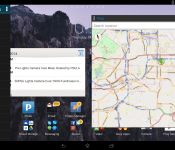
Multitasking Pro aims to bring more functionality to your device
If you’re a power user like myself, you may notice that stock and most manufacturer versions of Android do not let you have two programs on your screen at once. Multitasking Pro aims to change that by adding a sidebar app that lets you use multiple apps at once.
One of the reasons I envy Windows tablets is because of the Snap feature that Windows 7/8/8.1 brought with it. The ability to do two things at once is something I find myself an expert at. On my laptop, this feature is present and I use it nearly all of the time. In fact, right now I have Hulu on one side and am writing this review on the other side and a work report is sitting in Word on a second monitor. The story with Android is that unless you have a device that has received some sort of multitasking blessing you are pretty much stuck to one item on your screen at a time. Yes, you can switch easily back and forth between apps, but having two apps on the screen at once? Yeah, can’t do that. It is one of the few areas that I believe Android needs further development.
Multitasking Pro gives a fair shot at trying to solve this problem. Using a series of built-in apps, developer OryonCorp lets you have different windows floating around your Android screen. These windows are movable and realizable allowing you to place as many as you want on your screen at a time. In order to make this work, the developer had to create a number of custom mini-apps, including a browser, calculator, calendar, camera, file explorer, gallery, map, music player, news, recorder, video player, weather and YouTube app.

To their credit, the Multitasking Pro app is beautiful and runs very smoothly. The only problem I had on my Sony Xperia Tablet Z was that I wasn’t able to get the YouTube video to load. I was able to search YouTube without any problems, but actually loading the video was a problem. I was able to play movies using the video player, test out the compass, map my house, paint a picture of a dog and look at some beautiful pictures of my daughter in the photo gallery.
The feature I found myself using the most was the browser on one side of the screen with a video playing on the other side. This enabled me to consume some entertainment content while working on the web, something I haven’t been able to do during the last 9 months that I’ve owned my tablet.
There was only one shortcoming that I found in this app, which was that I would really like to have a Facebook or Netflix window that I’m able to re-size on my screen. Despite the missing feature, the app is very well-built and provides a look, feel and functionality that flows naturally with Android.
If you’re tired of doing one thing at a time, you can pick this app up at the Google Play Store in both free and pro versions. The differences between the two are slim, with the Pro version being ad-free, adding slightly more functionality and the ability to hide the icon on the top of the screen.
The post Multitasking Pro aims to bring more functionality to your device appeared first on AndroidGuys.
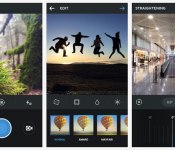
Instagram crosses 200 million users, welcomes Oculus to the family

In news that Zuckerberg, Luckey & Co. hope bodes well for Facebook’s latest acquisition, Instagram just announced it’s crossed 200 million users, with over 50 million joining in the last six months and 50 billion photos shared so far. Facebook CEO Zuckerberg mentioned the number during his conference call discussing his company’s purchase of Oculus VR, highlighting Instagram’s better-than-expected growth as an example of how it continues to operate independently within Facebook. Recent developments have included ads, a revamped app for Android and testing out integration of Facebook Places instead of Foursquare, but so far Instagram hasn’t even used Facebook accounts for logins yet. We’ll see if that changes anytime soon, and if the team finds itself redirected to work on filters for the virtual reality experiences its owner is suddenly jumping into.
Filed under: Internet, Mobile, Facebook
Source: Instagram Blog

Notch cancels Minecraft for Oculus Rift, but other developers still have interest

It looks as if the Facebook and Oculus deal already has its first casualty. Minecraft mastermind Markus “Notch” Persson has said that he’ll no longer be developing his game for the VR headset following Zuckerberg’s latest purchase. “We were in talks about maybe bringing a version of Minecraft to Oculus,” he tweeted. “I just cancelled that deal. Facebook creeps me out.” Persson continues on his blog that, while social aspects could be one of VR’s biggest applications, he doesn’t want to work with social experiences — he wants to work with games. Beyond that, he doesn’t see the social network as a stable platform, and won’t work with it in any form as such.
If you were dead-set on traversing a pixelated Great Britain in VR, it’s looking like you might have to settle for the hacked PC version for now. All isn’t lost, though. Minecraft‘s already been announced as a PlayStation 4 title and the wraps recently came off Sony’s Project Morpheus headset — it could possibly show up there.
That arguably one of the biggest indie developers (and one of Oculus’ earliest supporters), however, has cancelled a project the scale of Minecraft is pretty major. What do others in the indie scene make of the news, though? Those we spoke to actually seemed pretty happy about it.
The developer behind the Rift’s highest profile game, and the one that Oculus trots out time and again when there’s new hardware to show off (EVE: Valkyrie), has nothing but praise.
“We’re very excited for our friends and colleagues at Oculus,” David Reid, CCP Games’ CMO told us. “We share their vision about the future of VR and gaming and are looking forward to participating in the consumer launch of the Oculus Rift with EVE: Valkyrie.”
“I think this is a smart move for Oculus,” Rami Ismail of Vlambeer told us. The developer behind Ridiculous Fishing, and, most recently, Luftrausers, said that while Oculus is well known on the tech scene, it needs a backer with huge public mind-share now that Sony has entered the VR space. “Facebook is a huge established tech presence, has amazing engineers, hardware, software, public mind-share and lots of money,” he said. “I mean, I am not a big fan of exits as a business model at all, but in light of not really having a profitable business model, it makes total sense for them to exit,” he said.
Indie publishers are bullish, too. “Ultimately if Facebook allows the Oculus platform to get into the hands of more people, gamers or otherwise, then this acquisition will prove to be a good thing,” Devolver Digital (of Hotline Miami fame) partner Nigel Lowrie told us. “We’ve seen what this next generation of VR technology from Oculus, Valve and Sony can do and how it can change the game. Anything that achieves a greater awareness and broader reach for video games as mainstream entertainment, and pushes new technology forward in new ways is ace.”
Filed under: Gaming, Wearables, HD, Facebook
Source: Markus “Notch” Persson (Twitter), Notch

Palmer Luckey says Oculus’ future ‘just became crystal clear,’ but Facebook’s impact is still murky

If you’re reading this, you’re likely already aware that social networking juggernaut Facebook has just announced plans for yet another multi-billion dollar acquisition. This time it’s spending $2 billion dollars (that’s $17 billion less than WhatsApp for those keeping track) to buy virtual reality headset maker Oculus. Just minutes after the announcement, the startup’s founder, Palmer Luckey took to Reddit to provide some perspective about the deal:
“When Facebook first approached us about partnering, I was skeptical. As I learned more about the company and its vision and spoke with Mark, the partnership not only made sense, but became the clear and obvious path to delivering virtual reality to everyone. Facebook was founded with the vision of making the world a more connected place. Virtual reality is a medium that allows us to share experiences with others in ways that were never before possible.”
Luckey praised Facebook’s dedication to open hardware and software initiatives, with its investment in the Open Compute Project and said the partnership “allows us to execute on some of our most creative ideas and take risks that were otherwise impossible.” He said very little would change at Oculus day to day, a familiar sentiment for those familiar with the WhatsApp acquisition. And while he claimed that the move means “a better Oculus Rift with fewer compromises even faster than we anticipated,” one can’t help but wonder what this means for the future of the scrappy Kickstarter success story. Luckey said, “This is a special moment for the gaming industry – Oculus’ somewhat unpredictable future just became crystal clear: virtual reality is coming, and it’s going to change the way we play games forever.”
So operations likely won’t change drastically at Oculus, and we could even see a consumer-ready Rift sooner than expected. But in an investors call this afternoon Facebook CEO Mark Zuckerberg unsurprisingly suggested that possible revenue opportunities from the deal could include advertising in whatever form that might take. Bottom line: if you thought your virtual escape would be a commercial-free zone, think again.
Photo by Sam Comen for Engadget Distro
Filed under: Gaming, Internet, Facebook
Source: Reddit
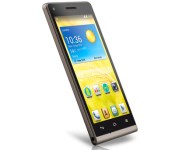
UK’s EE to launch own-brand LTE smartphone for just £100 off-contract

We got wind that EE was cooking up an own-brand smartphone for its 4G network a couple of weeks ago, and now the UK operator’s ready to come clean about the device. It’s called the Kestrel, and as we suspected, it’ll offer the cheapest ride on EE’s LTE network at £100 on pay-as-you-go (PAYG), or free from £14 per month on the new entry-level tariff, when it launches towards the end of April. Now, being £30 less on PAYG than Alcatel’s One Touch Idol S (which is also free from £14 per month), a mixed-bag of specs was to be expected. On the plus side, it’s packing a 1.2GHz quad-core Snapdragon 400 and as a Cat 4 handset, it’s capable of maxing out the theoretical 150Mbps download speeds of EE’s “Extra” plans. Not so enticing is the 4.5-inch qHD display (960 x 540), and beyond that, we’re looking at 1GB of RAM, 8 gigs of storage (with a microSD slot for expansion), a 2,000mAh battery, 5-megapixel main camera and 1-megapixel front-facer.
The Kestrel’s running Android 4.3 Jelly Bean behind Huawei’s Emotion UI, with bloatware comprising a couple of EE apps and “free games,” as the spec sheet puts it. Curiously, Amazon’s app suite is also pre-loaded on the device alongside Google’s familiar services. We’ve had a very brief encounter with a prototype handset, which was pleasant enough with its angular styling and “graphite” tint. Further indication of Huawei’s involvement as EE’s ODM can be seen in the phone’s curved bottom edge, which is fairly common to the Chinese company’s own devices. According to EE, a homegrown handset was always part of the network’s long-term plan — one that doesn’t stop with the Kestrel.
In fact, this is just the first in a series of planned devices bearing EE branding and named after British birds of prey. We don’t need to tell you that the Kestrel is all about affordability, but it would now seem the only way is up. We don’t know if some kind of own-brand flagship makes as much sense as a bargain offering, but we’re happy to wait for the EE Barn Owl to be announced before passing any formal judgement.
Filed under: Cellphones, Mobile

EE adds new entry-level 4G tariffs starting at £14 per month

Yesterday, the cheapest way to hop on UK carrier EE’s LTE network, with smartphone for keeps, would set you back £19 per month. Today, call it £14, as EE’s introduced a pair of lower price tiers in its 24-month, handset-included plans. For that £14, you get 500 minutes, 500MB of data, and unlimited texts. That would’ve been the same as the £19 per month plan (just with half the minutes) yesterday, but today £19 gets you 1GB of data. The situation is a little different for EE’s “double-speed” Extra tariffs. Nothing changes to any of the existing plans, so the new £22 per month option, which gets you 1000 minutes and 2GB of data, just sits in behind the 4GB for £27 tier. Now, these cheaper plans are going to be offset by steeper handset costs, but there are still some thrifty choices. The Alcatel One Touch Idol S is free from £14 per month, as will EE’s own Kestrel when it launches, with other phones starting at £20 upfront.
Shared 4G plans are getting more wallet-friendly, too, with anyone on at least a £23 per month contract able to tack another phone onto their plan for £17 extra each month, or a tablet for £10. Lastly, a new £2 per day bolt-on buys you unlimited calls and texts within the EU, so provided you opt-in once, that’s the max you’ll be charged thereafter. So, with the boring stuff sorted, maybe it’s time to hash out a few more of those 4G roaming agreements, eh?
Filed under: Cellphones, Wireless, Mobile
 AIVAnet