



The next version of Android could be truly business-friendly

Android has a lot of market share, but it doesn’t have a big footprint in the corporate world; outside of special efforts like Samsung’s Knox, the OS isn’t well-suited to business demands. All that may change in the near future, though, as The Information‘s sources claim that the next major Android release will place a much stronger emphasis on office-grade security. The new OS will reportedly allow apps that require their own authentication (including biometrics), as well as data storage on secure chips. It should also offer better remote management controls. If the rumor is accurate, we may not have long to wait to see these suit-and-tie features — Google could unveil them at its I/O conference in late June.
Filed under: Cellphones, Mobile, Google
Via: The Next Web
How Does Sales Enablement Impact Business
The world is going digitize and almost 80 percent of the businesses are now online or at least keep their online presence. The trend of making an online identity is growing with every passing day. Technology has pushed the businesses to the next level of development and removed the barriers of countries and long distance issue. But the problem is that not every small business is aware of the fact that how to convert leads into guaranteed sales.
 All new businesses try to attract large number of customers towards them or maybe their products but they fail to determine their potential customers that will give them a sale or lead. Because they may not know that how sales enablement impact their businesses and let them meet their potential buyers and this is where ROInnovation comes in handy.
Problems and Facts that Every Small Business Should Know:
Online world is evolving day in and day out and every newly setup business should know the fact that
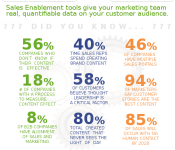
- Every small business try to produce quality content but 56% of companies from them, do not know that whether their content is effective for the growth of their business or not.
- Every small business make proper arrangements to test the effectiveness of their content but only 18% of companies have the accurate process to measure the content effectiveness.
- Another big reason for a mismanagement scenario is that only 8% of B2B companies have proper alignment in their sales and marketing cycle and rest of them suffer for neglecting this aspect of their business strategy.
- Only 40% of sales representatives spend their time for creating effective brand content for their businesses to grow.
- Generally, only 58% customers believe that ‘Leadership is a critical factor’ for any business to grow.
- Every business try to create best and most relevant content to promote their business but unfortunately 20% of it sees the light of day.
- Every company starve to make a better relationship with their customers but only 46% of them succeed in making the right decision and are having multiple sales portals to make the customer at ease to access the product.
- Every company focuses on customers and this is the reason that around 94% marketers believes that those contents are best that are based on customer stories for any product.
- A survey that held to test customer behavior says that about 85% sales will be done without any human contact by 2020.
Who We Are:
We are the leading company in the market since year 2002 that understands the need of your small business and enables you to not only track your customers’ behavior with your product but also give you the power to make the best decision for any specific situation you are facing.
ROInnovation has a complete range of products for your business either to channelize a product or campaign or, to reach your customers through mobile data and demographics that will give you the accurate results about how your customers deal with your products or services. We have best resources and tools for your business to not only track your business progress but to convert your visitors or customers into sales for the success of your small business.

This PowerGlove stays in the kitchen, not with your NES (video)

We’ve seen the PowerGlove pop up in a few different places before, but until now the focus hasn’t strayed far from gaming. To wit, the Power Mitt wants to make your trips to the kitchen awesome in the way that only a heat-resistant-rubber oven mitt shaped like Mattel’s wearable peripheral ever could. Unless the one-size-fits-most baking accessory hits its Indiegogo campaign’s 450-backer target, however, that won’t happen. One right-handed glove will set you back $39 (larger and leftie flavors are stretch goals), and there’s a $20 discount if you order two. Let’s say you want to get crazy, though: cough up a whopping $10,000 and you’ll get a one-of-a-kind gold-plated version of the Power Mitt. Sure, you’ll lose heat resistance, but the flip-side is gaining a boatload of geek cred — isn’t that what matters most?

Filed under: Gaming, Household
Via: Laughing Squid
Source: Indiegogo

Businesses Profiting From Rise in Mobile Subscription Services
 In 2012, the United States had over 93 million mobile service subscribers, as the World Bank highlights. The number of mobile phone users is expected to reach 4.55 billion in 2014, according to eMarketer. As the number of people connected continues to grow, businesses continue to try and keep up by creating new ways to pull those customers in. Offering multiple ways to connect to their business is one way they are trying to connect with customers.
Shopping Apps – In June of 2012, smartphone users accessed shopping apps 17 times a day, according to Nielsen. Businesses are making it easier for customers to connect with them by creating mobile optimized sites and shopping apps. Top contenders, eBay and Amazon had 25 million unique users through their shopping apps. New online businesses have sprung up that offer daily deals, such as Groupon and LivingSocial. Other businesses are focusing on making shopping easier by creating apps that help you shop, like Out of Milk and Shopkick.
Online Coupons – Clipping coupons has long been a great way to save money, but those savings have gotten even easier with the number of mobile coupons offered by businesses. In 2013, the number of US smartphone users cashing in on coupons reached 47.1 million. With the ability to integrate GPS and device tracking into their coupons, businesses can actually offer device-specific and location-based coupons that are available right where users are. Tracking a customer’s past digital shopping history can refine it even further to coupons for only items they have purchased before.
Subscriptions and Loyalty Programs – Offering loyalty programs and deals only for subscribers is another way that businesses reach out to customers. Earning points or rewards for loyalty and frequent purchases is incentive for many to keep shopping. Others, such as Starbucks’ Passbook app allows customers to make wallet-free payments along with their coupons and deals. By asking customers to subscribe, they are also able to determine whose interested in receiving information.
Mobile Payments – Businesses are making it easier than ever to make purchases by offering easy payment options, easy account management, and mobile payment options with apps such as Chargify. Setting up accounts can give customers many options for payment, including auto-pay, single credit card charges, or recurring payments for subscriptions. One option many businesses are utilizing is mobile credit card acceptance. A mobile credit card reader allows customers to pay with credit cards no matter where the business is.
Social Media Connections – Businesses are now connecting with customers where they hang out as well as where they shop. They are Tweeting, putting up Facebook pages, and talking to customers about what’s important in their lives. Almost any business you see today invites people to connect with them on their social media pages. A more personal approach not only helps them to understand their consumers, but also offers customers a new way to be heard by the company. The move to social media has improved customers service and even inspired new ideas for some companies.

NASA reveals three spacesuit designs, wants you to choose a favorite

Looks like NASA wants to add more zing to its futuristic Z-series spacesuits, because the agency just revealed three far-out outer shell designs for the newest prototype. The new model (called the Z-2) is a follow-up to NASA’s Buzz Lightyear-esque Z-1 spacesuit prototype, which was named one of Time Magazine’s Best Inventions of 2012. There are several differences between the two, including the quality of their upper torsos: while the Z-1′s is soft, the Z-2′s is hard and impact resistant. Another interesting tidbit about the new suit is that its creators used 3D-printed hardware during the development and sizing phase.
Unfortunately, this doesn’t mean we’ll see three fancy Z-2 variants in the future. NASA plans to use only one design — and it’s giving the public the power to choose which one it is. Each concept draws inspiration from different sources, including nature and everyday life. For instance, the one called Biomimicry (pictured above) has lights that replicate the bioluminescence of deep-sea creatures and a body that’s reminiscent of fish and reptile scales. “Technology” updates NASA’s iconic spacesuit with electroluminescent wires and patches, while “Trends in Society” was inspired by sportswear and wearables. People can cast their votes until April 15, after which NASA will build the Z-2 with the winning outer shell. We could see the finished suit as soon as November 2014, but it still has a ways to go before it’s ready — NASA’s other suit (the CSSS) will likely make it to space first.
Technology:

Trends in Society:

Via: The Verge

MLB.tv and Epix streaming apps are coming to Xbox One

Xbox One owners already have their fair share of video services to choose from in the US, but they’re about to get a pair of welcome additions. Major League Baseball now says that MLB.tv Premium should be available to stream live games on the console in time for opening day. Meanwhile, Epix has revealed plans to bring its primarily movie-focused service to the Xbox One in the near future. And don’t worry about being left out if you’re still hanging on to your Xbox 360 — Starz has just launched Encore Play and Movieplex Play apps for the earlier system, while Major League Gaming released its e-sports app yesterday. All told, it looks like you’ll have plenty of viewing options this spring.
Filed under: Gaming, Home Entertainment, HD, Microsoft

Candy Crush maker’s IPO values company at more than $7 billion

King, the company behind the Candy Crush saga filed its IPO today, but is the maker another Zynga (Farmville), another Rovio (Angry Birds) or something else again? Nearly 100 million users play Candy Crush every day, and while the company’s titles remain free to play, it depends on virtual goods, additional levels and content purchases to bring in the cash. Selling shares at $22.50, it’s raised around $500 million for the company and its early investors, valuing King at around $7 billion.
The company apparently isn’t going public because it needed the money, however, but because it will give the company stock it can use to make acquisitions… and let investors cash out if they want to. Shareholders will be pushing the gamesmaker to repeat the success of Candy Crush, something that more recent titles, like Farm Heroes saga, haven’t (so far, at least) been able to accomplish.
Filed under: Cellphones, Gaming, Tablets

[OP-ED] The 3,686,400 Pixel Question: Is a 2K Display Really Necessary On a Mobile Device in March 2014?

Image courtesy of ExtremeTech
A lot has been made about the ‘new standard’ in mobile technology, the 2K display resolution. Most manufacturers who have announced, or will announce, their new flagships are selling the 2K resolution like it is the next frontier, and maybe it is. But how much difference is there in having a 2K resolution on your mobile device; do you get any tangible benefits from having it? That’s what we’re here to discuss today, and hopefully you’ll be able to make your own decision about it once we’re done.
First of all, some background. The 2K display name comes from the fact that the resolution is over 2000 pixels wide (2560 to be exact). The full resolution, 2560×1440, is also twice the height of ‘conventional’ HD screens; the height of a 2K display is 1440 pixels high whereas HD measures exactly half at 720 pixels. This is why you will occasionally hear a 2K display referred to as ‘Quad HD’ i.e. able to fit four HD screens into one Quad HD screen.

Image courtesy of Cult of Android
The first phones to boast having 2K displays were the <insert phones>. While these phones can be blamed for instigating this whole ordeal, the ‘arms race’ mentality of the smartphone industry is much more deep-seeded. Manufacturers strive to out-do each other, even if the benefits to the consumer are diminishing; who doesn’t love bigger numbers, right?
So in the case of 2K displays, what exactly are the considerations that we need to take into account, and how does it affect the phone itself?
 First and foremost, many Android users will place extra importance on performance figures. In the last few months, we’ve had unconfirmed benchmarks of devices that have, or will, come in two variants (Samsung Galaxy S5 and Oppo Find 7). Interesting, in both cases, it was suggested that the ‘lesser’ model, which had a 1080p display, would either perform at, or above, the level of the ‘premium’ model with the 2K display.
The most likely explanation for this phenomenon is likely the increased power consumption and CPU usage required to run the bigger screen resolution. You may argue tooth and nail that these results are unconfirmed or from prototype testing and therefore not final, however the logic of this hypothesis is sound, as well as the fact a similar occurred when screen resolutions jumped from 720p to 1080p about a year ago. This isn’t to say that 2K displays cause bad performance; it is more the fact that we do not have processors which give us enough of a processing advantage to offset the additional load that a 2K display brings with it.
 A flow-on effect of the increased power consumption due to the 2K display is of course decreased battery life; even disregarding high performance scenarios, the 2K display is going to demand more power than a 1080p display simply by virtue of the increased number of pixels to be output. This will occur even in everyday use; many of you will know that Android device displays are far and away the biggest consumer of battery power.
Moving away from objective facts for a bit, we can also consider the actual perceivable detail ‘improvement’ in having a 2K display. For a reference comparison, TVs we saw at CES 2014 have only just made 4K resolution mainstream. While the resolution comparison between mobile and TV isn’t perfect, it’s pretty obvious that TVs are far larger than mobile devices, yet why do we need such a huge number of pixels (3,686,400 to be exact) in the same area as our palm?
 For a more scientific comparison, a 65-inch 4K TV will have 68 pixels-per-inch (ppi), the most common measurement of detail. Furthermore, Apple refers to its Retina display as a device that has around 326ppi, hotly contested as the most detail an eye can perceive. The new Oppo Find 7 variant which has a 2K display, will have 538ppi on its 5.5-inch screen, and even the Find 7a is going to have pretty impressive 441ppi.
With this in mind, nobody is going to say that a 4K TV is a bit blurry, and (Apple prejudice aside) nobody is going to disagree that the iPhone screen is one of the best on the smartphone market right now. Sure, a 2K display is going to look desperately good, but is it going to look that much better than a 1080p display? And even if this were true, can we really legitimize the additional pixel real estate if the only other tangible effects are going to be increases in power and battery consumption?
 The case for tablets is a bit better than that for mobile devices; tablets are designed with large enough batteries to support larger display resolutions, and while battery life would still take a hit due to a possible 2K display, the effect wouldn’t be as profound as on a mobile device. Indeed, the Samsung Galaxy Note Pro carries a 12.2-inch 2560×1600 resolution display, which is basically the gold standard for tablet resolutions, big and small, and it doesn’t look like anybody is going to venture much further than that any time soon. So why are manufacturers insisting on pushing mobile device displays to 2K resolution?
We’ve covered quite a few arguments here, but probably the biggest take home message here is this: this is only the situation for 2K displays in March 2014 (and possibly the very near future). 2K displays are only just become available, so it’s natural that pairing them with yesteryear’s technology is going to result in some teething issues. Even with slightly upgraded processors and slightly bigger batteries, we’re only going to be seeing minute improvements in the areas that matter to us, if that.
As such, it’s very difficult to recommend a mobile device with a 2K display right now; despite it’s obvious marketing and technical brilliance, it really has no tangible advantages for you and me as consumers, and arguably never will.
What do you think about 2K displays? Do you have any additional considerations to add to the discussion? Feel free to add to the discussion by commenting below.
//<![CDATA[
ord = window.ord || Math.floor(Math.random()*1E16);
document.write('’);
//]]>
All New HTC One (M8) is Now Official! – ManDroid Quickie

Happy HTC One day my friends. Pretty exciting stuff coming out of the HTC world. The ALl New One is finally upon us and some of you probably already have one. HTC decided that customers can order or go pick themselves up a New One right after they announced it. How nice of them. Let me know your thoughts about the new flagship, and check out the ManDroid Quickie video that isn’t so quick because I tend ton babble.
News Topics
All New HTC One if official
New HTC one Google PLay Edition
Gary Oldman HTC One video
//<![CDATA[
ord = window.ord || Math.floor(Math.random()*1E16);
document.write('’);
//]]>

Apple engineer explains where the iPhone came from

Offering a rare interview in the run-up to another legal fray between Samsung and Apple, the senior engineer behind the iPhone has explained where it all started, part of Apple’s plan to communicate how groundbreaking the original iPhone was. Talking to the WSJ, he explained how the secret project, Purple, brought the iPhone to life. At some point, the former Apple boss told him straight: the team had two weeks, or he would assign the project elsewhere. “Steve had pretty much had it… He wanted bigger ideas and bigger concepts.” In the end, the “shockingly small” team had outlined a touchscreen phone with swipe-to-unlock, no physical keyboard and all the music-playing features of the company’s iPod series. They ran early software tests on a plastic touchscreen, hooked up to a dated desktop Mac [seen above] — an effort to emulate a low-powered mobile processor.
Greg Christie had to make twice-a-month presentations directly to Steve Jobs, and once it was decided that this was going to be something real, apparently that’s when the real work began. A “two and a half year marathon” where Jobs obsessed over every detail. In the six months between revealing the iPhone and it going on sale, the changes didn’t stop, with a split-screen view for email showing both the message and sender information scrapped before launch. “Steve thought it was foolish to do a split screen on such a small display.”
Source: WSJ
 AIVAnet