



Civilization V Updated for Mac Pro, Includes 4K and OpenCL Support [Mac Blog]
Aspyr has updated Civilization V with support for the new Mac Pro, offering OpenCL frameworks to improve performance on NVIDIA and ATI chipsets in OS X Mavericks, as well as 4K resolution.
The company says Civilization V is the only game on the Mac to support both video cards on the Mac Pro, and users should see faster game and visual performance.

Mac gamers that play on the Mac Pro will now be able to fully take advantage of the machine’s second video card, which means better visuals and improved performance for the critically acclaimed strategy game. In particular, Civilization V on the Mac Pro will now support 4k monitors while running into fewer crashes. Additionally, the game should run faster (meaning less waiting in between turns in late-game situations).
This update makes Civilization V the only Mac game that currently supports the second video card on the Mac Pro. It should automatically download and install for Steam users; Mac App users can head to the Mac App Store to get the update. For even more info on how to take advantage of the new update, check out the knowledge base article over at our Support site.
Civilization V is available on the Mac from the Mac App Store [$14.99], Steam, and Aspyr’s GameAgent digital store. The game is being offered for 50% off temporarily on the GameAgent store alongside the update.
     |

Load links the correct way with Link Bubble [App of the Day]
When browsing the Internet on your smartphone, there are a few problems when you need to click on a link. Take the official Twitter app, for instance. If you click on a link, the browser needs to load, then continues to launch the dedicated app for that link. Or when you’d like to load multiple links at the same time, similar to what you can do on the computer, it’s a pretty big headache. Well, Link Bubble is here to help!
From the developer of the ever-so-popular Action Launcher, Chris Lacy is back with his next app innovation. Link Bubble aims to save you time that your browser would normally take to load a link. When you click on a link in any app, a bubble pops up on the edge of your screen – not unlike Facebook Messenger Chat Heads. The link will begin to load in the background, allowing you to still browse content in your app. When the link is loaded, it animates to the screen.

Here’s where the fun part kicks in. When you’re done reading, either back out of the bubble or long-press the bubble and flick it to one of the corners of your device. You can flick it to the trash, to the sharing bubble, or a shortcut to save it to Pocket.

There’s also added functionality that allows you to redirect links to an app (Instagram, Twitter) rather than wasting your time by adding a step to the process. The app is free, but we’d urge you to spring for the pro version for the extra features.
The pro key lets you load multiple bubbles AT THE SAME TIME. It also allows you to load links from all apps on your device (the free version intercepts links from only one app). It also acts as a little donation to Mr. Lacy for doing such a good job on this one. The pro version will set you back $4.99, but it’s definitely worth it.
This app is already helping me out quite a bit. It’s really innovative, not to mention a fun way to browse. Click the Play link to try it out!
The post Load links the correct way with Link Bubble [App of the Day] appeared first on AndroidGuys.

Xprize wants to fund a TED Talk given by artificial intelligence, and you can help

Xprize is known for its ambition. The outfit, with the help of some big name (and deep pocketed) partners, has launched initiatives to spur Star Trek-like tricorder development and even get private industry to land a rover on the moon. But now, it’s teaming up with TED, that forum for big ideas, to do something a little different. The two companies have just announced an Xprize for Artificial Intelligence and here’s the hook: they want the AI to conduct its own TED Talk with no human assist. Mind. Blown. None of this is actually set in stone though and, in fact, the partners are looking to you — yes, you — for help in deciding how this all goes down.
Xprize is hosting a dedicated subsite so that readers (excuse us, big thinkers!) like you can pitch in with ideas on what the AI TED Talk format should be, how long it should run, what topic will be chosen and so on and so forth. You’ll even get to help determine what type of AI makes the grade: will it be a walking robot, a rollie or a disembodied voice? It’s up to you to pitch in and figure it out. Because, hey, if you can’t actually help build the AI, setting it up for stage fright is the next best thing.
Source: Xprize

castAR’s vision of immersive gaming gets closer to final production

Five months ago, Technical Illusions gained over a million dollars in funding thanks to a highly successful Kickstarter campaign for castAR, a projected augmented reality project that company founders Jeri Ellsworth and Rick Johnson brought over from Valve when they were laid off almost two years ago. Ever since the campaign’s success, the company has been ramping up prototyping on a rapid scale so that the final unit can be sent off for mass production. Along the way, the company has grown from two employees to 11, and Ellsworth has since moved from Portland to Seattle to be with the team (dragging her collection of 80-plus pinball machines along with her). Ellsworth has also just hired the services of a Japanese company (she won’t name which) to provide her with improved optics and thinner circuitry, which she admits is better than the homemade solutions she and her partners have cobbled together so far. This all means, sadly, that castAR is still very much in progress, which is why even though Technical Illusions is here at GDC 2014, we were unable to look at the final castAR hardware. We were, however, able to take a look at castAR’s latest prototype that has never before been seen outside of Technical Illusion’s office until this week.
The hardware is, without a doubt, leaps and bounds ahead of what we saw last year. As a reminder, here’s the way castAR works: a pair of active shutter glasses with tiny projectors casts 3D images onto a retroreflective surface which are then returned to your eyes. At the same time, a camera module in the eyewear scans for infrared LEDs on the surface to track the location and movement of your head. The initial builds for the castAR glasses were very rough around the edges, but understandably so — they were initial builds, right? The latest iteration, however, is far cleaner and smoother in appearance. The circuitry and guts of the headset are now relegated to the right temple, leaving just the projectors and the camera perched above the glasses, which lessens the weight above the nose bridge. Further, the camera part has a much lower profile and doesn’t jut out as much as before. That along with the projectors are also now housed in a simple black plastic block. It doesn’t seem like much, but it’s a lot tidier than previous versions that exposed visible wiring. Ellsworth says they plan to attach a thinner cable to the glasses as well, again to reduce the headset’s overall weight. In the end, she hopes the final unit will weigh less than a 100 grams each.
What’s perhaps more interesting than the design however, are the new tiny projectors embedded in the glasses. The projectors, located above each eye, now have full 720p HD resolution. Not only that, but according to Ellsworth, they also project more light along with richer, more uniform colors. In our brief hands-on with the castAR prototype, we can certainly tell the difference between it and the older standard-definition model. Images were visibly brighter and sharper, and we could lean down toward the display and make out finer details than before. We tried our hand at a beta zombie game that Technical Illusions developed in-house to demonstrate the glasses, and while gameplay was a little unrefined, we could see that the graphics seemed crisper than the other demos in the room. Also, each projector has a 65 degree field of view, while the camera for head tracking has a 125 degree field of view, though Ellsworth promises us that the final version will have a 145 degree view instead. This means that you could cover a much wider surface area with castAR’s retroreflective material for an even larger game environment.

As we were finding out about castAR’s progress, we also took the opportunity to ask Ellsworth and her team about their involvement in the Immersive Technology Alliance (ITA), a virtual reality collective that launched last week. As a founding member of the alliance, Technical Illusions sees the ITA as an advocacy group for virtual and augmented reality and the benefits immersive technology brings. Brian Bruning, who heads up Technical Illusions’ marketing and business development, says both VR and AR have uses far outside gaming, and can be used in training, education and medical imaging. One of ITA’s main duties would be educating the public and developers about those different avenues. Additionally, Bruning said that as VR and AR are still so new, that the various outfits in the organization can take the opportunity to learn tips and tricks from each other. Technical Illusions, as one of the rare firms doing projected AR in addition to VR, is well-positioned to both teach and learn in those areas.
Speaking about projected AR in particular, Ellsworth says, “Projected AR is very graphical and visual, but it’s not just staring at the screen.” One of the benefits of AR as opposed to VR is that you can simply lift your head and still interact with the world. “This comes into play especially with the social aspect of games,” she says, pointing out that part of the fun of playing a video game with pals is being able to see your friends reactions. “It’s a fresh spin on games,” says Ellsworth. “A new driving force.” Seeing as castAR managed to get 3,863 backers on Kickstarter, it certainly seems some people think so. The first developer and Kickstarter prototype units will be available this summer, while the rest of Kickstarter and the first commercial units should ship by Q4.
Filed under: Gaming

Microsoft aims to power up PC and mobile games with DirectX 12

The time for teasing is over. Today at GDC, Microsoft pulled back the curtain on DirectX 12, a shiny new edition of its venerable graphics APIs that some lucky developers can start mucking around with later this year. Microsoft Graphics Development Manager Anuj Gosalia talked up a storm out in SF: he noted that DX12 would (among other things) yield performance boosts across all of Microsoft’s platforms, including Xbox One and Windows Phone.
That mobile angle is an awfully tantalizing one considering how tightly Windows Phone integrates with Xbox Live. Polygon reports that DX12 should improve how much power those games suck, and will make porting content from consoles and PCs to mobile devices easier. On the PC side of things, game developers will also get lower-level access to hardware to help keep graphical performance as snappy as possible. Throw in smarter shuffling of processing tasks to multiple CPU cores to keep any one from getting bogged down, and you’ve got yourself a tantalizing little development package. There’s a decent chance you won’t even have to shell out for new hardware either, since Microsoft says some 80% of the gaming PCs being sold on the market right now will play nice with DirectX 12 games. Just don’t expect to nab them very soon though — those titles are expected to hit shelves in time for the 2015 holiday season.
Source: DirectX Developer Blog

Netflix’s Reed Hastings calls out weak net neutrality rules, ‘reluctantly’ pays ISP tolls

Reed Hastings, the CEO of Netflix has finally chimed in with his own statement about net neutrality and the deal his company struck with Comcast. As written in a blog post, the traditional standards recently overturned by a Verizon lawsuit (which prevent ISPs from restricting or meddling with data) are “important…but insufficient.” As we noted when the deal happened, a peering agreement like the one Comcast and Netflix now have is not covered by existing network neutrality rules, but Hastings argues that in order for strong net neutrality to exist, it should be. While he says that in the short term Netflix is playing ball with ISPs like Comcast (and may make other, similar agreements in the future) to improve the experience for its customers, he hopes that those same companies will support “strong” net neutrality that lets Netflix connect to their networks with no fees (Open Connect).
Update: Comcast has responded to Hastings’ blog post with a statement of its own (available in full after the break).
(function(d, s, id) var js, fjs = d.getElementsByTagName(s)[0]; if (d.getElementById(id)) return; js = d.createElement(s); js.id = id; js.src = “//connect.facebook.net/en_US/all.js#xfbml=1”; fjs.parentNode.insertBefore(js, fjs); (document, ‘script’, ‘facebook-jssdk’));
Hastings specifically calls out the argument made by executives of the big ISPs (Verizon) that Netflix is dumping data (aka, responding to requests by users of said ISPs), and said he’s asked what would happen if Netflix changed its service to upload as much as it downloads. Their silence in response to his Spotify-style peer-to-peer proposal, despite allowing such no-fee interconnects between their own networks, “isn’t sensible.” One specific example is because they don’t pay fees to backup services that only receive large uploads from their networks.
Hastings didn’t reveal specifics about Netflix’s deal with Comcast, but said ISPs demand “roughly the same arbitrary tax” from middlemen like Cogent and Level 3. Level 3′s general counsel Michael Mooney recently published a similar blog post calling what the ISPs were doing a “game of chicken” that they’ve been playing for years.
There has been no company that has had a stronger commitment to openness of the Internet than Comcast. We supported the FCC’s Open Internet rules because they struck the appropriate balance between consumer protection and reasonable network management rights for ISPs. We are now the only ISP in the country that is bound by them.
“The Open Internet rules never were designed to deal with peering and Internet interconnection, which have been an essential part of the growth of the Internet for two decades. Providers like Netflix have always paid for their interconnection to the Internet and have always had ample options to ensure that their customers receive an optimal performance through all ISPs at a fair price. We are happy that Comcast and Netflix were able to reach an amicable, market-based solution to our interconnection issues and believe that our agreement demonstrates the effectiveness of the market as a mechanism to deal with these matters.
Filed under: Home Entertainment, Internet, HD
Source: Netflix Blog

Apple may improve your iPhone’s battery life by understanding your habits

Battery-saving software on a phone tends to have all the subtlety of a sledgehammer — it either waits until you’re low on power to do anything, or limits functionality at all times. Apple may eventually take a smarter approach, if a newly published patent application is any indication. The technique would optimize your mobile device’s power consumption based on both your daily activities and charging patterns. If your iPhone doesn’t get much use during working hours, for instance, it could automatically throttle down for that period. The technology also adjusts power for specific events; check into a long flight and your phone will conserve battery while you’re in the air. We don’t know if Apple will ever use this energy-saving technology, but the patent is grounded more firmly in reality than others we’ve seen.
Filed under: Cellphones, Laptops, Tablets, Mobile, Apple
Via: BGR
Source: USPTO
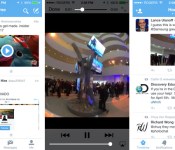
Twitter now shows you video previews inside its mobile apps

Checking out a linked video from within Twitter’s official mobile apps is frequently a clumsy process, but it’s about to get a lot smoother. The social network has started rolling out simple in-line video previews on both its Android and iOS apps. If you’ve received the upgrade, you’ll see thumbnails of clips in your timeline; all you have to do is tap them to watch the footage from within the Twitter app. The move is no doubt meant to drive up views of promoted videos, but we won’t mind if it helps us catch up on cat videos during our daily commutes.
Filed under: Cellphones, Tablets, Internet
Source: New York Times
 AIVAnet