


Live from PlayStation’s ‘Driving the Future of Innovation’ panel (the VR one)
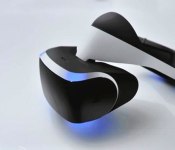

What is the “Future of Innovation”? Sony’s gonna tell us tonight, but we’re pretty sure we can tell you what it is right now: bacon-scented alarm clocks. Oh, right, the future of innovation is also the rumored virtual reality headset from Sony’s PlayStation team. At least we’re pretty sure that’s the case, both based on the rumor mill and our own cabal of sources on the ground here at GDC 2014. We’ll certainly find out soon enough, as the event kicks off shortly. Stick around, as we’re starting shortly.
March 18, 2014 8:45:00 PM EDT
Hey folks! We’re in and seated at Sony’s “Driving the Future of Innovation” panel at GDC 2014.
Joining me today is intrepid photog Michael Gorman, co-liveblogger Nicole Lee, social media man John Colucci and extra help Sean Buckley.
The room is packed! SCE Worldwide Studios head Shuhei Yoshida is in the house, as is PlayStation head Andrew House. Oh, and about 500 other folks.

Surprisingly — and somewhat amazingly — there’s no loud house music pounding.

You see that man in the image? He’s a delightful gentleman from the Moscone Center staff, where tonight’s shindig is going down.
Right now there’s a screen with images of Playstation symbols floating around. Just in case you forgot what the announcement will be about.
There’s also a SHROUDED device up on stage. WHAT COULD IT BE? (It’s probably the VR headset. Like, come on.)

We’d love to point you to a stream, but Sony isn’t streaming tonight’s proceedings. It is being filmed, though no filming by the press is allowed. So, ya know, we’ll probably see it soon!

And we’re beginning!
Shuhei Yoshida’s on-stage. “Good afternoon everyone, and thanks for coming to this cryptic Sony-sponsored session. You have no idea what we’re gonna talk about.” Big laughs!


He’s speaking to the inspiration he takes from GDC.

Shu’s moving quickly, from inspiration to innovation.


Speaking to PlayStation announcements, he’s naming 3D graphics, CD-ROM tech, Remote Play, and a wide variety of other PlayStation products.


Big announcement: Virtual Reality. Surprise surprise.


Shu is saying that immersive gaming is the focus. He says technology like 3D gaming and motion capture takes us there, but VR takes us further.

Another important point is “sense of presence,” which Shu says can only be realized by VR.

Shu is showing PS Move handhelds on the screen. He’s also showing pictures of himself wearing early heads-up displays back in 2010 and 2011, essentially pointing out that Sony was there in the beginning.


We’re currently looking at God of War 3 in “HMD mode.” It’s a first-person view and, well, it’s God of War.
The demo happened years ago, part of Sony’s (apparent) long-running VR project.
Another such example is being shown of indie game Datura, which used the PlayStation Move as the main form of input. It’s an incredibly silly video with panning shots of a guy with a Sony HMD (PlayStation Moves mounted to the headset).


Another headset is being shown that looks an awful lot like an Oculus Rift. It still has a Move piece attached to the top, but looks much more like a standard VR headset.
Shu is now showing the finished product of what will be the Sony’s VR headset. It’s a beautiful panning shot of a headset that showcases minimalist and clean design.
And it’s called Project Morpheus


Shu just unveiled the headset right here on stage to much applause. There are blue lights glowing above the visor and it looks like something out of a science fiction movie.


Shu is saying that Project Morpheus will work seamlessly with PS Move and the Eye with the PS4
Shu is seeking feedback from developers. That’s why they chose GDC to introduce Project Morpheus.

Shu namechecks Oculus Rift as one of the pioneers in the virtual reality industry. Indeed, he even says he has tremendous respect for them.

Shu’s leaving the stage and Dr. Richard Marks, who’s part of Sony’s R&D is coming up to talk about the development of VR with Sony.


Marks wants VR to be widely adopted, and is a huge advocate for it.
He’s showing a graph on stage that says VR has been rather flat for a long time, but is now gaining traction. He says that “presence is disruptive” and that VR will be disruptive not just in games but non-entertainment applications.

For example, Sony has been working with NASA’s JPL


One of the things that Marks has worked on is a Mars demo that let you feel like you’re actually standing on the surface of the Red Planet with images captured from the Mars rover.


Marks emphasizes that VR’s potential is pervasive. However, he identifies six main challenges of VR. Sight, Sound, Tracking, Control, Ease of Use and Content.

The first challenge is Sight. You need great optics, which he says Sony is already an expert in, so they were fortunate there. The graphics power of PS4 is also important here.

Equally important is Sound, and Marks namechecks Sony’s history with that (Walkman, Discman, remember those?). Having spatialized sound is really important, says Marks. The directionality of sound is key.

Next is Tracking, which is what makes VR, well, VR. When you move your head, it should all move as it should. Marks says that Sony uses the same sensor technology that’s in Move along with the Eye to create that position tracking.


Control is another key point, which is Marks’ special area of expertise. He says that control and VR is a key problem, which he hopes he can help improve. According to him, the controls in the DualShock informs that, along with the Move.


Ease of Use is also important. It can’t be difficult to use, without any special drivers. It also has to be comfortable and easy to put on without any serious adjustments.
Last but not least, Content is key. Which is why they’re here at GDC, to offer developers the tools to create games for this new headset.


Some of the partners that Sony’s working on includes Unity, Havok, Epic and Crytek. Those are some big names!
VR is still the “wild wild west” according to Marks. It’s still early days yet, and he’s excited to work in this new medium.

Marks is now leaving the stage and introducing Anton Mikhailov, one of his colleagues in R&D. He’s here to talk about the long-term plans for VR and how devs can get involved.


Mikhailov says that VR is a medium, not a peripheral. The rules are therefore different. Here, again, he points out that presence is the all-important holy grail. Developers and designers should focus in on that. Normal game art doesn’t apply, and player’s head motion is law.
An example Mikhailov gave is that third-person view works just as well as first-person, especially when it comes to cut scenes, which doesn’t work as well from the former.


Another point is that arm position in real life isn’t always the same in VR. Developers have to take into account depth conflict and clipping.


Again, Mikhailov hammers home presence as the killer app. Latency has to be low, framerate has to be high, 3D audio has to be high quality. VR is very demanding, it turns out!

Another key point is haptic feedback. Mikhailov says it would help for the controller as well as a seat to provide vibrations to further immerse the player in the game.

VR isn’t just for games, of course. Like with NASA’s JPL, you could potentially use VR for virtual tourism, interactive media, etc. But games are still the best, he says, clearly pandering to the GDC audience.


Why all the emphasis on presence? Emotion. Because most of your senses are so focused in another environment, emotions are impacted. Some of those include vertigo and even claustrophobia. But that could be a good thing! Maybe?

Multiplayer is also a consideration, both online and couch buddies. He adds that the hardware is comfortable and friendly, and the content is varied enough for everyone to share.


Specs! The current dev kit has a 1080p display and a 90-plus degree field of view. He emphasizes that this is not necessarily final, but it’s what they’re working with.

Other stats include 1000Hz, 3-meter working volume and a full 360 degrees for the position and rotation head-tracking. It supports forward prediction, and the PS4 and the PS Move work with the same camera.


He also promises true spatial sound, showing an image of how they tested it with a swivel chair in the middle of a large warehouse full of microphones.


The headset, he says, is highly adjustable, comfortable for prolonged use AND it supports custom headphones. It has an audio jack for wired headphones and you can use a wireless headset too.
There’ll also be a social screen that mirrors the experience onto the TV, so that others in the same room can share in the experience.
He’s showing a series of VR demos. They are The Deep (London Studios), The Castle and, surprise, EVE Valkyrie! Another demo that’ll use Sony’s VR is Square Enix’s Thief. Very exciting to see big-name developers already getting on board.

Now it’s Q&A.


Our own Ben Gilbert is asking whether it’ll be wired or wireless. Right now the dev kit has a 5-meter wire, but obviously they’re looking for a wireless solution as well.
Someone asked about latency. Marks says as low as possible, to big laughs.
Question: Will it work for PC as well? Sony then says that it’s focused on it as a PS4 peripheral.


Another question about mobile connectivity with PS Vita. Right now they’re focused on PS4, though technically it might be possible if it ever becomes wireless.
Marks says that haptic feedback is just one avenue for further enhancing the VR experience, and it’s not necessary for all applications.
Marks answers a question about non-gaming and educational applications for the VR. He says that it’ll certainly be useful for that, and gives the example of NASA JPL. He says that since it’s a consumer electronics product, it should be cheap enough for those uses.
Our own Ben Gilbert asked about the origins of the Project Morpheus name. Shu said they apparently chose the name last week, to laughs in the room. Marks says they chose the name because Morpheus is the god of dreams, and Sony’s headset will lead to a dream-like experience.
Question from the crowd: You can use your hands with the PS Move. Is there a way to use your feet? Mikhailov says not at the moment, but they’re open to looking for solutions.
And we’re done! Thanks so much for following along with us! We hope you enjoyed it, and please check out our site for more news on Sony’s VR headset as we get it.


 AIVAnet