


Tech21 Impact Mesh and Impact Shield for Galaxy S4 Review
Up today for review is the Impact Mesh case and the Impact Shield screen protector from Tech21. These two accessories are a match made in heaven for someone looking to provide great protection for both body and screen of the Galaxy S4. Let’s dig into, the case first:
The Good:
- Case feels sturdy and shock absorbent material is quite impressive
- See through so you can still see the back of your S4
- Not slippery, so you don’t have to worry about sliding off a table
- Feels good in my hand
The Bad:
- The volumes buttons are hard to press, I have noticed that when it is cold it is harder but when I have used it during the day it gets better
Judgement:
The case is quite durable and just has that feeling of high quality. It is unfortunate that the volume buttons are harder to press, but with time (1 week so far) this might resolve itself. Coming in at 35 bucks, this is something definitely worth checking, it is on the higher end side of the price range, however you are getting a high quality case, check it out at Tech21′s website.
Impact Shield screen protector:
The Good:
- Easiest install I have ever had for a screen protector
- No bubbles, always a plus
- Self Heal Technology
The Bad:
- None, quite impressed with this screen protector
Judgement:
The screen protector is quite impressive with its self-heal technology and how easy it was to install. I’ve never enjoyed a screen protector quite like this one and would highly recommended it to any, however it will cost you 35 bucks for this type of convenience and quality, which you can find at Tech21′s website.
Overall: Both the case and screen protector are great ways to protect your phone, however 70 bucks is alot to spend for most people. However, I had to choose just one of these items I would go with the Impact Shield screen protector, because it is that good and impressive!
The post Tech21 Impact Mesh and Impact Shield for Galaxy S4 Review appeared first on AndroidGuys.
Google acquires Green Throttle Games, gaming set-top TV box possibly in sight
With rumors spreading that Google is working on a set-top TV box, supposedly centered around games, adding fuel to the fire is the recent confirmation that it semi-acquired Green Throttle Games.
PandoDaily first reported the news of the deal that was for an unknown price.
You may remember that Green Throttle released a bluetooth game controller last year that turns your Android into a portable console, which we reviewed, and it’s much like the MOGA and MOGA Pro, with setup working with the aid of the Arena app from the Google Play store. The Atlas controllers sold individually for $39.95 each or in a pair for $79.95 (with a free HD TV connector). It’s safe to say that Atlas never took off with the likes of its competitors, including OUYA and PowerA. Please note that the Atlas app was taken down from Google Play in November, so the controller is now “functionally useless.”
Green Throttle Games, which launched in late 2012, is the brainchild of Charles Huang of Guitar Hero fame and Matt Crowley and Karl Townsend, who worked on the initial iteration of the Palm Pilot. While Google wouldn’t disclose the terms of the deal to PandoDaily, it did confirm that one part of the acquisition, that the former Green Throttle staff, including Crowley and Townsend, will be joining the Google and that Huang has not joined them, but retains rights over the Green Throttle business.
It will be interesting to see what Google will do with its newest semi-acquisition since it now has some experts with experience in Bluetooth, controllers, video games and the allowing of “easy mobile control of a large screen interface.”
via PandoDaily
The post Google acquires Green Throttle Games, gaming set-top TV box possibly in sight appeared first on AndroidGuys.

Touring the Sony Archives in Tokyo: Walkmans, robot dogs and a golden guinea pig

Sony has had some tough times recently, and while it’s finally started to make some difficult changes in a bid to turn its fortunes around, the Archives building is where the company’s success stories live forever. A fair distance from most of Sony’s high-rise structures in Shinagawa, it’s a well-stocked pantheon to everything that made the electronics maker what it is today. It’s open to the public (as long you make an appointment), and the tour includes a rousing TV presentation from Sony co-founders Masaru Ibuka and Akio Morita, and a walk through 60 years in the electronics business. An AIBO robot will greet you at the door, and if you’ve spent any time around tech, there’s bound to be something here to make you smile — even if it’s just the Billy Joel CD. Our own highlights are right after the gallery.

If anything, the Archives are a little lacking in products from the last few decades. There’s just a single, lonely PlayStation sitting in the 意外 (“unexpected”) section and the company’s phone presence (it started collaborating with Ericsson in 1987 before buying the arm wholly in 2012) is almost nonexistent.

Our tour guide occasionally jumps in with stories and color, even if our group was more than happy to wander off alone and stare at products like a 0.3-megapixel digital camera (the DSC-F1: “Sony’s first!”). We soon reach arguably Sony’s biggest product ever, the Walkman, and hear how many executives at Sony just couldn’t get the appeal of a portable music player — let alone one that didn’t have a record function.
Fortunately, Sony co-chairman Morita got his way. The Sony exec was apparently never quite satisfied with the name, although there must have been something to it. Its Japanese rivals, the Walky, the CassetteBoy and the MiJockey (from Toshiba, Aiwa and Panasonic, respectively) are a little harder to recall. Subsequent Walkman iterations are also display in glass cabinets elsewhere, from the initial model, through those sports yellow versions, into the (less epoch-defining) MP3 iterations.

Sharing shelf-space nearby, you’ll find Sony’s AIBO range, with various prototypes and model numbers. Underneath those, the less well-known QRIO bipedal robot stares out impassively — it never made it to stores.

Back to the main exhibit, there’s also space dedicated to the cassette player’s replacement: Sony’s first compact disc player… with a Billy Joel CD jacket, for any visitors who forgot what CDs were. A few steps farther down, and the aforementioned digital cameras take their place in Sony history, with a brief mention of the now-divorced VAIO PC range. In the center of the Archives, there’s space given to Sony’s transistor radios, professional recording inventions and its TV developments, including plenty of Trinitron sets, which used a new aperture grille to offer finer picture quality. Alongside the boom in color TVs, well, Sony did OK — it even won an Emmy for them, which is encased here with the prize-winning set.

A smaller room, off to the side of the main route, houses some of the most interesting stuff, including a prototype electric rice cooker from 1946, whose results varied depending on electricity fluctuations, and an electric cushion so basic (its wires were between reinforced paper) that Sony actually marketed it under a different company, the “Ginza Heating Company.”

Nearby, Sony’s ill-fated premium QUALIA miniature digital camera is laid to rest, replete with a whole business case of lenses and add-ons. There’s also the Chorocco: an adorable toy-sized van that never made it to retail. Intended to inspire creativity within Sony, it was a promotional gadget that “drove” around vinyl records, playing the music out of its built-in speakers.

It’s a sign of the times, but the archive could soon be the only Sony building left in this neighborhood. The company, having housed its HQ here for more than six decades, is reportedly attempting to sell the surrounding buildings and land.
But what about the golden guinea pig? A present to Sony co-founder Ibuka from his employees, it was in response to an article that said Sony was a guinea pig for transistors, and that (in 1958) many companies were now besting them in production volume. In a radio interview years later, Ibuka said in response:
“If the guinea pig spirit means developing innovative ideas and embodying them in new products, then I think this is an admirable spirit.”

Here’s to more guinea pig spirit.
Filed under: Cellphones, Cameras, Home Entertainment, Sony

Tinder wants to verify celebrities so you know they’re really into you

Tinder, the iOS and Android app that matches people by how close they are from one another, has a celebrity problem. While signing up to a dating app is probably the last thing you’d expect any privacy-conscious alphabet-lister to consider, Tinder already counts a few famous faces amongst its millions of users (Ashton Kutcher and Lindsay Lohan reportedly are fans), but they aren’t racking up matches because people believe their profiles are fake. According to Hollywood Reporter, the mobile startup wants to remove all doubt from that equation by introducing a verification system for celebrity users that could use Twitter-style checkmarks to signify that an actor, actress or musician (etc) is who they say they are. Tinder CEO Sean Rad also says that the company could drop the requirement for stars to sign up using Facebook, where they’d have to use their real name instead of an alias, allowing them “to enter Tinder in a different way.” We don’t yet know when the new system will be implemented, but if it does lure famous users to the service, you never know, you could only be five right-swipes away from Kevin Bacon.
Filed under: Cellphones, Internet, Software, Mobile
Source: Hollywood Reporter

Apple Shortens iPhone Return Window to 14 Calendar Days [iOS Blog]
Customers who purchased an iPhone from an Apple Store in the U.S. had a 30-day period to try out the phone and return it for any reason. Starting March 13th, this return window is being shortened to 14 calendar days, claims 9to5Mac.
According to an internal document provided by one of our retail sources, Apple plans to change its iPhone return policy to just 14 days beginning on March 13th. However the return policy currently published on Apple.com already reflects this change.

This change brings Apple’s return policy in line with U.S. carriers, which offer a 14-day return period for customers who buy an iPhone from a carrier’s website or retail store. Previously, Apple would accept returns beyond the carrier’s 14-day period, but within the company’s 30-day return window. These customers would be credited for their iPhone purchase, but they still had to pay an early termination fee and any other associated charges to the carrier. This policy often was confusing to customers who expected to return their phone without penalty.
This change also standardizes Apple’s return policy across all product categories. Starting March 13th, customers who purchase an item from Apple will have 14 days in which to make a return, regardless of what they purchased.
     |
Seidio Ledger case for Moto X Review
Up for review today is the Seidio Ledger, wallet style, case for the Moto X. The case is decently built for the price, but does lack in some areas that I was hoping it would shine. However, lets dig into and see what we got!
What we got:
- Seidio Ledger case for Moto X
The Good:
- Fit phone securely and features a slim profile
- Holds my driver’s license and credit cards easily
- Provides adequate protection to the front and back
- Cutouts do not interfere with microphone or camera (except you can’t take selfies because it is covered up, but why would anyone do that with the flap closed?)
- The cover and case are lined with felt to provide further protection
- It looks pretty sweet
The Bad:
- Buttons on the side are hard to push due to the case
- The flap doesn’t secure to the case (no magnet), so it tends to sit open, this isn’t an issue if you have it in your pocket, but maybe a purse or just sitting out on the table
- The material used for the flap don’t seem durable and if a little heavier could solve this issue and the previous one
- Only comes in gray and red
Judgement:
Overall the case is not that bad. I prefer a case that is slim and does not bulge in my pocket. The flap not being able to stay closed is a letdown, but I would still consider the case. It is sleek, looks nice, and provides excellent screen protection if you do not prefer a screen protector. You can check them out on Amazon, where they are priced around 30 bucks or buzz over to Seidio for more information!
The post Seidio Ledger case for Moto X Review appeared first on AndroidGuys.

US Cellular may give customers more data for the same money

US Cellular’s shared data plan subscribers might be able to enjoy more data sometime soon. That’ll be the case anyway, if the carrier’s truly increasing its shared data subscribers’ caps, as indicated by a leaked internal document unearthed by Droid Life. If the memo is legit, then the $40 shared plan will come with 1GB of data that triples the original 300MB, the $50 tier will come with a 2GB cap instead of 1GB and the $60 plan will net subscribers 3GB of data, up from 2GB. The company is reportedly bumping up current subscribers’ data allotments automatically, though it’s giving new customers the choice to sign up for an introductory 300MB tier for $15 a month. In addition to higher shared data caps, US Cellular is apparently going to launch a $60 single line plan with 1GB of data for a limited time.
Considering the company’s rivals (AT&T, Verizon and T-Mobile) have recently debuted more customer-friendly options, it makes sense for US cellular to keep up. Good thing we won’t have to wait long to know if the memo’s real, as the revamped shared data structure’s supposed to go live on March 13th. Those raring to go and sign up for a new line might want to keep this in mind, though: while the they’ll get more data for the same price, they still have to pay a connection charge for each of their devices.
[Image credit: Vincent Desjardins, Flickr]

Filed under: Cellphones, Misc, Mobile
Via: CNET
Source: Droid Life
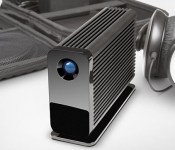
LaCie’s hyper fast 1TB Thunderbolt 2 disk now on sale for $1,300

Though 1,375MB/s worth of disk speed might seem extravagant, applications like 4K RAW video need to squeeze every byte. Luckily, you’ll get all of that with LaCie’s Little Big Disk with Thunderbolt 2, now on sale starting at $1,300 with 1TB of storage (two 500GB SSDs in a RAID). If even that isn’t enough — and you happen to have a new Mac Pro with six Thunderbolt 2 ports — you can put two in parallel for an eye-watering 2.5GB/s (capital ‘B’). That’ll let you transfer 1TB of footage in under seven minutes or run over 10 streams of 14-bit RAW 4K video simultaneously. Overkill? Sure, but we don’t need a 949 HP car, either.
Filed under: Storage
Source: LaCie

Instagram for Android gets updated to version 5.1, slims down for a faster Android Experience
 For the longest time, the Instagram app on Android has been getting more and more bloated to the point where even loading up your feed would repeatedly fail if your internet connection was anything less than perfect. Thankfully, Instagram has listened as Instagram for Android gets updated to version 5.1, cutting the app size in half to create a much faster experience.
 Instagram says that apart from speeding the app up, they’ve also rearranged the buttons for ease-of-use and simplified all the menus. After playing with the updated app, I can definitely say that it’s a more pleasant experience now with the updated visuals, and while there have been no changes functionality wise, the speed does appear to have drastically improved since the last version.
 If you’re an avid Instragrammer, you may have already seen the update hit your device today, but if you haven’t, make sure to update the app or visit the Play Store page (link below), particularly if you previously uninstalled the app and just want to check out what’s changed. Feel free to let us know what you think of the changes!
Source: Instagram via engadget
Application: Instagram
Price: Free

Bend it like robo-Beckham with the U14 Free Kick toy

Axpro is a Taiwanese company that makes flash drives, so it’s surprising to see it building app-connected toys like U14 Free Kick – a game that’s a weird hybrid between Frujit Ninja, Subbuteo and Robot Football. Making Fruit Ninja-style swipes on the iOS app determines the power and direction of a free-kick made by a robotic footballer, in the hope of getting it up and over a defending wall. It’s been designed for groups of soccerball fanatics who want to show off their ball-curving prowess without doing the real thing, and seems ideal for late night pub competitions. Unfortunately, it won’t become commercially available until Axpro finds a contributor, so we might have to clip our nails and dust off that Subbuteo box after all.
Sharif Sakr received a yellow card for simulation during this report.
 AIVAnet